
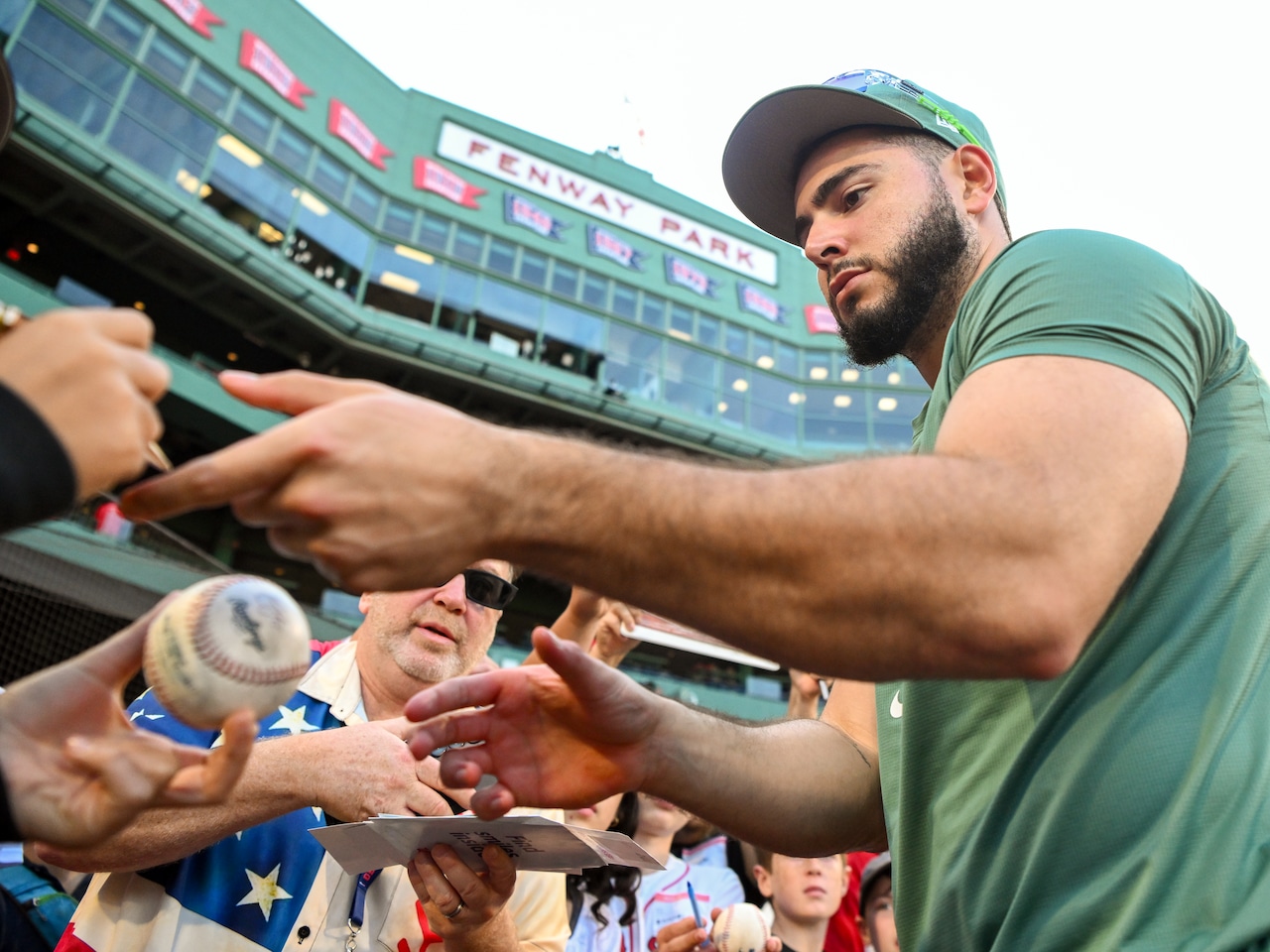
FORT MYERS, Fla. — Perhaps the most memorable moment of the Red Sox’ champagne celebration after clinching a postseason berth last September came from the usually calm Wilyer Abreu. Speaking to suds-soaked NESN reporter Jahmai Webster, Abreu — who throughout his first three major league seasons did nearly all interviews with a team translator — let loose.
“The best experience that I’ve ever had!” Abreu, wearing ski goggles, screamed. “You know? The best. The best experience.”
The exchange went viral among Red Sox fans in the wake of Boston’s walk-off win over the Tigers that night and showed fans a different side of Abreu, the genial — yet relatively unflappable — 26-year-old. It’s a moment Abreu knows was “all over the internet” and nearly five months later, looks back at fondly.
“That was a funny moment,” Abreu said, laughing, at his locker Thursday, “and it’s still one of the best experiences of my life.”
English-speaking Red Sox fans hoping to learn more about Abreu’s personality are in luck this season as the Venezuela native, after years of learning a second language, is doing interviews without the aid of a team translator this spring. For years, Abreu has been conversational in English, a language he first started learning after signing with the Astros as an 18-year-old in 2017, but like many foreign players, has been hesitant to speak English in interviews. Throughout the 2025 season, he occasionally did TV, radio and print interviews in English but usually had a team translator (usually fellow Venezuelan Carlos Villoria Benítez) standing by. This year, Abreu has challenged himself to take what he has deemed an important next step in his bilingual journey.
“I started to get more confidence talking in English, doing interviews in English,” he said Thursday. “At the beginning, I (did not feel) too comfortable talking in English, especially when I had a camera in front of me. I started to feel more comfortable so that’s why I started to do interviews in English.”
Abreu, who was born in Maracaibo, Venezuela, first started learning the language as a minor leaguer in Houston’s system and took classes with that organization before being traded to the Red Sox in the 2022 deadline deal that sent Christian Vázquez to the Astros. By the time he made his major league debut in August 2023, he had a pretty good grasp on a second language and has used both Spanish and English to become a very well-liked teammate throughout three tastes of big league action.
“I took a lot of classes there (with Houston) but I learned a lot, or learned more, when I started to talk with my teammates and when I started to ask questions or say, ‘Hey, how do you say that?’ or ‘What does that mean?’ and all that stuff,” Abreu said. “Then, I start to learn more.
“It’s been really hard. It has been very difficult to learn because it’s a second language. It’s not that easy to learn a second language. So, it took me time. But I started to get more comfortable.”
The Red Sox employ two Spanish speakers on their media relations staff in Villoria Benítez, who carries the title of interpreter/manager and Daveson Perez, a Massachusetts native who previously served as the full-time translator and is now a manager in the department. Both staffers are available nearly full-time to Spanish-speaking players to assist with interviews or conversations with teammates, coaches or club officials. On the current roster, Brayan Bello (Dominican Republic), Aroldis Chapman (Cuba), Ranger Suárez (Venezuela) and Masataka Yoshida (Japan) often do formal interviews with the help of an interpreter. Willson Contreras (Venezuela), Carlos Narváez (Venezuela), Johan Oviedo (Cuba) and Ceddanne Rafaela (Curacao) are among those who speak to reporters in English.
The Red Sox, like other teams across sports with players from different countries, urge their players to do what makes them feel comfortable. Manager Alex Cora, who himself had to learn English as a young professional after growing up in Puerto Rico, often takes questions in both English and Spanish before games. His experience has made him appreciate Abreu’s.
“It’s important,” Cora said. “Even in the meetings, he understands. He keeps getting better.
“It’s good for his brand, quote-unquote. Two-time Gold Glover, people should know who he is and who he is all about. I’m glad he’s doing that.”
Abreu has been an early star in spring training, reporting to Fort Myers in trimmed down physical form and standing out with hard contact in live batting practice sessions against Boston’s top pitchers. As he looks to take a meaningful step forward as a player in 2026, he’s also excited by the opportunity to make more connections with Red Sox fans.
“When you connect with all the fans and you can express yourself with them, I think they appreciate it a lot,” Abreu said. “It means a lot because I can communicate myself better, I can talk with more freedom with everybody.”
In a matter of weeks, Abreu will leave Red Sox camp to suit up for Team Venezuela in the World Baseball Classic. There, he’ll represent his country on baseball’s biggest stage. Speaking both English and Spanish, he hopes, will inspire other young players on a similar path.
“Don’t be scared. Don’t be afraid to ask. Don’t be afraid to speak,” Abreu said. “I think the hardest part is to speak because we feel afraid when we’re speaking. We don’t want to make a mistake. But I think when you make a mistake, it’s where you learn the most.”