
Spring training is finally here, and the non-roster invitees for every big-league team see it as a prime chance to break into The Show. For the Chicago Cubs, there are three non-roster invitees who could be in line to make some extra noise and contribute on the north side of Chicago in 2026.
Jaxon Wiggins
This name drop feels self-explanatory. Wiggins is the top pitching prospect in the Cubs pipeline. The hard-throwing righty ended his season in Triple-A Iowa last year, with one of the best fastball-slider combos in the minors.
The fastball, earning a 65 grade at the end of the 2025 campaign, sits comfortably in the 96-97 mph range and can touch 100 mph when the 24-year-old gets ramped up. The velocity also holds up well within outings, an important attribute for someone who has frontline starter potential. Stuff models don’t like the heater as much as scouts do, but there’s time for the team and Wiggins to improve the pitch’s combination of shapes and locations.
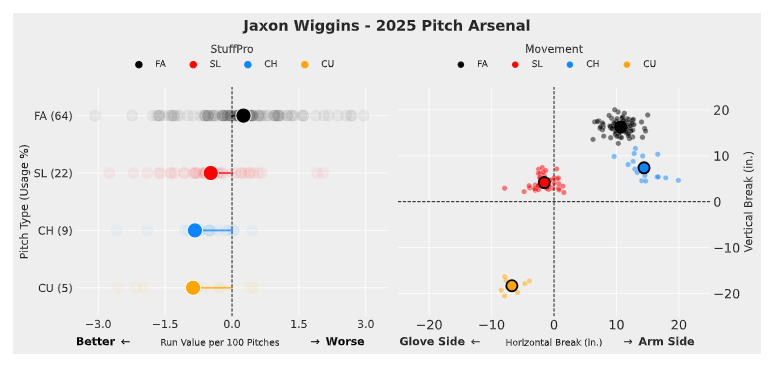
Wiggins’s mid-80s slider has hard bite to it and has the capability to generate whiffs, but he has struggled to control it at times. He also has a mid-80s changeup with decent arm-side ride. Overall, Wiggins has 168 strikeouts in 138 innings of professional baseball, and it’s looking like he can keep racking up punchouts in the majors—perhaps as soon as this summer.
It’s unlikely that we’ll see Wiggins right away, of course. His ability to break into this year’s rotation got dicey once the Cubs traded for projected starter Edward Cabrera. Matthew Boyd, Shota Imanaga, Cade Horton and Jameson Taillon round out what will likely be Chicago’s starting five. Meanwhile, erstwhile ace Justin Steele is expected to make a midseason return, and appears to be ahead of schedule. Injuries can happen, and with those come opportunities, but between the depth of the rotation and the bevy of veteran arms in camp to compete for bullpen spots, we’re likely to see Wiggins spend at least the first two months in Iowa.
Jonathon Long
Like Wiggins, Long has only a slim chance to crack the roster at a relatively loaded position. Still, the 24-year-old corner infielder is making his case to be a big bat, as he registered a .305 batting average and a .404 on-base percentage in 140 games at Triple-A Iowa in 2025.
Long also belted a career-best 20 long (Long?) balls and drove in 91 runs. His 55-grade power has blossomed over time, and the Cactus League will give him a chance to test himself against some big-league arms.
Michael Busch is a star-caliber first baseman, but right-handed platoon bat and backup Tyler Austin is more of an enigma. There may be room for the 2023 9th-rounder to earn a DH spot or to overtake Austin, but he’ll have to truly wreak havoc to compete with Moisés Ballesteros, Kevin Alcántara, Matt Shaw and Austin for a spot. He’s a bit buried on the Cubs’ depth chart, but if nothing else, he has some burgeoning trade value.
Grant Kipp
Once you get past Wiggins, there’s a bit of a lacuna on the Cubs’ organizational starting pitching depth chart. Kipp, who had 110 strikeouts (but 57 walks and a whopping 18 hit batsmen) in 108 innings at Double-A Knoxville, will try to help fill it, though he probably doesn’t have much of a future as a starter in the majors.
His 60-grade curveball is the sharpest of any of his pitches, as it generates 3,000 rpm with a shape that he’s able to customize throughout his starts. Kipp has come a long way from signing on for $50,000 as a nondrafted free agent in 2022. Can he make the next step? His ability to rule at-bats with his off speed stuff this spring could answer that question.
These aren’t the non-roster guys most likely to help the 2026 Cubs. There are several players in camp whom the team signed specifically to compete for limited but important roles, and who have big-league track records that foretell success. However, the Cubs system needs to start achieving greater success in terms of churning out homegrown players at each level of a roster. In Wiggins, Long and Kipp, there are three guys in big-league camp who personify the potential and the developmental needs that define the team’s long-term goals.