
Whichever draft spot you have, your first pick is a defining moment for your fantasy baseball draft. And yet, because there are no sleepers to be found here, this spot is often glossed over in analysis and pre-draft prep. Let’s take a deep dive on the first and biggest fork in the road.
Who’s No. 1: Ohtani vs. Judge
Shohei Ohtani is the consensus No. 1 pick, and if your format let’s you have him as both a hitter and pitcher in one roster spot, then he should absolutely be the first name off the board. What about in cases where Ohtani is split into a hitter and pitcher? In those leagues, there is a real case for Aaron Judge.
Last year, Judge outearned Ohtani by $7 as a hitter, according to Fangraphs’ auction calculator, before factoring in positional adjustments on the strength of his .331 average on top of unreal counting stats. Most projection systems call for a tumble down to around .287, but projection systems are built for humans and don’t know what to do with demigods with barrel rates well into the 20s. Judge is likely to once again best Ohtani in average and RBIs, while the Dodger should notch plenty more runs and steals. As for homers, Judge has 101 to Ohtani’s 99 over the past two years, so you can basically flip a coin. Ohtani has the higher ceiling, because he can reach 30+ steals if he’s in the mood.
The real x-factor is health: Judge turns 34 at the end of April, so Ohtani has the relative youth at 31. As a pitcher, Ohtani has more ways for things to go wrong, though that’s partially mitigated by the fact he doesn’t play the field and Judge does. Both have held up remarkably well the past two years, so it’s hard to ding either of them for now.
Ultimately I lean Ohtani – the steals and supporting cast give him the extra nudge – but it’s close enough that Judge is a very defensible pick, especially in five-outfielder, one-UT leagues.
Juan Soto and other speedsters with power
Life’s like this: you grow up, try to be someone in the world, make every kind of mistake, and yet one day you turn around and feel that you actually finally understand a few things about the universe and your place in it. Then Juan Soto steals 38 bases (tied for second in MLB!) and you realize that, like Socrates before you, the one thing you really know is that you know nothing.
But projection systems can help. Here is what ATC thinks will happen with the next batch of hitters (I’ll get to Tarik Skubal and the other pitchers shortly).
PlayerHRRRBISBAVGOBP
28
100
92
34
0.291
0.347
38
108
99
21
0.273
0.409
28
92
89
33
0.273
0.347
28
105
77
24
0.279
0.384
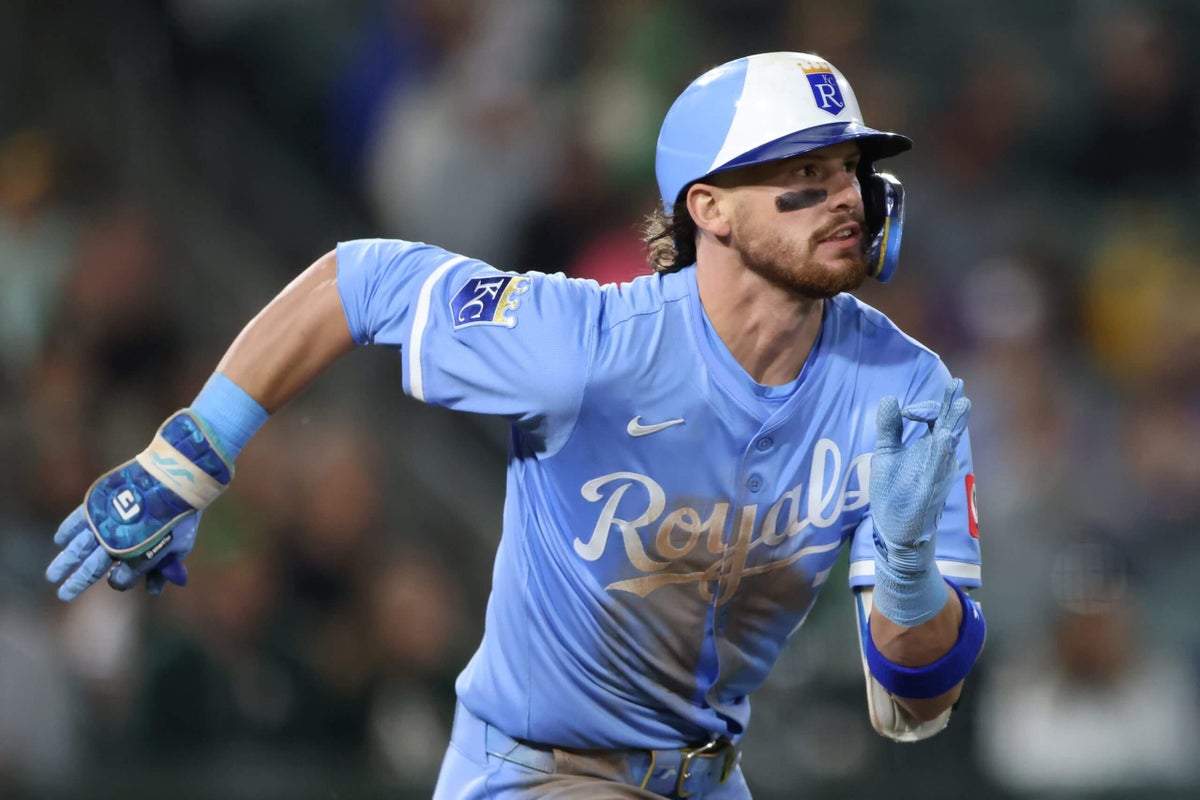
Witt has been the consensus third pick, and I can’t really argue with that, especially with Kansas City’s fences coming in (except in OBP leagues, where Soto is your guy here). Witt should be near the top of the league in steals, around 30 homers, and have an excellent average. Also, every projection system pulls his BABIP down around 20 points from the .334 he ran last year, but you almost couldn’t design a player more likely to have a high BABIP, and I’ll take the over on his projected .291 batting average.
All that said, it’s easy to imagine several others out-earning him. Soto’s 21 steals are about all I want to pay for, but maybe he still owns the skills that brought him 38 thefts with a 13th percentile sprint speed last year. Or Ronald Acuña’s wheels plus Atlanta’s hiring of Antoan Richardson (the first base coach credited with elevating Soto’s running game) could help him return to some truly lofty heights. Assuming he doesn’t miss significant time, Acuña’s projection feels more like a floor than a median. Would anyone be shocked by a 40-40 season?
I’m talking myself into Acuña at the fifth pick, but I won’t fault anyone for taking Jose Ramirez there or even fourth. He is 33 and at some point he’s going to lose just a little of that speed on those incredibly twitchy wrists and the high swing percentage is going to become an issue, but I’m guessing that’s more something that could come into play next year or the year after. He has reached 30 homers and 40 steals each of the past two seasons. You also get the luxury of shopping in other bins when third base gets iffy in the middle of the draft. The only real knock on him is the supporting cast, which is among the worst in the league, and will put a damper on his counting stats.
We’ll get to the next batch of hitters soon, but first let’s ask:
When can you take a pitcher?
The No. 5 pick represents the first major crossroads, because that’s when some drafters are taking a serious look at Skubal. He’s generally the first ace off the board, with Paul Skenes and Garrett Crochet usually going in the 10-13 range.
To get this out of apples and oranges territory, let’s see where Skubal’s insane performances put him on Fangraphs’ auction calculator the past two years (he was the top earning pitcher both years).
Last year, he was fifth among all players, between Soto and Ramirez, despite notching only 13 wins. In 2024, he was just as dominant and had 18 wins, but that was still only good for sixth. Volatility, the arbitrariness of the win stat, and the fact they only score in four categories keep starting pitchers out of the top draft spots and the list of top fantasy earners.
I’ll consider a pitcher once we get past the super studs, which for me are Ohtani, Judge, Witt, Soto, Acuña, and Ramirez (Corbin Carroll would likely have been in there before the hamate bone injury). Elly De La Cruz, Julio Rodríguez, and Skubal represent a weird mini-tier for me, and I can see taking any of those three at the seventh pick, depending on format and risk tolerance. As for Skenes and Crochet, I have them a half-step below Skubal, and I’ve gone back and forth on where and which order to slot them in. We’ll tackle that shortly, but first a look at the ATC projections for the mid-Round 1 tier of hitters.
PlayerHRRRBISBAVGOBP
23
92
77
40
0.258
0.332
30
93
91
28
0.271
0.332
26
96
84
24
0.270
0.349
30
94
89
23
0.269
0.370
28
99
79
26
0.269
0.355
The Elly question
Could Elly De La Cruz go bananas and have a 30-homer, 65-steal season? Of course he could. He might be the most tooled-up player in baseball. Last year he played through a partial quad strain, and still finished with 22 homers and 37 steals. That’s a nice floor, but you’re not picking him for the floor. Assuming he’s back to full strength, I think we’re looking at something like 25-45, with 100 runs and an average in the .260s. That’s a first rounder, with upside for more. What makes me nervous is the potential for a season like last one, or his weakness against non-fastballs giving pitchers an effective way to attack him. Or he could learn to hit more pulled flies and go off for 40 homers. I don’t like this much volatility in my top pick, but at a certain point it’s hard to say no. He’s close to a coin flip with Julio Rodríguez for me, and my answer may come down to whether I want more floor (Julio) or ceiling (Elly).
The West Coast outfielders: Rodriguez, Tatis, Tucker
We’re already at a spot in the draft where you’ll see a fair amount of variance. And yet, if we’re at pick No. 9 with Skubal and all the hitters previously mentioned off the board, this one’s pretty easy: Rodríguez.
Rodriguez had a relatively wobbly 2024, but answered all of those questions last year with a career low K-rate and chase rate and a 30-30 season. I expect something similar, and even see a little extra upside if he can combine last year’s approach with his previous BABIPs and get his average up to around .280.
Fernando Tatis is similar with maybe a shade less power. There is just enough of a gap that I can see pivoting to Skenes instead, but I’m not going to argue with either. Where I will argue is with snapping up Kyle Tucker here (Tucker’s ADP is just ahead of Tatis’). I won’t go as far as to call him a bad pick here, but at this point I might go for one of the aces or talk myself into Gunnar Henderson. The positives for Tucker are obvious enough: great hitter who steals, hitting in the middle of a bunch of Hall of Famers (and in OBP leagues he is a top-8 pick). At this price, however, we’re paying for a lot to go right. You’re banking on him avoiding the injuries that led to a miserable second half last year, and only half a season of playing time the year before. You’re also counting on the steals not tapering off too much.
He is moving to a much better park for lefty homers, and the R/RBI totals could be excellent, but people can overestimate the (non-Shohei) Dodgers on that front. Last year, Ohtani led MLB in runs with 146, but the next highest Dodger was Mookie Betts at 95 (20th), followed by Freddie Freeman at 81 (54th). In RBIs, Ohtani knocked in 102 (14th), followed by Freeman with 90 (30th). These aren’t bad numbers, but it’s worth remembering you can play in a legendary lineup, and still not have a player with more RBIs than Taylor Ward, who somehow found 103 Angels to knock in last year (36 of which were himself).
Potential top-six value at the turn
On one hand, if we’re saying to be cautious around Kyle Tucker in part because there is a risk injuries could slow him down, than we should say the same about Gunnar Henderson, who began 2025 on the IL and said recently he was playing through a shoulder impingement for about three quarters of the season. However, if they’re both healthy, I prefer Gunnar. Even in a year where he couldn’t do anything against lefties (71 wRC+ against them in 2025), he managed 17 homers, 30 steals, and a .274 average. Even if we dial back the steals to the mid-20s, I expect a power bounce back, and he hits in the middle of a strong lineup. I’m optimistic about him putting up mid-first round value.
Henderson’s new ADP neighbor is Corbin Carroll, who has slid on account of hamate bone surgery. He could miss the first week or so of the season, or possibly longer if the Diamondbacks want to give him a mini-spring training rehab assignment. The greater concern is that the power takes a month or two to fully come back, as often happens with hamate bone surgery. I’d project low-20s homers and low-30s steals with an average around .255-.260. That’s basically 2025 Elly: still great, but more of a second-rounder. The upside is he comes back fine or has an insane second half and goes 30-30 with triple-digit runs and RBIs not far behind. There is risk here, but he’s one of the last guys on the board who can do anything like that.
Even when you know you are getting a stud, there is risk and reward at the very top. Let me know how you’re handling the top pick in the comments.