
SCOTTSDALE, Ariz. — Luis Arraez won’t give away all the details. It might be a tug on his batting gloves or a hand to the helmet or tapping his cleats with his bat. But when Arraez wants to send a special message to a base runner, he has a mode of communication.
Over the past few seasons, when the three-time batting champion sees the opportunity for a hit-and-run play, he doesn’t wait for a sign from the dugout.
“I would put it on,” said Arraez, as he settled into his first week in San Francisco Giants camp. “I can’t tell you how. I had a sign for the runner. Sometimes the manager gives it to me. But if I see something, I’ll put it on. Depends on who’s pitching. Maybe he throws a lot of sinkers. Why not?”
When it comes to the hit-and-run play, Arraez might be the only hitter in the major leagues who can use “why not” as a legitimate justification. For everyone else, there’s a reason the gambit has all but disappeared. Pitchers are throwing harder and nastier stuff than ever. The league-wide strikeout rate has increased by nearly 50 percent since 2005. The whiff threatens to turn every hit-and-run attempt into a rally-killing double play. Clubs have gotten smarter, too. An intern in any team’s analytics department could calculate for you how the risks are usually not worth the potential rewards.
You’ll still see the play’s close cousin, the run-and-hit, employed on occasion — especially after the league adopted rule changes that incentivize taking more risks on the basepaths. But sending the below-average runner with the pitch? As a common strategy, that’s become as fashionable as an Ed Hardy T-shirt. You’ll never again see anything like Will Clark’s 1987 season, when he stole five bases in 22 attempts mostly due to the fact that Giants manager Roger Craig’s zeal for the hit-and-run exceeded his hitters’ ability to execute it.
But Arraez can throw another data point into the equation: His 2.6 percent swinging strike rate last season wasn’t merely the lowest of his career. It wasn’t merely the lowest in the major leagues by a considerable margin. It was the lowest by any hitter since the Statcast pitch-tracking era began in 2008. His strikeout ratio of one per 29.5 at-bats was the best since Hall of Famer Tony Gwynn in 1995.
The hit-and-run might be a throwback play. If it remains all the rage for Arraez, that’s because he is a throwback player. And the Giants might be the team that brings it back into style.
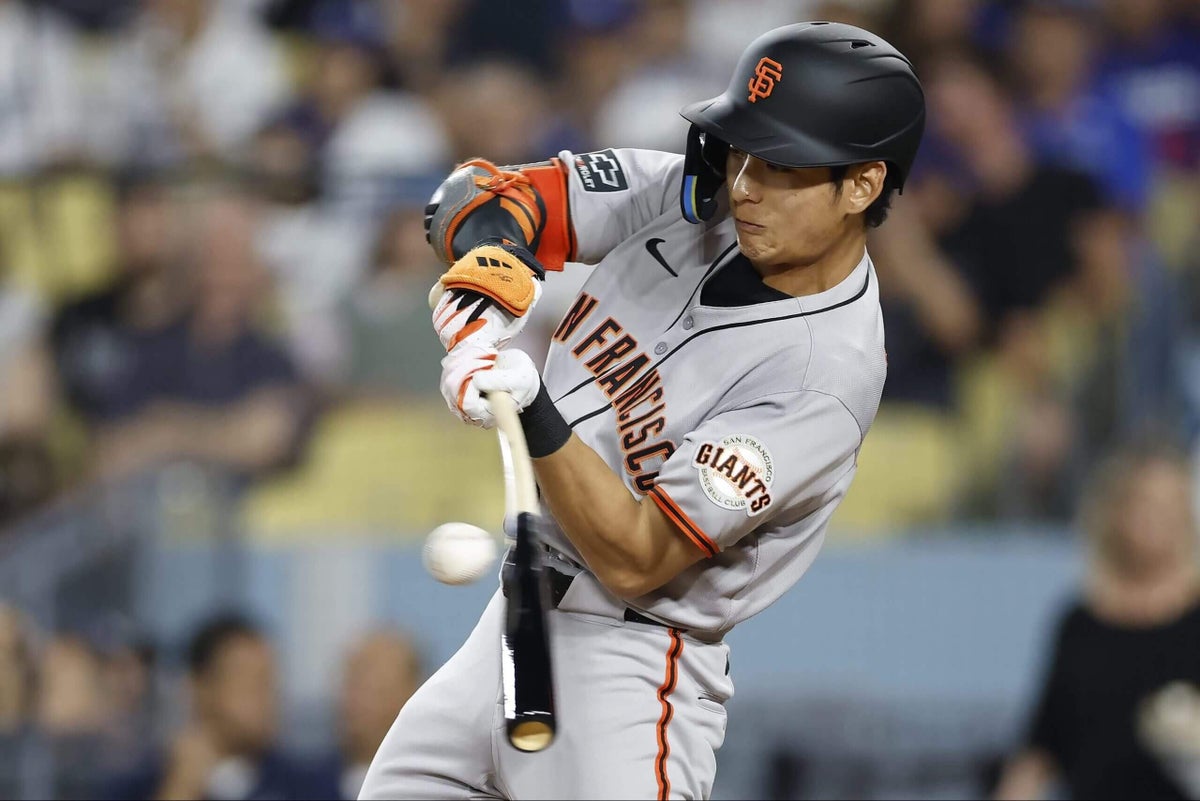
That’s because they have another version of Arraez in their lineup. Jung Hoo Lee’s swinging strike rate of 5.9 percent last season ranked seventh out of 132 major-league hitters who saw at least 2,000 pitches.
Their swings aren’t identical. Arraez seemingly could fit his short swing in a door frame, while Lee’s is a bit longer. And Arraez lets the ball get a little deeper. (His average contact point is 2.8 inches behind the front of home plate, whereas Lee’s average contact happens 3.5 inches in front of the plate.)
But having two of the league’s most reliable contact men could open opportunities for the Giants’ offense to get creative, aggressive and multifaceted — three words club president Buster Posey has used to describe the kind of lineup he wants to assemble.
It’s an approach that new hitting coach Hunter Mense heartily endorses.
“I’m a fan of it,” said Mense, who helped the Toronto Blue Jays string together scoring rallies all the way to the World Series last season. “I love being on offense when we’re on offense. Too many times in baseball, from an offensive standpoint, we become on our heels. With a hit-and-run, or run-and-hit, you’re creating action. You’re pushing the envelope on somebody else. I think that’s always beneficial. I want to do things that can take the game to the other team.
“When you have bat-to-ball skill guys, you can push on that stuff.”
Putting runners in motion also creates holes as middle infielders vacate their position to cover second base. When a left-handed hitter like Lee or Arraez hits a grounder through one of those holes, the hit-and-run can do more than keep a team out of a double play. It can create a first-and-third situation and set the table for a big inning.
One of the reasons the Giants offered Arraez a one-year, $12 million contract is because his contact skills blended well with the established pieces in their lineup. Rafael Devers shrinks the Giants’ waterfront ballpark like no left-handed hitter since Barry Bonds, but he also swung and missed at 456 pitches last year, second in the major leagues only to the Seattle Mariners’ Cal Raleigh. Willy Adames and Matt Chapman will hit their share of home runs while amassing their share of strikeouts.
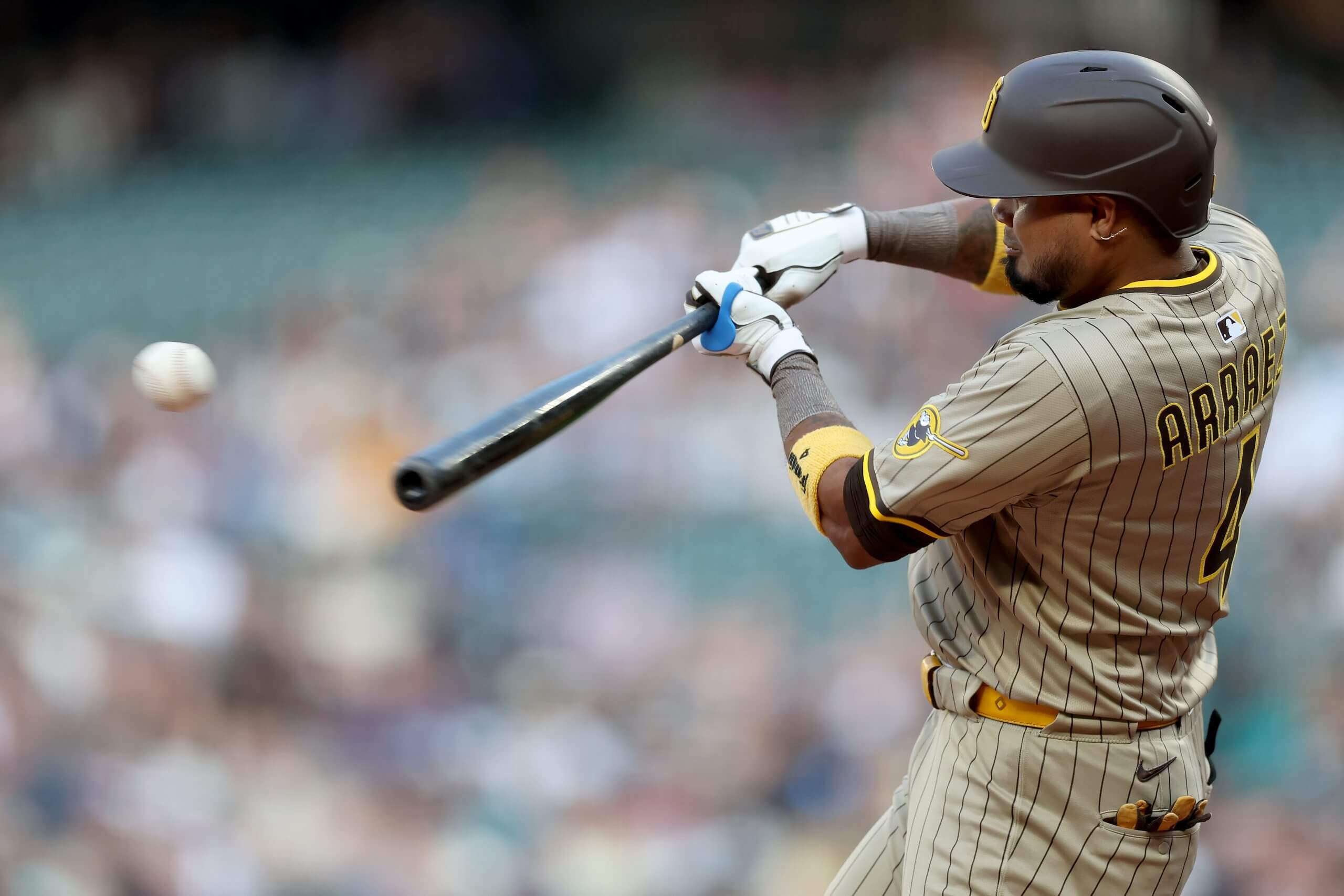
Luis Arraez led the National League in hits last season with 181. (Steph Chambers / Getty Images)
When the Giants put together their two hottest sustained stretches last season, it didn’t take a genius to recognize that those were also the two periods when they hit home runs in bunches. Adding a contact hitter like Arraez, the thinking went, might make them a little less slump-prone as a team and create ways to score runs that aren’t dependent on the long ball.
Those designs stand an even better chance of working if the Giants can get more out of Lee, who struggled at times while adjusting to his first full major-league season. As diligent as the coaching staff worked with Lee, his relationship with former hitting coach Pat Burrell might best be described as tentative. The coaches were careful not to overload him or dictate swing changes, but they did suggest he adjust his position in the batter’s box. Only the New York Yankees’ Cody Bellinger stood more on top of the plate than Lee, who was concerned about covering the outside edge of the zone (and sometimes beyond) where umpires were routinely calling strikes on him.
So it will be interesting to see how much Lee is able to connect with new manager Tony Vitello and his coaches. Along with Mense and returning hitting coach Oscar Bernard, the Giants have one other new hitting voice in the room.
Turns out Arraez is pretty good at making contact outside the batter’s box, too.
“We were just talking about hitting,” Arraez said of Lee. “We talked about my plan when I face those nasty pitchers and I say, ‘Hey, just try to hit the ball up the middle and see what happens.’ He’s almost the same as me. He just has to hit the ball to the middle of the field. But I don’t think he needs to pull the ball. When I saw him hitting, and he hit a groundball to first base, I said to him, ‘Wait for the ball and hit it the other way.’ He’ll be fine. He’s got some power, too. He just needs to touch the ball. And speed! I wish I had his speed. I’d have a lot more hits.”
Arraez also encouraged Lee to bunt for more hits. He’ll encourage Lee to be more aggressive on the bases, too.
“I still have more questions for Louie,” Lee said through Korean interpreter Justin Han. “We hit in the same cage. We’re just getting to know each other. He’s one of the best contact hitters. Just having him around the clubhouse and off the field will be a big help for me. I’m excited to be around him this season.”
Lee said the hit-and-run play was rare in the Korea Baseball Organization. He certainly never called one on his own.
“That’s what you call elite confidence there,” Lee said of Arraez. “I’m wishing that Louie and I can poke on the pitcher a lot this season. I’m also very confident making contact with the ball, so with Louie and I in the same lineup, you guys are gonna see a lot of fun stuff.”
“He’s going to be a really good hitter,” Arraez said. “Let’s see what we can do together. Let’s see what happens in the first game.”
The Giants’ lineup for their Cactus League opener won’t be a full dress rehearsal — several everyday players won’t make the trip to Peoria Sports Complex to play the Mariners — but it won’t be long before we see a few potential arrangements. If Arraez bats first, could they slot Lee in the No. 9 spot to create a second leadoff hitter when the lineup turns over? Or would they rather split up the two left-handed hitters? It’s an ongoing conversation.
“We’ve brought it up: Tomorrow is opening day, what’s your lineup?” Vitello said. “And I can tell you this: Not one person had the same lineup. There were five of us in the room and five lineups. That’s what makes baseball and other sports fun. You debate, but ultimately you’ve got to roll with something, and the game will give you some feedback.”
“People see guys who have contact skills as guys who are good table-setters to get on base,” Mense said. “But I’ve always felt that for lineup construction, you want them in situations where the ball needs to be put in play or you need a hit.”
The swinging strike might be the death of a hit-and-run play, but the pitchout ranks up there as well. Here’s the thing: Teams no longer need to fear it. The pitchout is almost extinct, too. Gone are the cat-and-mouse days when Bruce Bochy and Bobby Cox would see an ideal running count and call for a wide one. Along with the disappearance of the hit-and-run play, the increased understanding of count leverage has something to do with that. There were 619 pitchouts in 2008. It was down to 238 in 2015. There were just 54 pitchouts last season. The Giants didn’t pitch out once all year. They’ve done it just three times over the past five seasons.
To recap: The Giants have two of the best contact hitters in the major leagues, the pitchout is nothing to worry about, they are looking to create offensive dynamism, and they don’t exactly have a lineup full of burners. Even Will Clark might agree there’s an opportunity here.
“The hit-and-run has come and gone throughout the years, but you can always do it with the right guys,” Mense said. “It’s a tool in the manager’s tool belt if you feel you need to get going.
“I’ll just put it this way: I’m for anything that scores runs.”