
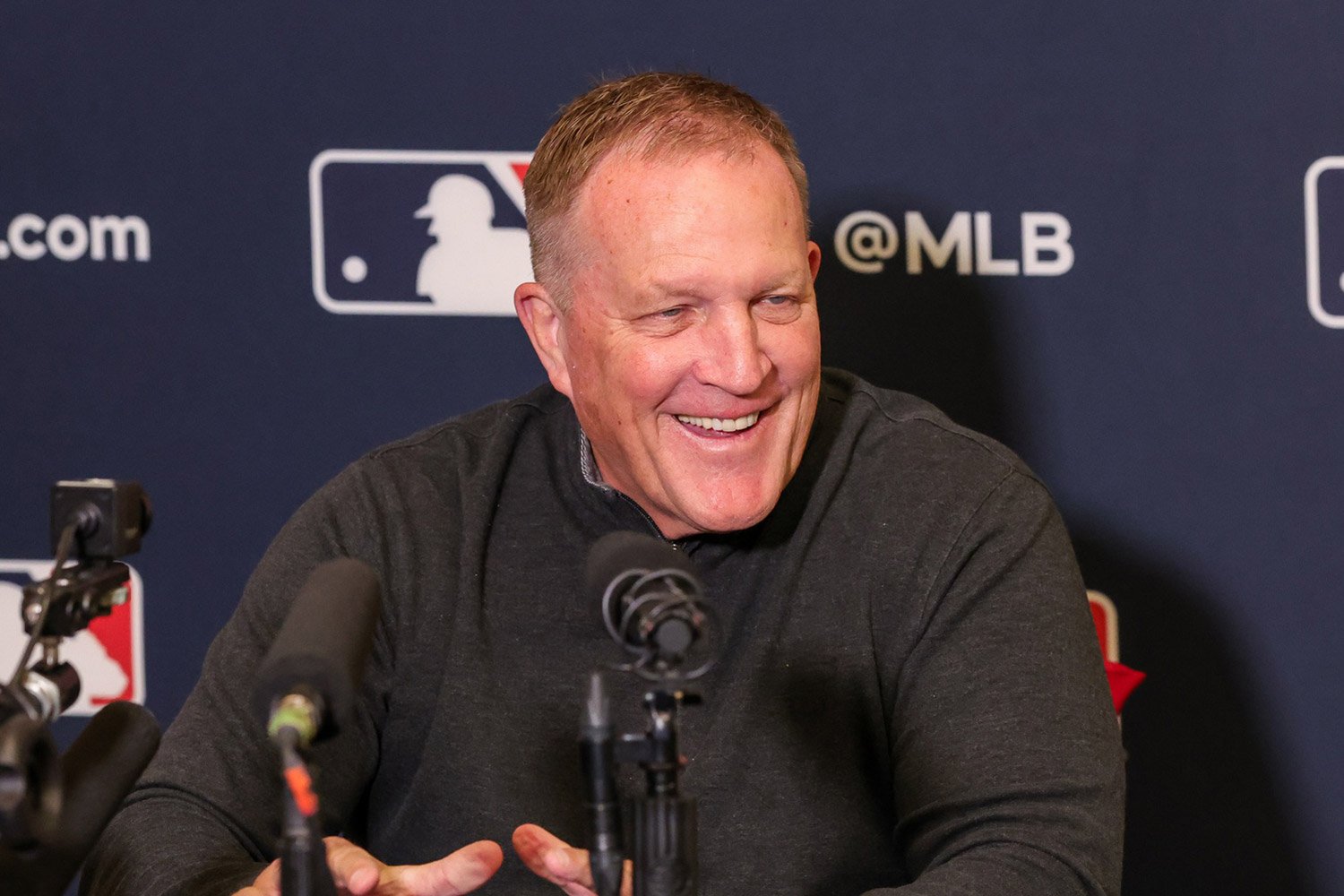
There was little question that Pat Murphy remained the best fit to manage the Brewers beyond 2026, but it’s now official. Instead of managing this season as a lame duck, Murphy and the Brewers signed a new three-year contract with a club option for 2029.
“I feel lucky. I feel fortunate,” Murphy said from his office at American Family Fields of Phoenix on Friday morning. “I know how tough it is to get here, but I think with it comes a responsibility. I didn’t need to be certain that I was wanted. I didn’t need this to happen. I just felt like it probably is the best to get it done, and I don’t want to be with any other organization. I feel really connected. Going on my 11th season, I feel really part of it, and I feel like this is where I’m supposed to be.”
In two seasons under Murphy, the Brewers have gone 190-134 in the regular season and won a franchise-record 97 games last season. The 67-year-old moved into the manager’s chair in November 2023 after Craig Counsell signed with the division-rival Cubs and has kept the club highly competitive amid what could have been more tumultuous turnover.
“Things didn’t change a ton when he took over,” said Christian Yelich. “Obviously, him and ‘Couns’ have different personalities and different ways of going about things, but he was familiar with us and the way we did things. I was glad that he was the one that was taking over. Obviously, it went really well for a couple of years.”
Murphy has been specifically hailed for his leadership in the clubhouse, balancing his trademark humor with a no-nonsense, straight-shooting approach to the game that has resonated with players.
“I think players know when it’s time to have fun with him and joke around, but know when it’s time to lock it in, and you have to do your job,” Yelich said. “There’s high expectations, and you have to meet those expectations, or there’s going to be some discussions if you don’t. I think it’s fine knowing where you stand with the manager and knowing that you don’t ever have to wonder. With Murph, he’s going to tell you good or bad.”
A longtime college coach before joining the professional ranks, Murphy’s reputation as an old-school coach seemed to clash with a forward-thinking front office that relies heavily on analytics. However, he has proven he understands the modern game enough to effectively blend his perspective with the information he receives from the ivory tower.
“I think there’s value in the old school mentality, absolutely,” president of baseball operations Matt Arnold said. “But he’s not completely old school. He’s not closed-minded. There’s a difference between those two. I think he’s very open to ideas and continuing to get better. I think that’s the goal here for all of us. We all want to get better.”
“I’ve learned so much about how the game is run,” Murphy said. “How the game is run from the top down. I’m constantly growing myself. I think of myself coming out of college, trying to be a college coach, and then turn into a major league coach, like, wow. The education that I needed in order to do that, I’ve learned so much.”
Some of those college elements are still evident in Murphy’s style. Because those players are far less polished than professionals, the college playing environment is an unpredictable bloodbath condensed into a 60-game season. Coaching in that setting for nearly 30 years solidified Murphy’s “win tonight” approach, which often prompts him to green-light aggressive player workloads, even as many teams set strict usage guardrails as part of load-management plans.
“Every game might be the difference between a seeding in the postseason,” Murphy said. “Every game, no matter where it is and what the environment. It’s a good thing to build into your computer, you know? And I can’t shake it. So that’s why every game means so much.
“Sometimes, perspective-wise, that’s not the best, but I think as a core value, I think it really rubs off, and it resonates with people that these all matter. There’s no reason to believe that you can give anything away. It’s that competitive. So I think that part. But the season is so much longer, it really challenges you.”
Murphy acknowledged last October that such a hard-nosed approach may have worn some players down by the postseason, where the Brewers were swept by the Los Angeles Dodgers in the NLCS. Finding the right balance between winning tonight and planning for the future may still be his greatest weakness, but he’s been self-aware and open to feedback.
“That’s part of the job,” he said. “You’ve got to try to stay the course in the right way. I’m hungry. I’m still hungry. I still want to learn. I still want to impact people.”
He could have the opportunity to continue impacting people in Milwaukee for up to four more seasons.
“I think it’s important to know where you’re going to be. I really didn’t have any doubt that this was going to work out, and I’m really grateful, really thankful.”