

The Royals are 1-1 so far in the Cactus League in 2026. After winning their Spring Training opener against the Texas Rangers, Kansas City had a much rougher day on Saturday, losing 10-3 to the Padres.
One pitcher that stood out in the Royals’ first couple of games was Stephen Kolek, who started Kansas City’s Cactus League opener on Friday. In two innings of work, he allowed one run on three hits and one walk while striking out two. He threw a total of 36 pitches in his first Spring Training start of the season.
When it came to his advanced metrics, Kolek did a decent job of finding the zone, but struggled when it came to generating chases and whiffs. And yet, his TJ Stuff+ metrics were decent overall, especially considering it was his first Spring Training start and his diverse pitch mix.
Below is a look at what his outing looked like via his TJ Stats summary from Friday’s outing.
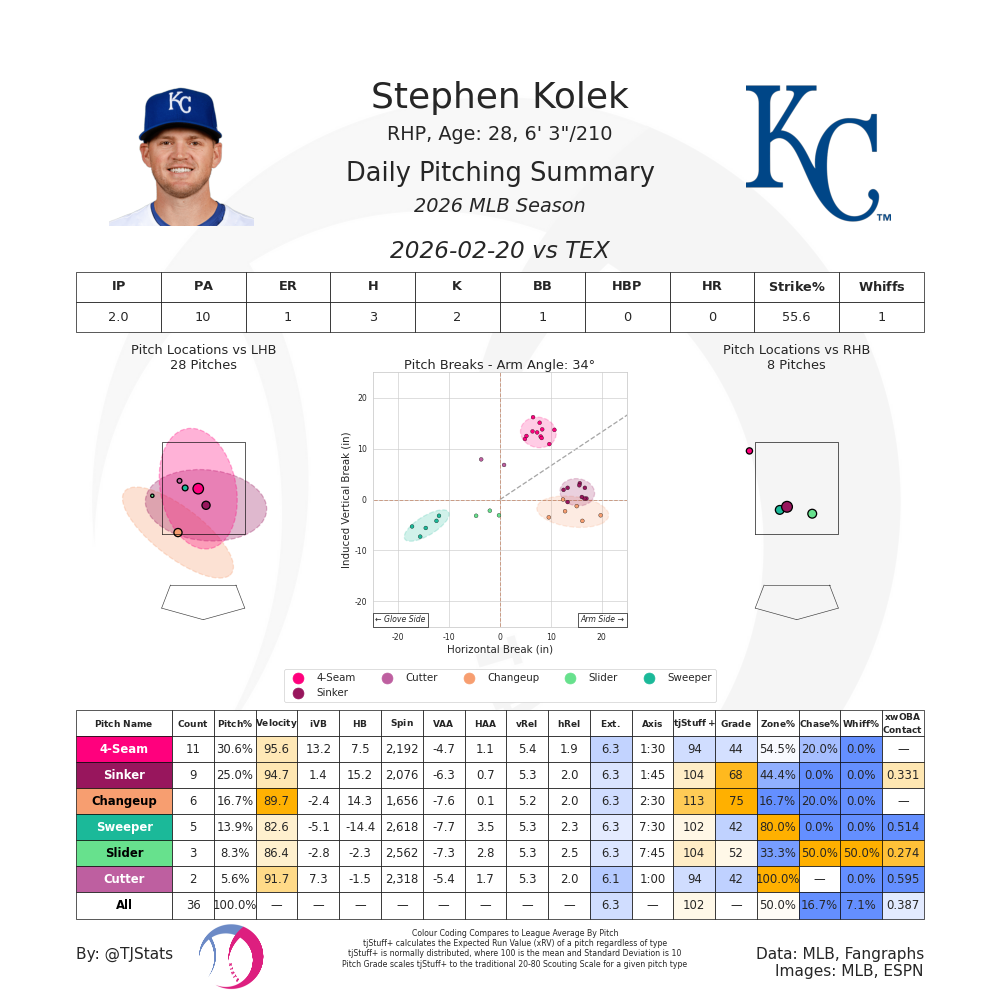 Kolek posted a 102 overall TJ Stuff+ with four of his pitches sporting TJ Stuff+ marks over 100 (his sinker, changeup, sweeper, and slider). His sinker and changeup graded 68 and 75, respectively. However, that didn’t translate much into his other metrics, as his 16.7% chase rate, 7.1% whiff rate, and .387 xwOBACON were mediocre marks, to put it nicely.
Still, stuff is what one wants to see from early Spring Training starts, especially as pitchers get ramped back up after a long offseason. Kolek showing solid TJ Stuff+ marks demonstrates that he’s ready to go, and could put up better numbers in Cactus League play once his command irons out over more outings.
Nonetheless, one has to wonder where Kolek fits on this Royals pitching staff for 2026. The 28-year-old had a solid debut for Kansas City in 2026, posting a 1.93 ERA, 2.71 FIP, and 0.9 fWAR in 33 IP after coming over from San Diego at the Trade Deadline. That said, he has a lot of competition for a spot on the pitching staff, especially with the rotation that consists of Cole Ragans, Michael Wacha, Seth Lugo, Kris Bubic, and Noah Cameron. In addition to that projected five, Kolek also will be competing with Ryan Bergert (who started today), Mason Black, Ben Kudrna, Luinder Avila, and Mitch Spence.
Despite all that competition, Kolek has a chance to break with the club at the conclusion of Spring Training. Here are three pitch-related trends to pay attention to with Kolek this spring, as they could determine his chance to make Kansas City’s Opening Day roster.
Kolek’s Four-Seamer vs. Sinker
Kolek’s primary two pitches are his four-seamer and sinker. He threw the pitches 26% and 24% of the time, respectively, last season. When it came to the metrics on those pitches, this is how they fared, according to his season-long TJ Stats summary.
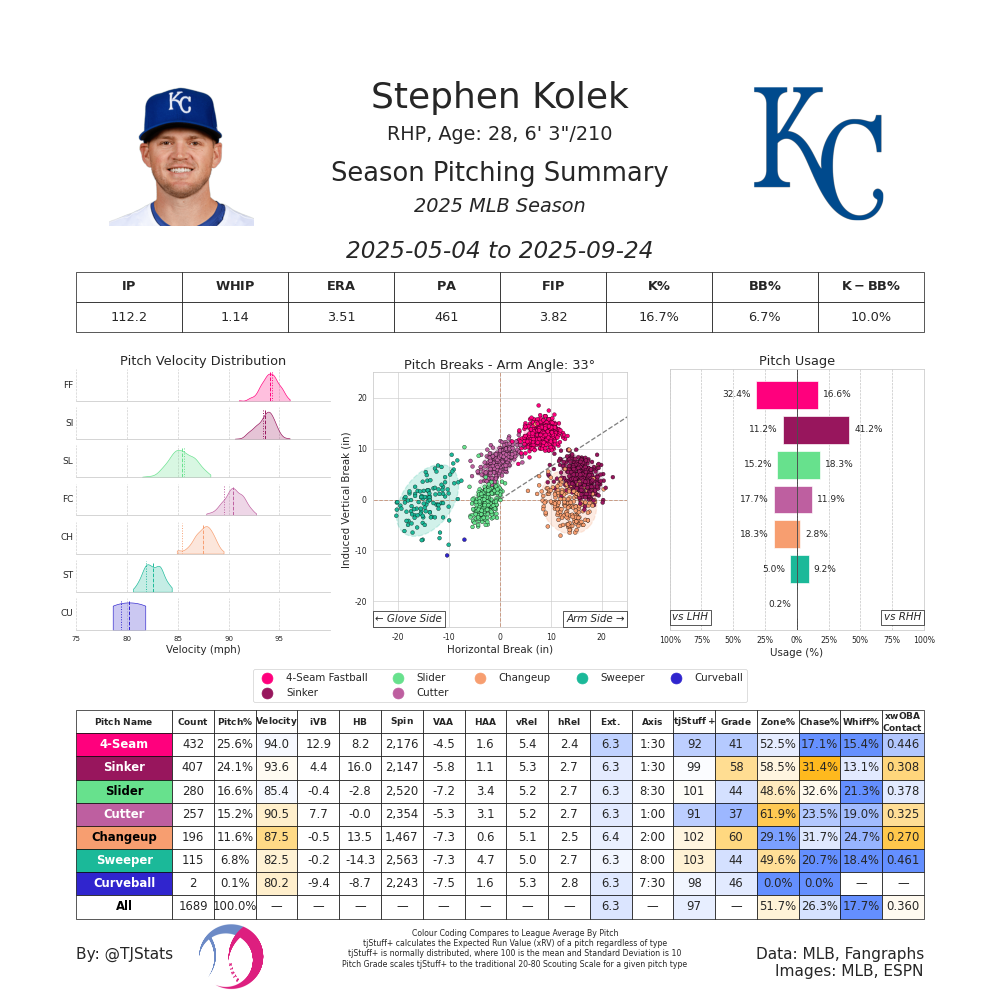
Kolek’s sinker rated as a better offering than his four-seamer a season ago. The sinker had a 99 TJ Stuff+ and 58 grade, and produced a 58.5% zone rate, 31.4% chase, and a .308 xwOBACON. Conversely, the four-seamer had only a 92 TJ Stuff+ and 41 grade, and produced a 52.5% zone rate, 17.1% chase rate, and .446 xwOBACON, all worse marks in those categories than the sinker. That said, the four-seamer had a slightly better whiff rate (15.4%) than the sinker (13.1%).
Below is the heatmap data of the four-seamer, which also includes split results, in addition to heatmaps against hitters from each side of the plate.
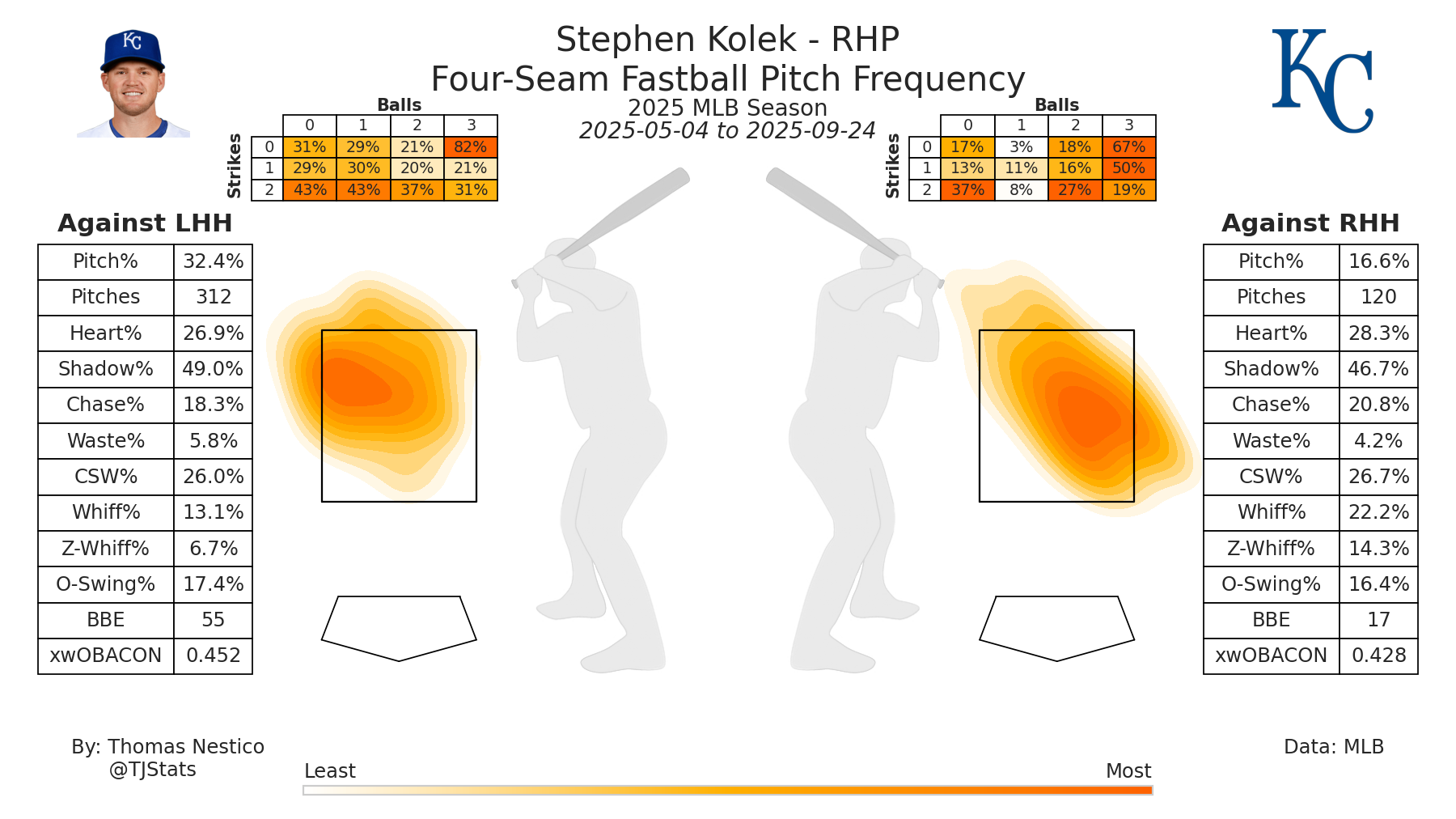
Kolek threw the four-seamer more against lefties and tended to locate the pitch up and away. While the four-seamer CSW numbers against lefties (26%) were similar to those against righties (26.7%) and the chase rate was slightly better (17.4% to 16.4% O-Swing%), he also had a lower whiff rate (13.1% to 22.2%) and a higher xwOBACON (.452 to .428). Thus, one has to wonder if that four-seamer usage gap (15.8%) will close a bit in 2026.
Now, let’s take a look at the TJ Stats heatmap data with the sinker below.
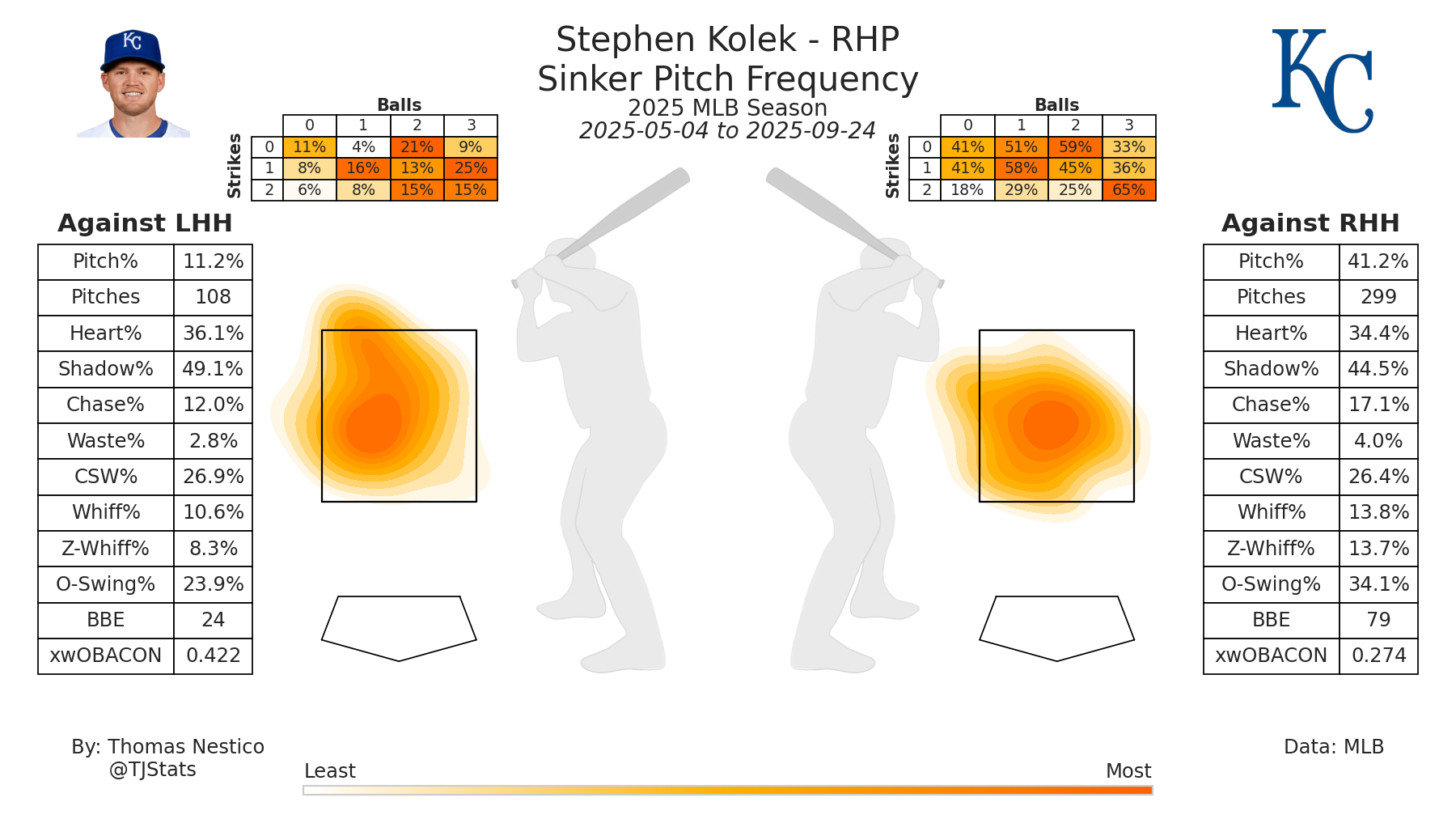
The sinker was less of a whiff-inducing pitch than the four-seamer overall. Furthermore, it produced a 26.9% CSW against lefties and a 26.4% mark against righties. Those rates are not all that different from his four-seamer. However, his sinker was a much better chase-inducing offering, producing a 34.1% O-Swing% against righties and 23.9% mark against lefties. Thus, it’s not surprising that his xwOBACON was .274 against righties, as hitters had a hard time squaring up against a pitch they chased nearly 35% of the time. His xwOBACON was less stellar against lefties at .422. However, he also threw the sinker 30% less against lefties (11.2% against lefties; 41.2% against righties).
It appears that his sinker is his go-to fastball offering against righties, and his four-seamer is his go-to against lefties. However, I wonder whether closing that gap a bit and mixing more sinkers against righties could be beneficial in the long term. Granted, the sinker is a more horizontal offering, which makes it less of a whiff-inducing pitch compared to the more vertical four-seamer. That said, it’s intriguing how Kolek locates both pitches and how they can work effectively when commanded effectively, as seen in the clip compilation below.

How Kolek’s sinker and four-seamer usage fare this spring should be watched closely by Royals fans. If changes in this mix lead to better results (especially in chase and whiff), he could find himself stealing a rotation or bullpen spot by Opening Day.
Mixing the Changeup In Effectively
Kolek’s changeup was one of the most impressive pitches, stuff-wise, in his 2026 Spring Training debut. It sported a 75 grade and 113 TJ Stuff+. However, it had a zone rate of 16.7%, a chase rate of 20%, and a 0% whiff rate. In 2025, the pitch had a 102 TJ Stuff+, a 60 grade, and a .270 xwOBACON. However, the zone (29.1%), chase (31.7%), and whiff (24.7%) rates were all a bit meager. It would also be nicer to see that chase rate up, especially if the zone is going to remain low.
Here’s the heatmap data on his changeup, and how it was thrown against lefties and righties last season.
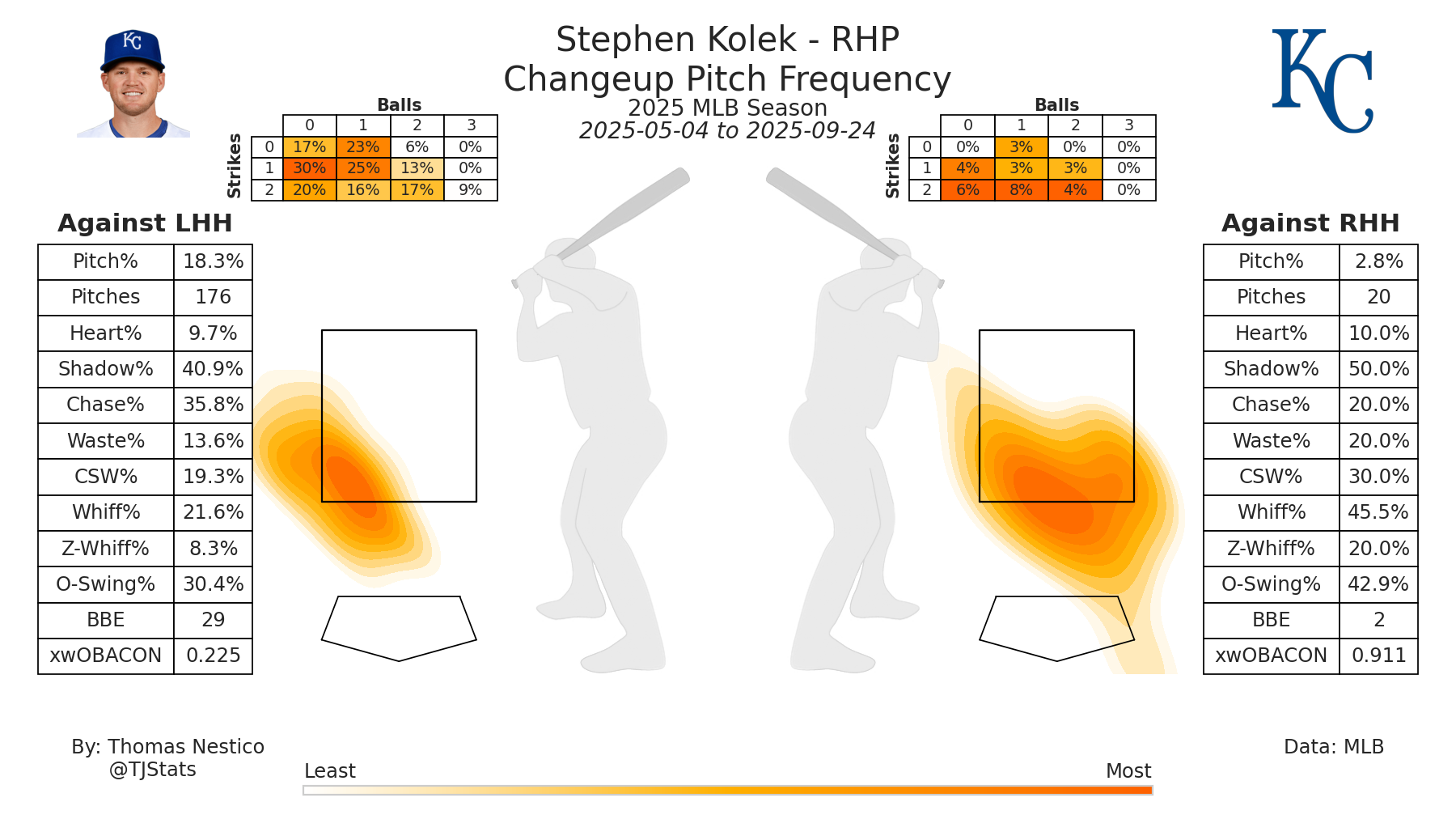
His changeup was primarily thrown against lefties, as it had an 18.3% usage against lefty hitters compared to a 2.8% usage against righties. Regardless, it was primarily a pitch designated to generate chase, as it was thrown in the chase zone 35.8% of the time and waste zone 13.6% against lefties. While it didn’t produce a ton of CSW (19.3%) against lefties, hitters didn’t do much against Kolek’s offspeed offering either, as evidenced by the .225 xwOBACON.
Below is a clip of his changeup located in that chase zone, effectively against left-handed Twins hitter James Outman. Kolek forces Outman to not only chase but also whiff badly.
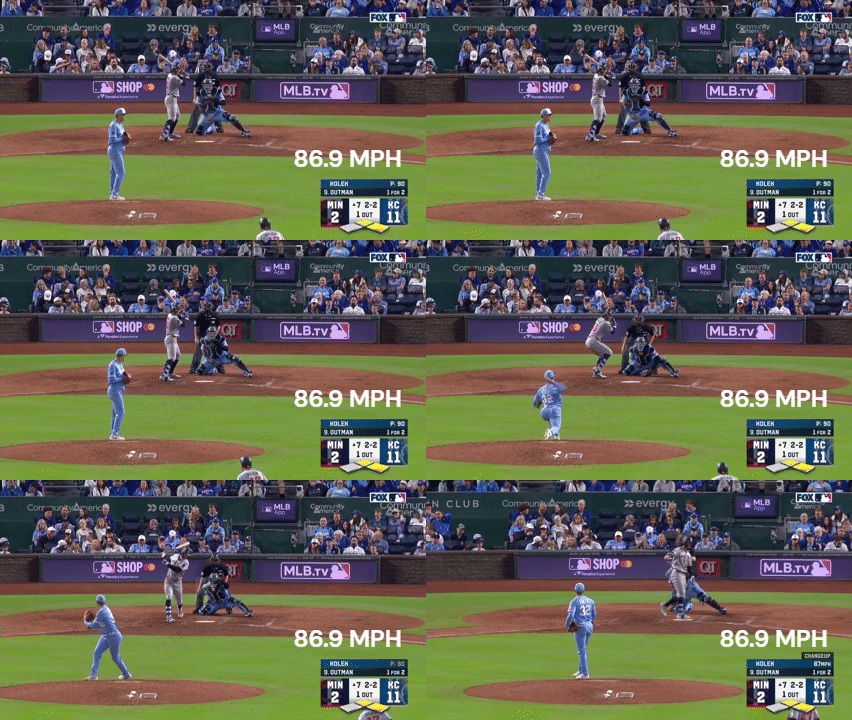
Kolek’s changeup is a unique weapon, even if it doesn’t generate many called or swinging strikes. It would be nice to see him utilize this offering more with the sinker, especially since they sport similar movement. The changeup’s 6.1 MPH difference from the sinker could lead to more whiffs on the offspeed pitch this spring and in 2026.
Which Breaking Offering is More Effective?
Kolek sports a slider (16.6% usage) and a sweeper (6.8% usage) as his primary breaking pitches. The slider has produced better results, especially in terms of xwOBACON (.378 to sweeper’s .461) and chase (32.6% to sweeper’s 20.7%). That said, the sweeper had slightly better stuff, with a 103 TJ Stuff+ (the slider had a 102).
Here’s a look at the slider’s heatmap data via TJ Stats.
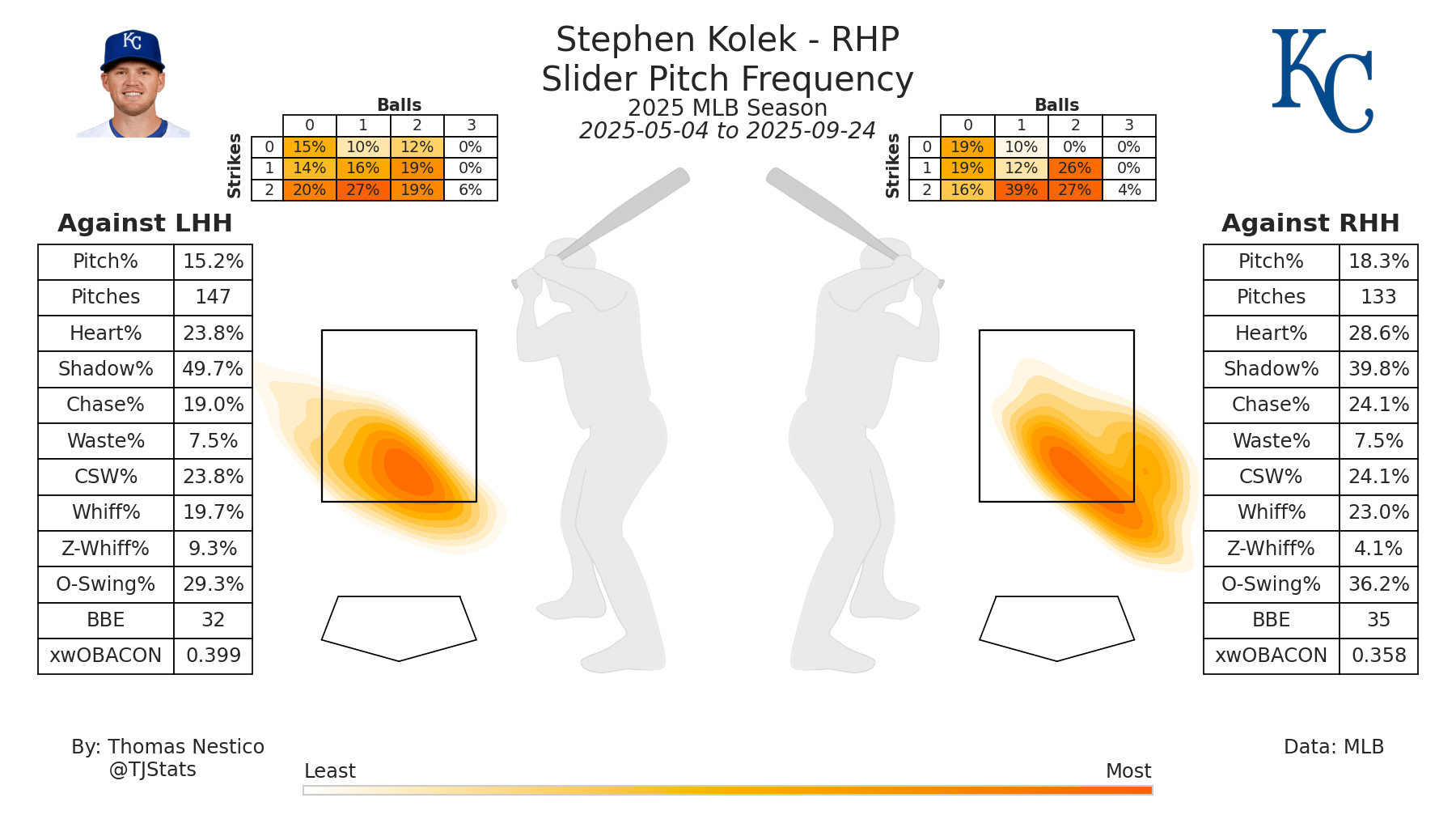
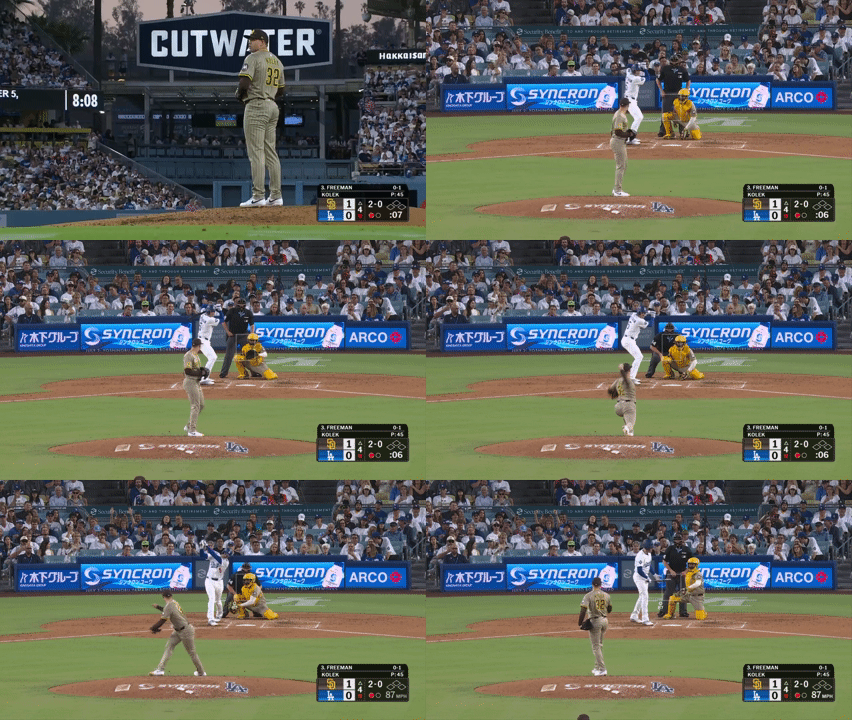
The encouraging characteristic with Kolek’s slider is that he generates strong chase against lefties (29.3%) and righties (36.2%). While the pitch is a better whiff-inducing offering against righties (23%), the whiff rate isn’t that bad against lefties, as it is only 3.3% lower. When Kolek is able to locate the slider knee high and into lefties, he can produce effective whiffs like this one below against Freddie Freeman.
That said, the sweeper is an intriguing pitch, and I think it could be a more worthwhile offering, especially against righties. Below is a look at his sweeper heatmap data via TJ Stats.
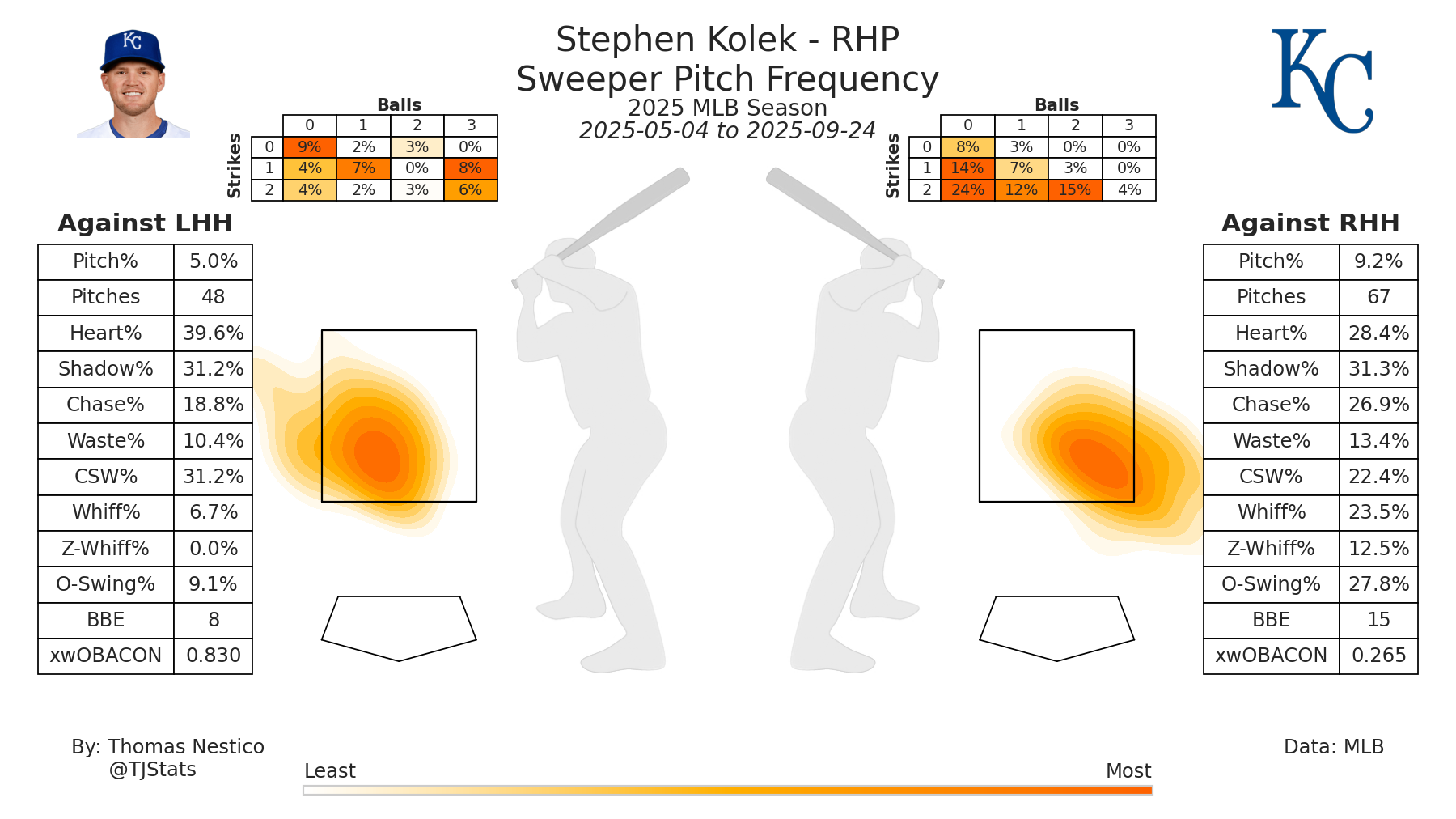
He only threw the sweeper 9.2% against righties last year. However, it induced a 27.8% O-Swing% and a .265 xwOBACON. That xwOBACON was 93 points better than his slider’s xwOBACON against righties. The sweeper is a much “loopier” breaking offering, averaging 82.5 MPH last year, 1.9 MPH slower than his slider. That said, the sweeper shape and velocity may make it a nice change of pace, especially when paired with the sinker and four-seamer.
Below is an example of Kolek pulling the strings on Angels catcher (and former Royal) Sebastian Rivero last year on a sweeper. Rivero whiffs because he’s sitting on a four-seamer or sinker.
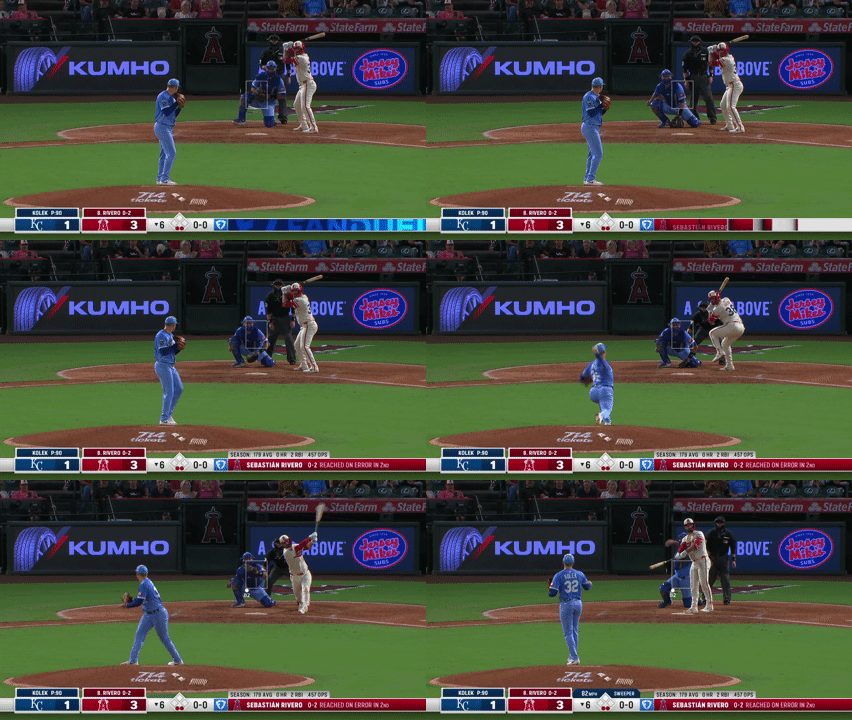
I don’t think Kolek needs to add a traditional curveball to his pitch mix. He has a slider, a harder cutter, and a sweeper in addition to the sweeper. However, utilizing his sweeper more could help make his breaking offerings more effective in 2026. The sweeper is the kind of pitch that can really get right-handed hitters swinging out of their shoes badly, as Rivero demonstrated in the clip above.
Kolek threw the sweeper 13.9% of the time in his first Catcus League start, which is 7.1% more than his sweeper usage in 2025. Thus, pitching coaches Brian Sweeney and Mike McFerran may also believe that Kolek should be throwing his sweeper more in 2026 and are getting that process started with Kolek in Arizona.