
SURPRISE, Ariz. — The Texas Rangers clubhouse erupted into cheer Sunday morning, shortly after it was closed to media (the celebration could be heard through the walls of the locker room), when center Jack Hughes scored a golden goal to lift the United States men’s hockey over Canada and to a gold medal at the Milano Cortina Winter Olympics.
Rangers manager Skip Schumaker met with reporters minutes afterward for his morning availability.
“Tiegs is not happy,” Schumaker said. “Quantrill is not happy. There’s a lot of American music playing right now.”
Rangers pitching coach Jordan Tiegs, of Woodstock, Canada, and right-handed pitcher Cal Quantrill, of Port Hope, Canada, were on the wrong end of the overtime thriller. Schumaker said that Tiegs has worn a Canada hockey jersey around the complex this spring.
Rangers
It makes for an easy target.
“He kind of put it on himself,” Schumaker said.
That’s a good reminder that culture and chemistry remain priorities for the first-year manager.
Here’s what else we learned last week at camp.
Young bullpen arms will get a look: The Rangers lost four bullpen contributors to free agency this winter. They did not invest considerable resources into replacements — partly because of their unwillingness or inability to pursue high-dollar relievers and partly because of their belief that it can be rebuilt in a cost-effective manner — and now have a month to parse through all available candidates for a bullpen they deem best fit to start the regular season with.
That means that the big league camp’s young relievers (right-handers Gavin Collyer, Carter Baumler, Ryan Lobus, Eric Loomis and left-hander Robby Ahlstrom) will be seriously evaluated even though Ahlstrom is the only one with experience above the Double-A level.
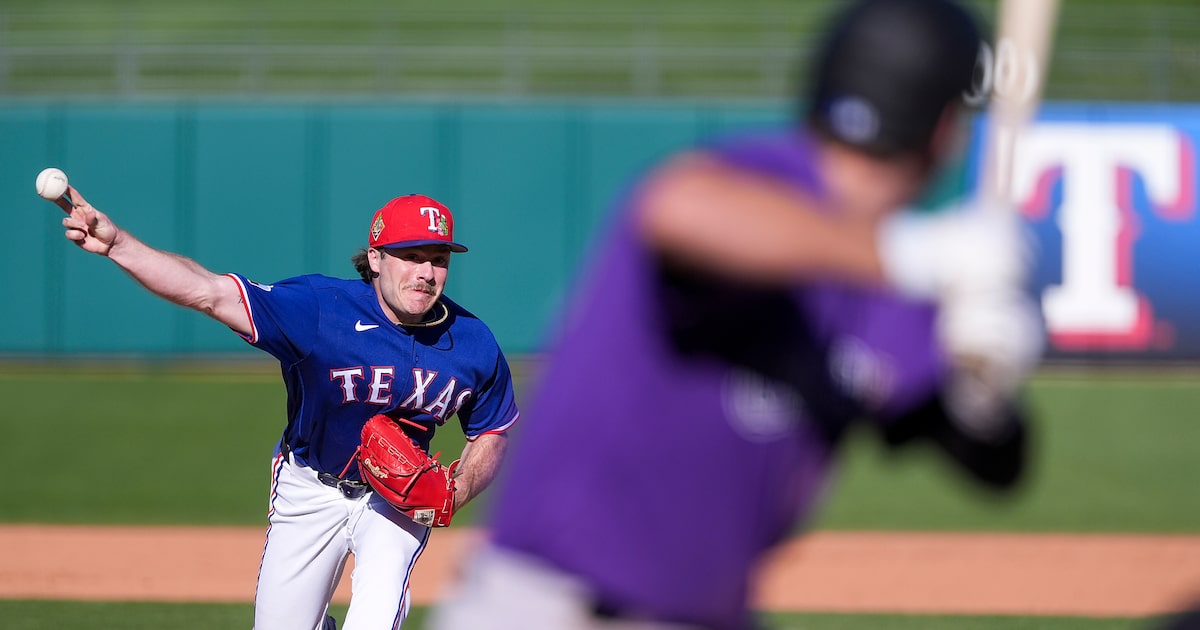
Collyer’s near-triple-digit fastball is the kind of high-octane gas that the bullpen currently lacks. Baumler’s curveball may be major league ready. Lobus was deemed as someone that will help the Rangers “this season” by Schumaker. Loomis has a unique fastball profile that helped him win the system’s reliever of the year award last season. Ahlstrom was a standout in camp last season and looked sharp in his Cactus League debut Sunday vs. the Colorado Rockies.
It’s a matter of whether the Rangers will pick a young and unproven arm over those with more experience. Their ability to throw strikes this spring will be a large factor in the ultimate determination.
The second base competition is … maybe not a competition?: Last Monday, in his first availability of the spring, shortstop Corey Seager was asked about a “new second base partner,” with no individual names mentioned, after Marcus Semien was traded to the New York Mets.
He did not lean into mystery.
“It’ll be exciting,” Seager said. “I’ve played some games with him already so you kind of know how he operates. I’m really more excited for him just to get this opportunity.”
The him in question is utility infielder Josh Smith, the clubhouse leader to replace Semien full time at second base, and the most-experienced option of the candidates. This isn’t to say that the Rangers have officially given Smith the job, or that Seager’s word is inherently bond, but rather that the 28-year-old appears to have a sizable lead in the race.
He’s played exclusively second base in the two Cactus League games that he’s appeared in and has exited each contest with the other expected starters. He’s worked out at second base during infield drills on the backfields. He’s been flat out one of the club’s most productive players in each of the last two seasons despite a pair of second-half slumps.
Infielder Cody Freeman, who suffered a lumbar stress reaction and will be sidelined for four-to-six weeks, was the most likely candidate to challenge for the position out of the gates. His injury timeline now complicates that. Utility player Ezequiel Duran, the other second base option, started at shortstop Saturday against the Chicago Cubs in a game that Smith did not travel for.
It’s the time to test: The Rangers are 2-6 on ABS challenges through three games. Hitters are 0-2 when they’ve challenged a strike call and pitchers or catchers are 2-4 when they’ve challenged called balls.
The challenge system, which takes all of 10-15 seconds to run, will be implimented in the regular season. Each teams gets two challenges and retains their challenges if a call is overturned. Right-handed pitcher Nathan Eovaldi aknowledged after his Friday start vs. the Kansas City Royals that it “still felt weird” but will remain something that the club will need to get acclimated to.
“During the season, if we were to lose both our challenges in the first two innings, we’d be in some trouble I feel like,” Eovaldi said. “I think the tough thing is before, we had one structured strike zone, and now it kind of fluctuates between each hitter. The bottom of the zone will be at their knees and things like that … I just think, moving forward, it’s one of those things we definitely have to pay attention to.”
Find more Rangers coverage from The Dallas Morning News here.
Click or tap here to sign up for our Rangers newsletter.
Rangers’ Brandon Nimmo explains role as veteran mentor for Wyatt Langford, Evan CarterTexas Rangers top 30 prospects: No. 30 Mason McConnaughey looks the part of a starter