
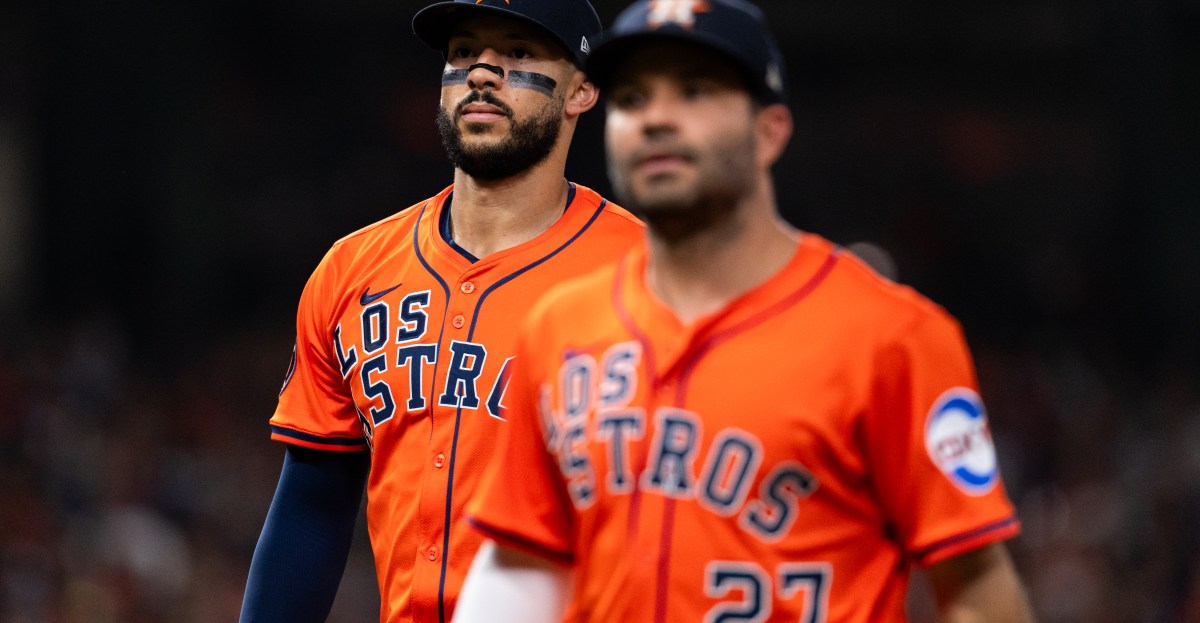
This one is going to be a longer piece because I am adding some additional information. However, I think it is crucial information, so I hope everyone stays until the end. Officially, the Astros have three primary second basemen in camp. There might only be one on the final roster because Nick Allen can play second base and Isaac Paredes can theoretically play second. We have already profiled Paredes and we will profile Allen when we get to shortstops.
The extra information surrounds Jose Altuve. To understand where he is and likely to go we also have to understand where he was when he was at his best. Just like the last two times, we will be looking at chase rates, hard hit ball rates, BABIP, contact rates, and home runs per fly ball. Just as a reminder, here is what we are looking at for those five metrics.
Chase rate: This is the percentage of balls a player swings at outside of the zone. The league average normally lives between 30 and 32 percent, but we will be looking at three year intervals and we should notice trends more than where a player is in relationship to the league average.Hard hit percentage: This is simply the percentage of balls that a player hits hard. Hard hit balls become hits and extra base hits more often than softer contact. Typically 35 percent is around the league average in this category.BABIP: This is batting average on balls in play. Home runs are obviously excluded since they are not in play. The league average tends to hover around .300 but it will largely depend on hard hit percentages and breakdowns between groundballs, flyballs, and line drives.Contact percentage: This is the percentage of swings that turn into contact. Typically 70-75 percent is around league average.HR/FB percentage: This is the percentage of flyballs that result in home runs. Ten percent is typically around the league average.ChaseHardhitBABIPContactHR/FB202330.631.4.34882.918.3202437.531.2.33779.512.0202538.130.9.28382.013.6Aggregate35.431.2.32381.514.6ChaseHardhitBABIPContactHR/FB201631.936.4.34791.413.0201731.928.4.37092.214.6201830.533.8.35289.89.6Aggregate31.432.9.35691.312.4
I could spend an eternity on Altuve alone. His metrics are fascinating because they go against the norm. His Statcast numbers routinely underestimate him, so going with the predicted stats also don’t work. Much of that is because he has had nearly 300 infield hits in his career. However, the interplay between his last three years and the top three seasons of his career (2016-2018) are also fascinating. It helps explain exactly where the rot has been between his peak and now.
In particular, the contact rates during his prime would rival Tony Gwynn and Rod Carew historically. There isn’t a player currently in baseball putting up those numbers outside of maybe Luis Arreaz. The current numbers are still well above average, but he just can’t sustain those high contact rates anymore. Couple that with the higher chase rates from the last two seasons and we can see what is happening to Altuve. He is still maintaining the power and the hard hit rates.
Predicting a bounce back in BABIP seems reasonable enough just based on the numbers we are looking at. However, career norms seem to show that he is averaging between 20 and 25 infield hits a season. His speed is also waning, so he might produce somewhere closer to 15 this season. Remove ten hits from his score and we can see part of the reason for his diminished BABIP. If I were to speculate, I think he might end up closer to .300 this season. That would push him closer to a .280 average if the rest of the numbers hold. Predicting an uptick in contact is irresponsible, but maybe the new hitting coaches can coax more patience out of him. If we could get him down to a 35 percent chase rate then we could see some gains in OBP.
ChaseHardhitBABIPContactHR/FB2023—-—-.27570.613.32024—-—-.37067.221.1202523.339.2.34667.017.3Aggregate23.339.2.33068.317.2
The numbers above represent what Matthews has done in the minors the last three seasons. Unfortunately, batted ball data is not fully available outside of AAA which is why it is missing for the chase rate and hard hit rate the first two seasons. Again, there are four distinct skills here. Matthews is close to elite in three of them. He lays off of pitches outside the zone well, hits the ball hard, and hits plenty of home runs. The missing tool is contact and those are dangerously low considering most of these numbers come from AA or lower.
The questions surrounding Matthews are two-fold. First, how much can he accomplish making contact at that rate? Most players lack a tool here and there, but the question is how deficient are they in that tool. I don’t have a minor league to major league decoder ring, but players typically don’t get better in the majors. That brings the second question: can he improve on contact over time? Some tools can be improved and some can’t.
This is where scouting and analytics sometimes diverge. Scouting treats each tool equally, but they are not all equal in value. So, the open question is how much will Matthews’ inability to make consistent contact mute his other tools? We have seen players with swing and miss tendencies before. Some succeed because they are able to make enough contact to have those other tools play up. We will have to see if Matthews will be one of those guys.
ChaseHardhitBABIPContactHR/FB202318.033.0.30478.310.8202415.716.7.28878.810.9202517.938.0.23476.23.8Aggregate17.229.2.27577.88.5
As can be heard on the air, seeing Biggio’s chase rate gets me baseball horny. His chase rate over the last three years is essentially the same as Juan Soto’s which puts him in the top one percent in that category. Otherwise, he is a fairly ordinary looking hitter. His hard hit rate is below average and his contact rate is essentially average. The biggest alarm bells go off when we see his power numbers from the last season. That could help explain his collapse in BABIP.
At this point, Biggio is more or less a lottery ticket. The general idea is that he could end up being a decent bounce back candidate if his power and hard contact rates come near league average. At that point, his solid overall contact rate and elite pitch recognition would make him an above average offensive player overall. The downside is that if his power and hard contact rate stays well below average then he could be washed. The Astros ventured little to sign him, so it is reasonable gamble. At worst, he gives the team depth in Sugar Land. At best, he could be an interesting utility option as the 26th man on the big club. So, what do you think of these guys? Is there hope for all three to be productive members of the Astros in 2026?