
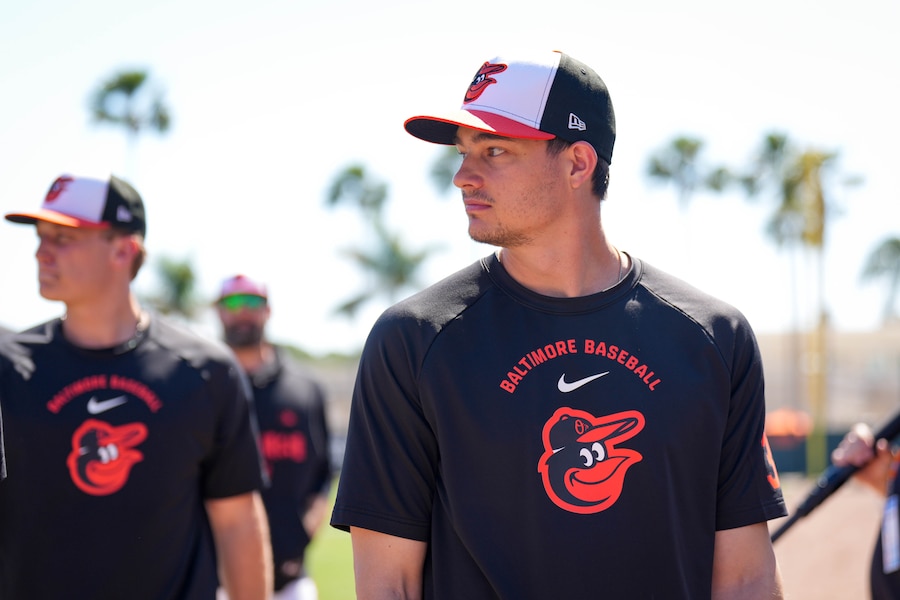
SARASOTA, Fla. — It does not take advanced analytics to realize the situations in which Cade Povich found himself in the most trouble. It is a universal truth in baseball — behind in the count, pitchers are at a massive disadvantage.
The Orioles left-hander was especially susceptible in those situations the last two years, because batters knew what was coming. Consider the 3-0 count he reached against Taylor Ward last week during a live bullpen session. Ward’s teammates urged him to swing away, and Povich’s four-seam fastball in the heart of the strike zone turned into a home run.
A few batters later, Povich had a better answer.
He fell behind Leody Taveras, 2-0. Instead of turning to the four-seam fastball again, Povich fiddled with the ball, found that new grip and ripped his new pitch — two of them, freezing Taveras, before a high four-seamer drew a whiff and a strikeout.
That was the gyro slider, which is a new addition to Povich’s arsenal. As he readies for a competitive battle for a place in the starting rotation (or even in the bullpen as a lefty specialist), this new offering could elevate the rest of Povich’s attack plan, giving him a path out of behind-in-count situations.
“When I’m 2-0, 2-1 is when guys have really good results off me,” Povich said. The gyro slider is something he can throw “to either steal a strike or get weak contact, is what I’m striving for. So far in spring training, I’m getting decent results with it.”
What, exactly, is a gyro slider? It is not a pitch slathered in tzatziki sauce.
Instead, Povich induces a tight spin, similar to the spiral of a football, which leads to very little horizontal break. The pitch comes out of his hand similarly to his four-seam fastball, following a similar tunnel to the plate, but at the last moment the gyro slider drops just enough to create a whiff or force soft contact. It’s similar to the “death ball” that right-hander Trey Gibson throws, though Povich calls it a different name.
Strike one is the most important pitch for any pitcher, and it’s true for Povich, too. In his career, opponents hold a .710 on-base-plus-slugging percentage when Povich is ahead in a count. When batters are ahead, which means there are more balls than strikes, they have produced a 1.072 OPS.
Like many pitchers, Povich is frequently tinkering with his arsenal to find ways to combat hitters. The gyro slider is the biggest addition, but he has overhauled his selection in several ways.
Last spring, he added a kick change. While that may have been his best pitch in 2025, Povich worked at Tread Athletics, a pitch training and development facility, this offseason to augment it. In his own words, he describes it as seeking less kick on his kick change.
“The consistency with it last year, it was obviously a really good pitch for swing and miss outside the zone, but it wasn’t necessarily a big in-zone pitch. And the variability with the movement was pretty drastic,” Povich said. “It was hard to know what it was going to do, and it was probably tough for bullpen catchers.”
 Povich hopes he can use his new slider against left-handed and right-handed hitters. (Ulysses Muñoz/The Banner)
Sometimes it cut to the glove side. Sometimes it ran back arm-side. This winter, Povich improved the consistency of his kick change’s movement profile while maintaining the drop that forced a 34.3% whiff rate last year. He couldn’t use such an unpredictable offering when behind in the count.
The gyro slider, meanwhile, is something Povich is more confident he can use in the zone, to get back into a count. In October, as Povich watched the postseason, he took notice of how left-hander Blake Snell used his slider — another tightly spun pitch with less horizontal movement than a traditional slider. Snell forced a 54% whiff rate with that pitch last year.
Povich doesn’t expect his own slider to immediately generate that much swing and miss, but he thinks it’ll play better than his cutter, which was hit hard.
“When I had the cutter, it was an easy [pitch to] get back in the zone when I needed a strike,” Povich said. “Something to work off the fastball. Obviously, performance-wise, when that pitch was put into play, the results weren’t great with it. But I still wanted something similar I could use to get into the zone, bridge the gap between the four-seam and the big curveball,” so the gyro slider was the answer.
Povich’s new slider is also something he can use to hitters of both hands. He boasts six pitches, but they would be broken into groups of three — some for lefties, some for righties. He now has an additional weapon against any batter.
It’s hard to know how Povich’s gyro slider will operate in games. He starts for the Orioles on Monday, and he’s likely to test the pitch frequently to receive feedback. So far, though, Povich’s newest slider is a positive addition.
“It’s weird,” Povich said. “It plays tricks with hitters.”
The more tricks, the better. And, if it can help Povich avoid behind-in-count moments, the results should improve.