Minnesota Twins left-handed pitching prospect Kendry Rojas got his first spring training action Sunday. He worked two innings, tossing 24 pitches, with three strikeouts and no walks against the Atlanta Braves. Rojas also generated an encouraging five swings and misses over his two innings, while touching 98 mph on the radar gun. After coming over from Toronto in the trade that sent Louis Varland out of Minnesota, Rojas will hope to be that electric on a more consistent basis.
There’s still plenty of room to grow for the 23-year-old left-hander, who has struggled to stay healthy during his pro career. To be a starter, Rojas will need to throw more innings than he has proved capable of. His career high for innings in a season is 84, achieved in A-ball back in 2023.
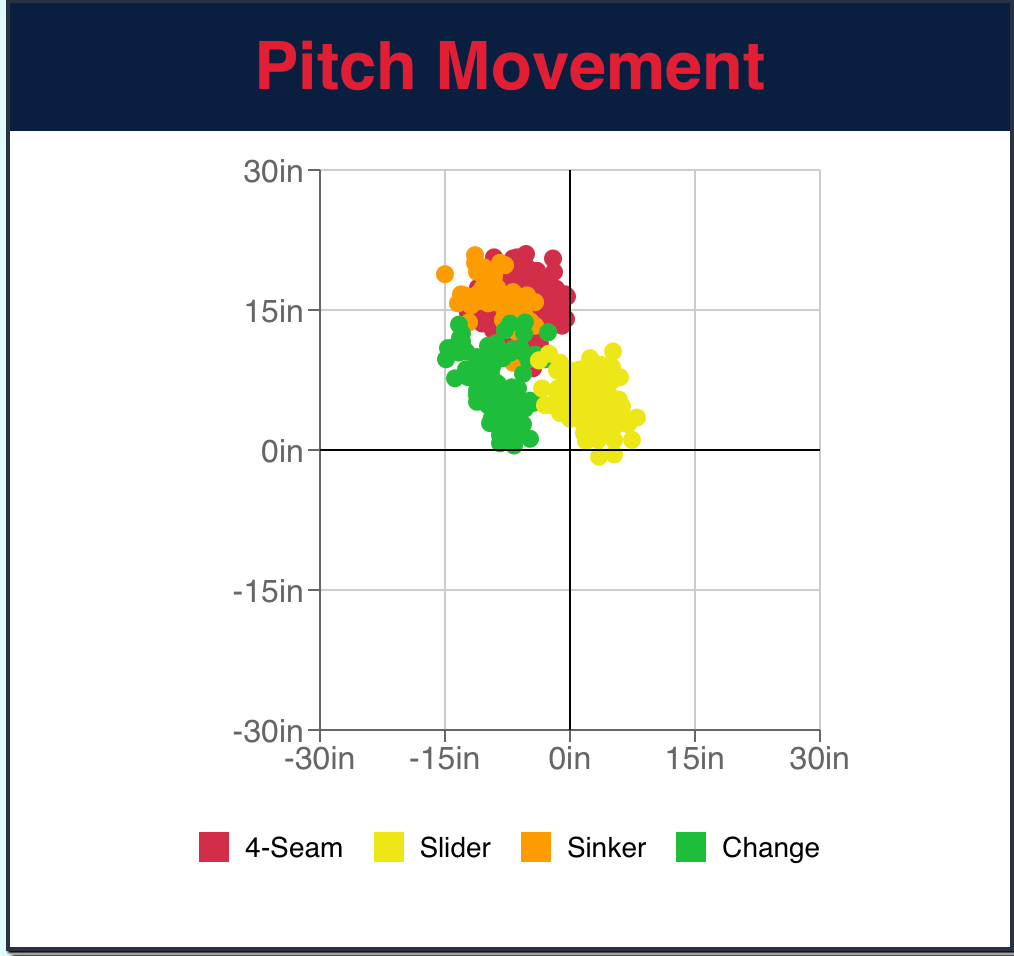
Rojas has traditionally been a fastball-slider pitcher, but there seem to be issues with both of those pitches. The heater has sometimes had a four-seam shape, and sometimes been much more of a running two-seamer. The two-seam version of the pitch got hit hard last year, and overall fastball execution is a key area in which to make progress for Rojas.
Rojas’s slider grades out fairly well, but still got hit hard last season, itself. The lack of consistent execution in terms of lateral movement sometimes leaves Rojas’s fastball(s), changeup and slider looking too similar; he has rarely shown the ability to create big contrasts in movement and location. That’s limited him in thee effort to get whiffs.
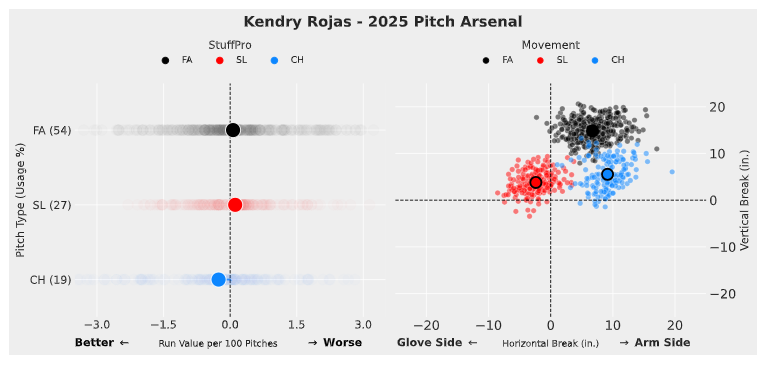
The key to that might be committing to the four-seamer, and scrapping the sinker. Rojas’s four-seamer averaged north of 97 MPH Sunday, and because he kept it from running and flattening out, it set up his changeup and slider better.
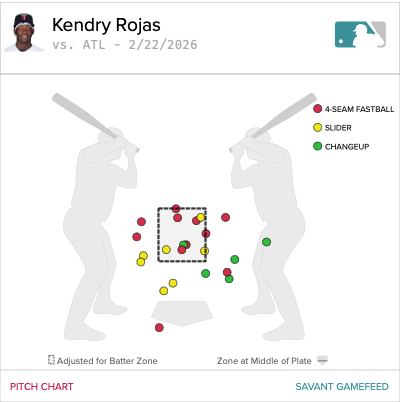
This will be an interesting development to keep an eye on. As we outlined above, Rojas’s heat has been hit hard in the past. Is his first outing of the spring the sign of a new approach in pitch mix for the young pitcher, or simply a one-off that worked against the Braves?
This is the point where we usually ask whether Rojas should remain a starter or be considered for a relief role. However, this team is already loaded with lefty relief options for 2026. Furthermore, as we said at the beginning, from a value standpoint, the Twins really need Rojas to blossom into the effective starter they traded Varland for. Rojas has also told reporters this spring that the Twins have told him he is a starter, making the answer to that question simple.
Rojas is plenty young and has plenty of time before any true panic needs to set in—that is, unless injuries, trades or ineffectiveness cause the Twins to need to call upon their Triple-A depth sooner than they would wish to. He has all three minor-league option years remaining, but if he’s going to break through as a starter, it will probably happen before then. It will probably happen, too, via the tightening of that fastball into a pitch with consistent ride and less run, giving him more chances to generate swings and misses.