

 Brandon Pollard/EVT Sports
A look at the San Diego Padres’ top 32 prospects.
The San Diego Padres’ farm system is always abuzz with talent.
Regardless of any trade, transaction, or circumstance, the Padres’ scouting and player development staff continue their work in restocking and building the talent that will look to impress in brown and gold someday down the line. While the Major League team looks to push forward for a third consecutive playoff berth, the future core of the team is growing down on the farm.
A.J. Preller, Chris Kemp, and the Padres’ scouting and player development departments have done their homework for sure, continually bringing in talent while other talents have been traded away. While national evaluators may not be as high on this Padres’ system as the classes from nearly a decade in the past, let’s dive into the talent residing down on the farm.
Here is a look at the Padres’ Top 32 Prospects, starting with a few honorable mentions that just missed the cut.

Honorable Mentions:
Abraham Parra, RHP
Acquired: International Amateur Free Agent, April 2023
Highest Level Reached: Single-A
2025 Stats: 20 Games (11 Starts), 87.2 IP, 5.13 ERA, 4.79 FIP, 4.60 xFIP, 20.6% K, 9.0% BB, 80 K, 35 BB, 45.2% GB
Signed out of Venezuela in 2023, Parra made it to his first stop of full-season ball in 2025, spending most of the season with Single-A Lake Elsinore. His first foray in the California League saw its fair share of ups and downs, as in 87.2 total innings in 2025, he finished with a 5.13 ERA (4.79 FIP, 4.60 xFIP) across 20 games. Parra’s 20.6% strikeout rate was around league average for the California League’s offensive environment, and he showed an ability to get swings within the strike zone. His 11.4% swinging strike rate was above the league average, albeit not by much.
Parra showed strong growth in his first season with Lake Elsinore, as his 91-94 mph fastball touched 95-96 early in outings. He showed growth in his secondaries, as his changeup showed potential in 2025. Parra remains one of the younger arms in the system, and the now-20-year-old is in line for a consistent starting opportunity with Lake Elsinore. Despite his youth, Parra has a chance to make a name for himself in 2026. MLB ETA – 2028
Jaxon Dalena, RHP
Acquired: 6th Round, 2025 MLB Draft
Highest Level Reached: Single-A
2025 Stats: 3 Games (2 Starts), 5 IP, 1.80 ERA, 2.80 FIP, 3.50 xFIP, 9 K, 4 BB, 55.6% GB
The 2025 Padres’ draft class was highlighted by pitching, and Jaxon Dalena could very well be the next breakout player from this class. Dalena was a relative unknown to the general public, entering the draft coming out of Division II Shippensburg University. Taken in the sixth round, Dalena possesses a strong basis of maturity and fundamentals on the mound. The right-hander emerged as the Raiders’ ace in his junior season, and his final season was a successful platform year. Dalena pitched to a 3.36 ERA and a stronger 2.61 FIP in 83 innings. Dalena fanned 29.4% of batters while walking 8.9%, and threw six-plus innings in 12 of 14 starts. After the draft, Dalena made three appearances with the Padres’ Single-A affiliate in Lake Elsinore, striking out nine batters in five innings.
What Dalena brings to the mound is an arsenal that is both tantalizing and full of potential. Dalena’s fastball clocks in at 94-98 mph in velocity, while carrying up to 18 inches of induced vertical break. His splitter is a nightmare of a combination for opposing hitters, as it sits in the 84 mph range with low spin rates and strong downward break. He complements this arsenal with an 89-91 mph cutter with rise and horizontal break, as well as a pair of breaking balls.
Dalena has both a 12-6 curveball and “gyro” slider, both of which sit in the low-to-mid 80s. A very cerebral player both on the field and off, Dalena exhibits a steady poise on the mound and a drop-and-drive style of pitching motion that allows him to get consistent results, much like his mentor in Hall of Famer Mike Mussina. Despite not coming from a big SEC or Big 10 school, Dalena’s maturity and the advanced nature of his game coming out of the draft have him in line for a big season in either Lake Elsinore or Fort Wayne’s six-man rotations, and the right-hander could be a major arm for the organization down the line. MLB ETA – Mid-Late 2027/Early 2028
 Credit: Brandon Pollard/ EVT Sports
Alex McCoy, OF
Acquired: Undrafted Free Agent, July 2024
Highest Level Reached: Single-A
2025 Cumulative Stats: 58 Games, .315/.391/.521 (.912 OPS, 146 wRC+), 7 HR, 40 RBI, 14 SB, 24.3% K, 8.1% BB
San Diego has a knack for finding unsung talents post-draft, and they did just that with Alex McCoy. McCoy signed with San Diego in July 2024 after two seasons at the University of Maryland Eastern Shore and one campaign at Hofstra. McCoy unlocked his power upon arriving at Hofstra, where he slashed .306/.384/.509 with 11 home runs, 44 RBI, and 22 stolen bases. The 6-foot-6 McCoy was primarily a first baseman at the NCAA level, but has played exclusively as an outfielder since joining the Padres organization.
McCoy finally made his pro debut in 2025, and the results spoke for themselves. Despite missing time between May and the All-Star Break, McCoy managed to play in 58 games, slashing .315/.393/.521 with seven home runs and 40 RBI. He also added 14 stolen bases to his season ledger. McCoy’s quality of contact was among the most impressive, as he paired a strong eye with barrels. McCoy’s max exit velocity last season was a staggering 118.9 mph, while he was hitting over 100 mph off the bat with regularity. McCoy is more than a slugger, as he has legitimate five-tool potential.
His size and in-game IQ allow him to make the most of his time on the basepaths, posting an 82.4% successful stolen base percentage in 17 attempts. McCoy has the athleticism to play center field, though he is more likely to see time at a corner spot to make the best use of his speed and arm strength. McCoy may not be a household name yet, but he remains a prospect with a high ceiling should all his tools develop and gel together. MLB ETA – 2028
Josh Mallitz, RHP
Acquired: Undrafted Free Agent, July 2024
Highest Level Reached: Double-A
2025 Cumulative Stats: 30 Games (3 Starts), 54.1 IP, 3.64 ERA, 3.36 FIP, 3.12 xFIP, 25.7% K, 5.9% BB, 57 K, 13 BB, 47% GB
Outside evaluators sometimes proclaim that the Padres have a factory of relief pitching depth, and Mallitz is the next in the somewhat stacked line. An undrafted free agent signing out of Ole Miss, Mallitz debuted down the stretch in 2024, and while the numbers in three appearances were not ideal (8.10 ERA), he showed that there was more beyond the first impression. After all, Mallitz was coming off missing the 2023 season due to Tommy John surgery and showed some rust in his final season in college. 2025 was his first season removed from the return, and the comeback campaign was exactly that.
Despite missing time for an undisclosed reason from June 1 to mid-July, Mallitz’s performance was one of steadiness and consistency. Starting the year at High-A, Mallitz posted a 4.09 ERA with the TinCaps, though his performance was much stronger per the underlying numbers (3.09 FIP, 2.73 xFIP, 19.8% K-BB). Mallitz simply refused to allow baserunners and showed excellent command of his full arsenal en route to a late-season promotion to Double-A, where he made four scoreless appearances.
Mallitz’s three-pitch mix has flashed swing-and-miss capability, as the right-hander’s fastball sits between 93-96 mph. His fastball has shown impressive iVB numbers, peaking between 20-22 inches of iVB and four inches of horizontal break. His go-to secondary is a fall-off-the-table splitter with 16 inches of horizontal movement. His slider lives in the slider/cutter realm, as its hard velocity (~89 mph) and tight spin allow it to be a serviceable third offering. Mallitz is set to pitch in the World Baseball Classic as of the time of this article’s writing, and is set to return to Double-A, where he very well could be on the David Morgan trajectory to the Major Leagues. MLB ETA – Late 2026/Early 2027
Luis Gutierrez, LHP
Acquired: International Amateur Free Agency, July 2019
Highest Level Reached: Triple-A
2025 Cumulative Stats: 25 Games (21 Starts), 125 IP, 3.31 ERA, 3.93 FIP, 4.00 xFIP, 21.8% K, 8.3% BB, 115 K, 44 BB, 47.4% GB
Luis Gutierrez is the kind of prospect who doesn’t possess overwhelming velocity, but has the makeup of a traditional left-handed starter. One of the few remaining prospects from the Padres’ 2019 international signing class, Gutierrez saw time at all four full-season affiliates this season. Starting the season as the Storm’s Sunday starter, Gutierrez made ten appearances with Lake Elsinore to the tune of a 2.88 ERA and his highest strikeout numbers since 2023 before a promotion. Now in the Midwest League, he made 13 starts and pitched to a 3.74 ERA (3.68 FIP/3.97 xFIP) in 65 innings across 13 starts. The left-hander finished the season with one start at each Double-A and Triple-A, completing the gauntlet.
Gutierrez’s arsenal is not the flashiest, but he nonetheless shows a strong understanding of how his stuff plays. His main pitches are his sinker and slider; the sinker sits at 91-93 mph consistently, with roughly equal measurements of vertical and horizontal movement (11.4 inches iVB, 12 inches horizontal break). His sinker tunnels well off his slider, which is his main secondary offering. The slider averages 81-84 mph out of his hand, and the sequencing allows him to generate chases outside the zone.
Gutierrez uses a changeup as a bridge pitch, and its 87-88 mph average velocity sequences well with his sinker. While Gutierrez also has a four-seamer, it was more of a tertiary offering for the left-hander in 2025. The left-hander’s arsenal lends well to ground balls and soft contact, as his 47.4% ground ball rate and 20.2% infield-fly rate indicate. Gutierrez will likely open the season at High-A or Double-A and will likely be pushed up the ladder as he remains Rule 5 eligible. MLB ETA – Late 2026 or 2027
And now, onto the Top 32!
 Credit: San Antonio Missions
Victor Lizarraga, RHP
Acquired: International Amateur Free Agency, March 2021
Highest Level Reached: Triple-A
2025 Cumulative Stats: 27 Games (25 Starts), 101.1 IP, 5.77 ERA, 4.89 FIP, 5.04 xFIP, 19.9% K, 13% BB, 92 K, 60 BB, 38.9% GB
Past: Victor Lizarraga has been a steady climber in the Padres’ system, as since signing with San Diego, he has spent one season at each level. The San Diego native has been one of the most mature arms to watch in the system, as he made up for his lack of velocity with pinpoint command and sequencing. The right-hander’s 2024 campaign at Double-A saw him pitch 96 innings of 4.03 ERA ball. His 3.96 FIP and 4.25 xFIP also showed some promise for his first season at the Double-A level, although a major drop in his ground ball rate was a question mark going into 2025.
Present: Lizarraga’s trend of one season per level did not continue in 2025, as he returned as a part of the Missions’ rotation. His season, unfortunately, got off to a slow start; Lizarraga was tagged to the tune of a 10.43 ERA across April, with back-to-back starts against Northwest Arkansas and Amarillo pushing the numbers so high (7.2 IP, 11 ER). His season got back on the rails over his next seven starts, five of which saw him give up three runs or fewer.
Even in this stretch, there was still one major concern: the right-hander was walking more batters than in seasons past. Opponents were not chasing as much as in 2024. As if his season wasn’t already a roller-coaster, Lizarraga departed his next start on June 13 after 19 pitches, with what appeared to be a wrist/forearm injury (no official diagnosis was announced). He returned to the mound two weeks later, and in his ensuing six outings, he looked to be the Lizarraga of seasons past (17.2 IP, 6 ER, 16 K, 11 BB). Then came a slump to end July and open August; in this stretch, he allowed 19 earned runs in 8.2 innings. His final four starts at Double-A salvaged his season somewhat, as he pitched back-to-back scoreless starts against Tulsa and Amarillo in mid-August before making his final Missions start against Corpus Christi on September 5 (5 IP, 1 ER, 4 K, 3 BB). San Diego opted to promote him to Triple-A to give him a taste of the PCL, and the results came back strongly. While his FIP was at 5.37, he pitched 10 innings and allowed only two earned runs in his pair of starts for the Chihuahuas.
Lizarraga’s season certainly merits a case study, as it was truly an exercise in patience and mental fortitude. The now 22-year-old was still one of the younger players in all of Double-A for most of the season, as he was three-and-a-half years younger than the average Double-A player. However, his command was not the same as it had been in seasons past. While his first-pitch strike rate sat in a similar realm to his 2024 season (48.9% in 2025), it was still part of the reason for the right-hander’s struggles when they occurred. Lizarraga has been most successful when he is ahead in the count, allowing him to be in the driver’s seat of his sequencing. Falling behind does not play in his favor.
Lizarraga continued to average 89-92 mph on his four-seam fastball, and while the pitch’s individual qualities don’t jump off the page, his 7.1 average feet of extension off the mound allow him to generate swings and misses (23.1% whiff rate at Triple-A). His curveball and slider showed development this season, as Lizarraga was able to more clearly differentiate the two. The curveball continues to be his bread-and-butter pitch, as it flashed strong two-plane movement to the gloveside. Both the curveball and slider got most of their whiffs in the down-and-to-the-gloveside quadrant of the strike zone, sending right-handed batters fishing. His changeup and sinker showed identical levels of horizontal break, averaging 13.75 inches of horizontal break, and both showed effectiveness at generating weak contact this season. Lizarraga continued to be a force against right-handed batters, who hit .223 against him this past season.
Future: Lizarraga is still very young for the amount of experience he has, as his 2025 season saw him face pro hitters at an age where most prospects are college juniors preparing for the draft. For Lizarraga to take the next step, he needs to refine a pitch to better tackle left-handed hitters, who hit .320 against him in 2025. Lizarraga has taken steps to expand his arsenal, making the most of his velocity at this point. He has been able to touch the mid-90s at times, so adding velocity and a primary pitch to mitigate barrels from left-handed hitters would allow him to be a viable starter long-term.
With his experience, it can be easy to forget he is barely 22, so he has some time to continue developing his craft. Lizarraga will likely begin the 2026 campaign at Triple-A El Paso, but a brief stint in Double-A (see the Jackson Wolf 2025 playbook) could be in the cards to allow the right-hander to gain confidence in any pre-season adjustments. While his ceiling as a starter is limited at this point, he has the ceiling to be a No. 3 to No. 5 starter in a big-league rotation. If the Padres opt to move him to relief, he has all the tools to be a 2021 Nabil Crismatt-esque arm who can rely on changing speeds and deception for long-term success. MLB ETA – 2026
 Credit: Valley News
Carson Montgomery, RHP
Acquired: 11th Round, 2023 MLB Draft
Highest Level Reached: Single-A
2025 Arizona Fall League Stats: 4 Starts, 10.1 IP, 1.74 ERA, 4.12 FIP, 14.6% K, 14.6% BB, 7 K, 7 BB
Past/Present: Montgomery’s debut season in pro ball in 2024 lasted all of seven innings, as the right-hander went down with an injury and missed the remainder of 2024. Montgomery flashed strikeout potential in a trio of shorter outings, but did not appear in regular game action throughout 2025. Montgomery’s 2025 season was spent rehabbing from Tommy John surgery, and he did get live batting practice and scrimmage action in the off-the-books Arizona Continuation League.
The Padres sent Montgomery to get game action in the Arizona Fall League, where he would get the reps he missed while also facing top prospects and higher levels of competition. In the fall league, Montgomery threw 10.1 innings, issuing seven walks and strikeouts apiece. While the results-based metrics came out as mixed, Montgomery was able to rebuild some of his stock as a prospect.
The right-hander’s four-seam fastball and sinker averaged 94.3 mph and 93.9 mph, respectively. Montgomery’s four-seamer showed impressive iVB from his slot, clocking in at 16.3 inches of iVB from a 5.7 feet high release height. The sinker has more carry than most sinkers, as its 12.6 inches of iVB suggest. Pair that with 12.9 inches of armside run on average, and the sinker has the potential to generate chases en masse. Both of Montgomery’s fastballs come from the exact same slot, so batters have milliseconds to guess which way the pitch is moving.
His secondary offerings excelled at suppressing hard contact in the AFL, with both putting up elite xWOBACon numbers in the small sample. Montgomery’s slider has a strong late break, at times playing like a traditional north-south slider as opposed to the more east-west gyro or sweeper. Its velocity sits between 83-85 mph, and while the shape has shown potential for the traditional gyro profile, a full season’s slate will likely see more consistency. While his changeup is also in its infancy, its shape shows promise for a harder changeup. Sitting at 88 mph on average in the AFL, his changeup may not have the Stuff+ grades that scream off the page, but since the pitch’s movement is in a similar realm to the sinker, its effectiveness as a bridge pitch or strike three offering cannot be overstated.
Future: 2026 will be Carson Montgomery’s second season seeing game action in a full-season calendar. The right-hander’s AFL stint provided a glimpse into what he can be at the professional level, even at such an early stage in his career. He still only has 18.1 innings of professional experience under his belt, and his role for 2026 has not yet been defined publicly.
If he is to remain a starter, he has the makings of a middle-to-back-end starter as things stand, with further development cementing his ceiling as a starting pitcher long term. His fastball did touch 96-97 mph in the Fall League, working in shorter stints, so a future as a hard-throwing middle to late inning reliever could be in the cards as well. MLB ETA – Mid-Late 2027
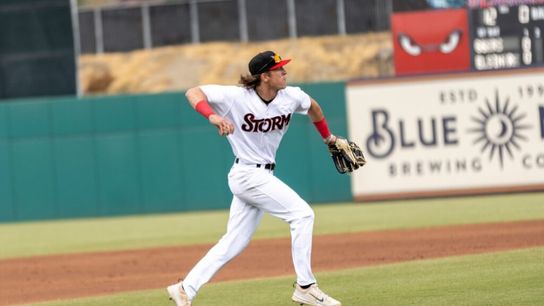 Credit: Brandon Pollard/ EVT Sports
Zach Evans, IF
Acquired: 9th Round, 2024 MLB Draft
Highest Level Reached: High-A
2025 Cumulative Stats: 125 Games, .275/.343/.344 (.687 OPS, 95 wRC+), 3 HR, 72 RBI, 15 SB
Past: Coming off a strong season at Lenoir-Rhyne, Evans was selected by the Padres in the ninth round of the 2024 draft and saw time in the instructional league after the draft. His redshirt junior season at Lenoir-Rhyne was a strong platform season, as in 51 games, Evans hit 11 homers and reached base 40% of the time. For a middle infielder, a .321/.400/.591 slash line with 11 homers, 44 RBI, and five steals was solid production that could indicate a future in the pros.
Present: Evans made his professional debut in 2025, opening the season at Single-A Lake Elsinore. The infielder played all over the diamond in his debut campaign, but spent most of his time with the Storm as their starting third baseman. The jump to the pro level did not appear rough for Evans in Lake Elsinore, as he slashed .296/.367/.377 in 96 games with the Storm. While the power output dropped from 2024, Evans made up for it by making the most of opportunities with runners in scoring position, hitting .318 with an .801 OPS in 176 at-bats.
He was one of the best hitters in the entire system with runners in scoring position, and his glove work around the diamond was solid. Unlike most ballplayers, Evans welcomed the grind of bouncing around, eagerly anticipating knowing where he’d be called on to play. After 96 games with the Storm, Evans was called up to Fort Wayne for the final stretch. The jump to High-A was a true test of Evans’ moxie and mental makeup, given the change in pitching approaches at the higher level. While the final 27 games left a hunger in Evans after the start to his season, his cumulative stats showed that there remains room for him to grow.
For starters, Evans is 6-foot-4, so he is far from the average utilityman. The right-handed-hitting Evans’ approach at the plate is professional for a player of his age, as he showed an ability to hit to all fields. He never gets too big in any swing, taking pitches where they come from, which allows him to make the most of any plate appearance. Evans also showed reverse splits in 2025, which remains an area in which he can grow (and is actively working on).
Future: Entering his second professional season, Zach Evans has one of the more unique profiles in the Padres’ system. His offseason work has been centered around making the most of quality of contact, as well as improving in driving the ball.
The Buffalo, New York, native has not yet reached his upside, but remains driven to improve. With his height and positional versatility, it remains to be seen whether the Padres organization values him at one specific position or as a Swiss Army Knife of sorts. If he can make strides in the power department, he could very well be a 10-15 homer threat going up the minor league ladder. MLB ETA – Late 2027 or Early 2028
 Credit: Missions
Romeo Sanabria, 1B
Acquired: 18th Round, 2022 MLB Draft
Highest Level Reached: Double-A
2025 Stats: 119 Games, .257/.309/.376 (.685 OPS, 98 wRC+), 12 HR, 56 RBI, 4 SB, 21.4% K, 7.4% BB
Past: Drafted in the 18th round, Romeo Sanabria consistently delivered plus bat-to-ball skills with developing power. His calling card early on through his career was his contact and on-base skills. He was an on-base machine through the lower levels, as he consistently reached base at a .350-.450 clip. Sanabria was pushed through three levels of the minor leagues in 2024, and while he kept hitting, his on-base ability was not as strong as in 2023. He spent 34 games at High-A and 32 games at Double-A, posting a wRC+ of 116 and 114 at each level, respectively. While he never appeared to be overmatched, his 2025 season was set to be telling of his ceiling.
Present: Sanabria’s success led to his assignment to Double-A San Antonio for the 2025 season, and the season was up-and-down. The start of his season was a continuation of his 2024, as over April and May, he hit .331 with a .378 on-base percentage. Sanabria hit five homers, 10 doubles, and drove in 19 runs, and posted a .497 slugging percentage. This stretch was highlighted by a towering walk-off homer against Frisco on May 10.
Despite the strong start to the season, Sanabria’s season soon hit a wall. Opposing pitchers began to take advantage of Sanabria’s aggression at the plate, as his swing percentage went up while his production dipped in the second half. His June and July produced a .228 batting average, and August did not see much improvement, as Sanabria hit .191 with an OPS of .541. While he finished the season on a 9-for-37 stretch, the left-handed hitting Sanabria’s campaign was certainly not what he expected.
For Sanabria, this season was the first in his career where he faced a prolonged slump. Despite the second-half production not being ideal, there were still signs of growth for the Miami-born first baseman. Sanabria’s swing was not as overmatched against high velocity, which was an area of struggle for him in 2024. He was able to hit the ball to the opposite field at a more reasonable rate than his initial Double-A stint. Sanabria’s swing continued to produce a healthy amount of line drives, as his 28.7% line drive rate was his highest in a full season.
Future: Sanabria is still viewed highly by the Padres organization, as he was invited to Major League spring training in 2026. The left-handed hitting Sanabria still possesses above-average in-game power and a strong eye at the plate. While he is limited defensively, he was a strong defender at first base, posting a .993 fielding percentage with the Missions. If Sanabria can establish some offensive rhythm at the dish and cut down on the strikeouts, the former 18th-round pick could break through in 2026. He has the upside to be a 15-20 homer bat at the big league level, and the quintessential secret weapon slugger for a contenting team. MLB ETA – 2026
 Credit: Journal Gazette
Ryan Jackson, IF
Acquired: 17th Round, 2024 MLB Draft
Highest Level Reached: Double-A
2025 Cumulative Stats: 129 Games, .259/.389/.341 (.730 OPS, 116 wRC+), 4 HR, 58 RBI, 19 SB, 17.4% K, 16% BB
Past: After two seasons at the University of Nevada, Ryan Jackson transferred to USC, and his two seasons with the Trojans were an unmitigated success. His 2024 senior campaign was a breakout; Jackson always had a keen eye at the plate, but also found his slugging in ‘24. Jackson slashed .323/.407/.461 in 59 games, leading the team in multi-hit games and hits. This production got him selected in the 17th round by San Diego, and he signed before ending 2024 with 13 games at Single-A Lake Elsinore, where he hit .261/.404/.283.
Present: 2025 saw Jackson open the season as the Storm’s starting shortstop (say that five times fast). While Jackson’s plate discipline was a highly regarded aspect of his game, he blew past any expectations. Through the first two weeks of the season, his OBP was .605. By the end of April, he led the California League in on-base percentage, and in mid-May, his OBP was still at .474. It’s not like all he did was draw walks either, as Jackson hit .298 in 62 games with the Storm, driving in 33 runs and stealing 15 bases. He had more walks than strikeouts (55 BB, 49 K’s), and was top 5 in the California League in OBP, OPS, walks, hits, & doubles at the time of his promotion to High-A.
Making the jump to the Midwest League brought a new challenge for Jackson, but he still posted a .357 OBP in 42 games with the TinCaps. While his slugging numbers saw a dropoff against tougher pitching, he was still hitting at a hit-per-game pace in his time in the Midwest. Jackson didn’t end the year there either, as he got called up to Double-A on August 19. The third and final promotion of the season was a bigger hurdle, as he went 13-for-67 (.194) with a .494 OPS in 19 games with the Missions.
Despite the late-season slump, he was one of eight Padres assigned to the Arizona Fall League. In 16 games in the desert, Jackson hit .213 with a gargantuan .424 on-base percentage. Jackson finished the regular season with a 16% walk rate against a 17.3% strikeout rate, and in the AFL, he had 15 strikeouts to… 15 walks. Defensively, Jackson was a Swiss Army knife in the field, spending time at second base, third base, shortstop, and even left field in 2025.
Future: Jackson’s offensive profile is one of the most unique in the system, as he was never a huge power threat in college. Despite the lack of power, he more than makes up for it with a borderline elite eye at the plate and strong defensive instincts. While he was primarily a shortstop in college, his plate discipline and baserunning IQ will play anywhere on the field. His assignment to the Arizona Fall League saw him face top prospects and higher competition, and he managed to hold his own there. Jackson’s swing is short and compact, getting the barrel to the ball to make the most of his size. IF Jackson can work on getting through the baseball and develop more consistent line drive output, his bat will certainly play at the Major League level as a right-handed hitting Jake Cronenworth-esque player. MLB ETA – 2027
 Credit: Lake Elsinore Storm
Vicarte Domingo, RHP
Acquired: 19th Round, 2024 MLB Draft
Highest Level Reached: Single-A
2025 Stats: 37 Games, 63 IP, 3.86 ERA, 3.45 FIP, 3.92 xFIP, 32% K, 12.6% BB, 86 K, 34 BB, 36.4% GB
Past: Coming out of an NAIA school, Vicarte Domingo had three strong seasons out of the bullpen for the University of British Columbia. His college numbers were nothing to scoff at, as in 83.1 career innings, he pitched to a 3.24 ERA, 2.65 FIP, 33.5% strikeout rate, and 9.3% walk rate. Had he posted these numbers at a “larger” school, there’s a chance he would have gone off the board much earlier in the draft, but the Padres’ scouring in the Pacific Northwest paid off, as they were able to snag Domingo in the 19th round.
Present: One year removed from the draft, Domingo appears to be en route to being one of the biggest steals in the entire 2024 draft. The right-hander spent all of 2025 at Single-A Lake Elsinore, and the results showed the kind of success he can have. In 63 innings across 37 appearances, Domingo led the Lake Elsinore bullpen in strikeouts with 86 (only two behind Kash Mayfield). Domingo pitched to a 3.86 ERA, 3.45 FIP, and 3.92 xFIP, striking out 32% of batters while walking 12.6%.
The right-handed pitcher worked more than one inning at a time in 25 appearances, maxing out at three innings in one outing (which he did three times). The native of Cacnda racked up strikeouts en masse when his stuff was on, like on July 23 vs. Stockton (3 IP, 6 K, 0 ER). Speaking of stuff, Domingo’s arsenal has some of the highest graded stuff in the Padres’ system per Stuff+. The right-hander’s four-seam fastball sat in the mid-90s, topping out at 97-98 mph with 20-plus inches of induced vertical break. The pitch also has 3-4 inches of armside run, and coming from a low-¾ slot gives the offering plenty of late life. Pair this with above-average extension, and the right-hander’s fastball shape is comparable to that of Jeremiah Estrada, just coming from a lower slot.
He complements his fastball with a trio of offerings, highlighted by a strong changeup. While he did not use it much in the California League due to the league’s offensive environment, the pitch generated a higher-than-average whiff rate when he did turn to it. The changeup clocked in at 84 mph on average, with 16-19 inches of armside run. Domingo also throws a gyro-slider and a hard cutter, both of which he has worked to differentiate over the course of the season. Both offerings tunnel well off his fastball, and he used both to strong results in his debut campaign.
Future: While Domingo had some starting experience in college, it is more likely that he remains in the bullpen at the professional level. Domingo has some of the best stuff in the entire system and has openly embraced the analytics to take his game to the next level. Even if his future outlook is simply as a reliever, the stuff and the mental foundation are such that he could see time at multiple levels in 2026 if he can keep the whiffs and strikeouts at similar rates. Set to open the 2026 campaign at High-A Fort Wayne, Domingo could be an arm with the upside of a setup/closing reliever, thanks in part to his high-rise fastball and deep arsenal. MLB ETA – Mid-Late 2027
 Credit: Brandon Pollard/ EVT Sports
Kannon Kemp, RHP
Acquired: 8th Round, 2023 MLB Draft
Highest Level Reached: Single-A
2025 Cumulative Stats: 18 Games (10 Starts), 77.2 IP, 5.56 ERA, 4.68 FIP, 4.80 xFIP, 18.3% K, 9.1% BB, 64 K, 32 BB, 47.3% GB
Past/Present: The highest-drafted member of the 2023 Padres draft class remaining in the organization, Kannon Kemp, made his long-awaited debut in the 2025 season, starting on Opening Day for the ACL Padres. Kemp had battled through a shoulder impingement that required surgery, not throwing in a competitive game in 2024.
Now healthy, Kemp made it through the desert and up to Single-A. Kemp pitched in five games at the ACL level, tossing 24 innings. While the counting stats were so-so, the Padres were satisfied with how his arm bounced back from the time off. Dispatched to Single-A in May, Kemp pitched in 13 games (seven starts) for the Storm. While his 5.87 ERA was high, he managed to strike out 48 batters in 53.2 innings. Kemp’s durability was the most promising sign of his season, and his poise on the mound never relented.
Batters struggled to hit his fastball when he located it at the top of the zone, as the pitch was sitting in the 92-94 mph range as a starter. His slider showed refinement in its shape from the draft to now, as he was able to use the pitch for swings-and-misses. Working with Padres Arizona League pitching coach Leo Rosales to adjust the grip on the slider allowed for tighter spin. His changeup remains a work-in-progress, but it is an offering Kemp is confident will continue to develop. The changeup has shown promising armside movement and sits in the upper-80s.
Kemp was also one of the Padres’ arms sent to the Arizona Fall League, where he made six appearances. The AFL may have been a preview for the film that could be his 2026, as Kemp’s fastball averaged 97 mph and topped out at 100 mph. His slider generated a 37.8% whiff rate in that small sample, and he showed development of a sinker with 13 inches of armside run. Kemp’s arm action has found a consistent slot, and his relatively short-arm delivery allowed him to add velocity in shorter spurts.
Future: Still just 21, Kannon Kemp remains an arm with plenty of upside. The AFL showed a glimpse of what his ceiling could be, as his delivery remains relatively low effort but explosive at the same time. Continuing to refine his changeup and sinker could be the next steps for the right-hander, and it is likely the organization continues to push him as a starter. Kemp will likely slot in beside Kruz Schoolcraft in the Storm’s rotation to open the season, but he could be in line for a fast promotion should the swing-and-miss stuff he showed in Arizona continue to show. Kemp has the potential to be a starter long-term, and 2026 will see him navigate a larger workload. MLB ETA – Late 2028 or Early 2029
 Credit: Missions
Francis Pena, RHP
Acquired: International Amateur Free Agency, January 2022
Highest Level Reached: Triple-A
2025 Stats: 43 Games, 52.1 IP, 4.99 ERA, 5.23 FIP, 5.50 xFIP, 19.8% K, 14.3% BB, 47 K, 34 BB, 55.6% GB
Past: Pena was a breakout arm in 2024, starting the season with one inning of High-A ball on his resume. However, he rocketed up the system in 2024, pitching well at High-A and Double-A before a tough Triple-A debut. His season as a whole ended with a 2.43 ERA, 3.16 FIP, 3.33 xFIP, and 25.1% strikeout rate in 63 innings of work. Pena’s velocity was eye-catching, as he was topping out at 99 mph with a hard mid-90s cutter. 2025 would see him start at Triple-A, on the cusp of reaching the major leagues.
Present: Pena indeed opened the season at Triple-A, but the struggles he faced there in ‘24 only amplified. Pena’s stuff succumbed to the altitude of the PCL, as he finished with a 4.99 ERA, 5.23 FIP, and 5.50 xFIP. Concerningly, Pena’s blistering arsenal saw a downtick in velocity, as his once-high-90s four-seam fastball averaged 94.9 mph.
His cutter drew stronger results on balls in play (0.141 xWOBACon in 2025) despite losing one mph of velocity on average. Pena was able to differentiate his slider in 2025, and it was his best-graded pitch per Stuff+ despite average whiff rates. Part of the regression came as a result of a lack of throwing strikes. Pena’s 46.3% in-zone percentage was a decrease from an already below-average 49.3% in 2024, which effectively neutered his ability to get chases outside the zone. His 31.2% hard-hit rate was better than the league average of 35%, and his 0.275 xWOBACon total was above average.
Future: Pena’s future outlook is not all too different from this time last year, and his presence in Spring Training reinforces the Padres’ belief in the right-hander. However, it appears that the changes Pena made to improve his slider may have played a role in subpar results in 2025. The lack of command at the Triple-A level was a red flag in 2025, and given the drop in velocity, his outlook as currently performing is that of a hard-throwing middle reliever at the MLB level. MLB ETA – 2026
 Credit: MiLB
Truitt Madonna, C/1B
Acquired: 11th Round, 2025 MLB Draft
Highest Level Reached: Single-A
2025 Stats: 14 Games, .185/.267/.278 (.545 OPS, 55 wRC+), 0 HR, 5 RBI, 38.3% K, 10% BB
Past/Present: San Diego’s scouting in the Pacific Northwest helped them discover one of the best names AND hidden talents in the 2025 draft in Truitt Madonna. Madonna made his statement in 12 games in the MLB Draft League, which allows college and high school players an opportunity to exhibit their skills before the draft and after their school seasons come to an end. Madonna hit .279/.360/.512 with two homers and four doubles in the Draft League, and he did this as a high school senior facing off against college juniors and seniors. Madonna did not shy away from the competition, and he became his alma mater (Ballard High School in Seattle, Washington)’s first player taken in the MLB draft in 27 years.
The Padres gave Madonna top-120 money to forgo a commitment to UCLA, signing the 18-year-old for $650,000. Unlike a lot of draftees out of high school, Madonna actually saw game action for the Padres minor league system, spending 14 games with Single-A Lake Elsinore. While he hit .185 in 14 games, Madonna got to face pro pitching for the first time in his career and will likely start the 2026 season in Lake Elsinore.
Future: Madonna’s bat and athleticism were a huge part of his offensive profile going into the draft, as he has a strong swing. When facing college pitchers in the draft league, Madonna registered average exit velocities in the 90th percentile of MLB hitters. His bat showed promise in producing a strong quality of contact, but showed some areas for growth, particularly against breaking balls.
Defensively, Madonna is likely to see time at a variety of positions, as his defense graded out as average behind the plate. While his arm strength is average, he struggled in limiting stolen bases at the pro level, posting a 7% caught stealing rate at both the draft league and Single-A level. Madonna’s frame and bat will certainly play around the diamond, be it at first base, catcher, or an outfield corner. He will likely see time at different positions over the course of 2026, and if he can close the holes in his swing, he has the upside to be a left-handed hitting slugger at first base, catcher, or DH at the MLB level. MLB ETA – 2029
 MLB Pipeline
Ty Harvey, C
Acquired: 5th Round, 2025 MLB Draft
Highest Level Reached: Single-A
2025 Stats: 7 Games, .174/.367/.174 (.541 OPS, 79 wRC+), 0 HR, 3 RBI, 40% K, 23.3% BB
Past/Present: While the 2025 MLB draft class was fairly pedestrian in its catching talent after the first round, Ty Harvey could very well be the standout of the class. The 6-foot-2 Harvey showed one of the strongest power tools among backstops with one of the lower swing-and-miss rates in the class. His power tool had scouts astounded, and while he projected as a power-over-hit prospect coming out of Florida, there may not be too big a gap between those two tools.
Harvey has a mature approach at the plate and displays a controlled aggression that allows him to generate some of the gaudiest raw power numbers in the whole system. Defensively, Harvey moves well for a 6-foot-2 catcher and has a strong throwing arm to pair with his plus receiving skills. Harvey’s arm action has some room for adjustments to make the most of its strength, and the Padres seem confident in his ability behind the dish long term; they did give him their second-highest bonus in the class after all.
Future: Clearly, the sky is the limit with Ty Harvey, as he possesses all the physical tools to be a catcher at the professional level. There is plenty to like with his offensive profile, and he even showed plus plate discipline in his first seven professional games.
Like his draftmate in Truitt Madonna, Harvey will likely open the season at Single-A Lake Elsinore, though a stint in the Arizona Complex League could be an option if starting reps are available for him there. Harvey will also likely see time at first base or in the outfield, given his athleticism and the toll of catching over a long season. Projecting high school catchers’ future outlook in the Major Leagues is murky, but if his tools develop over time, Harvey has a legitimate chance to stick behind the plate. MLB ETA – Late 2028/Early 2029
 Credit: Lake Elsinore Storm
Bryan Balzer, RHP
Acquired: International Amateur Free Agency, January 2023
Highest Level Reached: Single-A
2025 Stats: 16 Games (13 Starts), 50 IP, 7.82 ERA, 5.34 FIP, 5.12 xFIP, 20.3% K, 11.6% BB, 49 K, 28 BB, 60.5% GB
Past: Bryan Balzer’s path to the Padres’ organization could very well be a film on its own. Balzer’s childhood was spent in the US before returning to Japan for his secondary school years. In high school, his arm talent was noticed by a coach and former Yokohama Bay Stars championship reliever Naoya Shimoda, who suggested Balzer move to pitching.
The right-hander showed high potential in high school, but ultimately needed Tommy John surgery in 2022. San Diego had been one of several pro baseball teams (in both MLB and NPB) scouting the Yokosuka-born Balzer, and they would go on to sign him in their 2023 international class. Balzer spent the 2023 season and most of 2024 on the mend from the procedure, but managed to make his pro debut at the tail end of the 2024 season, spinning seven frames for the ACL Padres.
Present: Balzer would be assigned to Single-A Lake Elsinore in 2025 and begin the season in the rotation. Balzer’s season took place in two chunks, as he missed a month for a publicly undisclosed reason (could be injury or load management). His first half (from Opening Day to May 24) saw him throw 29.2 innings of 6.98 ERA ball, though he struck out 30 batters in that span. His second half performance was not as sharp (20.1 IP, 21 ER, 19 K, 14 BB), but he was able to work his way back to full strength despite the stat sheet.
Balzer ended the season with a 7.82 ERA, but his 5.34 FIP and 5.12 xFIP showed room for regression to the mean. Balzer was also one of the best pitchers in minor league baseball at generating ground balls, as 60.5% of batted balls against him ended up on the ground. If this figure were at the MLB level, it would have been the eighth-highest in MLB. His 19% called-strike rate was around the MLB average, which helped to offset his 7.5% swinging-strike rate, which… was a rate.
Balzer’s struggles came as a result of falling behind in the count, as when he is ahead, it lets him utilize the movement bonanza that is his full arsenal. Balzer carries two distinct fastball shapes, those being a four-seamer and a sinker. The four-seamer sat between 94-97 consistently, and in terms of movement, carried 15 inches of iVB and 12-15 inches of armside run. Coming from a below-average release height, there is a legitimate chance it can be effective against batters from both sides. His sinker drops a tick in its velocity (93-95) but still carries 16 inches of vertical break from the same release point.
His slider exhibits traits of a sweeper, as its average velocity sat between 83-84 mph with 14 inches of gloveside break, along with an iVB in the negatives. The eye test makes it look like a Yu Darvish sweeper, which had comparable velocity in 2025. The final piece to Balzer’s arsenal is a hard splitter, which has the potential to be an elite offering down the line. With his strong extension and east-west movement profile on his offerings, a north-south splitter in the upper 80s is a strong complementary offering, which showed high swing-and-miss capabilities in 2025. The pitch’s shape is already above-average, and if Balzer can continue to use it effectively off the rest of his pitches, it could be the key to his long-term outlook as a starter.
Future: Despite not having as much experience on the mound as other members of the system, Bryan Balzer is one of the most underrated arms in a system full of them. His pure stuff is more than enough to get him into a starter’s role, as he has three legitimate offerings so far. If Balzer can stay healthy and get more game reps in, there is ace potential with this young pitcher. While he is still a few years away from the major leagues, Balzer already shows traits of a future MLB starter, and if he is better able to maintain his velocity in longer outings, he very well could be a No. 1 or No. 2 starter down the line. MLB ETA – 2028
 Credit: Journal Gazette
Rosman Verdugo, IF
Acquired: International Amateur Free Agency, January 2022
Highest Level Reached: High-A
2025 Stats: 117 Games, .209/.335/.354 (.689 OPS, 104 wRC+), 13 HR, 43 RBI, 6 SB, 32.2% K, 14.7% BB
Past: Signed out of Mexico in 2022, Rosman Verdugo made some noise in his first pro season, launching seven homers in 52 games with the ACL Padres. His 110 wRC+ in that time was strong enough that he started the next season at Single-A, where he put up a .640 OPS in 113 games. His first 100+ game season saw him hit only three homers, but he racked up a career-high 15 stolen bases in 2023.
The 2024 season saw him break through Single-A, as in 81 games with the Storm, he hit .250 with an .807 OPS. Verdugo drew walks in 14.5% of his plate appearances, and his ISO of .157 was an above-average mark for the California League. His debut in the Midwest League lasted all of 25 games, where he hit .186. Despite this debut, he finished the season with a 99 wRC+.
Present: In 2025, Verdugo spent the full season at High-A Fort Wayne. He played in 117 games, which saw him slash .205/.339/.354 with 13 home runs and six stolen bases. Verdugo’s strong eye at the plate translated over from Single-A, as his 14.7% walk rate was a new career high. At one point in the season, Verdugo walked 29 times in 22 games, good for a 29.9% walk rate in that stretch.
The right-handed hitting infielder’s best month came in June, where, despite hitting .194, he posted a .426 on-base percentage and .358 slugging percentage. Verdugo’s biggest issue was the strikeouts; after striking out 27.9% of the time in 2024, that rate went up to a below-average 32.2%. His setup at the plate is simple, and his bat speed and path are quick to the ball. While he has struggled to make consistent contact, Verdugo was able to close some of the hitches in his swing, allowing him to drive the ball with much more intent than before.
Future: With three full pro seasons under his belt, it is very easy to forget that Rosman Verdugo is still just 21 years old. The Ensenada-born infielder still carries a power-over-hit profile at the dish, and while the improvements in his batted ball quality may not have translated to the stat sheet, his power and slugging will only continue to develop as he continues to see pro pitching.
Verdugo’s eye at the plate allows him to reach base and slightly offset his strikeout concerns, although there are still concerns about his ability to consistently make contact for long stretches. Defensively, he was moved off shortstop in 2025 and spent most of his time defensively at second and third base. His defensive foundation is solid for a player of his age and projects to remain strong at the hot corner or the keystone. While shortstop may not be in his future,
Verdugo is a prospect who may take more time than expected to reach the Majors. However, he has the offensive upside to be a strong defensive infielder with 15-20 home run power, the kind that will make him a folk hero to a fanbase wherever he plays. MLB ETA – 2028
 Credit: Missions
Jagger Haynes, LHP
Acquired: 5th Round, 2020 MLB Draft
Highest Level Reached: Double-A
2025 Stats: 26 Games (25 Starts), 103 IP, 4.11 ERA, 5.01 FIP, 4.56 xFIP, 22.8% K, 14% BB, 101 K, 62 BB, 43.7% GB
Past: The last remaining member of the 2020 draft class in the organization, Jagger Haynes, was finally able to overcome a litany of shoulder injuries and Tommy John surgery to debut in 2023. While his 2023 campaign was focused on getting him into pro games (25.1 IP in 11 games), 2024 was his first full campaign at the minor league level. His first full campaign showed flashes of what he could be, as he had a 14-game stretch where he pitched to a 3.10 ERA in 75.1 innings of work. His overall numbers faded down the stretch, but he wound up working 110.2 innings in 2024, a new career-high. He struck out 24% of batters while walking 13.9%, and 4.63 FIP was in line with his 4.64 ERA.
Present: The Padres pushed Haynes aggressively, assigning the left-hander to Double-A for the 2025 season. His season’s numbers were oddly similar to 2024, as he started slow in April before a 16-game stretch that saw him post solid production. Despite posting a 5.40 ERA in April, Haynes was able to eventually post three months of sub-4.00 ERA production. From May 1 to August 1, Haynes pitched in 15 games (14 starts), accumulating 73 strikeouts in 69.1 innings. He posted a 3.50 ERA in that span, albeit with a 4.66 FIP.
Haynes’ workload on the season was just below his career-high from 2024, although it could have matched or surpassed the past total had it not been for an injury-shortened outing on August 1. Haynes’ results-based metrics were in line with his past seasons, as his 43.7% ground-ball rate was the strongest he had since 2023. Haynes also allowed fly balls at a career-low 32.2%, though his 13.8% HR/FB rate was a career-high.
Haynes’ arsenal is led by a fastball that sat 91-94 mph, while touching 96 early on in outings. He comes at batters from a below-average vertical approach angle, which gives his fastball an illusion of rise despite an average shape with armside run. The fastball doesn’t get many whiffs compared to the rest of his arsenal, and right-handed batters did not miss against it.
His slider showed improvements from 2024, as it has gone from an “in-between” shape to a gyro-slider with two-plane movement in the low-80s. The left-hander rounds out his arsenal with an 81-84 mph changeup with cutting action. The changeup’s deception comes from arm speed as opposed to release, but even so, the changeup got whiffs on 47% of swings against. His delivery as a whole appeared to be more controlled in 2025, compared to a somewhat violent motion in the past.
Future: While Jagger Haynes’ predictive stats were not as gleaming as the surface-level numbers, there remains an opportunity for the left-hander to continue as a starter. Haynes’ velocity bumped up in shorter stints, so a future in relief is also possible. His invitation to Spring Training emphasized the Padres’ belief in the left-hander.
Haynes is not an arm who allows hits en masse, but in order to remain as a starting pitcher for the long term, he must find a way to effectively neutralize right-handed batters for long-term viability. If he does not remain a starter, a long-relief sort of fireman role could be his next path, considering that his velocity trended up in shorter stints (averaged 92-94 mph in 2025 Spring Training). MLB ETA – Late 2026/Early 2027
 Credit: Padres
Lan-Hong Su, RHP
Acquired: International Amateur Free Agency, December 2025
Highest Level Reached: N/A
2025 Stats: Yet to Make Pro Debut
Past/Present: One of the breakout stars of the 18U World Cup, the Padres used a large chunk of their remaining international bonus money to sign the Taiwanese-born Su ($775,000). Su made a name for himself at the 18U World Cup, as he fanned 14 in five appearances, topping out at 94 mph. The right-hander was averaging 92.1 mph on his fastball in the tournament before signing.
While he has not made his pro debut, his makeup as a young pitcher is advanced for his age. Su carries a traditional starter’s four-pitch mix, with a curveball, slider, and changeup complementing the fastball. He showed a good feel for his curveball (78.5 mph average velocity) and slider (80.4 mph), with potential to be above-average pitches with further professional development. His fastball showed an ability to sneak up on batters, especially coming from his 6-foot-1, 150-pound frame. While his changeup is somewhat behind the rest of his arsenal in its development, there is still potential for the offering to be an average pitch to serve as a change of pace in his arsenal.
Future: The next step for Lan-Hong Su will be the start of his pro career in affiliated ball, as he will likely see time in the Arizona Complex League in 2026. The right-hander already brings a strong foundation to his craft and will only continue to thrive with professional development. Su’s foundation is reminiscent of Humberto Cruz when he signed with San Diego, and it is too soon to determine what Su’s upside could be at the MLB level. Su’s mound presence and action are balanced and in strong coordination, so his upside only looks to grow as he develops. MLB ETA – 2029/2030
 Credit: Padres
Lamar King Jr, C/1B
Acquired: 4th Round, 2022 MLB Draft
Highest Level Reached: High-A
2025 Cumulative Stats: 105 Games, .274/.353/.384 (.737 OPS, 108 wRC+), 4 HR, 44 RBI, 21 SB, 20.4% K, 9.6% BB
Past: Lamar King Jr was taken by the Padres in the fourth round of the 2022 draft, but injuries slowed his development early on. He played in a combined 25 games between 2022 and 2023, logging just 95 at-bats. His 2024 was a major step in the right direction, as he played in 62 games. 37 of those games came in the Arizona Complex League, and the remaining 25 came in Single-A. Over the total season, King hit .271/.379/.421 with two home runs and a 113 wRC+. King played most of his games in the field at first base, not seeing an inning behind the plate in 2024.
Present: King would go on to play in a career-high 105 games in 2025, seeing time at first base, catcher, and designated hitter. His offensive performance was a continuation of the growth he showed in 2024, as he hit .286 with a .778 OPS in 81 games at Single-A. His month of June was particularly notable, as he hit .408 with an OPS of 1.084. 12 of his 31 hits that month went for extra bases, and he walked more (13 walks) than he struck out (nine strikeouts).
King hit four home runs at Single-A, and 29 of his 89 base hits with Lake Elsinore went for extra bases. His slug showed signs of life, and partly as a result, he was soon promoted to High-A Fort Wayne. The jump to the Midwest League did not see the strongest results for King, as he hit .233 in 97 at-bats with the TinCaps with no home runs. Despite this, his batted ball profile remained pretty identical to his results at Single-A. King also stole 21 bases on the season, showing strong baserunning IQ without above-average speed.
Defensively, King returned to catching in 2025, but the results were definitely mixed. King’s past shoulder maladies could be partly contributing to the results, but he struggled in baserunner management. On the whole, he threw out 13 of 124 attempted baserunners, which comes out to a 10.5% caught stealing rate. He also allowed 14 passed balls in 509 innings of work behind the plate. King showed accuracy at throwing to the bases, but his throws were often late. King’s accuracy and success at managing the run game showed improvement at High-A, where he threw out four of 20 attempted base thieves (20% caught stealing rate). He also played 310 innings of first base, where he posted a .983 fielding percentage.
Future: Lamar King Jr remains a developmental project for the Padres’ organization, as the time he missed early on in his career has delayed his trajectory to the majors. That’s not always a bad thing, as King has a major opportunity to run with the opportunity as a starting catcher for the TinCaps in 2026. King’s bat showed a strong gap-to-gap ability that aligns with the organization’s Petco-Park-hitting philosophy, and if he can remain healthy and continue to show improvements defensively, he has a chance to stick long term behind the plate. MLB ETA – 2028
 Credit: Peoria Javelinas
Tucker Musgrove, RHP
Acquired: 7th Round, 2023 MLB Draft
Highest Level Reached: Single-A
2025 Stats: 14 Games (7 Starts), 20 IP, 5.40 ERA, 4.35 FIP, 3.75 xFIP, 30.6% K, 11.8% BB, 26 K, 10 BB, 47.8% GB
Past/Present: A two-way player at the University of Mobile, Musgrove signed with the Padres after being selected in the 7th round of the 2023 MLB draft. Musgrove underwent Tommy John surgery around the time of the draft, and the Padres saw more upside in his pitching acumen than his hit tool, so he would become a full-time pitcher when he was fully healthy. The 2025 season saw Musgrove’s return to the mound, as he debuted in July and made 14 appearances at Single-A.
While his 5.40 ERA was on the higher side, his 4.35 FIP and 3.75 xFIP showcase the quality of his performance. Musgrove struck out 30.6% of batters faced while walking 11.8% over 20 innings, while also posting a 48.7% ground ball rate. Musgrove missed a week in early August, but outside of that remained healthy after debuting. The Padres assigned Musgrove to the Arizona Fall League, and he went on to make the National League Fall Stars. Despite a 5.06 ERA in the Fall League, Musgrove struck out eight batters in 5.1 innings, posting a cumulative Stuff+ of 108.
Musgrove flashed a six-pitch mix in 2025, led by a hard fastball averaging 97.7 mph in 2025. The fastball was elite, posting a whiff rate of 40% and consistently sitting in the 97-99 mph range, touching 100 at times. His fastball carries 16 inches of iVB with an average of 8.9 inches of horizontal break, and coming from a 5.5-foot release height, it really sneaks up on batters. Musgrove averaged 7-7.2 feet of extension down the mound, which adds to the fastball’s efficiency.
His sinker also flashed traits of being a plus pitch, as the pitch averaged 15.2 inches of armside movement at 98 mph. While it doesn’t have the same rise as the four-seamer, it tunnels well against left-handed hitters when used in conjunction. When it comes to breaking balls, Musgrove offers a bit of everything, as his slider and sweeper both possess above-average break. His breaking balls averaged north of 14 inches of gloveside break, and are already plus offerings in their present state. The right-hander also possesses a changeup, which he threw twice in the AFL (Single-A pitch classifications are not something that is publicly available, but it made a few appearances there, too). The changeup is somewhat in its infancy, but is more than serviceable, averaging 12.8 inches of armside run with a 15-inch difference in iVB from the fastball.
Future: Quite frankly, the sky really is the limit with Musgrove, who very well has the stuff to be a Major League starter. Musgrove made all sorts of top prospects look helpless at the plate in the AFL, and found his stride the more that he pitched. Health remains a concern with Musgrove, as he has only tallied 125 innings since turning 19. 2026 will be his first full regular season removed from Tommy John surgery, and he will likely see starting opportunities as the calendar turns to April.
The stuff is some of the gaudiest in the system, clearly. The chance exists that the Padres keep him in a relief role a la Garrett Hawkins, to fast-track him to the Majors. Regardless of what role Musgrove winds up in 2026, if he can stay healthy, nothing is going to break his stride or slow him down. MLB ETA – Mid-Late 2027
 Credit: Missions
Eric Yost, RHP
Acquired: 17th Round, 2023 MLB Draft
Highest Level Reached: Double-A
2025 Cumulative Stats: 25 Games (All Starts), 124.2 IP, 3.75 ERA, 3.92 FIP, 4.09 xFIP, 20.8% K, 11% BB, 113 K, 60 BB, 50.0% GB
Past: A day three selection out of Northeastern University, Eric Yost did not enter pro ball with a ton of fanfare. Sure, he had an NCAA Div. I ABCA/Rawlings Northeast All-Region Second Team award in 2022, but his 2023 college numbers saw a higher ERA. However, he was able to prove himself as a full-time starter for the first time in his career, and this played into the Padres taking Yost in the 17th round in 2023. It marked the second consecutive year where the Padres drafted an arm from Northeastern (Thomas Balboni Jr, 2022 15th Round), and Yost got his first taste of pro ball after the draft.
In 12.1 innings, he pitched to an 8.76 ERA (with a 3.96 FIP) mostly at Single-A. 2024 showed signs of promise, as the right-hander pitched to a 4.16 FIP and 4.11 xFIP in 107.1 innings. Yost’s rate statistics were solid for his production, as he struck out 20.6% of hitters while walking 7.4%.
Present: While he opened the 2025 season at High-A, Yost went on to have a breakout campaign. After his first start saw him allow four runs in 2.2 innings (all runs being of the unearned sort), Yost allowed three runs or less in his next seven starts with a 41-to-12 K-to-BB ratio. From May 4 to July 19, Yost did not pitch less than five innings in a start, with the highlight in that span being an 11-strikeout start against Dayton in which he went seven innings. At the time of his promotion to Double-A, Yost had a 2.89 ERA, 3.45 FIP, 23.6% strikeout rate, and 8.9% walk rate.
While his walk rate went up from 2024, he saw a slight uptick in swinging-strike rate while debuting a newfound sweeper. His debut outing in Double-A showcased this, as he pitched 6.1 innings of one-run baseball. After another six-inning start, it looked like the jump was seamless, but he would run into tougher competition in his next three starts, allowing 12 runs in 12.1 innings against Frisco, Tulsa, and Springfield. His Double-A stint was up and down, as he had three quality starts in eight appearances.
When looking at Yost’s pitches, there is a lot to work with. As a supinator, Yost gets a deadzone shape on his fastball, but even so, the pitch has some late armside run that makes it a platoon-neutral offering. Yost’s fastball averages 90-93 and has hit as high as 96 mph in outings. The breaking balls Yost brings are some of the most intriguing in the Padres’ entire system. Yost’s curveball was one of his strengths coming out of college, and the pitch has shown some evolution in the pro game, sitting 78-82 with impressive vertical drop.
However, his newly developed sweeper has been stealing the headlines. His sweeper sits at 82-85 mph with 18-21 inches of gloveside movement depending on the day. The pitch has been effective against both sides, and Yost uses it to generate whiffs and called strikes alike. The latest development for Yost has been the addition of a kick-changeup, which has lived between 84-86 mph. While this isn’t the biggest difference in velocity between a fastball and kick-change, Yost’s development of the kick-change appears to be the missing piece in his arsenal.
Future: Despite a tough time in Double-A to close out the season, Eric Yost’s newfound secondaries and command continue to give him the upside of a starter long term. While he does not throw overly hard, his arsenal will sequence well, and the development of his kick-change will be something that can take his game to the next level. Yost’s stuff is reminiscent of Michael King, from mechanics to arsenal, and there is a chance that Yost can be a back-end to mid-rotation starter if he can carry his successes from High-A into the 2026 season. There is a chance he ends up in long relief down the line, but given that he enters the 2026 season at 23 years old, he very well stands to have a chance to open the season as a regular starter for the Missions. MLB ETA – 2027
 Credit: Dominican Baseball
Jhoan De La Cruz, IF
Acquired: International Amateur Free Agency, January 2025
Highest Level Reached: Dominican Summer League
2025 Stats: 51 Games, .259/.477/.360 (.837 OPS, 135 wRC+), 1 HR, 21 RBI, 11 SB, 22.7% K, 23.2% BB
Past/Present: Another member of the Padres’ 2025 international signing class, Jhoan De La Cruz, can best be described as “a ballplayer’s ballplayer”. Signed for $1 million, De La Cruz showed an impressive floor and potential in the DSL this past season. He was a big part of the DSL Padres Gold’s DSL Cup victory run, as he hit .259 with a .477 on-base percentage in 51 games.
De La Cruz launched his first career homer, driving in 21 runs, scoring 37 runs, and stealing 11 bases. He drew more walks than strikeouts, as his 23.2% walk rate was higher than his 22.7% strikeout rate. For a young player, his performance was rather impressive, and his 135 wRC+ encapsulates that.
Defensively, De La Cruz was described as having a high baseball IQ, and his footwork was strong for his age. His arm has gotten mixed reviews, as he may be able to stick at shortstop long term, but could also be transitioned to second base. His swing from both sides gets the hands through the zone quickly, allowing him to get the barrel to the ball quickly as well. His swing is stronger from the left side, but the difference is almost minuscule. He was able to hit the ball to all fields from both sides, which bodes well for his hit tool at higher levels.
Future: De La Cruz has a profile driven by his foundation, as at only 5-foot-9, there is a mixed opinion as to how much room for physical growth he has. Given his frame and average speed, he profiles as a table setter in any lineup, especially if his plate discipline can translate stateside. The glove work is there to stick up the middle, but he could also become a solid defensive utilityman who can also be the sparkplug leading off in any given lineup. MLB ETA – 2030
 (Photo by Dave Yates/Pickin’ Splinters)
Michael Salina, RHP
Acquired: 4th Round, 2025 MLB Draft
Highest Level Reached: N/A
2025 Stats: Yet to Make Pro Debut
Past/Present: Any player whose draft profile begins with “throws 102 as a starter” will raise some eyebrows, and Michael Salina is such a case. Salina spent his freshman season at George Mason University, where he threw ten relief innings before transferring to another Atlantic 10 in, St. Bonaventure University. His lone full campaign in 2024 saw him start 12 games and strike out 62 batters in 58.1 innings of work. Salina finished in the top 10 in the A10 in strikeouts in 2024.
Salina saw a major velo jump from 2024 to 2025, going from 91-96 mph on the fastball in 2024 to 95-98 mph in 2025. Salina topped out at 102 mph in his short 2025 season. His slider also sat between 86-90 mph in 2025, and its movement profile can best be described as “fall-off-the-table”. The slider averaged 7-8 inches of gloveside movement, which sequenced well off his fastball. His third pitch is a changeup that averaged 90-93 mph, generating 15 inches of armside run with a 10-inch iVB difference from the fastball. This movement profile lends well to pitch sequencing and tunneling, though he threw very few changeups in his 17.1 innings of work in 2025.
Future: Once Michael Salina returns to health, his path to the big leagues will be much clearer. 2026 will likely see Salina spend the first half of the season recovering before debuting at some point in the second half. While his debut remains some time away, the Padres would like to see how much of his velocity and spin has been retained as he works his way back.
As of the publication of this article, Salina has been seen throwing at spring training, where he has touched 96 mph on his fastball. There is a chance he doesn’t throw 102 as a starter again, but if he can live mid-90s on the fastball with his slider and changeup landing in the zone consistently, there is starter’s upside here. Considering his draft position, he should have opportunities to start, but there is a chance the Padres move him to a relief role down the line. MLB ETA – 2028
 MiLB
MiLB
Kavares Tears, OF
Acquired: 4th Round, Compensatory Phase, 2024 MLB Draft
Highest Level Reached: Single-A
2025 Stats: 107 Games, .227/.320/.389 (.705 OPS, 98 wRC+), 13 HR, 65 RBI, 6 SB, 29.1% K, 12.2% BB
Past: Ranked as the No. 15 player in Tennessee high school ball, Tears stayed fairly local, committing to the University of Tennessee. Playing under Tony Vitello, Tears redshirted his freshman year before seeing semi-regular playing time over the ensuing two seasons. While he played in only 29 games in 2023, 2024 was his major breakout campaign. In a starting role for the first time in his career, Tears took the chance and ran with it, as he went on to hit .324/.427/.643 with a 1.070 OPS in 71 games. Tears hit 20 home runs in that span, finding his power stroke after hitting only two homers in 29 games in 2023.
He also displayed plus athleticism, with 60-grade arm strength with the Vols. Tears played mostly right field, but stepped into center field action during the College World Series tournament and held his own. His power upside, speed, and defensive acumen got the attention of scouts, as he ranked as high as No. 66 on MLB Pipeline’s big board.
Present: Tears entered his first pro season at Single-A Lake Elsinore, playing in 107 games. Tears was one of the team’s highest-producing bats, as he finished the season with 13 homers, 65 RBI, and a .385 slugging percentage. Tears’s slash line came out to a 98 wRC+ in his first pro season, which was not a bad first impression at all. Tears’ offensive output did show strengths, as he was able to consistently pull the baseball (41.7% pull rate).
However, in a hitting environment that was arguably more favorable to the batter than the SEC, Tears swung and missed a lot more than he did in college. His 16.2% swinging-strike rate exhibited this and contributed in part to a 29.1% strikeout rate in 475 plate appearances. His plate discipline also suffered as a result, with Tears sporting a 12.2% walk rate in 2025. While the walk rate is something that he and the organization can definitely work with, his plate discipline is still developing at the pro level.
Despite the first-year blues, Tears’ game does possess tools that can lead him to pro-ball success. His bat speed is above-average, which allows him to generate power from his 6-foot, 215-pound frame. His swing can generate strong launch angle figures given its uphill nature, but it does leave him exposed against both high fastballs and low breaking balls; essentially, he is vulnerable to pitches that lead to a lot of out-of-zone chasing. This is definitely an area where Tears can improve with Padres coaches, as he spent 73 of 107 games in Lake Elsinore as the designated hitter.
Future: There is some risk with Kavares Tears’ hit tool, as he is prone to chasing pitches and, as a result, striking out. However, with this risk exists the reward that he can be a 20-20 player at the professional level. While he has a high offensive ceiling, the floor is such that he could be relegated to platoon duty in the future. Even so, his reverse splits in 2025 cloud the waters even more. Tears remains at least a couple seasons away from the majors, and his upside is that of a mashing corner outfielder who can hit 20 homers and 20 doubles in a season, paired with serviceable-to-solid defense in a corner outfield spot. MLB ETA – Late 2027/Early 2028
 MiLB
MiLB
Deivid Coronil, IF
Acquired: International Amateur Free Agency, January 2025
Highest Level Reached: Dominican Summer League
2025 Stats: 45 Games, .186/.327/.214 (.541 OPS, 56 wRC+), 0 HR, 12 RBI, 8 SB, 27% K, 12.1% BB
Past/Present: Coronil was one of the Padres’ high-profile signings in the 2025 international signing class after the failed pursuit of persona non grata. He was so sought after that reports came out that other teams were looking to break his commitment with the Padres, but he stuck with San Diego. Coronil underwent a major growth spurt between agreement and signing, reaching 6-foot-3. Even with the growth spurt, he worked on adding muscle to his lean frame.
The switch-hitting Coronil made his pro debut in the Dominican Summer League this past season, and in 45 games, he was able to flash some of his tools to an extent. While he walked at a 12.1% rate, he also struck out in 27% of his at-bats. In the season, he hit .186 with a .541 OPS, while stealing eight bases. Coronil entered pro ball with a swing that was more conducive to contact hitting, but it remains to be seen how the growth spurt or the addition of more muscle mass will affect his approach at the plate.
Future: The idea of what Coronil can be is tantalizing, a 6-foot-3 shortstop with plus defense and average to above-average speed. However, projecting the idea of what he can be does carry its risk. First and foremost, Coronil will need to find more consistency at the plate before he takes major steps forward. He has the size to develop the power that can offset the swing-and-miss concerns from his debut season. Coronil appears to be a candidate to come stateside in 2026, though the timing of such a move will depend on how he opens the season. MLB ETA – 2030
 Phrake Photo
Ryan Wideman, OF
Acquired: 3rd Round, 2025 MLB Draft
Highest Level Reached: Single-A
2025 Stats: 26 Games, .229/.330/.271 (.601 OPS, 78 wRC+), 0 HR, 12 RBI, 11 SB, 28.6% K, 10.7% BB
Past/Present: Coming out of Georgia, Ryan Wideman has earned praise and gone under the radar as a prospect at the same time. A former Perfect Game 18U WWBA MVP, Wideman spent his first two collegiate seasons at Georgia Highlands College, a Division I Junior College, where he would only hit 423/.488/.724 in two seasons, launching 22 home runs, 39 doubles, and driving in 117 runs. He also stole 48 bases in 2024, good for sixth in the entire nation. This earned him interest in the transfer portal, as he went on to Western Kentucky. In his lone season at Western Kentucky,
Wideman cemented himself as the No. 3 batter in the lineup, hitting .398 with a .466 on-base percentage and .652 slugging percentage. Wideman’s power-speed combo translated fluently to Conference USA, as he stole 45 bases in 57 attempts (78.9% success rate) and hit 10 home runs in 60 games. His production earned him a slew of awards, including a Rawlings All-American Award, Conference USA Player of the Year AND Newcomer of the Year, and a National College Baseball Writer’s Association First Team All-American award. His tools were raved about during draft season, and San Diego wound up taking him at Pick 99. Wideman signed with the Padres and would make his debut on August 6.
In 26 games down the stretch at Single-A, Wideman hit .229/.330/..271 with 12 runs batted in and 11 stolen bases. Wideman drew walks in 10.7% of his plate appearances, striking out in 28.6% of his plate appearances. This small cup of coffee allowed the Georgia-born Wideman to get his first taste of pro ball ahead of his first full season. Some of the key tools in his game showed an ability to translate to the pro level, but so did some of his areas for growth. Wideman had one of the highest ground ball rates in Division I, and that carried over to Lake Elsinore; 66.1% of his batted balls were grounders. Wideman’s leg kick was also an area of concern, as it was suitable for college but a bit much for most pro scouts. While this could be something he could struggle with at higher levels, a full season’s work with pro coaching could allow him to mitigate any concerns that come with this part of his game.
Defensively, Wideman’s upside is riveting, as he played center field with a determination and drive that goes beyond the fielding statistics. Wideman makes use of every ounce of his speed and 6-foot-5 frame out on the grass, making both routine and highlight-reel plays. Seeing him play center field is a must-see experience, and to use some not-so-analytical terminology, there’s some dog in there. His arm strength graded out as average, but he has the range to allow it to play at all three outfield positions.
Future: While he is set to enter his first full professional season, Ryan Wideman is the scout and player evaluator’s dream: a big, athletic center fielder with plus potential at the plate. There is still plenty of room for growth in Wideman’s overall game, as he has only one full season of Division I experience under his belt.
However, he has shown he is up for any challenge early on in his career, and if he can cut down on the chases while maintaining top-notch exit velocity numbers (he posted EV90s of 108 mph with metal bats at WKU), there is five-tool potential here. Even if he does not move up the system as fast as guys like Wyatt Langford or Dylan Crews did with their respective organizations, allowing Wideman to develop over 1-2 seasons could allow his tools to flesh out and find consistency, at which point, look out! MLB ETA – 2028
The Top 10
 Credit: Missions
Acquired: Undrafted Free Agent, July 2022
Highest Level Reached: Double-A
2025 Cumulative Stats: 124 Games, .249/.357/.413 (.770 OPS, 123 wRC+), 15 HR, 65 RBI, 9 SB, 28% K, 14% BB
Past: Braedon Karpathios’ baseball journey is one of the most fascinating in a system chock full of fascinating stories. Karpathios opted to go the JuCo route coming out of high school and spent one season at Hartford Community College, where he served as a two-way player. Not only did he hit .377 with 10 homers, 44 RBI, and 49 walks in his lone season, but he also pitched 32.2 innings with a 4.13 ERA and 47 strikeouts. For those of you keeping track at home, he struck out almost as many hitters on the mound as the number of walks he drew at the plate.
The Padres saw his two-way play and signed him as an undrafted free agent in July 2022. 2023 saw him play in 62 games, and he only finished the season with a .444 on-base percentage despite a tough first taste of Single-A (.181 batting average, 31.1% strikeout rate). 2024 was his first season playing in over 100 games, and 119 games; his season was one of the most balanced in the Padres’ system. In 534 plate appearances, Karpathios hit .252 with a .388 on-base percentage and .385 slugging percentage, good for a 115 wRC+. His plate discipline remained as strong, walking 17.2% of the time while striking out 27.3% of the time. He found his power stroke as the season went on, with six of his eight homers coming in the second half. His performance was a key reason behind the Storm’s late-season push to the California League Finals, where the Storm would lose in three games.
Present: Karpathios’ late-season surge played into the Padres’ decision to assign him to High-A for 2025. Facing higher-level competition, Karpathios’ game held up; In 103 games as a Fort Wayne TinCap, he hit .254 with a .370 on-base and .410 slugging percentage. His power stroke also carried over, as he hit 12 home runs in the notoriously pitcher-friendly Midwest League. His performance in High-A (126 wRC+) earned him a late promotion to Double-A San Antonio. He held his own in the new environment; while he hit .229 with a .295 on-base, he slugged .425 in 21 games. He had a multi-homer at both High-A and Double-A, and exhibited impressive opposite-field power all season long. He even earned an invite to the Arizona Fall League, where he posted a 64.5% hard-hit rate in 69 plate appearances.
Karpathios has one of the more unique offensive games in the system, as he has continuously shown an above-average eye at the plate. Even with a plus eye at the plate, Karpathios has also shown a higher-than-average risk for strikeouts, as he has not had a season with a strikeout rate below 27%. There is a sense of controlled aggression to his game, as he can torch opposing pitches when he makes contact.
He draws more than his fair share of walks, as he walked in 14% of his total plate appearances in 2025. His understanding of the strike zone is one-of-one, as his background as a pitcher could play a role in his approach. Even so, his swing allows him to get the sweet spot on the ball fairly consistently. His newfound slugging was not only against right-handed pitching, as he hit .275 with an .865 OPS and 30% extra-base hit percentage against left-handers in 131 plate appearances.
Defensively, Karpathios graded out well at all three outfield positions, though most of his season was spent in right field. His defensive profile is strong for his size, as at 5-foot-11, he isn’t a towering athlete but still has plus range out there. Karpathios held his own in center field as well, and the arm that previously allowed him to rack up strikeouts has allowed him to rack up outfield assists. In 2025, he had 15 assists, with 12 coming from right field. While he isn’t posting elite sprint speed, he possesses average to above-average speed that allows him to cover routes effectively to chase down tough fly balls.
Future: Karpathios’ performance and development into one of the most under-the-radar prospects in the system has been a treat to watch, and the 22-year-old shows no signs of slowing down. Karpathios still has areas for growth at the dish, but if he can cut down on the swing-and-miss to even a league-average amount and rediscover his opposite field power, he has the makings to be an MLB-caliber starting corner outfielder with strong defense and a 15-20 home run bat.
His plate discipline is already a plus tool, and his pull-side power showed positive development in 2025. An average exit velocity of 94.5 mph will definitely play at the MLB level, and paired with smart swing decisions, there remains upside to tap into for the former undrafted free agent signee. If his game continues to exhibit growth as it did in 2025, he could be the Padres’ successor to Ramon Laureano in left field. MLB ETA – Late 2026 or Opening Day 2027
 Credit: Missions
Garrett Hawkins, RHP
Acquired: 9th Round, 2021 MLB Draft
Highest Level Reached: Double-A
2025 Stats: 45 Games, 60 IP, 1.50 ERA, 2.22 FIP, 2.94 xFIP, 35.1% K, 10.1% BB, 80 K, 23 BB, 36.7% GB
Past: Taken by the Padres in the 2021 draft, Garrett Hawkins was on his way to being a top pitching prospect in the system through the first season-plus in his career. Despite a 4.74 ERA in 2022, Hawkins struck out 30.1% of batters while walking 7.5% in 93 innings between Single-A and High-A. His FIP also sat at 3.99, which indicated some positive regression was en route. However, the breakout would last all of four starts, as Hawkins would undergo Tommy John surgery in August of 2023, missing all of 2024 as a result.
Present: The 2025 season brought Hawkins’ return to the mound, and unsurprisingly, he had a breakout season, just not in the same way as before. The Padres moved him to a relief role, and what did he do? Not only did he finish the season with a 1.50 ERA in 60 innings of relief, but he did so while striking out 35.1% of batters while walking 10.1%. To quote some of our earlier reporting on Hawkins, “To put it simply,
Hawkins delivered the longest scoreless streak the minor leagues have seen in almost a decade. From April 27 to August 9, Hawkins did not allow a run in 38 innings of work across 29 appearances. He walked six and struck out 51 during the scoreless streak.” The right-hander was just as strong in 16 innings at Double-A, where he pitched to a 1.69 ERA, 2.83 FIP, and earned himself both a Midwest League All-Star nod and a 40-man roster spot.
Hawkins’ bread-and-butter pitch remains his fastball, which has averaged 93-96 mph while touching 98 mph. Hawkins generates some of the flashiest iVB numbers in the Padres’ system, as he has consistently averaged 18-20 inches of iVB from a 6.9-foot release height. Hawkins complements this with three secondary offerings, with those being a sweeper, curveball, and changeup. The changeup showed the most development from 2023 to 2025, as he sells it well out of the hand, allowing it to have plus strikeout potential. His sweeper and curveball were more used in 2025, but their shapes would blend into each other at times. Both are still in Hawkins’ arsenal, so any development of those with Padres coaches will give him a trio (or even quartet) of plus swing-and-miss offerings.
Future: Hawkins went from an unknown to a force to be reckoned with in one season, as his return was an outright success. Unlike many other relief prospects, Hawkins has a track record of above-average command, which will allow him to be successful in the major leagues. The tall right-hander showed a stoic poise on the mound, unrattled and unrelenting.
Now on the 40-man roster, he finds himself on the doorstep of the big leagues, and could have success as a set-up or seventh-inning reliever, with the future opportunity to be a major league closer. His stuff and high release draw comparisons to Jeremiah Estrada, and he could very well fit the Estrada mold in the Padres’ bullpen, even as soon as Opening Day 2026. MLB ETA – 2026
 Credit: AP Photo
Bradgley Rodriguez, RHP
Acquired: International Amateur Free Agency, January 2021
Highest Level Reached: MLB
2025 Minor League Stats: 33 Games, 36.2 IP, 3.19 ERA, 3.33 FIP, 3.79 xFIP, 25.3% K, 10.7% BB, 38 K, 16 BB, 57.3% GB
Past: Rodriguez went from an unknown to the next case of “where did the Padres get this guy” in 2024. After missing most of two seasons due to arm troubles, Rodriguez returned to the mound in 2024 and traversed through three levels. On the whole, the numbers were awe-inducing, as he ended the season with a 2.64 ERA, 3.23 FIP, 29.5% strikeout rate, and 12.2% walk rate. His fastball registered high-90s consistently, and even with the full season, he was maintaining his velocity in late August/September.
Present: The right-hander returned to Double-A after opening eyes as a non-roster invitee in 2025 Spring Training, and in 18 appearances, he pitched 22.1 innings of 3.22 ERA baseball. He fanned 31 while walking only five in his brief Double-A stint, which got him the David Morgan treatment (another way of saying “called up straight from Double-A”). Rodriguez made his MLB debut on May 30, tossing 1.2 scoreless innings against the Pirates. After the game, he was optioned to Triple-A, where he made two appearances before missing two weeks for an undisclosed reason.
He returned to the mound in late June and pitched four scoreless appearances before being placed on the 7-day injured list due to a shoulder injury. This would cost him six weeks of game time, as he would be activated on August 22. He pitched in nine games for the Chihuahuas from August 22 to September 11 before being recalled to the major league team. Rodriguez would throw six innings of one-run ball for the Padres down the stretch and would even make the team’s postseason roster, but was one of two arms to not see game action in the Wild Card Series.
Rodriguez’s arsenal has been raved about ad nauseam, but don’t think that’s stopping now! His high-90s fastball has been the pitch that gets a lot of attention, as he was able to consistently average 98.3 mph on it with 16.5 inches of induced vertical break. His sinker came in even hotter, as it averaged 98.8 mph at the major league level with 15.3 inches of armside run. Both tunnels incredibly well off one another, and his arm action is consistent across his arsenal.
Rodriguez’s changeup is one of the best in the system, keeping a balance between fading and ‘floaty’. The cambio has 8.1 inches of iVB with 16 inches of armside fade, which produced a minuscule 0.038 xWOBACon in 2025 at the MLB level. His slider/cutter has shown the potential to be a whiff producer, and even garnered the highest Stuff+ grades of his full arsenal, but at times lacked consistency in its shape. Despite this, his arsenal will more than play at the back end of an MLB bullpen. Rodriguez does have an aggressive delivery, one that says “here comes 100 with all arm”, but he can get terrific transfer of energy from his lower half despite his slim frame.
Future: Rodriguez has shown tantalizing ability at the minor and major league levels, as his results indicate. The right-hander has every chance to be a legitimate late-inning weapon for the Padres in 2026 to pair with Jeremiah Estrada and Mason Miller. Rodriguez’s health will be something to monitor as he continues to progress in his career, considering the aggressive and violent nature of his delivery, but if he can maintain his velocity and above-average secondary offerings, he has the upside of a setup man or closer in his big league future. MLB ETA – He made it, but still, 2026
 Credit: MiLB
Humberto Cruz, RHP
Acquired: International Amateur Free Agency, February 2024
Highest Level Reached: Single-A
2025 Cumulative Stats: 14 Games (All Starts), 7.58 ERA, 6.78 FIP, 4.88 xFIP, 20.5% K, 9.9% BB, 35 K, 17 BB, 47.3% GB
Past: One of the more publicized signings among recent Padres international signees, Humberto Cruz joined the Padres out of Mexico’s Diablos Rojos Academy. The Padres really wanted to sign him, sending 2023 12th-rounder Blake Dickerson to the Tigers for international signing money. They then used the cash to sign Cruz for $750,000.
Cruz spent his 2024 campaign in the Arizona instructional league with Padres coaches, and did not make his pro debut until the season’s end, pitching two innings across two games. Before signing, Cruz had averaged 88 mph on his fastball, but after his season in the complex, he was averaging 93-94 mph on the good-ol’ number one.
Present: Cruz’s first full professional season saw him start in the Arizona Complex League. His stint there was not fully about the counting stats, but rather focused on getting him to face pro competition and getting him acclimated to a starter’s routine. While he allowed 16 runs in 17.1 innings in the Complex League, Cruz’s 15.2% swinging-strike rate was encouraging for his development. The organization then opted to promote him to Single-A Lake Elsinore to open June, where he debuted with three scoreless innings on June 1.
Cruz went on to make five more starts for the Storm. In six starts at Single-A, Cruz pitched to a 6.97 ERA but a 4.44 xFIP in 20.2 innings. His strikeout rate went up to 21.7% while he walked just 9.8% of opposing batters. Cruz’s season came to an early end, as the right-hander was placed on the injured list after his August 12 start before going on to have an internal brace UCL surgery in late August.
While Cruz’s first full season came to an end after 14 games, the right-hander still showed plenty of promise. Cruz’s fastball showed impressive bite and armside run, and he was able to throw the pitch for strikes in all areas of the zone. The pitch’s velocity was consistent with his 2024 showings, which was a sign of consistency for the right-hander. His slider continued to show growth, averaging 83-84 mph in the California League. The pitch was a big asset for Cruz in the swing-and-miss department, and the same can be said for his changeup. Cruz’s changeup was a big part of his prospect profile when he was signed, as it was advanced for a pitcher of his youth.
Future: Cruz’s future is not as clear as some of his peers, in large part due to the internal brace procedure. However, Cruz is still young, and the Padres organization can take its time with his recovery. While he will likely miss most (if not all) of the 2026 season, Cruz’s traits and mechanics are such that he will be able to rebound from the procedure. While he is still at least two years away from the Majors, Cruz has the stuff and upside to be a mid-rotation starter with his current arsenal, with the ceiling of a No. 2 starter. MLB ETA – 2029
 Credit: Storm
Jorge Quintana, IF
Acquired: Trade, July 2025
Highest Level Reached: Single-A
2025 Cumulative Stats: 75 Games, .243/.339/.363 (.702 OPS, 90 wRC+), 4 HR, 28 RBI, 26 SB, 25.5% K, 11.8% BB
Past/Present: Quintana had roughly 103 games’ worth of pro experience before he arrived in the Padres’ organization in the Nestor Cortes/Brandon Lockridge trade. Quintana received the highest signing bonus in the Milwaukee Brewers’ 2024 international signing class, higher than fellow signees Luis Pena and Jesus Made. His 2024 season in DSL action saw him post a 103 wRC+ in 53 games, with 22 stolen bases along the way.
Unlike Made and Pena, Quintana ran into growing pains at the ACL level, where he posted a 98 wRC+. He hit three home runs, reached base at a .349 clip, and stole 19 bases, which in a vacuum is solid for an 18-year-old. However, it wasn’t the transcendent performance of Made, which played a part in his inclusion in the aforementioned trade with San Diego. Upon arriving in San Diego, Quintana was pushed to Single-A, where he spent the rest of the 2025 season.
In a small sample of 101 plate appearances, he walked a career-high 14.9% of the time while his strikeout rate went up to 33.7%. His .191/.317/.265 slash line translated to a 70 wRC+ in that span. Despite this, there were plenty of signs of promise for the future. Quintana’s glove at shortstop was electric, as he showed above-average range up the middle (one diving play comes to mind). As a switch-hitter, Quintana is fairly advanced, as he does not exhibit any sort of favorable split in one direction; both sides have fairly even numbers thus far in his career. Quintana’s 6-foot-2 build could allow him to add power as he continues to develop, as he already possesses a top-10 percentile bat speed at 77 mph on average.
Future: Quintana’s move to the Padres organization gives him plenty of runway to make a name for himself. He has shown electric potential in his brief time in Lake Elsinore, with some going as far as to make Leo De Vries comparisons. Quintana, though, is not Leo De Vries, but he has a very particular set of skills that could allow him to reach the ceiling of a five-tool player in the future. If Quintana can continue to tap into his power while playing an exciting shortstop defense, his acquisition will be a coup on the Padres’ behalf, and he has every opportunity to reach that potential in a system without the overwhelming presence of middle-infield phenoms he had to counter in Milwaukee. MLB ETA – 2029-2030
 Credit: Brandon Pollard/ EVT Sports
Kale Fountain, 1B/3B
Acquired: 5th Round, 2024 MLB Draft
Highest Level Reached: Single-A
2025 Cumulative Stats: 65 Games, .226/.346/.309 (.655 OPS, 87 wRC+), 3 HR, 34 RBI, 21 SB, 23.2% K, 12.5% BB
Past/Present: One of the most projectable high school players in the 2024 draft, San Diego took Kale Fountain in the fourth round. He signed for $1.7 million, but underwent Tommy John surgery after the draft. Fountain’s professional debut was delayed to 2025, but he made a strong first impression out of the gate. In 31 games in the Arizona Complex League, Fountain slashed .262/.386/.364 with one home run and 18 RBI.
Despite being slowed by a lower-body injury early on, he stole 12 bases in 31 games. Fountain would also see time at Single-A Lake Elsinore, and while he hit .191 in 148 plate appearances, he homered twice, driving in 16 runs and racking up nine more steals. On the whole, his rate-based numbers were strong for a 19-year-old in their first season of professional ball, as he walked in 12.5% of his plate appearances against a 23.2% strikeout rate.
Fountain’s swing is a powerful, lifting swing that allows him to generate gaudy launch angles and exit velocities. His raw power is enough to light a city power grid, but harnessing that power in-game has been an area with room for growth for Fountain. He starts out his swing fairly open, but doesn’t maximize his stride enough to tap into that 70-grade power consistently. Without a doubt, seeing more pitches in competitive settings can allow him to test adjustments he makes with Storm coaches and Padres coaches in Spring Training.
Future: Fountain has all the athletic tools to make it as a third baseman, but the injury troubles that have slowed him early on could lead to a move across the diamond. Fountain has a powerful swing and generates all the raw power imaginable, but his stance and swing are still in need of development. He starts open and opens up even more, which leaves him vulnerable to higher velocity and outside breaking balls.
The tools are there for Fountain to be a strong fielding, high slugging corner infielder, but he is still a ways away from reaching that ceiling. It is an incredibly high ceiling, and with that also comes a concerning floor. Fountain remains an impressive talent in what he is capable of at the professional level, and the Padres are confident in what he brings to the table, along with his work ethic. The 2026 season will likely be his first full 80+ game campaign and will serve as a major test for what he can be going forward. MLB ETA – 2029
 Credit: Brandon Pollard
Miguel Mendez, RHP
Acquired: International Amateur Free Agency, February 2021
Highest Level Reached: Double-A
2025 Cumulative Stats: 21 Games (All Starts), 95 IP, 3.22 ERA, 3.86 FIP, 3.93 xFIP, 29.4% K, 11.4% BB, 118 K, 45 BB, 37.2% GB
Past: Miguel Mendez was a relative unknown for most of his minor league career. Signed by the Padres in 2021, he was a case of “electric stuff, but where’s the command?” Mendez’s first two seasons saw ERAs north of 4.90, but his predictive stats (FIP & xFIP) were consistently in the low 4.00s. He spent 2023 and 2024 in Single-A, where he struck out 20.2-23.4% of batters, but walked between 12-14%. He started 35 of 37 appearances over those two seasons, and entered his Rule 5 eligible season with a career ERA of 5.09.
Present: Looking at his past numbers, there really was no way to foresee the season that Mendez had in 2025. His velocity had always been sharp, but for the first time in his career, he found consistent command. Mendez spent all of three games in Lake Elsinore, fanning 18 batters in 11.1 innings before being moved up to Fort Wayne. It may have been cold in the Midwest League, but Mendez was bringing the heat.
Mendez spent half a season in Fort Wayne, where he had what was arguably the best stretch of his career. In 12 starts, Mendez threw 61.1 innings of 1.32 ERA baseball. His 3.33 FIP was over two runs higher than his ERA, but he allowed hits at the lowest rate of his career and struck out 28.6% of batters while walking 9.8%. San Diego pushed him aggressively, as after the trade deadline, he was assigned to Double-A San Antonio. He ended the season there, making six starts (22.1 IP) and striking out 30 while walking 17. His 8.06 ERA was inflated due to a pair of blowup starts in mid-August, as he still delivered a 5.91 FIP in that small sample.
Mendez’s arsenal remained electric, as his fastball was consistently lighting up the radar gun. He sat comfortably at 96-99 mph on the four-seamer, with a mid-80s slider and 89 mph changeup rounding out the three-pitch mix. The fastball has some two-plane movement, as it averaged 15.8 inches of iVB and 13 inches of horizontal movement, really exploding out of his hand. When he was on, he was on in 2025, as he would generate whiffs on 40-50% of swings for stretches.
However, his motion and delivery are very intense, which contributed to a lack of command at times for the wiry right-hander. His arm action is short and quick, which allows him to sell the slider and changeup well out of the hand. Despite his past command issues, Mendez has shown himself to be dialed in early on in outings, which leads to some projections of short relief pitching in his future. He has major league-caliber stuff, but could use more experience in controlling his stuff, instead of letting it control him.
Future: Future outlook on Miguel Mendez is mixed, as his command showed regression at the Double-A level in a six-game stint. His track record of command is not the strongest, as 2025 was his first campaign with walk rates below 10%. There are question marks from some evaluators about how his stuff will fare in a starting role in 2026, with relief risk being a part of his future.
The Padres have not attempted to have Mendez in a relief role, so there is some belief in his future as a starter. If he remains a starter, there is legitimate mid-rotation potential if he can develop his changeup to be a solid tertiary weapon. Should he be moved to a relief role and keep his velocity trending in the 99-100 mph range, he has all the potential to be a late-inning arm with the sort of wrestler-style entrance that pairs with late-inning setup/closing arms at the back end of games. MLB ETA – 2026
 Credit: Brandon Pollard/ EVT Sports
Kash Mayfield, LHP
Acquired: 1st Round, 2024 MLB Draft
Highest Level Reached: Single-A
2025 Stats: 19 Games (All Starts), 60.2 IP, 2.97 ERA, 3.06 FIP, 3.39 xFIP, 34.1% K, 10.9% BB, 88 K, 28 BB, 43.6% GB
Past: Mayfield’s impressive platform season earned him the Padres’ selection in the first round of the 2024 draft. Mayfield showed impressive growth in his senior season, as he went from upper-80s velocity to the 92-96 mph range on his fastball. The fastball was just part of the development, as his changeup was praised as one of the best in the 2024 draft class. Mayfield was a two-time Oklahoma High School Player of the Year before being drafted, and showed an advanced foundation for a high school draftee.
Present: Mayfield made his professional debut in 2025 with Single-A Lake Elsinore, and the results were stronger than anticipated. High school arms tend to either struggle in their first season or absolutely stifle the competition, and Mayfield’s season was the latter. His debut outing was electric, as he struck out six batters in three hitless innings against Modesto on April 8. Pitching as part of the Storm’s six-man rotation allowed Mayfield to get acclimated to the pro game while not over-taxing his arm and shoulder.
He made six starts to open the season, fanning 27 in 20.1 innings of work before departing his May 13 start with shoulder soreness. The ailment was one that Mayfield and the organization did not view as a major concern, giving him three weeks to recover and reset before returning to the mound on June 4. The reset seemed to make something click, as Mayfield allowed only one earned run in 8.2 innings of work in June, striking out 19 batters. The summer really was Mayfield’s summer, as from July 1 to August 31, he would go on to strike out 40 batters in 30.1 innings, walking only 16 and pitching to a 1.78 ERA, 2.68 FIP, and 30.8% strikeout rate. Despite a rough final outing (1.1 IP, 2 ER), Mayfield’s first pro season was an unmitigated success.
Mayfield’s results came on the back of a solid three-pitch mix and an advanced understanding of how his stuff works. The left-hander shows the maturity and poise of a seasoned pro on the mound, which helps him remain in the driver’s seat at all times. Mayfield’s fastball sits between 92-96 mph and possesses armside tailing action that gives the pitch late life. This allows his fastball to play particularly well in the upper part of the zone, or on the outside corners to right-handed batters. The results showed in the end, right-handed batters hit .191 against Mayfield in 2025.
His changeup showed strong metrics (8 inches of iVB, -11 inches of horizontal break), sitting between 80-82 mph on average. The changeup’s iVB separation from the fastball (8 inches of iVB separation) is part of its recipe for success, as the pitch’s vertical drop tunnels well. Mayfield’s slider has two-plane movement, with 11 inches of horizontal break at 78-80 mph. The slider has a slurve-esque shape and movement profile, with room to grow sharper with further development.
Future: Kash Mayfield’s foundation and debut performance present a high ceiling despite not possessing overwhelming velocity. Mayfield’s performance continues to flash potential to be a mid-to-high-end starting pitcher at the professional level, and he is in line to open the season at High-A if the Padres look to move him up the ranks aggressively. If Mayfield has a fully healthy season, he could be a top 100 prospect in the sport by this time next year. MLB ETA – Late 2027 or Early 2028
 MiLB
MiLB
Kruz Schoolcraft, LHP
Acquired: 1st Round, 2025 MLB Draft
Highest Level Reached: Single-A
2025 Stats: 1 Game, 1.2 IP, 10.80 ERA (4.60 FIP), 3 BB, 4 K
Past/Present: A former two-time Oregon High School Gatorade Player of the Year, Kruz Schoolcraft had a slow start to his high school season but finished with an alarmingly impressive 0.53 ERA in 40 innings entering his draft-eligible campaign. Schoolcraft was ranked by MLB Pipeline as the best high-school left-hander on the board entering draft season, and it’s clear why.
Standing at a towering 6-foot-8, Schoolcraft uses his long frame to generate plus extension coming off the mound. His fastball has been a true money pitch, as it has reached as high as 97-99 mph in both pre-draft showcases and Padres instructional camp in Arizona. Schoolcraft was selected by San Diego at 25th overall, and while there were some signability concerns around the industry, San Diego signed him at slot value ($3.606 million).
Schoolcraft spent most of his post-draft time in the Padres’ instructional league in Arizona, working with coaches and acclimating to the professional level. His publicized bridge league appearance saw him focus on landing the fastball and changeup, and he eventually debuted with Lake Elsinore on September 6. In his debut outing, Schoolcraft threw 1.2 innings, walking three and striking out four.
When looking at his pure stuff, it’s clear why San Diego was so high on the southpaw. Schoolcraft’s velocity has the potential to be upper-crust, despite an average movement profile on the heater. His fastball averaged 14 inches of horizontal and vertical break in his debut, which is a trend shared by other Padres farmhands. Despite the dead-zone shape of the offering, the velocity (95 to 97.6 mph) in his debut was inspiring, as for a young arm, he showed that there is a foundation there. Pair this velocity with a 30-degree arm angle, release height below six feet, and 7.1 feet of extension off the mound, and you get a release unlike many others.
His secondary stuff was just as notable in his debut campaign. Schoolcraft’s changeup might not get the 10+ mph velocity separation that the average MLB starter gets, but it more than makes up for the discrepancy in its movement. Schoolcraft’s changeup comes from what appears to be a two-seam orientation, making the release similar to his fastball. The changeup gets three inches of vertical break, but also sixteen inches of armside movement. Since both it and the heater come out of the same slot, there is plus potential for effective tunneling. The breaking ball is something that is debated, as he features a low-80s slider with a two-plane movement profile. His slider clocked in at 79 mph with Lake Elsinore, carrying traits of a “liftier” sweeper-esque offering. The pitch can definitely continue to develop the more he uses it, but the difference in velocity between it and the fastball can make it easy to distinguish for more advanced batters.
Future: Schoolcraft’s future outlook is promising, as he has all the tools and the physical makeup to be a starting pitcher in the long term. While he came out of high school as a two-way player, the Padres and Schoolcraft committed to having him as a pitcher, where he had a stronger base coming out of the Draft.
For Schoolcraft, his ceiling as a starter will be determined by how he can maintain his performance with a starter’s workload, as well as the continued development of his breaking ball. Developing a bridge pitch between his slider/sweeper and the rest of his arsenal could also be something that could lead him to further success. Schoolcraft’s ability to repeat his mechanics consistently is impressive for a young arm of his stature, and 2026 is set to be a runway season for the left-hander’s continued growth and development. MLB ETA – 2028 or Early 2029
 Credit: Getty Images
1 . Ethan Salas, C
Acquired: International Amateur Free Agency, January 2023
Highest Level Reached: Double-A
2025 Stats: 10 Games, .188/..324/.219 (.544 OPS, 76 wRC+), 0 HR, 5 RBI, 2 SB
Past: In the past, the talent of Ethan Salas has been fantasized about, gushed over, and so on. The former top international signee made quite a splash in his minor league debut, speeding through three levels across 66 games and delivering a 104 wRC+ in that span. The initial signs were ones of a phenom who could be in the Majors within two seasons.
However, catchers are notorious for having a non-linear developmental path, considering the mental and physical aspects of their game. San Diego was aggressive with Salas, assigning him to High-A Fort Wayne in 2024. There were some positives, as Salas played a mostly healthy season with the TinCaps. Salas’ 10% walk rate and 20.9% strikeout rate were both better than the league average.
Despite this, his offensive output was below expectations, as he tallied only four homers, a .311 slugging percentage, and 76 wRC+. During the 2024 All-Star Break, he traveled to work with Padres major league coaches, who helped him make adjustments in the batter’s box and in his stance. These adjustments led to his best month of the season in August 2024 (which saw him deliver a 109 wRC+). Salas’ glovework remained as strong as advertised, as his receiving, blocking, and game management drew positive reviews. Salas’ control of the run game was also showing maturity and poise, prioritizing efficient throws over the quickest pop times.
Present: If Salas’ 2024 campaign showed what his floor could be, 2025 can only be described as mercurial. Salas opened the season at Double-A San Antonio in another aggressive placement and played in 10 games. In his first ten games, he drew more walks than strikeouts (six walks to five strikeouts), but hit only one extra-base hit in that span. The Texas League is a major jump for prospects, and Salas played his last game of the season on April 17.
Salas went down with a back injury after that game, but the fact was not revealed until June. His official diagnosis was a stress reaction in his lower back. Salas did not return to any baseball activity until the second half, where he spent time at the Padres’ spring training complex in Arizona working on his defense, as he was not cleared to swing a bat until late August/early September. While he was assigned initially to the Arizona Fall League, Salas’ assignment was ultimately taken back, as the Padres organization instead opted to give Salas a regular offseason’s worth of time to prepare for the next season.
Future: Trying to project what Ethan Salas will be at the major league level is more challenging than sight-reading the Coltrane changes, but that is tertiary at this point. A healthy Ethan Salas is arguably one of the most talented catching prospects in the minor leagues, and while the Padres have not released their list of non-roster invitees to Spring Training, Salas is a lock to be in attendance. San Diego has not lost faith in the young backstop and will likely give him playing time with major league arms this spring.
His defensive upside remains that of a plus to Gold-Glove-caliber catcher in all facets. His true offensive upside remains an enigma, as he has all the tools to be a middle-of-the-order bat with 15-20 homer potential with a keen eye at the plate. Starting Salas at High-A or Single-A to give him game reps and build his confidence, in a way, scaffolds his exposure to higher levels of pitching as the season goes on. Salas’ ceiling remains as high as ever, and the Padres believe he can be the catcher of the future, but his development may take more time, given the lost season that was 2025. MLB ETA – 2027
Even in a “weaker” state, the San Diego Padres’ farm system remains full of talent, and while these players are all at differing stages of their professional careers, their abilities and upside enthrall scouts, teams, and fans alike. Keep an eye out for these young ballplayers going into 2026 and beyond!

A born and raised San Diegan, Diego Garcia is a lifetime Padres fan and self-proclaimed baseball nerd. Diego wrote about baseball on his own site between 2021-22 before joining the East Village Times team in 2024. He also posts baseball content on his YouTube channel “Stat Nerd Baseball”, creating content around trades, hypotheticals, player analyses, the San Diego Padres, and MLB as a whole.
A 2024 graduate of San Diego State, Diego aims to grow as a writer and content creator in the baseball community.
Continue Reading