
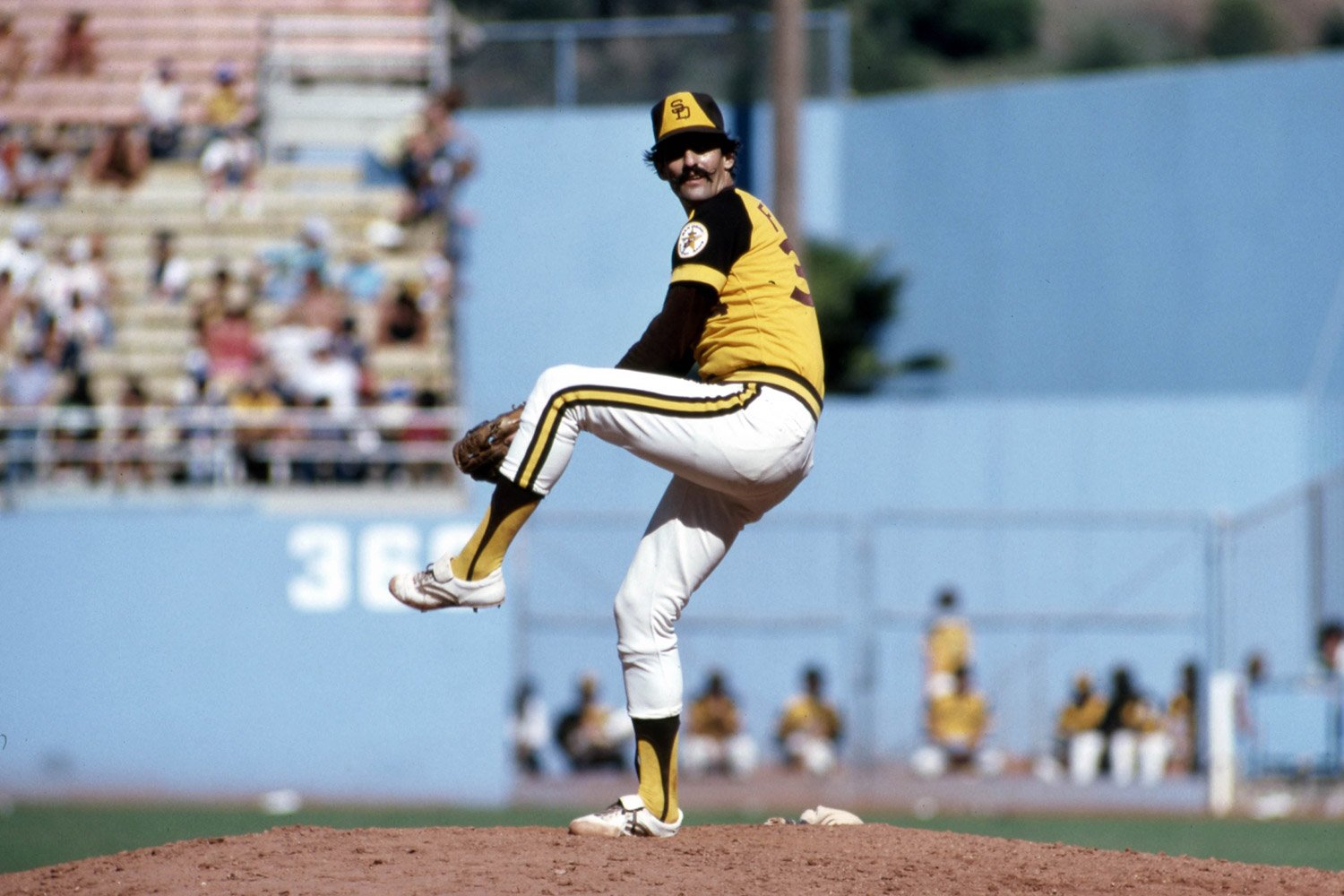
Baseball free agency, as we know it, began in 1976, so the 2025-26 offseason is the 50th season of free agent signings. The San Diego Padres have been both on the signing end and the losing end of free agent signings, but many of the free agents the Padres signed would make an impact.
The admittedly subjective top ten free agent signings in Padres history consist of five from the era of the Kroc family ownership and five from the Moores, Fowler, and Seidler ownerships. It should be noted that Nick Pivetta, who to date has played with the Padres only in 2025, is omitted from the list since his contributions to the Padres cannot be judged on a single season. James Shields, who was a bust with the Padres and was unloaded in a trade that included Fernando Tatis Jr., was excluded due to Shields’ lack of direct contributions to the Padres, even though his signing indirectly provided the team with Tatis.
For some years, a lack of financial resources prevented the Padres from signing desired free agents. Currently, the Padres’ free-agent struggles stem from penalties for violating the luxury tax. It could also be said that free agency hurt the Padres in the beginning, since in 1976 all four of their minor league affiliates won league championships, and the ability of other teams to sign free agents offset the Padres’ player development advantage. The first two free agents the Padres signed, both of whom are on the top ten list, displaced an incumbent catcher who caught Cy Young Award winner Randy Jones in 1976, as well as Rookie of the Year award co-winner Butch Metzger, who was himself displaced by the other initial free agent.
Given the displacement factor, it may have been beneficial to the Padres that Reggie Jackson chose the New York Yankees’ offer instead. The Padres’ 1976 outfield included Dave Winfield, Johnny Grubb, and Willie Davis, while the 1977 Padres outfielder Gene Richards would set a rookie record for stolen bases. Richards himself was allowed to become a free agent after the 1983 season when 1981 Padres draft picks Kevin McReynolds and Tony Gwynn had established themselves as major league outfielders.
Instead of signing Jackson, the Padres obtained two of his Oakland Athletics teammates on the same day for the Padres’ first two free agent signings. Four years later, those two free agents would be sent to the St. Louis Cardinals in the same trade. Both players remain among the Padres’ top ten free agent signings half a century later. Gene Tenace and Rollie Fingers both signed with the Padres on December 14, 1976.
Gene Tenace
Gene Tenace first came into prominence in 1972 when he became the first player to hit home runs in both of his first two World Series at-bats. By the time the World Series ended, he had tied the record of four home runs in a single World Series. Between 1973 and 1976, Tenace hit 101 regular-season home runs with the A’s.
A dropoff in that home run total with the Padres could have been expected. At the time, the San Diego Stadium outfield fence was 17 feet high, 330 feet away from home plate at the foul lines, 375 feet from the plate to the power alleys, and 420 feet from the batter’s box to center field. Tenace still accumulated 68 home runs during his four years with the Padres, and his 69 doubles from 1977 to 1980 nearly matched his 71 two-baggers during his previous four years in an Oakland uniform.
Tenace had 465 hits from 1973 to 1976 and 384 hits with the Padres. He walked 398 times during his final four seasons with the A’s and 423 times as a Padre, which currently ranks fifth all-time among Padres players. His on-base percentage with San Diego was .403, which remains the best figure of all qualifying Padres hitters (Tony Gwynn and Fred McGriff share second at .388) with two seasons above .400 and no season below .392. In 1977, he led the National League with 125 walks and 13 times being hit by a pitch, and his 35 plunkings over four years now rank fourth in team history.
The only other time during his Padres career when Tenace would lead the National League in a category was in 1979, when his .998 fielding percentage was the best among the league’s catchers. Tenace played only 94 games behind the plate that year, but also 72 as a first baseman. In 1978, Tenace played more games as a first baseman than as a catcher, and in 1977, he played 14 games at third base, 36 at first base, and 99 behind the plate.
Tenace and Fingers were sent to St. Louis in an 11-player trade, which brought Terry Kennedy, who would be the team’s starting catcher from 1981 through 1986, to the Padres, while also giving the Padres backup catcher Steve Swisher. Tenace played two seasons with the Cardinals and one with the Pittsburgh Pirates before concluding his major league regular-season career with 201 home runs and a .388 on-base percentage.
The signing of Tenace allowed the Padres to include catcher Fred Kendall, along with Johnny Grubb and infielder Hector Torres, in a trade to the Cleveland Indians for outfielder George Hendrick. Kendall would return to the Padres in 1979 and 1980, and his career batting average was .233 with the Padres and .234 when his seasons with the Indians and Boston Red Sox are included. Tenace had a .237 batting average with the Padres, which, even without the walks, was an offensive improvement over Kendall.
Rollie Fingers
The exclusion of Nick Pivetta from this list – because a player’s first season doesn’t guarantee long-term success – explains why the Padres signed Rollie Fingers even though Butch Metzger shared Rookie of the Year honors for 1976. Metzger was a September callup both in 1974 with the Giants and in 1975 with the Padres and had 1‑0 records each year. He won his first ten decisions in 1976, matching the record Hooks Wiltse set in 1904 of winning his first 12 career decisions. Metzger finished 1976 with an 11-4 record, 16 saves, and a 2.92 earned run average. His 77 appearances in 1976 broke both the team record and the major league rookie record of 76 appearances in 1974 by Larry Hardy. The 1976 Padres had the distinction of having both the National League’s complete games leader, with Randy Jones finishing 25 of his starts, and the league’s games finished leader, with Metzger closing 62 times. Metzger’s 16 saves in 1976 also set a team single‑season record.
Fingers also finished 62 games in 1976 and had 20 saves and a 2.47 ERA in his 70 appearances. Relief pitching was needed even more for the 1977 Padres. Jones had torn a nerve late in the 1976 season and had only one complete game in 1977, which set a still-standing major league record for the shortest night game, which took Jones and Philadelphia Phillies pitcher Jim Kaat 1:29 to complete. The 1977 Padres set a major league record for fewest complete games in a season with six. Fingers made 78 pitching appearances in 1977 to lead the league, while Dan Spillner and Dave Tomlin made 76 apiece to share second. Metzger, who was traded during the season, had 75 appearances with the Padres and Cardinals for fourth in that statistic that year. Fingers also led the National League with 69 games finished and 35 saves.
After the 1977 season, Tomlin was traded for Gaylord Perry, who gave the Padres their second Cy Young Award winner in three years and is the most recent Padres pitcher to win at least 20 games in a season. The 1978 Padres posted the first winning record in franchise history and had 21 complete games, so Fingers only appeared in 67 games and finished 62. The additional Padres leads in 1978 allowed Fingers to tie the National League record of 37 saves in one season. San Diego native John D’Acquisto, whom the Padres acquired when they traded Metzger, was second on the team with 10 saves. Fingers himself was 6-13 in decisions but posted a 2.52 ERA.
The 1979 Padres had 29 complete games and 68 wins. Fingers was 9-9 with 13 saves in 54 games, including 41 he finished.
Despite not starting a game in 1980, Fingers shared the team lead with 11 pitching victories. His 11-9 record was complemented by 23 saves and a 2.80 ERA. He appeared in 66 games and concluded 46.
In his four Padres seasons, Fingers pitched in 265 games and finished 218 of them. He had a 34-40 record with 108 saves and a 3.12 ERA.
The seven players the Padres acquired for Fingers, Tenace, pitcher Bob Shirley, and minor league catcher Bob Geren included two relief pitchers who combined for 80 appearances in the strike-shortened 1981 season. Gary Lucas (who was not part of that trade) became thePadres’s closer, leading the National League with 57 appearances and the team with 13 saves. Fingers never pitched for the Cardinals; he was sent to Milwaukee in a seven-player trade. Fingers won both the Cy Young Award and the American League’s Most Valuable Player award in 1981 after saving 28 games and posting a 1.04 ERA. A torn muscle kept Fingers out of the 1982 World Series, and he retired in 1985 with 341 regular-season saves in 944 career games. Fingers was elected to the Baseball Hall of Fame in 1992.
Before the Dodgers moved to Los Angeles, general manager and team president Branch Rickey said it was better to trade a player a year too early than a year too late. That philosophy would continue under subsequent Dodgers general managers. The 1970s Dodgers had the consistency of Steve Garvey at first base, Davey Lopes at second base, Bill Russell at shortstop, and Ron Cey at third base. In the 1970s, the Dodgers’ backups included Bill Buckner and Tom Paciorek at first, Lee Lacy at second, Ivan DeJesus at shortstop, and Jerry Royster at third. By 1982, first basemen Mike Marshall and Greg Brock were ready to play for the Dodgers, so the team made little attempt to keep Garvey from leaving as a free agent.
Padres general manager Jack McKeon had a philosophy of paying top dollar for a free agent who could take a team from third or second to first but not from sixth to fifth or fourth. A rebuilding effort was beginning to pay off in 1982, when the Padres were competitive for part of the season. On December 21, 1982, the Padres signed Garvey to a five-year contract.
Garvey holds the National League record for consecutive games played. During his first month as a Padres player, he tied Billy Williams’ record of 1,117 consecutive games played. Eventually, he played in 1,207 consecutive games before an injury sidelined him for the rest of 1983. Garvey played in exactly 100 games in 1983 and batted .294 with 76 runs scored, 59 runs batted in, 22 doubles, and 14 home runs.
The Padres won their first division championship in 1984, and the regulars were rested the day after the team clinched. Still, Garvey played in the other 161 regular-season games as well as the National League playoffs and the World Series. Although he had only eight home runs in the regular season, he batted .284 with 175 hits, 27 doubles, 72 runs scored, and 86 runs batted in. He shared the National League lead with ten sacrifice flies. Garvey also led the National League first basemen with a 1.000 fielding percentage, having made 1,232 putouts and 87 assists without an error (the three Padres who also had innings at first base in 1984 handled a cumulative 130 chances without an error).
The Padres faced the Chicago Cubs in the 1984 National League Championship Series. The Cubs won the first two games at Wrigley Field with Garvey batting in a run with a single during Game Two. A 7-1 Padres victory at San Diego Jack Murphy Stadium staved off elimination. In the fourth game, the Padres took a 2-0 lead on Garvey’s double in the third inning. The Cubs scored three runs in the fourth. In the bottom of the fifth, Garvey drove in the tying run with a single. Garvey singled in a run during the seventh inning, and a subsequent run gave the Padres a 5-3 lead. The Cubs tied the game with two runs in the top of the eighth. In the bottom of the ninth, Garvey came to the plate with Tony Gwynn on first and one out. Garvey’s walk-off home run gave the Padres a 7-5 victory. The following day, Garvey singled in the final run of the Padres’ 6-3 triumph. He batted .400 during the playoffs with seven runs batted in, and he was named the Most Valuable Player for the playoffs. During the 1984 World Series, Garvey batted .200 with four hits, including two doubles, in 20 at-bats and scored two runs.
Garvey played in all 162 of the Padres’ games in 1985, batting .281 with his 184 hits, including 34 doubles, six triples, and 17 homers. He scored 80 runs and drove in 81. Although he made five fielding errors, Garvey led National League first basemen with 1,442 putouts and 138 double plays. Garvey batted .255 in 1986, although his 21 home runs were his most since 1980. A shoulder injury in May 1987 ended his season and his playing career.
In his five Padres seasons, Garvey batted .275 with his 631 regular-season hits, including 107 doubles and 61 home runs. He scored 291 regular-season runs with the Padres while driving in 316. In his 19 total major league seasons, including three games in 1969, Garvey batted .294 with 2,599 hits, 440 doubles, 272 home runs, 1,143 runs scored, and 1,308 runs batted in.
Goose Gossage
After the Padres traded Rollie Fingers, the closer role was given to Gary Lucas in 1981. Fingers was traded to the Milwaukee Brewers in a multi-player deal, which sent outfielder Sixto Lezcano to the St. Louis Cardinals. In December 1981, the Padres and Cardinals executed a six-player trade that sent shortstop Ozzie Smith to St. Louis while sending shortstop Garry Templeton, Lezcano, and pitcher Luis DeLeon to San Diego. Lucas and DeLeon shared closer duties in 1982 and 1983. In December 1983, Lucas was sent to the Montreal Expos as part of a three-way trade that brought outfielder Carmelo Martinez and pitcher Craig Lefferts to the Padres. Three-time American League save leader Goose Gossage became a free agent after the 1983 season, and on January 6, 1984, the Padres signed Gossage.
Although Gossage never led the National League in saves while with the Padres, in 1984, his 10 relief wins ranked second in the league. His 10-6 record was complemented by 25 saves in his 62 appearances, including 51 games finished. He posted a 2.90 ERA in 102 1/3 innings pitched. He had one save in his three playoff appearances and pitched twice in the 1984 World Series.
Gossage threw 79 2/3 innings in 1985 and had a 1.82 ERA, 26 saves, and a 5-3 record in 50 appearances. He took the mound 45 times in 1986 and was 5-7 with 21 saves. Lance McCullers took over the closer role from Gossage during the 1987 season, when Gossage had 11 saves in 40 appearances, a 5-4 record, and a 3.12 ERA.
A four-player trade in February 1988 sent Gossage to the Chicago Cubs. He concluded his four Padres regular seasons with a 25-20 record, 83 saves, and a 2.99 ERA in 197 outings. Gossage retired after the 1994 season with 310 saves in 1,002 games and a 3.01 ERA, and in 200,8 he was elected to the Hall of Fame.
In 1988, Roger Clemens and Bruce Hurst shared the Boston Red Sox team lead with 18 pitching victories apiece. Hurst was 18-6, and his .750 winning percentage ranked second among American League pitchers. The Cy Young Award voters placed Hurst ahead of Clemens, with Hurst taking fifth in the voting and Clemens placing sixth. Hurst was unable to reach a contract agreement with the Red Sox after the 1988 season. The Padres, whose third-place finish in 1988 was their best since 1984, pursued Hurst. He signed a three‑year agreement with San Diego on December 8, 1988.
Although Hurst lost his first start with the Padres, his second start was a one-hit complete game victory. Hurst finished 1989 with a 15‑11 record, shared the National League lead with ten complete games, shared third in the league with 244 2/3 innings pitched, and placed fifth in the league with a 2.69 ERA and with 179 strikeouts.
The Padres were 89-73 in 1989 but fell to 75-87 in 1990. Hurst was 11-9 in his second San Diego year, shared the National League lead with four shutouts, and shared second in the league with nine complete games. He was eighth in the league with 162 strikeouts and tenth both with 223 2/3 innings pitched and his 3.14 ERA.
An 84-78 team record in 1991 included Hurst’s 15-8 record with the .652 winning percentage ranking fifth in the league. He struck out 141 batters in 221 2/3 innings and posted a 3.29 ERA.
Hurst threw four shutouts for the 1992 Padres, who were 82-80. The shutouts included a one-hitter against the New York Mets, and Hurst was 14-9 overall with a 3.85 ERA in 217 1/3 innings. He struck out 131 opponents in 1992.
The torn rotator cuff, which hindered Hurst near the end of the 1992 season, limited him to two games with the Padres in 1993. On July 26, 1993, Hurst was traded to the Colorado Rockies. The trade brought pitcher Andy Ashby and catcher Brad Ausmus to the Padres. Hurst started a total of 131 games for the Padres, posted a cumulative 55-38 record, completed 29 games, 10 of which were shutouts, struck out 616 batters in 911 2/3 innings, and had a 3.27 ERA, lower than the 4.23 ERA of his Red Sox years. He retired after the 1994 season with a career record of 145-113, a 3.92 ERA, and 23 shutouts.
Think you could write an article like this one? We’re looking for additional contributors, and we pay for all our content! Please click here, fill out the form, and someone will reply with more information.