
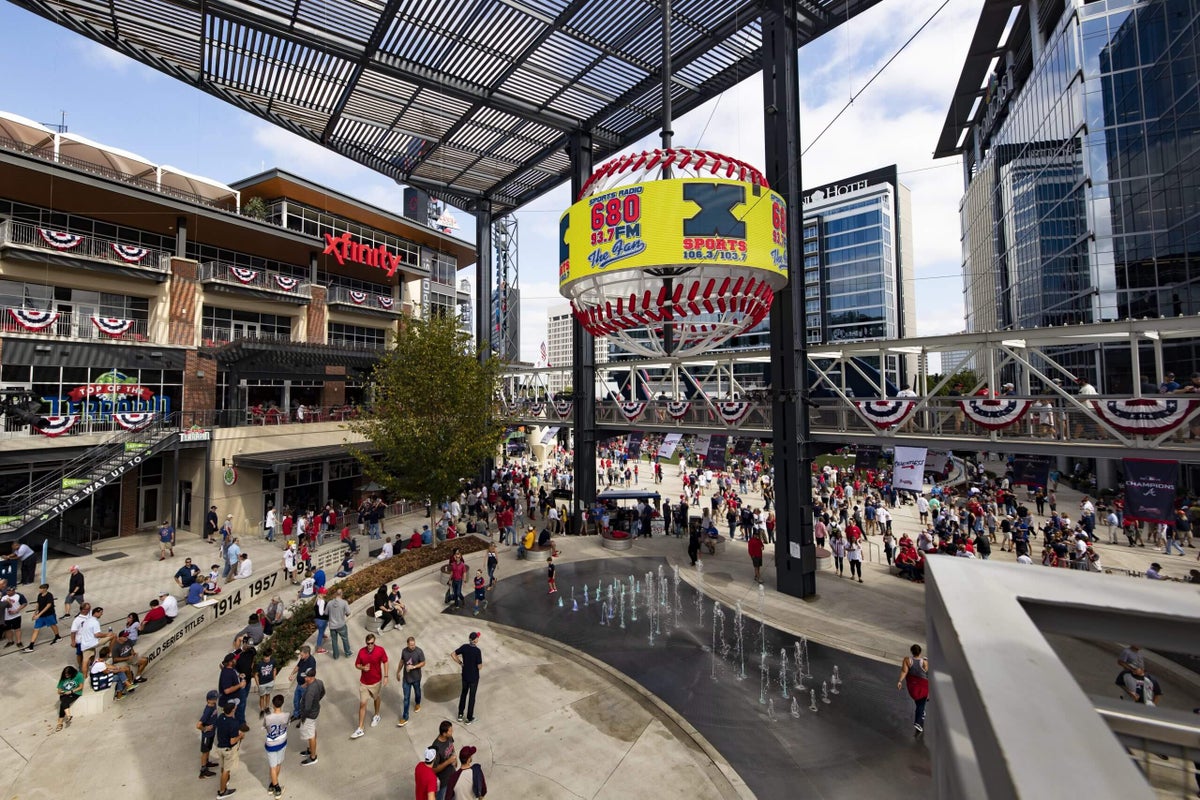
The Battery has been bustling.
Even with a fourth-place finish out of the playoffs last year, the Atlanta Braves grew their baseball-side revenues 7 percent, to $635 million, the team said Wednesday. Meanwhile, the club’s real-estate business surrounding its home stadium fared even better: a 45 percent jump to $97 million in 2025.
Revenues were up 11 percent overall for the year, to $732.5 million.
The Braves are the only Major League Baseball team publicly traded as a standalone entity, which also makes them the only team to regularly reveal finances. The team puts revenues into two buckets, “mixed-use” and “baseball.” The former refers to the Battery, a collection of shops, restaurants and homes near Truist Park that has become the model inside baseball for the so-called “ballpark village.”
“From a tenant perspective, in the battery 2025 was a record year,” said Mike Plant, president of the teams’ development company. “Our tenants collectively achieved a new annual sales milestone of approximately $137 million across just 30 doors, which we believe ranks among the most successful mixed-use operations in the country.”
How much money teams are making will be a key issue throughout baseball this year. Labor negotiations between players and owners are expected to begin in April, and a lockout appears likely to start in December.
Despite the revenue increases, the Braves reported an overall operating loss of about $14 million, an improvement versus the approximately $40 million loss the year prior. Much of the 2025 loss was driven by a roughly $30 million write-down of a broadcast contract asset, after the termination of the club’s former local television deal with Main Street Sports Group.
Per a different measurement — operating income before depreciation and amortization, or OIBDA — the team generated about $108 million last year, a 172 percent increase from roughly $40 million in 2024. OIBDA excludes depreciation, amortization and certain other non-cash items, and is commonly used to gauge underlying operating performance.
On the baseball side alone, OIBDA was $51 million, an increase of over $44 million from the prior year.
The league and the Players Association declined comment Wednesday.
The team’s financial performance stands in contrast to its recent on-field performance. The Braves finished 76-86 in fourth place in the National League East last year, and The Athletic’s Ken Rosenthal recently wrote about questions surrounding the Braves’ pitching rotation entering this season.
Payroll projects to be close to $260 million this season, per Cot’s Contracts, an increase of more than $20 million from 2025.
“We firmly believe we have all the pieces we need to make a postseason run this year and compete for a World Series title,” Braves chairman Terry McGuirk said Wednesday.
The earnings report came a day after the Braves announced that they were handling the production and distribution of their telecasts for 2026 internally through a product they’re calling “BravesVision.”
The Braves are one of nine MLB teams that last year partnered with Main Street Sports Group and that company’s channels, branded as FanDuel Sports Network. All of Main Street’s baseball partners fled this year as the company struggled to pay its bills.
Most ex-Main Street teams are letting MLB handle their broadcasts for this season, but the Braves decided to take up the effort individually. (MLB is still involved, however, handling the team’s in-market streaming.)
“We wanted to maximize reach and availability for fans while protecting our economics,” Braves CEO Derek Schiller said on the call. “BravesVision will allow fans to watch us on multiple platforms, including many of the same television providers, where fans are used to watching our games with all games available on a streaming platform in partnership with MLB.”
The team took in about $189 million in broadcast revenue, including local and national rights fees, last year, up from $166 million in 2024. Because the Braves have brought their TV efforts in-house, more granular information about the Braves’ TV revenues could now show up in the team’s financial reporting as soon as the second quarter.
“You should expect to see more detail about the financial results of this new operation,” said Jill Robinson, the team’s chief financial officer.
Whether BravesVision is temporary remains to be seen.
MLB commissioner Rob Manfred wants access to all 30 teams’ local rights so that when the league reaches new national TV deals for the 2029 season and beyond, it can sell more games nationally — and also potentially bundle teams’ local rights together. It’s possible that come 2029, one major streaming company could be the local home for a majority of MLB teams. But the marketplace is likely to dictate what happens.
“Rob Manfred, the commissioner, has been quoted, I think, in saying that our best opportunity — possible best opportunity — would be to aggregate all of our rights, like the NBA, like the NFL, like hockey,” McGuirk said. “That is still a strategy that is not clear yet as to how we’ll play that. But the commissioner will be leading that negotiation strategy discussion among the owners, and we will surely keep our shareholders and our analysts up to speed when that happens.”
One area to watch going forward will be tax law that would uniquely affect the Braves as a publicly traded team. Starting next year, the team could owe a steeper bill on player salaries, roughly $19 million, per reports. New tax law will limit the deductions corporations can take on their highest-paid employees, which for a baseball team includes some pricy players. The team has tried to lobby for exclusion from the law.
“’We’ve looked into it, we understand what’s out there and we’re working on that,” Schiller said Wednesday. “I don’t think it’s appropriate at this point in time to comment on that, because we’re still in the midst of those discussions.”
Revenue information for the rest of MLB is typically out of public view, save for the Toronto Blue Jays, which are owned by a publicly traded company, Rogers Communications.
Rogers recently said that it had a 126 percent jump in fourth-quarter media revenue for 2025, a growth “driven by” the Blue Jays’ World Series run as well as the arrival of newly acquired sports assets on its books, including the Toronto Maple Leafs in hockey and the Toronto Raptors in basketball. The Blue Jays lost to the Los Angeles Dodgers in a seven-game World Series.
Rogers took in about $1.2 billion in media revenue in the fourth quarter of 2025, compared to $547 million for that quarter year earlier. Overall revenue for Rogers was up 13 percent for the final quarter, and 5 percent on the year.