
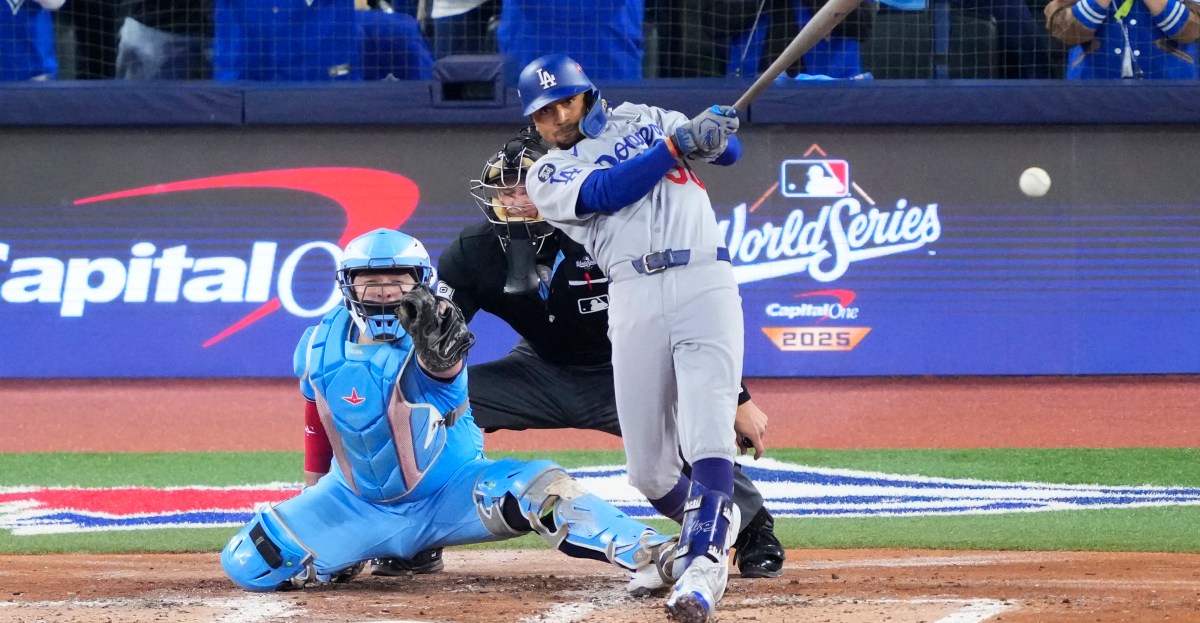
Over the last decade or so, it has felt like the balance of power in baseball has been shifting in favor of the pitchers. Paul Skenes just posted an ERA under 2.00 again, our very own Tarik Skubal is gunning for his third straight Cy Young Award, and hoards of flamethrowing relievers come out of every bullpen, night after night, to keep offenses in check. Velocity is up, stuff is better than ever, and even without the extreme shifts, ground balls are going for fewer and fewer hits. There’s rarely been a tougher time to be a hitter, and as fascinating as “pitching labs” might be, they certainly aren’t bringing more action to the game.
In modern baseball, a pitcher can walk into a bullpen, stand on a pitching mound with a force-pressure plate on it, throw 10 pitches in full motion-capture gear in view of a half-dozen high-speed cameras, and immediately have limitless data at their finger tips. Spin rate and velocity are just the start; wrist action, arm angles, finger pressure, and lower body mechanics are all quantifiable like never before. Pairing this data with feel and in-game results creates an action plan for pitchers. For example, after a single bullpen, a young pitcher can learn his supinator tendencies mean he should ditch the changeup, add a wide-grip splitter, and adjust his release slightly to get even more rise on his fastballs.
Hitters, unfortunately, haven’t had the same resources available. Part of that is the nature of the game: hitting is reactionary, so changes made in practice can be difficult to enforce in-game. To work around this, advice has largely been more general. Swinging harder is better because it adds power and the quicker you are to the ball, the more split seconds you have to react to the pitch, “selective aggression” is more important than simple ball-strike recognition, etc. These are all true statements that lack the individuality and specificity pitchers receive. Reese Olson and Troy Melton wouldn’t get the same advice, so why should Riley Greene and Zack McKinstry?
One option hitters have turned to for an edge is Driveline, a training facility that offers data-driven advice and coaching for players of all levels. After spearheading the pitching revolution, the company is now on their way toward unlocking better performance from hitters. You’ve likely heard of hitters who spent a winter at Driveline and increased their swing speeds by several miles per hour, like Max Clark recently shared. Sometimes that translates to production, sometimes it doesn’t. Their most recent announcement, though, could be a game changer for hitters.
They describe the whole process here, and I strongly encourage you to read their explanation in full, but here I’ll provide my best summary and share my thoughts on why I care so much. The short version is they’ve created a machine-learning model that takes data from a hitter’s bat path and swing mechanics, compares it to every other player in the majors, and then recommends specific swing changes to create a swing better in tune with that player’s abilities.
There’s a lot of math and coding I personally find fascinating but won’t explain in detail here, but the stand-outs to me are the player-matching system and the recommendation process. The player-matching system is exactly what it sounds like: based on biomechanical input data, what hitters does this player most resemble? There’s nothing revolutionary here in concept, but to my knowledge, this is the first time this logic has been applied to hitters with data as granular as swing mechanics. This could can then used to categorize players for easy suggestion flowcharts or to create highly-specific pathways for individual players.
That’s basically the simple version of Driveline’s recommendation process. Through a combination of factors, including the player’s starting point, how similar players have changed, and what effect certain training methods can consistently produce, the model evaluates every set of potential changes should translate to offensive production, then creates a “feasibility” score for each change. Hitters and their coaches can then choose whatever balance of feasibility and production they’re comfortable with and create a training program to achieve that. This process ensures the model doesn’t just recommend everyone swings like Aaron Judge, because while that’s theoretically optimal, a player like McKinstry simply can’t achieve that goal. Instead, he could choose from pathways that (presumably; their model isn’t available publicly) would lean towards hitters like Maikel Garcia, Steven Kwan, or Alex Bregman, all hitters with plus bat control and no better than average raw power.
Before getting too excited, it’s worth noting a few things. Firstly, this model is very new and is far from perfect. For starters, it doesn’t yet account for swing decisions, which are considered both the hardest change to make and the most important element of hitting. As such, chase-prone sluggers like James Wood and Riley Greene rate as nearly “optimized” hitters, which is obviously a bit off. The other issue is still baseball’s structure. Pitchers still move first and still have access to the toys and gadgets in their pitching labs; they’re not going to get any easier to hit for a long while. This is the start of catching hitters up, but there’s still plenty to be done.
Of course, that doesn’t mean progress isn’t worth recognizing or celebrating. This model represents tangible steps in the right direction. Arming hitters with data-driven, predictive changes and grounding those changes in the form of “productive major leaguers you can swing like” is almost certainly the best path forward. Now, hitters can be confident their swing changes will pay off, rather than haphazardly tweaking things or falling back on generalized principles. Upgrading the training methods available to hitters will be crucial as pitching quality continues to improve rapidly.