
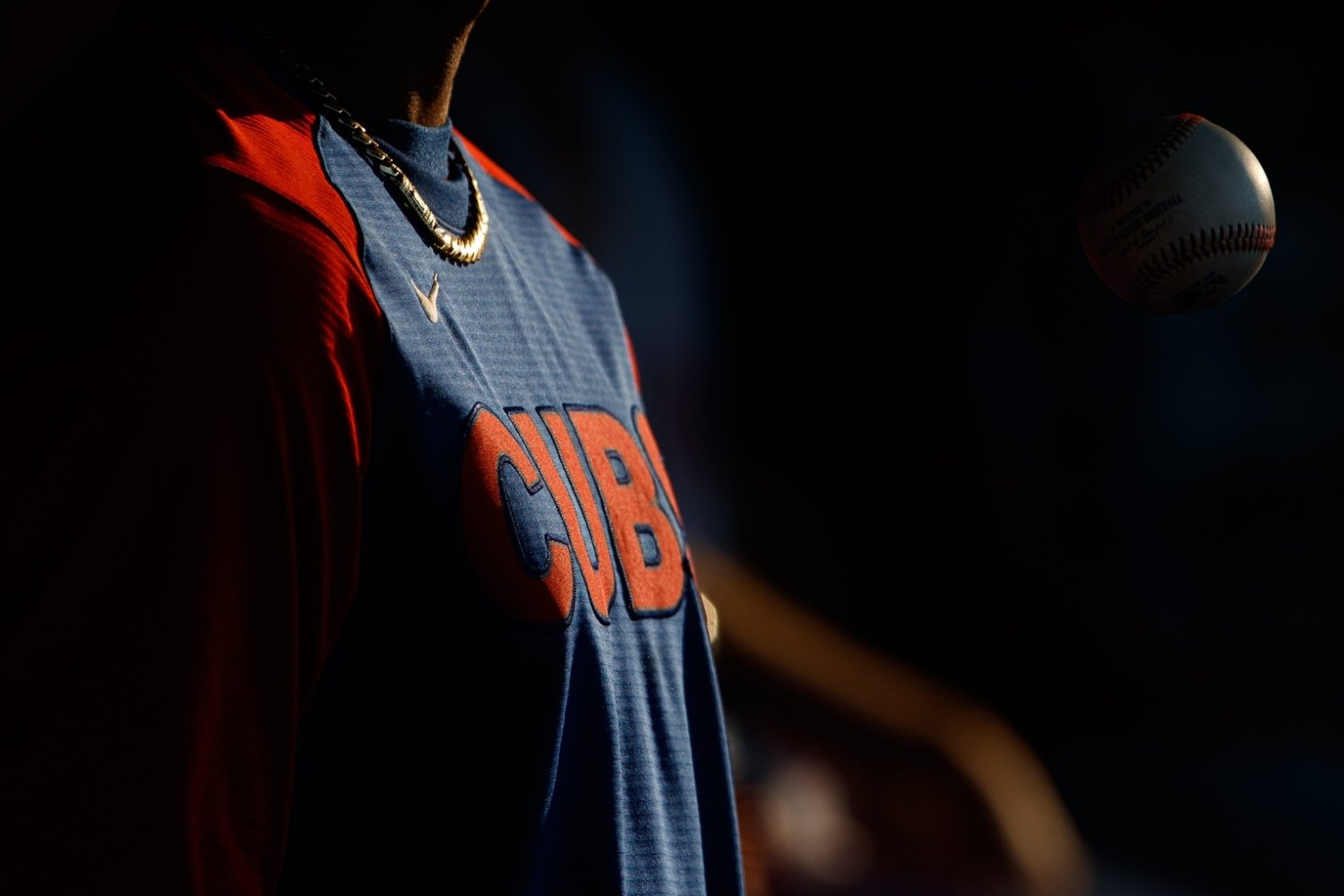
The Chicago Cubs’ farm system is in flux. This is a transition period, as many of their top prospects over the last few seasons (Pete Crow-Armstrong. Matt Shaw, Cade Horton, Cam Smith and Owen Caissie, to rattle off a handful) have either graduated off the list or been traded to other organizations. Transitions aren’t necessarily bad, but they come with uncertainty, as we attempt to figure out who the next crop of rising Cubs stars are, and who will begin to replace those who have left the rankings.
Our staff voted on the top 20 prospects in the system, so we can pin down where they are before they mak a rapid move toward wherever they’re going. Today, we begin with the players who came in 16th through 20th after that process.
#20 – Erian Rodriguez (Double-A)
Erian Rodriguez enters his age-24 season as a pitcher who has always had just enough intriguing aspects to remain on the burner, but sadly, has yet to bring his talent to a boil for a full season. Last year saw the right-handed pitcher struggle to get out of the starting gates due to injury, and while he would eventually earn a promotion to Double-A Knoxville, there’s clearly still work to be done.
As relayed by his scouting report on Baseball America, Rodriguez sits 93-96 mph, working exclusively out of the stretch. The velocity is good-enough for success as a low-end starter down the road, but his below-average control will probably be the deciding factor that eventually forces him into the bullpen. With that said, his fastball-slider combination could make him an interesting option against right-handed batters even at the highest level, and he does flash a changeup against lefties that would at least allow him to play up against both sides. With a move to the pen, perhaps a little extra juice can be squeezed from the fastball.
#19 – Ty Southisene (Low-A)
Ty Southisene had one of the most interesting lines of any player in the Cubs’ system last year, posting a 114 wRC+, more walks than strikeouts, and an ISO of .030. The diminutive middle infielder hit no home runs but had an on-base percentage of .388. Because of these oddities, it’s hard to fully figure out what the Cubs have in their fourth-round pick from 2024.
The approach is a plus; finding players who immediately turn pro and walk 63 times compared to just 43 punchouts is exceedingly rare in today’s game. But it’s going to be hard to replicate his offensive success at higher levels if he can’t flash enough power to start sending even a handful of baseballs over the fence. Southisene was a little old for his level in Myrtle Beach, despite being a draft pick who hadn’t attended a university, so the lack of power is probably worth noting, but with some age, time in the weight room and getting out of a difficult hitting environment in South Carolina may be able to help.
Defensively, Southisene has gotten strong marks, but is likely to fully transition to second base next year due to a lack of arm strength. His defense and his baserunning give him a strong foundation as a player, and give him multiple ways to add value to a team.
If the second baseman can add an iota of power without sacrificing his plate discipline, there’s the potential for a valuable big-leaguer here. But if he doesn’t add any thump into his game, pitchers will eventually begin to overpower him.
#18 – Dominick Reid (Abilene-Christian)
Dominick Reid was the Cubs’ third-round selection in the 2025 Draft, out of Abilene-Christian University. Previously, Reid had pitched sparingly at Oklahoma State, but had failed to establish himself fully. Transferring to the much smaller school he would be drafted from was a way to showcase what he could offer.
The righthander is a bit of a project, but there are some fairly interesting things when we start to look under the hood. The movement profile that Reid shows on his fastball-changeup-curveball combination is in the same ballpark as top-draft-pick Tyler Bremner. There are lots of things that separate the two. While Reid was transferring to Abilene-Christian, Bremner was a standout at UC-Santa Barbara, and while Reid sits in the low 90s, the former Bruin and (thanks to the Angels) second overall pick throws much harder; there’s a reason one was drafted 100 picks in front of the other. With that said, if the Cubs can begin to squeeze a little extra velocity out of Reid, all of a sudden, you can squint and see something.
The Cubs’ third-round pick has yet to make his professional debut, and it’s likely that we’ll first see him in Myrtle Beach, but keep an eye on the radar gun. If he were to show up this year sitting 94 while touching 96 mph, there’s a decent chance the Cubs could have a breakout arm here.
#17 – Jostin Florentino (Low-A)
The first thing that will jump out when looking at Jostin Florentino is how excellent his numbers were last year. During his time at Myrtle Beach, the right-handed pitcher recorded a sub-2.00 ERA in around 50 innings, with a 26.9% strikeout rate and an 8% walk rate. Numbers like this generally get you ranked higher on these kinds of lists, so if there are some alarm bells going off, they’re telling you something true.
The reason why he’s this low is that the stuff just isn’t special. Florentino sits 88-91, according to Baseball America, and tops out at 92 mph, so while the numbers are great, there’s a fair bit of skepticism that he will be able to continue this moving forward. A lot of that would change if he could add three or four ticks on his fastball, but that’s a pretty tall order for a 20-year-old. If you’re thinking that perhaps his shape will save him, according to that same BA scouting report, the shape of his fastball is below average.
What does stand out, however, is his slider. Baseball America called it one of the best of its kind in the entirety of the minors,
Much like Reid, you hope that there’s some projection left. Unlike Reid, Florentino’s body doesn’t suggest a lot of additional velocity, but never say never, as he added 5 mph between 2024 and 2025. When you have as much success as he had last year, there’s hope that he’s more than the sum of his parts.
#16 – Juan Cabada (Dominican Summer League)
Juan Cabada was one of the prized signings of the 2025 international free agency class, and he absolutely did not disappoint during his time with the DSL Cubs last year. In 42 games, the infielder posted a 134 wRC+ and a very encouraging 18.2 K%, while keeping his walk rate in double digits. The youngster did only hit three home runs, but at his ripe age of 17, that can be easily forgiven, considering everything else.
It’s highly likely that as 2025 turns to 2026, Cabada will spend a good deal of time in the Arizona Complex League. As of writing this, he’s yet to even turn 18, so there’s little reason to rush his progress. Staying in Arizona, adding some weight to his frame, and continuing to settle in Stateside will be a great first step, but there’s a good chance he’ll end his season with a look at Myrtle Beach, as well.
A good 2026 for Cabada would probably see him expand on his 90th-percentile exit velocity shown in the DSL last year, by adding a bit of lift in his swing and getting to more of his pull-side power. Defensively, reports are less exciting than his offensive profile, but as a second baseman, the impact of his mediocre arm strength would be mitigated. He’s got a decent profile for an upside breakout regardless, so keep an eye out for him when he eventually gets the bump to Low-A.
What do you think of our first five prospects? Which is your favorite to breakout? Let us know in the comments below!
Interested in learning more about the Chicago Cubs’ top prospects? Check out our comprehensive top prospects list that includes up-to-date stats, articles and videos about every prospect, scouting reports, and more!