
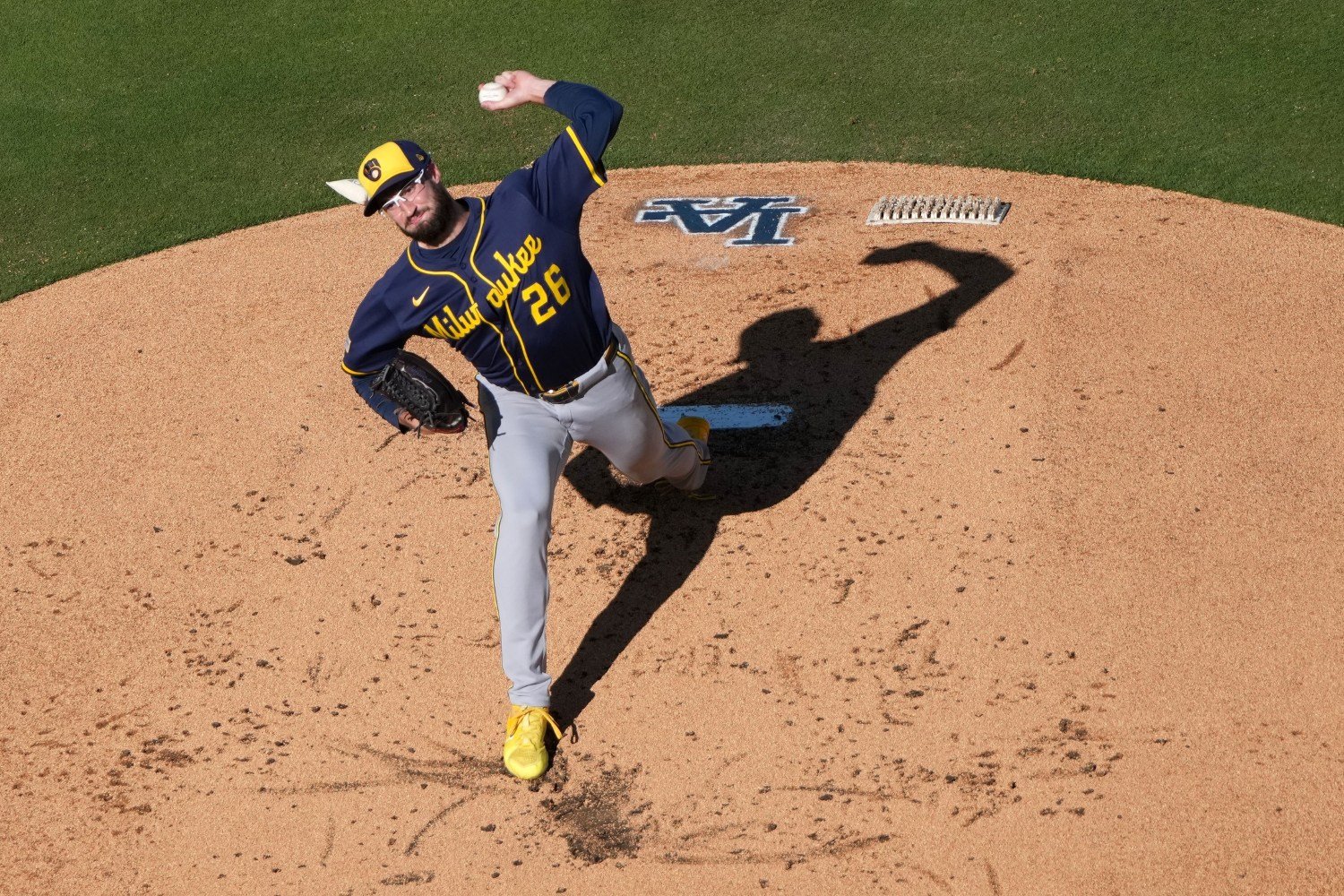
In four big-league seasons, Aaron Ashby has filled every possible role within the Brewers’ pitching staff. He’s started 26 games, most of which came in 2023. As a reliever, he’s been a long man, a left-handed specialist, a multi-inning setup man, and has even picked up five saves. In last year’s postseason, he started three games as an opener or first man up in a bullpen game.
During the 2025 regular season, Ashby became Pat Murphy’s bullpen iron man, partially at his own request. Despite not debuting until May 23 due to an oblique injury, he appeared in a career-high 43 games and worked 66 ⅔ innings, the third-most among Brewers relievers.
“Ashby wants to throw every day,” Murphy said last September. “He’s this kid who, since he’s rehabbed his injury, he’s just been adamant about touching the ball every day. We laugh about it. Every time he comes off the mound, he’s like, ‘I’m good to go. Keep going, keep going, keep going.’ He wants to throw every day.”
Ashby’s drive to pitch so often was partially motivated by a lighter first-half workload than several of his teammates, due to that oblique injury.
“We were thin at the end of the year,” he said last week from the Brewers’ spring training clubhouse in Arizona. “Everyone’s running on fumes, and I felt pretty good for where we were at. I’d missed the first two months of the season, essentially, so I had more rest and more time off than everyone else. So I felt like I kind of owed it to the team and to the bullpen to be available and take that workload, because they had all had another two months under their belt that I didn’t.”
Furthermore, his throwing program was already geared toward being available nearly every day. Ashby said the second half of last season was a “great learning experience” in how to prepare for such a workload, but pitching so often was not too dissimilar from the work he already did between appearances.
“I think I try to replicate an intense throwing volume or intensity every day, so that I feel good every day,” he said. “I kind of get to that point where I’m loose, I’m ready, and then I kind of let it rip for a little bit. So I think that’s something that’s helped me feel good every day. I think the frequency, I’ve tried to create on my own for many years by just having a really intense throwing program.”
Ashby spent time in a similar niche in 2024, albeit not until a promotion in late August from Triple-A, where he pitched most of the season as a starter. The move to a flexible relief role has brought out the best in him, as he’s pitched to a 1.98 ERA, 2.26 FIP, and 2.62 SIERA in 86 ⅓ innings.
In that time, Ashby has changed how he attacks hitters. When he debuted in 2021, he relied heavily on his high-spin breaking pitches, particularly his slider. Since returning from shoulder surgery in 2024, he’s thrown more sinkers than breaking balls. Last season, he threw his sinker a career-high 51.3% of the time.
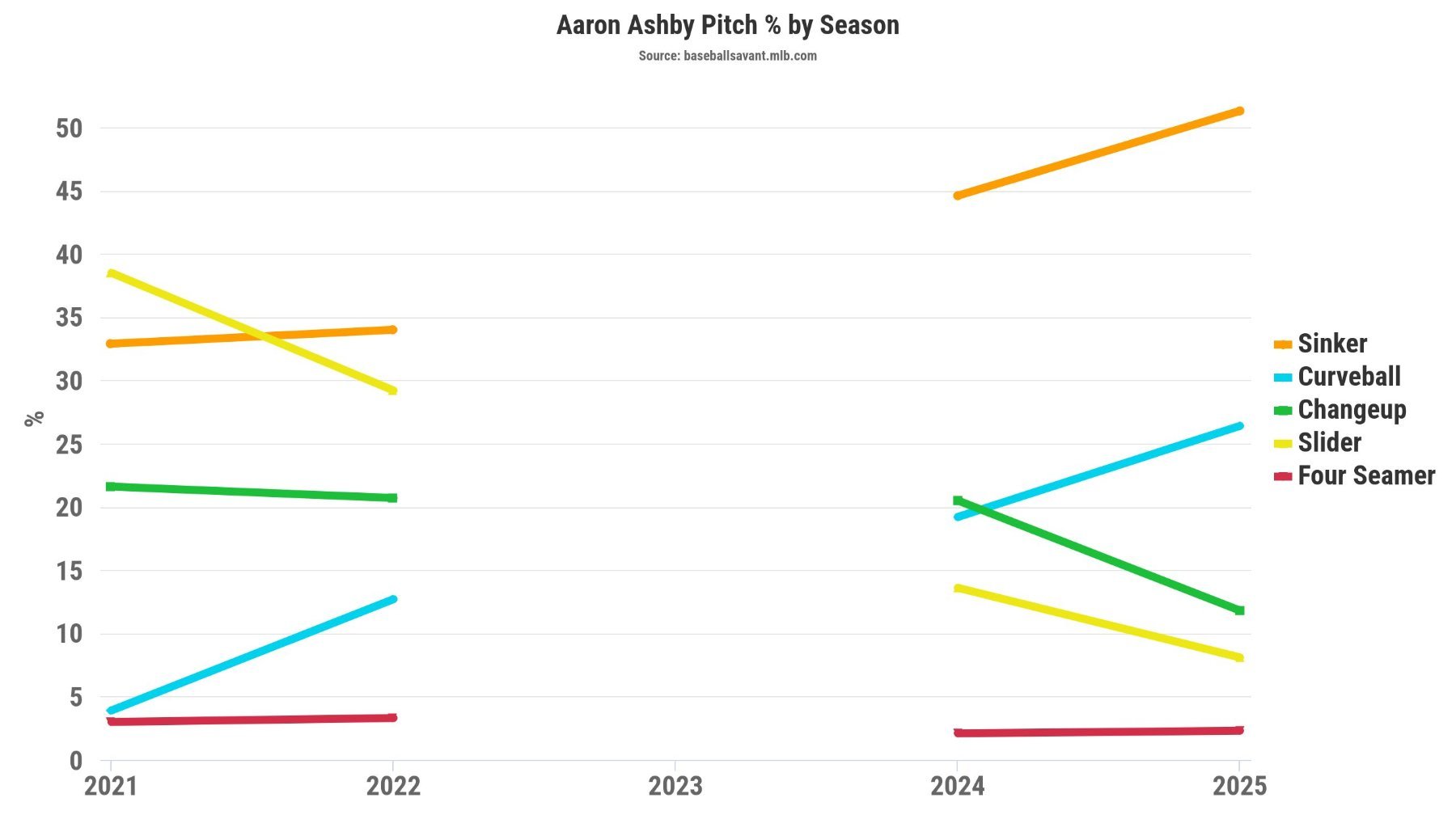
“I finally feel comfortable relying on the sinker to get me weak contact,” Ashby explained. “I have a bit of a better understanding of when I can throw it. I think that my other pitches have elevated the effectiveness of my sinker. I think that the curveball makes the sinker play up. I think the changeup makes the sinker play up. So, yeah, I think just knowing when to use it, knowing where to throw it, and kind of just believing in myself that I can get out of a jam with it.”
The sinker was more effective than ever last year, leading Ashby’s arsenal with a +8 Run Value, according to Statcast. It held opponents to a .297 wOBA and produced a 65.3% ground ball rate. Trusting it more has also made him more efficient, as Ashby averaged 3.8 pitches per plate appearance and 15.5 pitches per inning last year, both career bests.
“I think if you can establish a fastball early and make them swing at that, and then induce weak contact, I think that’s a good recipe for being effective and efficient,” he said.
Ashby’s breaking stuff has evolved, too. Post-surgery, he’s been unable to rediscover the same sweeping slider he once had, and has instead relied mostly on his big curveball, which has gained nearly 3 mph.
“Just coming back from surgery, that was the breaking ball,” he said. “The slider was kind of hard to get back, but for whatever reason, I was just able to throw [the curveball] pretty easily. I think the curveball got better the last two years. It’s just kind of the ebbs and flows of pitch shapes and stuff like that.”
Ashby got plenty of mileage out of a sinker, curveball, and changeup mix during the regular season, but he added another tool to his toolbelt late in the year. He had dabbled with a four-seamer before, but it rarely had much vertical separation from his sinker. Throughout the year, though, he developed a capable four-seamer while attempting to throw a different kind of fastball.
“More than any pitch that I throw, I want to throw a cutter, and I’m not able to do it,” Ashby said. “In trying to throw this cutter, I realized that I could throw a four-seam, and for whatever reason, it felt easy to execute.”
Averaging 13.7 inches of induced vertical break, the four-seamer doesn’t have much carry and grades out poorly on its own. However, for the first time, Ashby found another fastball that moves differently from his sinker.
“I’m not someone who spins the ball, at least my fastball, very well,” he said. “I throw a very below-average spin fastball. I’ve never really been able to get the vert ball, mainly due to my release height, but it just has to be enough separation off the sinker. I think it does that.”
Using it almost exclusively high and inside to right-handers to keep them off his sinker, the pitch quickly became a regular part of Ashby’s arsenal in the postseason.
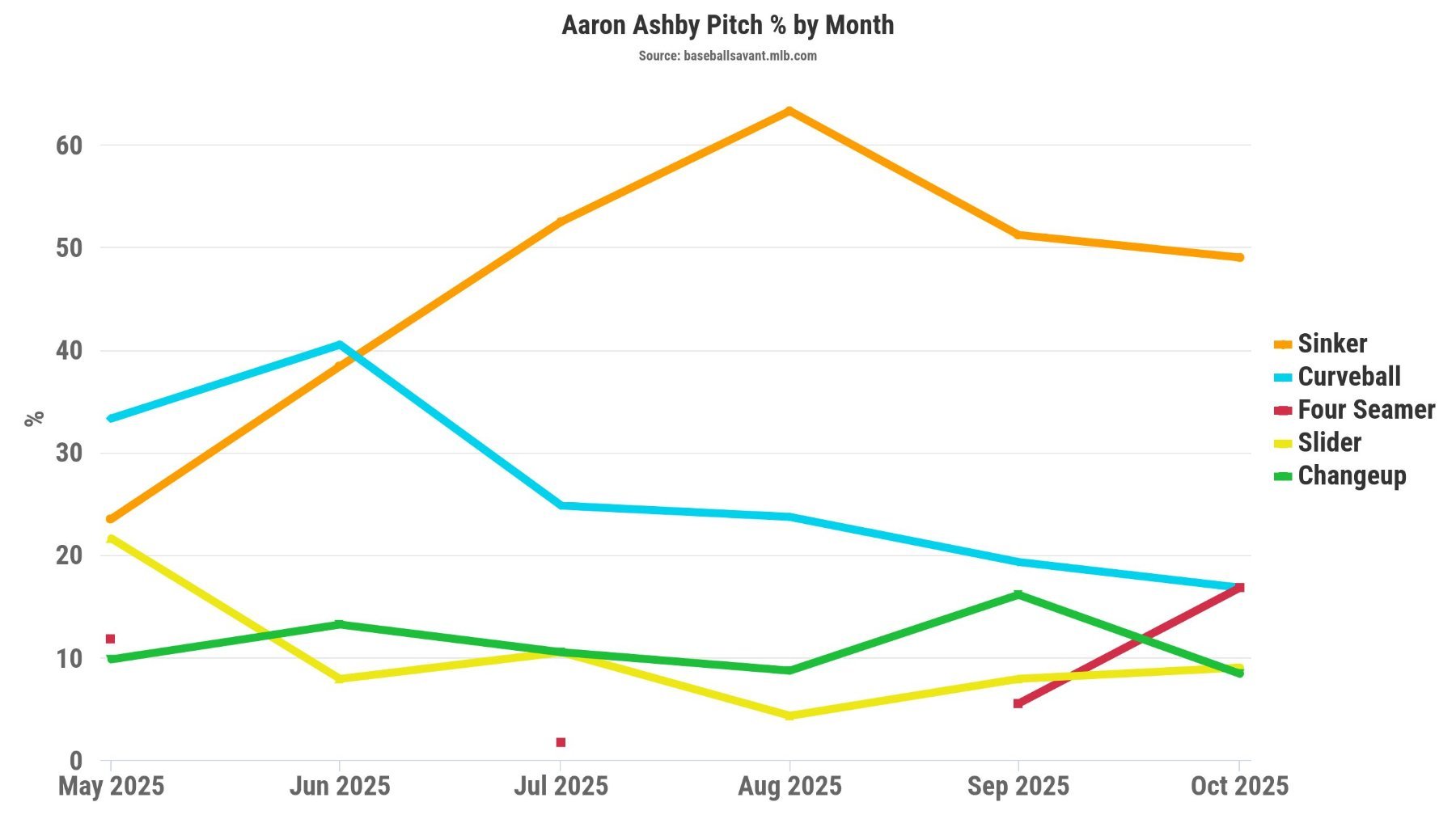
“You have to adapt in this game,” Ashby said. “Guys know I’m going to throw a sinker, so righties are diving out over the plate more, ready for it. If I have four-seam up and in that I can throw, it doesn’t make that very comfortable to do anymore. More of just a tool to use sparingly, but definitely something to keep working on.”
Ashby’s role for this season is not yet set in stone. For now, the Brewers are stretching him out to remain a multi-inning reliever, with starting still on the table should the need arise.
“You can always go back,” Murphy said of moving pitchers into shorter relief roles after initially building them up for longer outings. “It’s hard to go forward.”
Ashby remains willing to pitch in any capacity the Brewers need.
“I think the idea right now is just to build up to around three innings,” he said. “It could be more than that, it could be less than that. And then kind of with whatever the team needs is kind of where I’ll fall in.”