
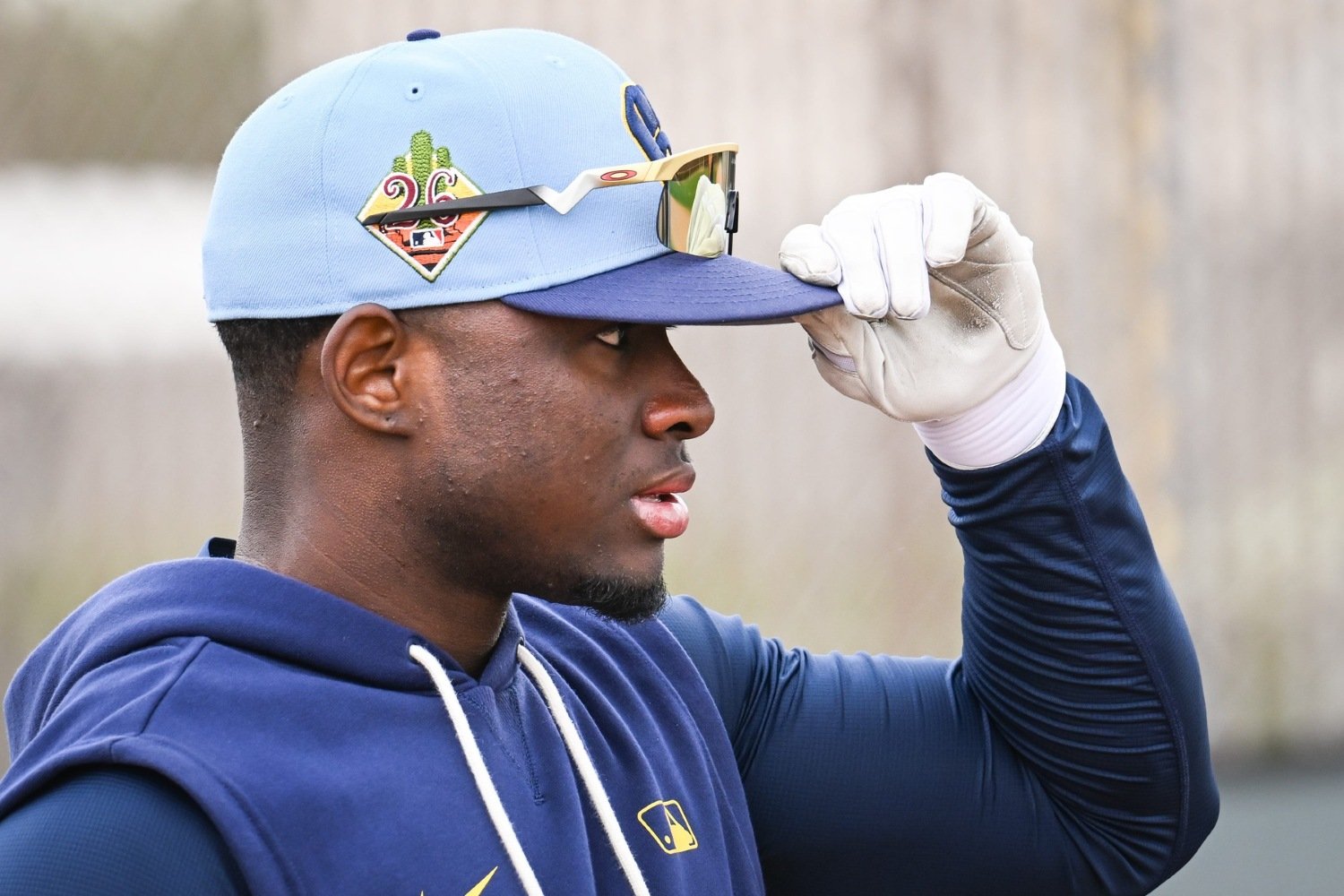
The depth in the Brewers’ system means many players outside the top 10 would make the majority of teams’ top 10, if not their top 5.
Let’s take a look at prospects 11-15, as voted on and compiled by the Brewer Fanatic writers.
#15 3B Brock Wilken (Biloxi Shuckers)
PA
H
2B
3B
HR
OPS
wRC+
wOBA
K%
BB%
SwStr%
Whiff%
PULL%
CENT%
OPPO%
LD%
GB%
FB%
IFFB%
SB
CS
SB%
90th EV
344
61
17
0
18
.876
159
.413
27.0%
20.1%
9.4%
29.1%
55.3%
24.6%
20.1%
21.6%
35.2%
43.2%
22.4%
2
0
100%
106.0
Several challenges marked Wilken’s 2024 season. He was hit in the face by a pitch early in the year, which led to lingering vision issues that affected him throughout the season. Off the field, he and his wife also welcomed their first child. That’s a positive personal milestone, but at the same time, balancing professional responsibilities with family life added another layer of adjustment during the season. He spent the offseason focused on recovery and on restoring his vision.
The early results in 2025 were very encouraging, highlighted by an outstanding May in which he hit nine home runs and posted a 170 wRC+. However, a knee injury suffered while celebrating Biloxi’s first-half playoff clinch limited him to just 14 games the rest of the year, and he did not appear fully healthy during that stretch. Even so, his first 280 plate appearances showed clear signs of offensive improvement.
Power production remains a defining part of Wilken’s profile. Despite playing roughly two-thirds of a full season, he finished third in the Southern League with 18 home runs. His plate discipline was a strength, reflected in a 20% walk rate, though he did allow a notable number of hittable pitches in the zone to pass by, and it’s fair to question whether the overall approach is a bit too passive at the moment. Swing-and-miss remains part of the profile, with elevated whiff and strikeout rates contributing to a definite power-over-contact approach.
Defensively, Wilken has shown steady progress at third base. While some evaluations have graded him below average at the position, his play has suggested the potential to develop into a serviceable defender. His arm strength is a clear plus, and he has generally handled routine plays well. At times, he has shown some difficulty charging softly hit balls, which seems to be tied more to his reads off the bat than to any athletic limitations.
Wilken is expected to begin the 2026 season at Triple-A, and may have reached that level earlier if not for the knee injury. With the Brewers continuing to evaluate long-term options at third base, his performance and defensive development could position him as a major-league option in the near future.
#14 1B Blake Burke (Wisconsin Timber Rattlers, Biloxi Shuckers)
PA
H
2B
3B
HR
OPS
wRC+
wOBA
K%
BB%
SwStr%
Whiff%
PULL%
CENT%
OPPO%
LD%
GB%
FB%
IFFB%
SB
CS
SB%
90th EV
567
143
27
2
16
.832
139
.393
23.8%
11.5%
12.9%
27.9%
34.3%
26.8%
39.0%
22.7%
49.6%
27.8%
21.4%
15
5
75%
108.8
Drafted in Competitive Balance Round A (just after the first round) of the 2024 draft, Burke got off to an interesting start at High-A in 2025. He posted a 124 wRC+ across 95 games at the level, but the power production did not match the underlying contact quality. Despite consistently hitting the ball hard (highlighted by an elite 108.8-MPH 90th-percentile exit velocity), he produced just five home runs in 408 plate appearances—a shockingly low total, given his size and raw power.
That changed following his promotion to Double-A. Burke’s ground-ball rate dropped from 52.4% at High-A to 42.4%, and the shift in batted-ball profile quickly translated into more over-the-fence production. He had been making hard contact throughout the season, but a lack of consistent elevation limited his power output earlier in the year. With Biloxi, he hit 11 home runs in just 159 plate appearances.
Even during the stretch in High-A when the power had not yet emerged, Burke did show the ability to hit for average and make a reasonable amount of contact, pointing to the potential for an average hit tool paired with above-average or even plus power.
Defensively, Burke’s glove work at first base has generally translated well from his time at Tennessee. He shows reliable hands and solid instincts around the bag. While his mobility may not stand out, he has shown more athleticism and reaction ability than many players with a similar build. His overall defensive profile is that of an average first baseman, perhaps even a tick better.
That athleticism also shows up in subtle ways. Burke is not a traditional speed threat, but he moves well once he gets moving and shows strong instincts on the bases. He was successful on 15 of 20 stolen base attempts and regularly shows awareness, taking extra bases on balls in play. As Josh Naylor showed this year, you can be a good baserunner without being very fast, though you probably won’t see Burke go on any stolen-base binges akin to what Naylor did in the second half of last year.
As a first base-only prospect, Burke’s long-term value will depend heavily on his offensive production. If his late-season power surge at Double-A proves sustainable, his overall profile could rise significantly, with the potential to position himself as a major league option as early as 2026. He’s more likely to have an impact on the 2027 season.
#13 1B Luke Adams (Biloxi Shuckers)
PA
H
2B
3B
HR
OPS
wRC+
wOBA
K%
BB%
SwStr%
Whiff%
PULL%
CENT%
OPPO%
LD%
GB%
FB%
IFFB%
SB
CS
SB%
90th EV
315
54
15
0
11
.853
158
.413
20.3%
16.5%
7.1%
23.5%
52.9%
22.7%
24.4%
25.0%
37.2%
37.8%
40.0%
10
3
77%
104.3
A 12th-round selection in the 2022 draft, Adams is one of the more interesting players in the system, with a profile that continues to produce despite some unusual characteristics.
At the plate, Adams presents a unique offensive profile. He has gradually simplified his swing mechanics in pro ball. While some unconventional elements remain, the overall operation is more controlled than earlier in his career, though it still has more moving parts than most players. Despite this, his production has consistently been strong at every level. That production continued at Double-A, where he posted a 159 wRC+ across his first 278 plate appearances.
Power production also took a step forward this season, as Adams accessed his in-game power more consistently and posted a .218 isolated slugging at the Double-A level, the highest mark of his career. His plate discipline remains a defining strength, though his extremely passive approach (33% swing-rate) will require adjustment against the highest levels of pitching. Increased aggressiveness on pitches in the strike zone, particularly earlier in counts, could help maximize his offensive impact as he advances.
His defensive home has been a notable part of his development. While he has the tools to play third base at an average level, he saw limited time there this season, spending the majority of his time at first base. While his defensive profile suggests he could develop into an above-average defender at first but merely average at third, there’s more value (all else equal) in being passable at the hot corner than in being a grade better at the cold one. If he’s to stick at the hot corner, continued refinement of his footwork and throwing mechanics will be important, as he’s shown a tendency to throw off-balance at times when there is no real need to.
Adams appears ready for a move to Triple-A, though roster construction could result in a return to Biloxi to begin the season. He will become Rule 5 Draft-eligible next winter, making this a big year for him to show he’ll be ready to contribute at the big-league level in short order.
#12 2B Josh Adamczewski (Carolina Mudcats, Wisconsin Timber Rattlers)
PA
H
2B
3B
HR
OPS
wRC+
wOBA
K%
BB%
SwStr%
Whiff%
PULL%
CENT%
OPPO%
LD%
GB%
FB%
IFFB%
SB
CS
SB%
308
81
18
5
5
.910
155
.434
17.2%
14.0%
12.1%
26.6%
46.9%
20.8%
32.4%
21.1%
41.7%
37.3%
17.1%
7
1
88%
Both Adams and Adamczewski were Day 3 draft picks, with Adamczewski going in the 15th round in 2023. Committed to Ball State at the time, he was a great find by area scout Ginger Poulson.
Adamczewski has been an intriguing offensive prospect since entering pro ball, with his swing mechanics standing out early and pointing to a strong overall hitting foundation. He showed some increased swing-and-miss during a brief stint with the Timber Rattlers to close out the 2025 season, as well as during his time in the Arizona Fall League, but his overall approach at the plate remains a clear strength. He consistently makes strong swing decisions and shows the ability to drive the ball to all fields.
The underlying power and contact quality have been encouraging. Adamczewski has recorded exit velocities above 110 MPH in the minor leagues and reached 109.6 MPH in the AFL. While he hit just five home runs during the regular season, he added four more in the Fall League, further highlighting his power potential. The offensive profile points to the possibility of an above-average hit tool with power production that could develop into at least the 20-home run range.
Defensively, his long-term position remains less certain. He has primarily played second base, though his defense at the position continues to draw mixed evaluations and may not fully align with the defensive expectations typically associated with the Brewers’ middle infield. He also saw significant time in left field during the Arizona Fall League, where his above-average speed and athleticism translated well despite limited experience. A move to the outfield remains a realistic long-term possibility.
Adamczewski experienced some struggles in a 16-game sample at High-A late in the 2025 season. He’s likely to return to Appleton to begin the year, with the opportunity to move quickly to Double-A if his offensive production returns to the level he showed in Carolina.
#11 CF Luis Lara (Biloxi Shuckers)
PA
H
2B
3B
HR
OPS
wRC+
wOBA
K%
BB%
SwStr%
Whiff%
PULL%
CENT%
OPPO%
LD%
GB%
FB%
IFFB%
SB
CS
SB%
612
132
32
3
2
.712
117
.348
16.2%
14.1%
6.7%
17.3%
38.0%
20.8%
41.1%
22.1%
50.9%
27.0%
20.7%
44
7
86%
After slipping down the rankings in 2024, Lara quickly moved back up the board following a strong 2025 season at Double-A, where he was one of the youngest players at the level and did not turn 21 until November.
The switch-hitter showed meaningful offensive growth, lowering his whiff rate by roughly three percentage points in a more challenging hitting environment while also increasing his walk rate by nearly six percentage points.
Lara’s power production remained limited, with just two home runs, and he’s listed at 5-foot-8, so it’s never likely to be a plus tool for him. However, he still demonstrated the ability to impact the baseball. He recorded multiple exit velocities of 110 MPH, suggesting more underlying strength than the traditional power numbers indicate.
Speed has long been a key part of his profile, and he took another step forward in that area in 2025, posting plus-plus run times. Improved instincts and better jumps on the bases helped him convert that speed into production, as he went 44-for-51 on stolen base attempts. His 86% success rate represented a clear improvement over the 75% and 76% marks he posted in 2023 and 2024.
While the offensive development was encouraging, Lara’s defense remained the most impactful part of his game and reached another level in 2025. He earned a Minor League Gold Glove, a result of his highlight-reel plays, but also his improved reads and routes. Those improvements allowed his athleticism to play up even further, and he regularly showed a willingness to make aggressive plays in the field, running into walls or laying out to make plays. Already a plus defender, he has the tools to develop into one of the premier defensive outfielders in the game. He also features a strong, accurate arm, which adds to his value.
Lara could return to Biloxi to begin the season. However, his performance suggests he’s ready for a move to Triple-A. He could position himself as a depth option at the major-league level with continued success. His combination of speed, defense, and improved offensive approach provides a high floor, and continued development at the plate would further elevate his overall profile. A median outcome for Lara could be a Blake Perkins-type fourth-outfield profile. On the higher end, you could be looking at a switch-hitting Sal Frelick, who’s consistently playing center field.
What stands out from 11-15 in this list? Let us know your thoughts in the comments!
Interested in learning more about the Milwaukee Brewers’ top prospects? Check out our comprehensive top prospects list that includes up-to-date stats, articles and videos about every prospect, scouting reports, and more!