
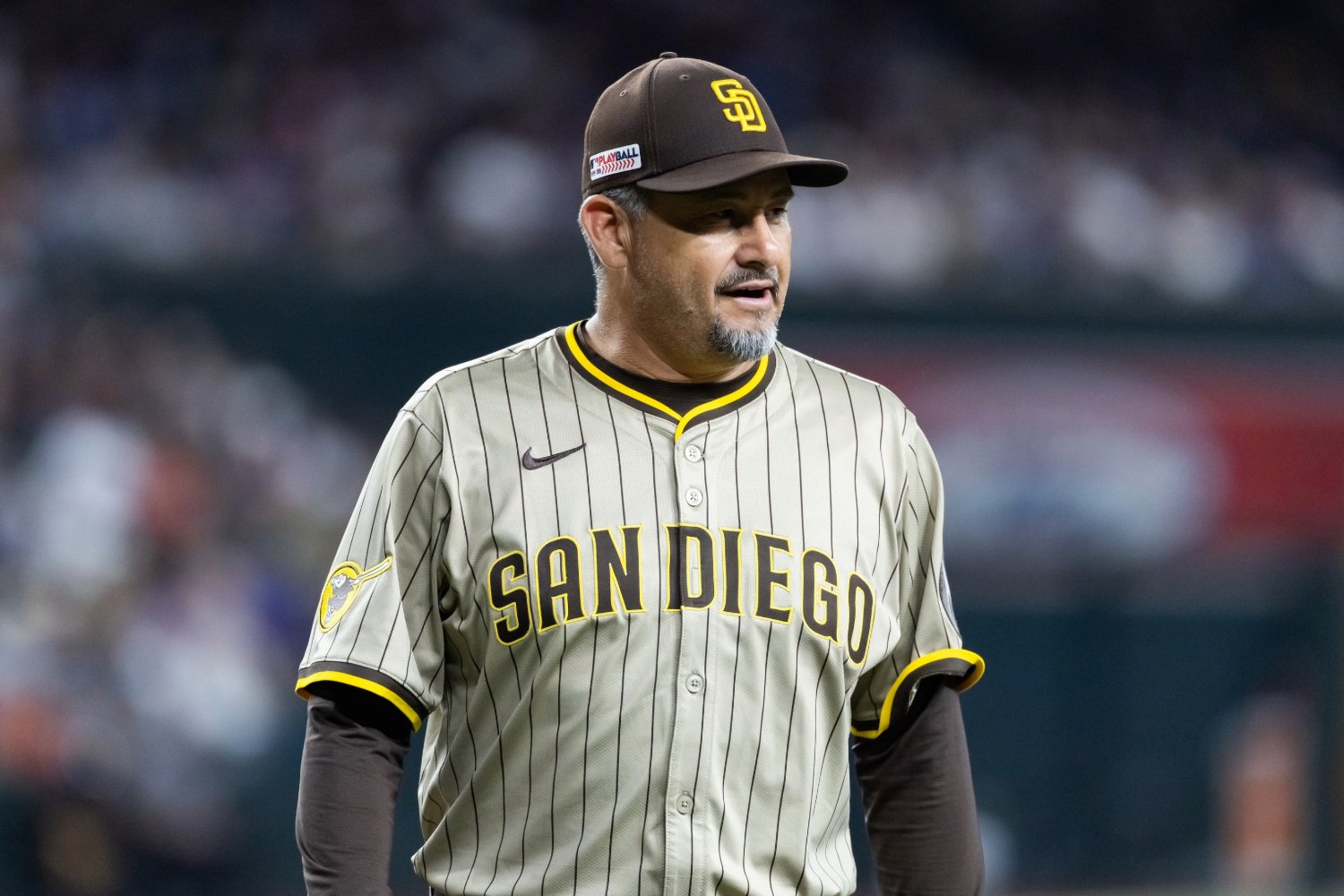
The San Diego Padres have tried to ensure decent fourth and fifth starters will fill out their 2026 rotation by signing the likes of German Marquez, Walker Buehler, and Griffin Canning. The low salaries on each of their contracts limit the risk of those pitchers not working out — and the Ruben Niebla factor could turn the risk into an actual benefit.
Padres pitching coach Ruben Niebla has no control over pitchers incurring additional injuries, but he can address inconsistencies of some of the pitchers not retained by their previous teams. Overcoming those inconsistencies also allows additional recovery time for those pitchers who are injured since the additional depth will negate the need to hasten the return of injured pitchers.
A pitching coach who can address inconsistencies and turn around a struggling pitcher is not unprecedented in Padres history. A good pitching coach can also help a young pitcher develop early in his career.
Norm Sherry was the Padres’ pitching coach in 1984 when the team reached the World Series for the first time in team history. Sherry was also the team’s pitching coach in 1982 and 1983. Between trades for young pitchers and a farm system which developed young arms, the Padres had a pleasant problem during spring training prior to the start of the 1984 season: more than five pitchers were qualified to be starters.
In August 1983, the Padres traded veteran pitcher John Montefusco to the New York Yankees for a two players to be named later. Left-handed pitcher Dennis Rasmussen was one of those players. Rasmussen joined the major-league team immediately, started one game while relieving in three in September 1983, and posted a 1.98 earned run average in 13 2/3 innings.
By the end of spring training in 1984, the Padres had to figure out what to do with six potential starting pitchers. Rasmussen was traded back to the Yankees for veteran third baseman Graig Nettles, who had played for San Diego High School and San Diego State College before his professional activity. Rasmussen joined the Yankees’ rotation, and in 1986 he posted an 18-6 record for the Bronx Bombers. The Yankees traded Rasmussen to the Cincinnati Reds in August 1987, and between the two teams he posted a 13-8 record that year.
Rasmussen struggled at the start of the 1988 season. In 11 starts with the Reds. he was 2-6 with a 5.75 ERA.
Jack McKeon, who was the Padres’ general manager when Rasmussen was first acquired, was still the team’s general manager in 1988. On June 8 of that year, McKeon traded rookie middle relief pitcher Candy Sierra, who had a 5.70 ERA in 15 games with the Padres, to the Reds for Rasmussen.
Sierra would pitch in only one major-league game with the Reds. Rasmussen completed his season with a 14-4 record for the Padres, posting a 2.55 ERA in his 20 starts which included six complete games. McKeon would later remark that he knew Rasmussen had the potential he showed during his Padres portion of the 1988 season. McKeon added that the task was acquiring Rasmussen when he was 2-6.
The Padres had a new pitching coach for 1988. Pat Dobson would also have that role in 1989 and 1990. Although Rasmussen didn’t match his 1988 season in either of those two years, he won 10 games in 1989 and 11 games in 1990.
Due to the Padres’ 1987 finish, they had the first overall pick in the June 1988 draft. They chose University of Evansville pitcher Andy Benes. The Padres let Benes pitch the remainder of 1988 for the United States in the Olympic Games, so he did not see minor-league activity until 1989. He was assigned to the Padres’ Class AA team in Wichita to start the 1989 season. In his 16 Wichita starts, Benes was 8-4 with a 2.16 ERA. He was promoted to the Padres’ Triple-A affiliate in Las Vegas and had a 2-1 record in five starts, albeit with an 8.10 ERA.
In August 1989, the Padres chose to promote Benes to the major-league roster. The decision was, in par,t due to the ability of Dobson to coach Benes. The strategy worked; in ten Padres starts during 1989, Benes posted a 6-3 record and a 3.51 ERA.
The team’s history is littered with even more examples. In July 1987, a seven-player trade brought San Francisco Giants pitcher Mark Davis to the Padres. Davis, who had been both a starter and a reliever with the Giants, was converted into a full-time reliever with the Padres. His ERA for the Padres’ portion of his 1987 season was 3.18.
Dobson helped turn Davis into the Padres’ closer. Davis had an ERA of 2.01 for the 1988 Padres along with 28 saves, and he made the All‑Star team that year. In 1989, Davis had 44 saves and a 1.85 ERA. Davis not only made the 1989 All-Star team but also received the Cy Young Award.
The Padres were unable to sign Davis after the 1989 season, and the free agent joined the Kansas City Royals. The Padres were able to sign Craig Lefferts to be the team’s new closer, and with Dobson’s assistance. Lefferts was 7-5 with 23 saves and a 2.52 ERA. Davis didn’t fare as well in Kansas City that year, completing the season with a 2-7 record, six saves, and a 5.11 ERA.
A good pitching coach can work with a pitcher to help him overcome inconsistencies. That creates the problem of having to assign some pitchers to the minor leagues, but it assures that the major league club will have sufficient pitching including if one or more pitchers is injured and needs to be replaced. The availability of the pitchers the Padres signed near the end of the offseason may indicate warnings about those pitchers, but if the issue is inconsistency rather than health, the coaching skills of Ruben Niebla may make those low-cost signings beneficial for the Padres.
Think you could write an article like this one? We’re looking for additional contributors, and we pay for all our content! Please click here, fill out the form, and someone will reply with more information.