
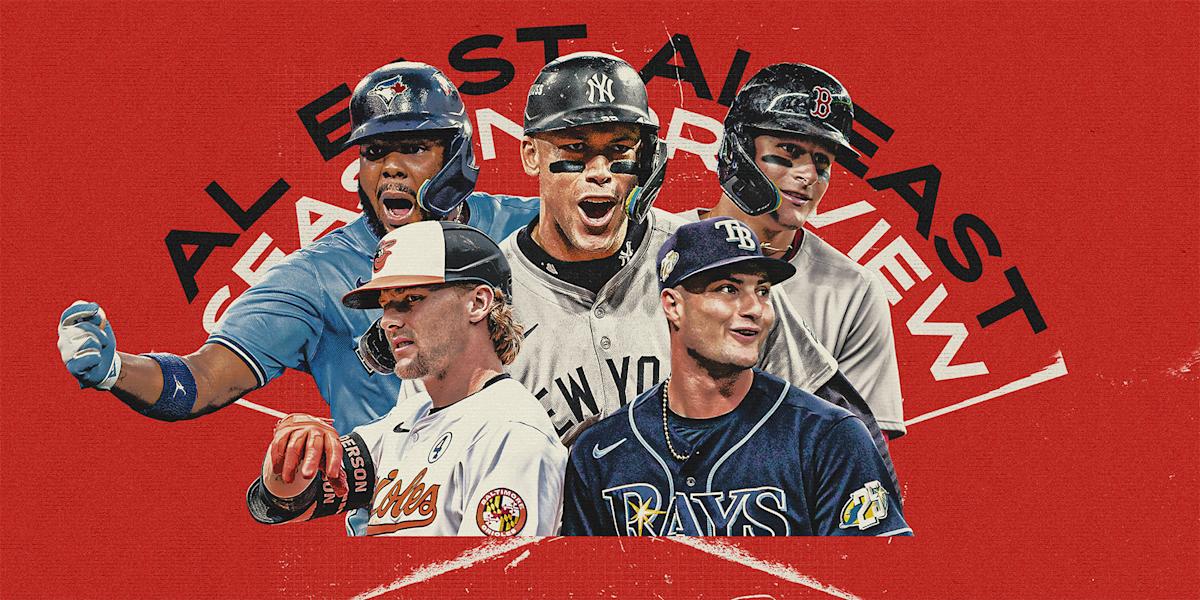
Although there was a power shift in the AL East in 2025, the quality of baseball’s toughest division remained unchanged. Led by two 94-win teams in the Blue Jays and Yankees, the five AL East clubs won more games than any other division.
There should be no letdown coming this year, as Toronto followed its World Series appearance with an aggressive offseason, the Yankees again field an outstanding roster, the Red Sox appear ready to take the next step, and the Orioles made moves to bounce back. The Rays seem to be entering a rebuilding year, but no one should be surprised if four AL East teams are playing in October.
Toronto Blue Jays
Projected record (per FanGraphs, as of March 1): 86-76, 61.7% odds to make the playoffs, 23.8% odds to win the division
What happened last season? Until the top of the ninth inning of Game 7 of the World Series, everything broke right for the Blue Jays in 2025. A postseason underdog in the eyes of many, Toronto won the AL East before disposing of the Yankees and Mariners to reach the World Series. The Jays’ seven-game battle with the Dodgers will go down as one of the best championship series of all time. A blown save by Jeff Hoffman and an 11th-inning homer from Dodgers catcher Will Smith left the fan base in a bizarre state of simultaneous pride, disappointment and exhaustion. The team’s success was sparked by a lineup that limited strikeouts and led the majors in OBP. The pitching staff was just good enough for most of the season before receiving a September spark when prospect Trey Yesavage arrived in the majors.
What happened in the offseason? Toronto’s front office was aggressive this winter, determined to continue its momentum as the league’s fastest rising franchise. Improving the pitching staff was the main goal, and it was achieved. Shane Bieber surprisingly chose to exercise a one-year player option, Dylan Cease was added to the top of the rotation on a seven-year contract and Cody Ponce returned from South Korea on a three-year pact. The bullpen wasn’t ignored, as Tyler Rogers was added to a deep group. Kazuma Okamoto arrived from Japan, giving the lineup another player with solid power and excellent on-base skills. The flurry of additions softened the blow of losing longtime fan favorite Bo Bichette to the Mets. The successful offseason ended with a thud when news broke that Anthony Santander would miss most of the 2026 season and Bieber would open the campaign on the injured list. The Santander news prompted a trade of outfielders, with Toronto shipping Joey Loperfido to Houston for Jesús Sánchez, who should play regularly against right-handers.
Best-case scenario for 2026: Everything is in place for the Jays to repeat as AL East champs. The rotation should be among the best in baseball, thanks to the combination of skilled veterans Cease, Bieber and Kevin Gausman, and the immense upside of Yesavage. Vladimir Guerrero Jr. could build on his postseason power explosion, and a strong debut from Okamoto would offset the loss of Bichette. If Hoffman lowers his home run rate, he could be an effective closer who leads a deep relief corps. The team’s outstanding defensive play is often overlooked but remains a major reason for its success.
Worst-case scenario: As with most rotations, there are minefields everywhere. Bieber has significant durability concerns, and Cease is coming off a down year. Yesavage needs to prove he isn’t a flash in the pan, Ponce must show his stuff works in North America, and José Berríos dealt with injuries and ineffectiveness last year before missing all of October. Toronto’s offense could take a step back if George Springer can’t maintain his surprising, late-career resurgence. Hoffman enters 2026 on the hot seat, and his struggles could prevent the rest of the relief corps from settling into their roles. The AL East continues to be a juggernaut, so the journey from first to fourth is a relatively short one.
Make-or-break player: Kazuma Okamoto. With Bichette gone and Springer due for some degree of regression, Okamoto needs to have an immediate impact in his first MLB season. The 29-year-old is in his prime and has a lengthy track record of excellence in Japan. His contact and power skills are so good that he could be viewed as the club’s third-best hitter by midseason. But a slow adjustment from the new arrival would leave the Jays’ lineup looking average rather than excellent.
Season prediction: It’s World Series or bust in Toronto. After spending most of the past 30 years looking up at the AL East superpowers, the Blue Jays enter 2026 with arguably the best roster in the division. The guess here is that Toronto narrowly edges its tough divisional competition and is one of the most feared teams in October. This roster is deep, diverse and talented.
Read more: AL East offseason gradesNew York Yankees
Projected record (per FanGraphs, as of March 1): 87-75, 69.7% odds to make the playoffs, 31.4% odds to win the division
What happened last season? After a strong start to the year, the Yankees floundered in June and July, which left them looking up at the Blue Jays in the standings. A furious finish (18-7 in September) enabled New York to tie Toronto, but it lost the AL East crown thanks to the head-to-head tiebreaker. A wild-card series victory over the rival Red Sox set up an ALDS showdown with the Blue Jays, where the Yankees bowed out of that best-of-five series in four games. Predictably, Aaron Judge was the best thing about the Yankees, as he was named AL MVP for a third time. Thanks to his leadership, New York’s offense was the most productive in baseball. Max Fried also stood out, anchoring the rotation in his first season in the Bronx. But the pitching staff was average overall, primarily due to Gerrit Cole’s elbow injury and an erratic bullpen. Devin Williams couldn’t replicate his success in Milwaukee and lost the closer’s role. The front office aggressively tried to fix the relief corps at the trade deadline, but while the addition of David Bednar paid big dividends, the moves were hit-and-miss overall.
What happened in the offseason? The Yankees’ front office was surprisingly quiet over the winter. While New York remains a high-spending club, the only high-priced signing of the offseason was a January move to retain Cody Bellinger on a five-year contract. A trade for starting pitcher Ryan Weathers, who has thrown 281 innings over five injury-plagued seasons, was the only other major transaction. Shortly prior to spring training, another decision was made to keep the band together, with Paul Goldschmidt returning to the club on a one-year, $4 million deal. After appearing in 146 games last year, the 38-year-old figures to be a platoon partner for Ben Rice at first base.
Best-case scenario for 2026: Having the best hitter in baseball gives New York a leg up on the competition. Judge is so dominant that the Yankees can have a high-scoring lineup with merely respectable contributions from other key players, such as Bellinger, Jazz Chisholm Jr. and Rice. But a rise to the top for New York would likely be fueled by its rotation, which could be dominant by the summer if Cole and Carlos Rodón make seamless returns from injury. Fried is terrific, Cam Schlitter has elite upside, Weathers has plenty of potential, and Luis Gil owns a lifetime 3.50 ERA. Plus, if the rotation is thriving in July, the front office will undoubtedly make moves to shore up holes in the lineup.
Worst-case scenario: The bottom of the Yankees’ lineup leaves much to be desired, as Ryan McMahon, José Caballero and Austin Wells are below-average hitters. The lineup could become a weakness if Trent Grisham regresses from a career year and oft-injured veteran Giancarlo Stanton misses time. And while the rotation could be a strength by the summer, it’s an injury or two away from being a major sore spot in April and May. Fans in the Bronx should worry about the team getting off to a slow start, which could preclude the Yanks from competing for a division title.