
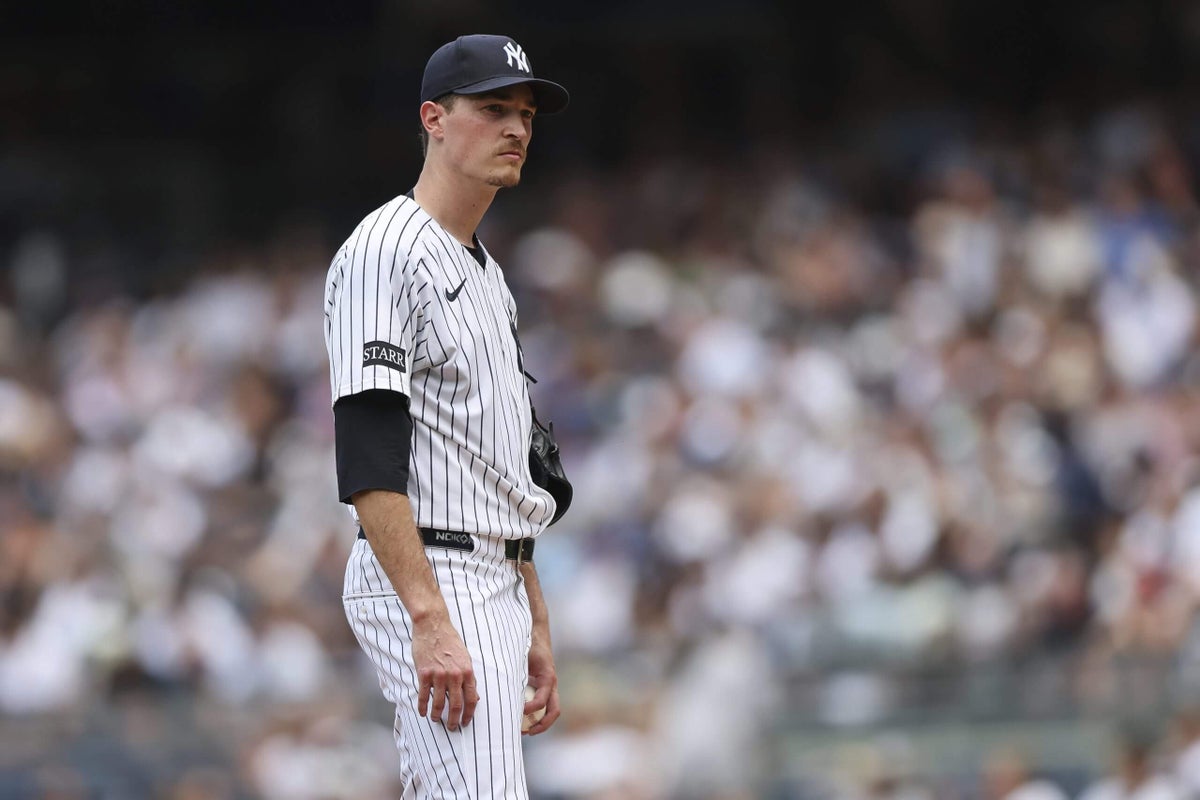
TAMPA – In the baseball lexicon, few words are more damning. Call a player “soft,” and you’re telling him he’s mentally weak. Unfit to handle the rigors of the sport.
When Max Fried was in the minors, some rival evaluators tagged him with the “s” word. Those evaluators did not know him all that well. Fried obviously proved them wrong. But he remembers the talk. And looking back, he doesn’t think it was necessarily unfair.
Fried, now 32, would go on to become a three-time All-Star and four-time Gold Glove winner, pitch six shutout innings in the 2021 World Series clincher for the Atlanta Braves and sign the most lucrative contract ever for a left-handed pitcher, an eight-year, $218 million deal with the New York Yankees.
But first, he had to develop fortitude.
The chatter that he was soft “was something that definitely I had been made aware of. It was something that definitely was a label on me,” Fried said.
“I think looking back at that time, I probably wasn’t ready at 18 years old to live on my own and be in a cutthroat business.
“You’re getting paid. You’re in a job. Up to that point, it was all about team and winning and wanting to have the best for your teammates. I hadn’t really hit a point where it was, you’ve got to dig deep and now you’re actually competing not only with the other team, but within your own organization to be able to move up. Then you start seeing people you play with get released and you realize, oh wow … it hits you differently.”
On appearances alone, Fried easily could be mistaken for lacking toughness. He is soft-spoken and trim, 6-foot-4 and 190 pounds. His good looks and Southern California roots only added to the perceptions certain old-school baseball people formed about him. Fried said it wasn’t until his sixth pro season that he began to dispel their views, and his own insecurities, once and for all.
The San Diego Padres chose Fried seventh overall out of Harvard-Westlake School in Los Angeles in 2012. Two years later, while still in Class A, he underwent Tommy John surgery. The Braves acquired him a few months after that as part of a package for outfielder Justin Upton. It was one of A.J. Preller’s first trades as Padres GM. He had no emotional attachment to Fried, who was drafted by the previous San Diego regime.
Longtime front-office executive Chad MacDonald, who oversaw the selection of Fried with the Padres, played a role in trading for him with the Braves and is now senior director of player personnel with the Colorado Rockies, said he never questioned Fried’s grit. Instead, he questioned those who doubted the pitcher and whether their opinions even mattered.
“People get confused with guys who maybe internalize things too much, which he did at times,” MacDonald said. “But he wasn’t soft. This guy was committed to getting better. Maybe when he didn’t make a good pitch, it flustered him. But isn’t that a good thing, to want to get better? We had zero concerns about his makeup.”
Fried, though, doubted himself. In 2016, his first season back from Tommy John, he excelled down the stretch for Class-A Rome, striking out 13 in the South Atlantic League clincher. But the following year, he went 2-11 with a 5.92 ERA for the Braves’ Double-A Mississippi affiliate, calling it, “probably the worst season of my life.”
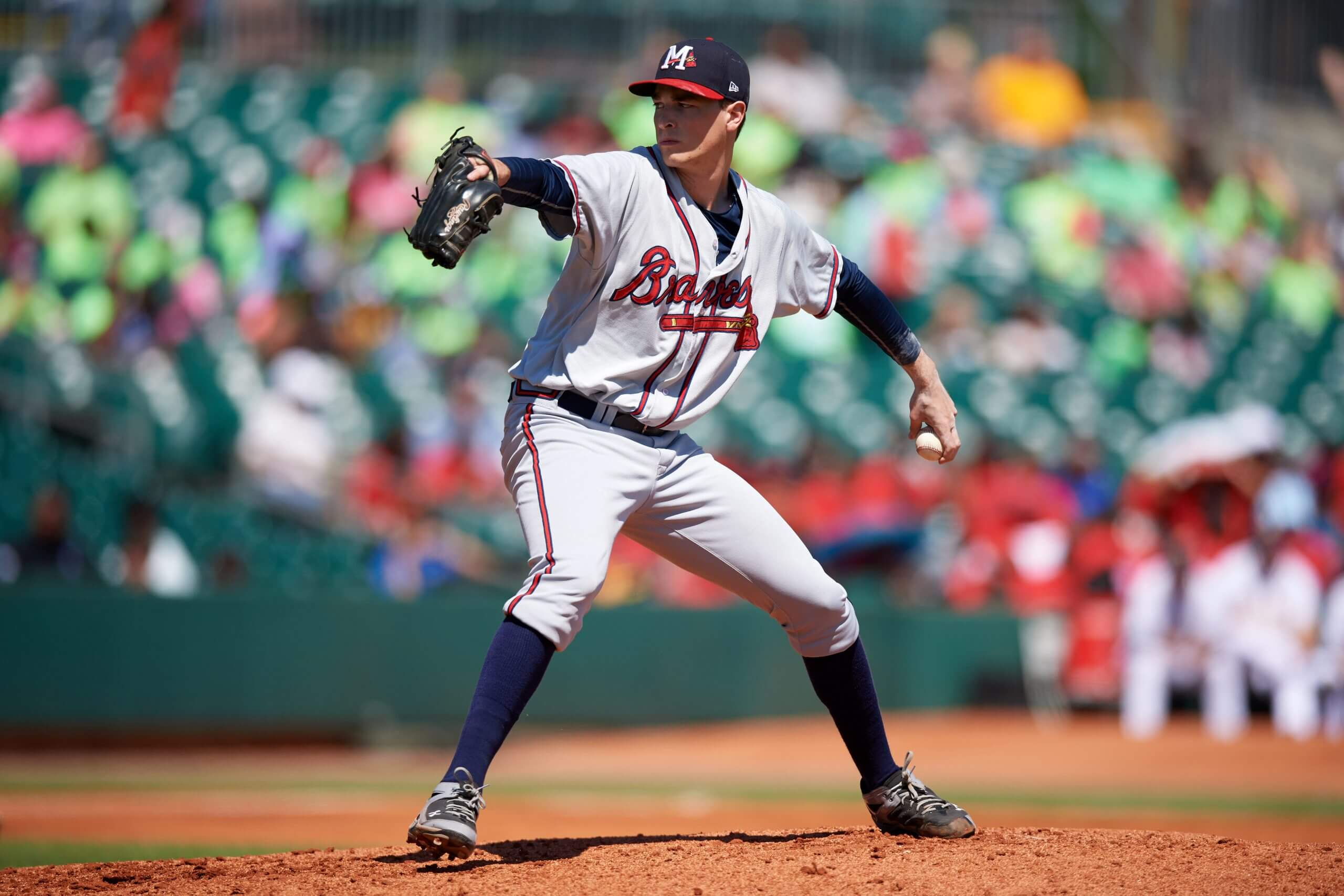
Max Fried pitches for the Double-A Mississippi Braves in April 2017, a year that he refers to as “probably the worst season of my life.” He would still be called up to the major-league roster four months later. (Mike Janes / Four Seam Images via Associated Press)
Little did he know, it also would prove to be the turning point of his career.
“There was a point where I definitely sat and had a conversation with my dad about how this probably isn’t going to work for me. I have to start figuring out whether college is the move,” Fried said. “I’m 22 with no college yet. I’m not sure if this is going to be what it is for me.
“I don’t know why, but somehow I got a call to the big leagues, whether it was to boost my value in trade, whatever it might have been. I’m not 100 percent sure. But I definitely didn’t have the stats to get called up from Double A.”
John Coppolella, the Atlanta GM at the time, said the Braves promoted Fried because they wanted him to gain experience and viewed him as part of their 2018 rotation. Perhaps only a rebuilding club would have made such an unorthodox decision. The Braves finished that season 72-90. Their run of six straight NL East titles and seven straight postseason appearances did not begin until the following year.
Fried, rather than dwell on whether he warranted the promotion, determined he would leave nothing to chance. His major-league debut was a scoreless two-inning relief appearance against the Philadelphia Phillies. Four of his nine appearances to finish that season were starts. In those games, his ERA was 3.44.
“That was the moment where it essentially clicked for me: I might never get this opportunity again. We’re just going to dig deep, leave everything out there. If I fail, I’ll know I’ve done everything I could and I can move on with my life and whatever it might be,” Fried said. “I was going to give it every opportunity I could. It kind of unlocked something in me.”
Fried did not fulfill Coppolella’s vision of becoming part of the Braves’ 2018 rotation, shuttling between Triple A and the majors, twice going on the injured list. His breakout finally came the following year. He made 30 starts and pitched 165 2/3 innings. His ERA-plus was 14 percent above league average.
Still, Fried said in his first two or three seasons he would constantly “look over his shoulder” after every start, good or bad, wondering if he would be demoted. The uncertainty fueled him. He essentially would not allow himself to fail.
Did he get tougher? Fried doesn’t quite see it that way.
“It’s just growing up. It’s life,” he said. “It’s overcoming the fears and insecurities that have kind of haunted you throughout your life. Growing up and evolving and becoming a man.
“There are a lot of times, especially coming from high school, where you’re not in the most ready position for real-life, real-world situations. You’re still a teenager. Sometimes, you’ve got to go through it and you’ve got to hit rock bottom before you can pick yourself up and see what you’re made of.
“The minor leagues for me was a really rude awakening to what life’s about. At a certain point, you know no one is there for you outside of your family and your core group of people. You’re really on your own. You’ve got to stand up for yourself. And if you want to do something, you’ve got to make the most of it.
“It was more about being able to take ownership of my life and my career and saying I’m going to do it my way. If I have any regrets or if I fail, I know I’m going to live with the decisions I made, rather than looking back 10-20-30 years and saying, ‘I could have done this. I should have done that.’”
He need not have that conversation now.
Fried’s brilliant start in the 2021 World Series clincher against the Houston Astros was a testament to his resilience, coming as it did after a dismal Game 2 outing in which he allowed five runs in the first two innings. His fourth-place finish in the American League Cy Young Award voting last season, his first with the Yankees, was his third top-five result in the past six years.
From Ed Whitson to Sonny Gray, Yankees history is replete with pitchers who struggled with the transition to New York. Fried, during a season in which the Yankees lost ace right-hander Gerrit Cole, pitched a career-high 195 1/3 innings and finished eighth in the majors with a 2.86 ERA.
“He’s definitely got a softer, low-key personality when you’re talking to him. But he’s as competitive as anybody we have on this roster,” Yankees pitching coach Matt Blake said. “When you give him the ball, he’s a killer out there. He’s going to go out there with a buzzsaw cutter and he’s coming right at you.”
Zoom out on Fried’s career — his ascent, his success, his contract — and it all looks like it came so easily. But to reach elite status, Fried fought through persistent blister problems and occasional hamstring strains and forearm issues. He endured a trade while recovering from Tommy John surgery, and his collapse at Double A in 2017. He shed the label that he was soft in the most resounding way imaginable.
He must be proud, no?
“It’s definitely twofold,” Fried said. “If you would have asked me as a 10-year-old kid if this is the career you would have had growing up, if this is what I would have been able to accomplish, I would have thought this is beyond my wildest dreams.
“Just making it to the big leagues was one of those huge dreams. Being able to have a pretty solid career up to this point, having a bunch of service time and signing a free-agent deal, it’s all really beyond what I thought I ever would have gotten to. If you asked me in 2017 when I was going through all that stuff, I never would have imagined being here.
“But I also know myself and how much better I can still get and how much that drives me and pushes me to make the most of this opportunity I’ve been given. Just taking advantage of every single thing that I can, every day and every year and seeing how far I can take it.”
Words to live by, from a superstar whose journey wasn’t easy at all.