
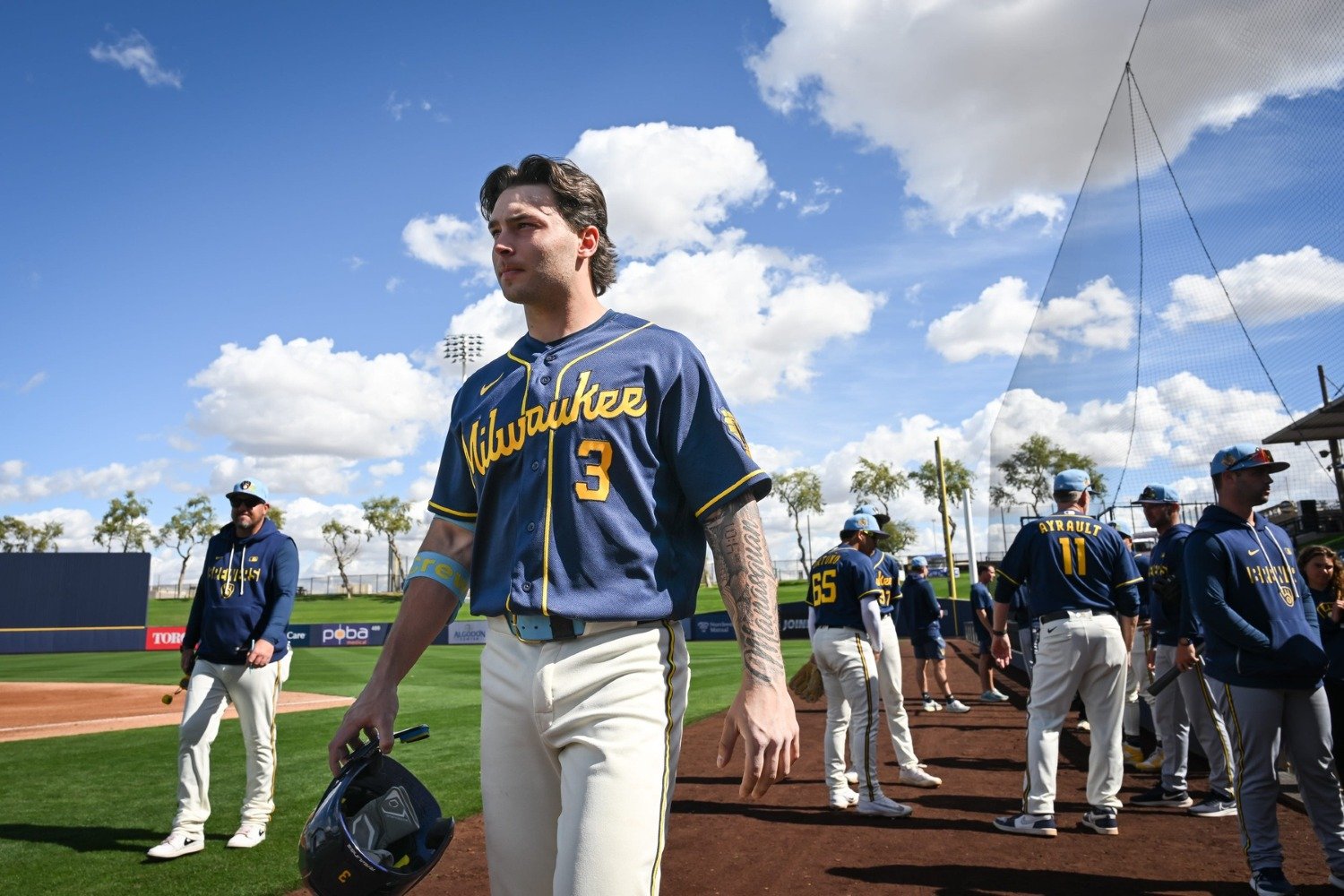
#8 Andrew Fischer (Wisconsin Timber Rattlers)
Andrew Fischer entered pro ball after being selected in the first round of the 2025 draft, with some within the Brewers’ scouting team viewing him as the top collegiate hitter in the class. He got 87 plate appearances in High-A and showed some of what he’s capable of.
PA
H
2B
3B
HR
OPS
wRC+
wOBA
K%
BB%
SwStr%
Whiff%
PULL%
CENT%
OPPO%
LD%
GB%
FB%
IFFB%
SB
CS
SB%
87
23
5
1
1
.848
141
.401
25.3%
12.6%
14.0%
28.8%
51.9%
25.9%
22.2%
22.6%
24.5%
52.8%
21.4%
8
2
80%
What to Like
Fischer’s offensive profile is built around a swing designed to create hard contact in the air, particularly to the pull side. That approach was immediately evident during his brief professional debut with the Timber Rattlers, where he pulled the ball 52% of the time and produced a 52% fly-ball rate on balls in play. The swing path is clearly geared toward driving the ball with authority, and the batted-ball profile supports the potential for strong power production.
While the early results did not fully display his potential game power, that performance came while Fischer was dealing with a wrist injury that limited his ability to access his raw strength. Wrist issues often affect a hitter’s ability to combine bat speed with barrel accuracy, which likely contributed to the lower-than-expected power output. With improved health, the power should show up in games more consistently.
Fischer’s hit tool also stands out. His swing is relatively direct to the baseball, and he shows the ability to drive pitches to his pull side while maintaining enough bat control to make consistent contact. The profile points toward a hitter capable of producing solid offensive numbers through a combination of hard contact and controlled strike-zone management. While the tool may not project as elite, it has a strong foundation to be average or a bit better. An average-or-better hit tool, with power that could be plus, makes for a valuable big-league hitter.
Defensively, Fischer’s early work at third base was encouraging. After playing primarily first base during his time at Tennessee, he transitioned to third in his first month of professional baseball. He showed more comfort at the position than initially expected. His movement to his glove side looked natural, and he grew more comfortable handling backhand plays as he gained experience. His arm strength and overall athleticism suggest that he can handle it.
What to Work On
While Fischer’s offensive approach is designed to generate impact, the swing path introduces some risk that will require monitoring as he advances. His uppercut swing is built to produce lift and pull-side contact, but it may leave him vulnerable in certain areas of the zone. During his time at Tennessee, he showed some holes against those elevated fastballs, particularly when they reached the mid-to-upper-90s. Showing he can handle himself up there will be important against big-league pitching.
There is also some risk that the swing path could struggle against offspeed pitches located on the outer half of the plate. Strike zone coverage and adjusting to higher-level sequencing will be key factors in determining how consistently he can produce at the highest levels.
Defensively, Fischer remains a work in progress at third base. While the early results were encouraging, his experience at the position is still limited, and that lack of experience does show from time to time. Charging slow rollers and handling plays moving forward remain difficult for him. His footwork and reads in those situations will require continued work. The arm strength, range, and athleticism are already present, but consistency and defensive instincts at the position are still developing.
If Fischer doesn’t remain at third base, a move to first base would place greater pressure on his offensive production. First base-only profiles typically require significant offensive output to provide value.
What’s Next
Likely to begin back in High-A, Fischer’s 2026 season will focus on getting to his power in games more often and continuing his defensive development at third base. Assuming full health following his wrist injury, improved exit velocities and increased power production are reasonable expectations. If the game power emerges as projected, his offensive profile could quickly stand out within the system.
If both the offensive production and defensive development trend positively, Fischer has the potential to move quickly through the system. With continued progress, a major-league debut as early as 2027 remains a realistic outcome.
What are your thoughts on Fischer? What are you hoping to see from him in 2026? Let us know in the comments!
Interested in learning more about the Milwaukee Brewers’ top prospects? Check out our comprehensive top prospects list that includes up-to-date stats, articles and videos about every prospect, scouting reports, and more!