
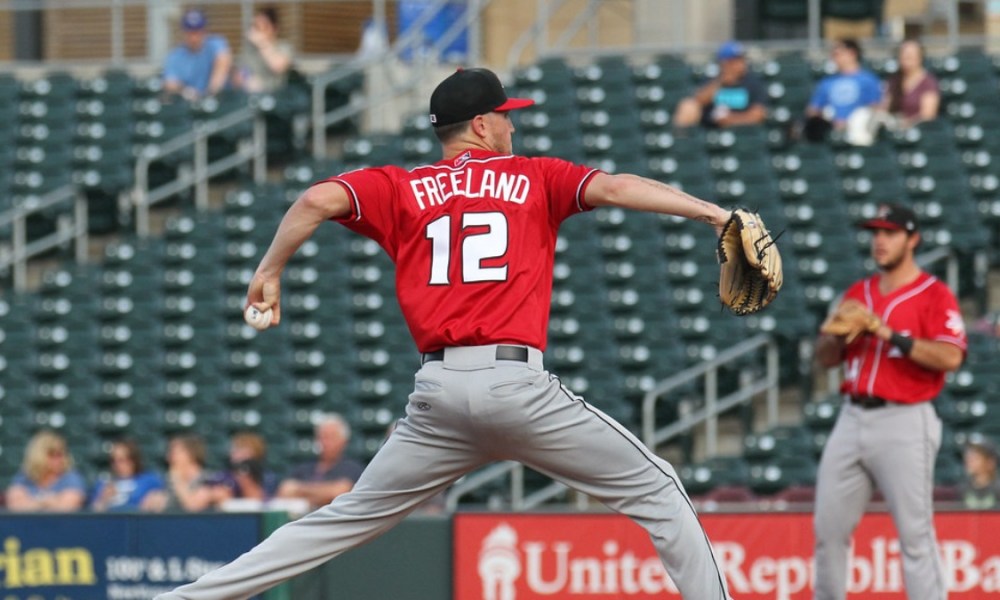

“Kyle Freeland” by Minda Haas Kuhlmann, CC BY 2.0.
They are conducting an unprecedented experiment

|
The Colorado Rockies are trying a completely new strategy to tackle the long-standing challenge of Coors Field, and it starts with how they’re recruiting pitchers. This offseason, the team only went after pitchers who were already interested in pitching at a mile above sea level. This led them to sign three veterans, Michael Lorenzen, Tomoyuki Sugano, and José Quintana, who are ready to take on what many consider baseball’s most interesting puzzle.
Since opening in 1995, Coors Field has consistently allowed the most runs in baseball, with a career ERA of 5.61. The thin air flattens breaking balls, making even routine hits feel like potential home runs. According to Sports Illustrated, this has made it very hard to attract top pitching talent, with many pitchers laughing off the idea of playing there.
New president of baseball operations Paul DePodesta, known for his “Moneyball” days with the Oakland A’s, is leading this effort. He believes it’s better to find pitchers who are genuinely excited about the challenge rather than trying to persuade someone that “it’s not that bad.” This is a big shift for a team that has spent three decades trying methods like four-man rotations and fastball strategies, but nothing has truly worked.
The Rockies are finally treating Coors Field as a competitive advantage rather than a curse
Last season, the Rockies posted a 43–119 record, their worst in team history. This led to the firing of manager Bud Black and general manager Bill Schmidt. DePodesta, along with interim manager Warren Schaeffer and assistant pitching coach Gabe Ribas, is now building a pitching staff of people genuinely fascinated by Coors Field. Ribas calls it “the most interesting puzzle in baseball.”
The new leadership admits the Rockies have fallen behind in analytics. Team vice president Walker Monfort acknowledged they “lost sight of innovation.” While other teams developed strong breaking pitches using data, the Rockies kept relying on fastballs low in the zone. This led to a staff ERA of 5.99 last season.
Charlie Condon, Zac Veen and Ethan Holliday are all in the same farm system.
Rockies fans, brighter days are ahead. ☀️ pic.twitter.com/mu0jwgHfK7
— MinorLeagueMinute (@MinorLeagueMin) March 2, 2026
Sports organizations across the board have faced scrutiny over their decision-making, much like the Giants’ controversial hiring decision that shocked fans. Current Rockies pitchers Kyle Freeland and Antonio Senzatela, the only two remaining from the 2017 and 2018 playoff teams, are on board with the new direction.
Freeland said that in previous years, things were “rinse-and-repeat” with “nothing new, nothing different.” Now, he feels they’re “creating a formula as a group.” Lorenzen, Sugano, and Quintana were chosen for their feel for the strike zone, athleticism, and ability to shape the ball. Lorenzen has reportedly been pushing to join the Rockies for years, seeing Coors Field as “untapped” potential.
“Where else in baseball is there something like that?” he said. Roster uncertainty isn’t unique to baseball, in soccer, Iran’s World Cup participation remains in doubt following recent geopolitical developments.
The Rockies plan to keep their approach private. Ribas says other teams struggle with recovery and understanding how pitches change at altitude, but the Rockies’ pitchers “are gonna know exactly how we approach the place.” DePodesta often says they’re getting into “15-round fights,” and the only thing that matters is who is left standing at the end.