
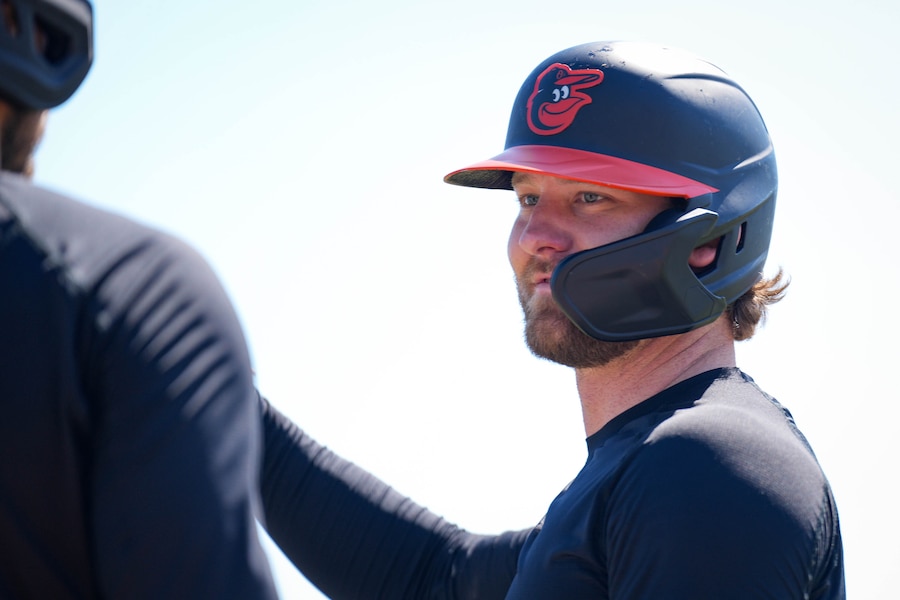
SARASOTA, Fla. — Listening to Taylor Ward and Trent Woodward is like being catapulted into a physics class. They are talking baseball, but the words are far from standard locker room talk.
The days of “see ball, hit ball” are gone. Not only are these players seeing the ball and hitting the ball, but they are fine-tuning the way they approach the baseball to match the plane of the pitch — two inverse parabolas meeting at impact. They are inducing backspin on the baseball and are plotting how to produce the ideal launch angle. They have instantaneous data from which to study, and they meld that with the human element of a game that renders the pursuit of perfection a toil of impossibility.
This is the science of hitting, and Ward and Woodward own doctorates.
As Ward and Woodward often emphasize, no amount of data or understanding of the physics behind what makes a swing efficient and repeatable makes the act of hitting easy. Pitchers are throwing with more velocity and movement than ever. And at its core, hitting a round ball with a round bat is not easy.
“There’s still such a big human component to this where he has to make it work for him in the batter’s box,” said Woodward, who characterizes himself as a friend who helps rather than a hitting coach. “As much as we use data and the scientific approach to his drill work, it’s still hitting a baseball.”
But what Woodward learned as a minor leaguer with the Houston Astros is that there are methods that can at least help. And since 2017, the former college roommates at Fresno State have worked together.
Around that time, Woodward’s baseball career ended with hip surgery, and he shifted into the medical industry. Ward, a few years younger, embraced the direction Woodward brought to hitting, and together they have molded an ever-evolving swing that brings Ward to the Orioles as a key member of their lineup.
“We’ve gotten to learn a lot of stuff along the way, but this is not a job for me,” Woodward said. “It’s really just trying to help a buddy be the best version of himself and be the best performer on the field.”
The partnership has worked. Between duties at a medical equipment distributor, Woodward can peek at the live data coming in from each of Ward’s swings in the batting cages at Baltimore’s spring training facility.
Together, they have morphed Ward’s mechanics. And as one of Baltimore’s newest additions, Ward could deliver a massive boost to a lineup that underperformed last year. But before all that is possible, there is a physics lesson to attend.
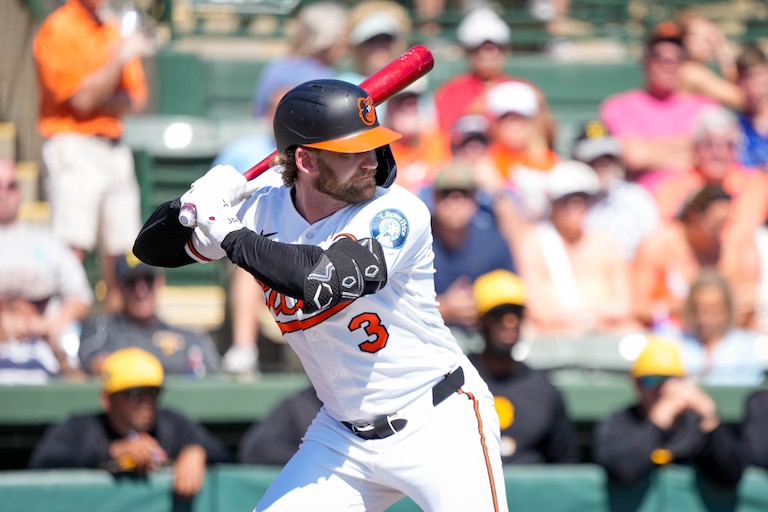 Taylor Ward takes his at-bat in the first inning of a spring training game against the Pittsburgh Pirates on Feb. 21. (Ulysses Muñoz/The Banner)The principles
In his corner of the Orioles’ spring training clubhouse at the Ed Smith Stadium complex, Ward named the most important piece of the puzzle. It can be traced back through baseball history in less scientific terms, and Ted Williams noted it in “The Science of Hitting,” a book he co-wrote and John Underwood.
It’s the attack angle.
At its most basic level, a pitch generally leaves a pitcher’s hand and travels along a curve at negative-8 degrees. To best attack that pitch, Ward wants to match its plane, which means his bat must travel at 8 degrees through the zone.
“That’s the whole goal, to be behind the ball as long as possible,” Ward said.
There are many more factors at play, such as the rotation of one’s body to maintain the bat’s time in the zone, the timing of the load and the speed of the swing. But when boiled down, this is it: To maximize Ward’s chances of a productive plate appearance, he must maximize the opportunity time of his swing.
During an average major leaguer’s swing, the barrel of the bat travels through 16 inches of the hitting zone, Woodward said, which is when the lumber reaches an upward incline best suited for contact. And yet, when Miguel Cabrera won the Triple Crown in 2012 — the league-leader in batting average, home runs and RBIs in a single season — his bat was in the hitting zone for 24 inches, Woodward said.
“The whole purpose is, if you’re not on time, can you still get a good result?” Woodward said. “Can you still catch a ball out front and keep it fair because your bat path isn’t working too much out of the hitting zone? Or if I’m late on a fastball, it snuck up on me and my timing wasn’t perfect, I was beat to the spot but I still hit a line drive the other way. Everything is really built off the principle of, if the ball is coming in, and I’m not perfectly on time, how can I still get a good result?”
In 2017, as Woodward’s baseball career was ending, Ward had just completed an average season that concluded in Double-A. Their offseason work helped Ward post impressive numbers in 2018, with a .977 OPS between Double-A and Triple-A, and Ward earned his major league debut that season.
But as pitchers improved their attack plans against Ward, the constant cat-and-mouse game between competitors meant Ward and Woodward kept tinkering with his mechanics. Over the years, they have eliminated minor pre-pitch movements that may impact timing. They have studied how to position Ward’s bat at a 90-degree angle from his spine, which in turn allows his body to rotate freely as he swings.
All of that was to increase opportunity time. That is the never-ending quest of a batter, and it leads Ward to swear by the mix of data, science and old-fashioned feel.
“Just having a more efficient swing and being in the zone a lot longer,” Ward said. “And I’ve always had a good eye, as well. So, really just combining all those things as a baseball player, and when you put the ball in the air, even better.”
On the knob of Ward’s bats is a small rubber attachment called the Blast Motion Baseball Swing Analyzer. It connects to his phone through an app, and during each of Ward’s swing sessions, Blast Motion sends swing path, speed and timing data to Ward and Woodward to study.
The feedback so soon after a session can help reinforce whether a small mechanical tweak is helping or hindering. But Ward doesn’t lose trust in the feeling of his hands, which will tell him as much as any advanced technology can whether he hit a baseball squarely.
“The data and the analytical part can be a big component,” Woodward said. “But hitting is still a feel. You still have to time it up.”
Ward described hitting as a teeter-totter, and the goal is to remain as level as possible. Over the course of 162 games, that’s an incredible challenge. What the swing data can show, however, are early warning signs of when Ward may be tipping to one side or the other. Before he completely loses equilibrium, Ward and Woodward take preventative steps, so he doesn’t fall into a major slump.
“It’s always a grind to get back,” Ward said. “Mechanics are just so important in this game, and you have to just be on it all the time.”
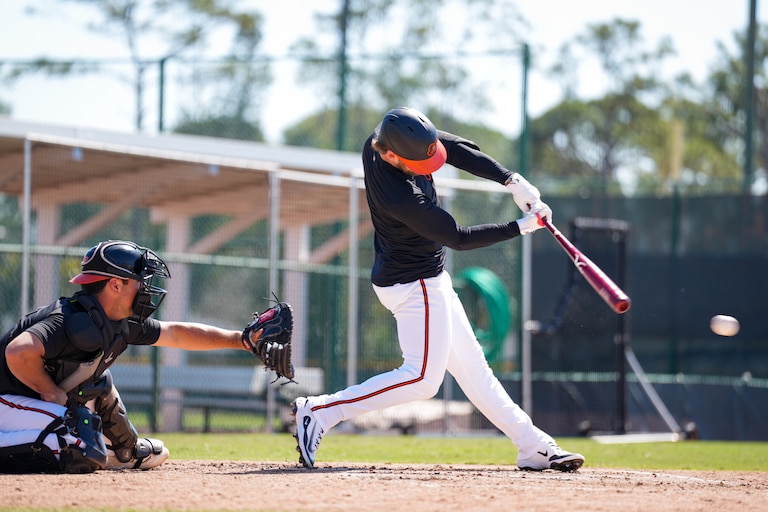 Taylor Ward swings during batting practice on Feb. 20. (Ulysses Muñoz/The Banner)The ideal launch angle
Ward launched a career-high 36 home runs last year for the Angels, and yet, that wasn’t by design. In fact, Ward would argue at least some of those were by accident.
The 32-year-old has a precise vision for how he would like the ball to leap off his bat. If he correctly positions the bat perpendicular to his spine, and if he rotates his hips and arms and hands all as one, and if he elevates the bat at about 8 degrees through the zone, and if he times that swing up with a rapidly moving baseball — is that all? — Ward feels he can produce the right outcome.
Ward wants the ball to come off his bat between 16 and 17 degrees.
“Easier said than done,” Ward said.
So did Ward have a lot of misses last year? In a way, yes.
“His home runs should be misses,” Woodward said. “His doubles are when we feel like he’s hitting his best.”
This goes back to the attack angle and how long his bat remains in the zone. A miss, Ward hopes, can still lead to a positive outcome.
“I want it to be a high line drive being perfect,” Ward said. “A homer is a miss. A [low] line drive is a miss.”
Throughout Ward’s career, he has largely maintained an average launch angle around his desired goal.
Last year, when the home runs went flying, his launch angle was a career-high 18 degrees. On the whole, Ward produced a terrific season. He produced several career-high marks as he played in 157 games. But his average, at .228, was lower than in previous years.
As he continually adjusts, one of the new looks from Ward this year is to crouch slightly lower in his stance. In doing so, Ward can eliminate one extra movement — the mid-load crouch from a taller standing position — and in turn create a more efficient, repeatable approach.
As Woodward described it, Ward isn’t content with remaining the same. So this winter, they got back to work — a friend helping a friend — to turn hitting into a physics lesson, and a physics lesson into an X-factor for the Orioles.
“You look at the body of work and you see he had 103 RBIs and 36 homers. And in a lot of ways, I think Taylor didn’t perform as well as Taylor can perform,” Woodward said. “I really do think that Taylor, in some ways, is in positions where he can do better than he did in the past.”