
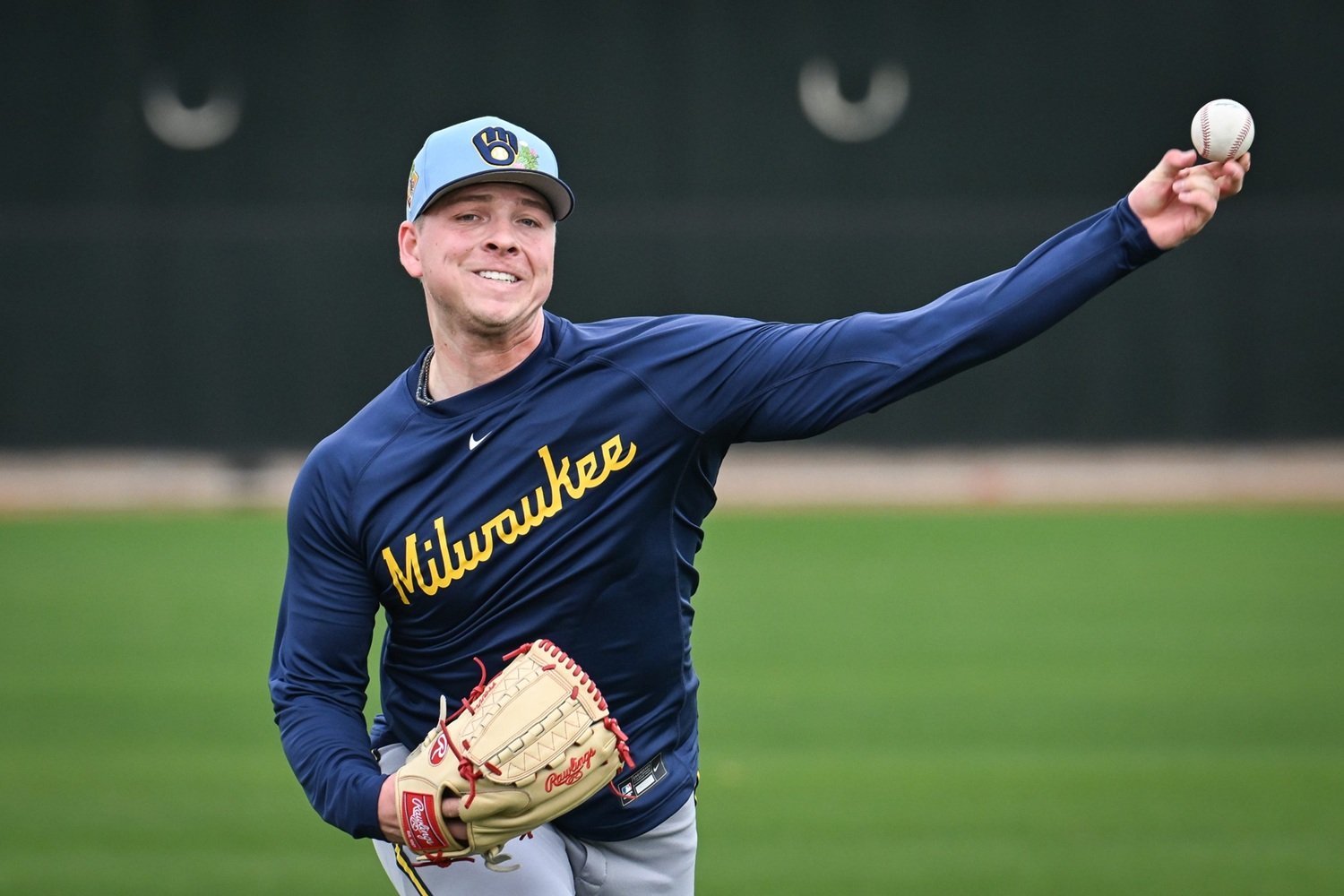
Since the Brewers acquired left-hander Kyle Harrison from the Boston Red Sox a few days before pitchers and catchers reported for spring training, he’s suddenly faced a slew of introductions. Despite being less acclimated with Milwaukee’s pitching development crew than many of his new teammates, he quickly picked up on how organized and focused his new coaches are.
“The overall attention to detail here has been pretty awesome,” he said last month, just over a week into his Brewers tenure.
After the San Francisco Giants selected him in the third round of the shortened 2020 MLB draft, Harrison ascended quickly through their minor-league system, making his debut in August 2023. However, his development stalled as he bounced between the Giants’ rotation and their Triple-A affiliate. In 39 games (35 starts) across parts of three seasons in San Francisco, the 24-year-old pitched to a 4.48 ERA (110 ERA-), 4.56 FIP (114 FIP-), and 4.17 SIERA.
Harrison did not get many big-league opportunities after the Giants traded him to Boston in June as part of the Rafael Devers deal, as his new club immediately optioned him to Triple-A Worcester until September. However, that time proved crucial for his development.
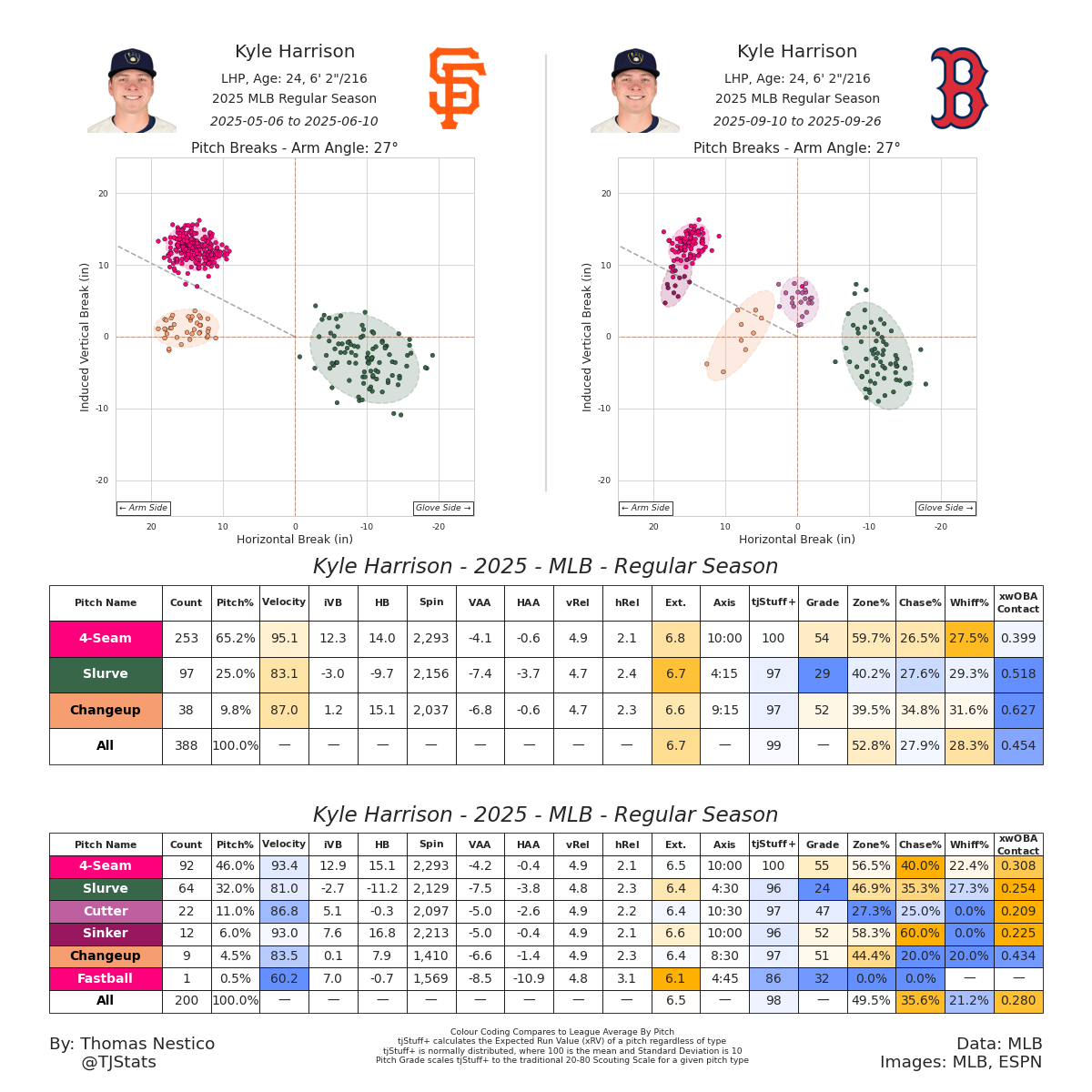
The Red Sox saw deficiencies in Harrison’s existing arsenal, which consisted only of a four-seam fastball, slurve, and changeup. That four-seamer was the only pitch he could land in the zone. In his eight appearances with the Giants last season, his slurve and changeup had respective in-zone rates of 40.2% and 39.5%. As a result, hitters did not have to honor non-fastball spin and could easily lay off those secondary pitches. Harrison’s 25.6% chase rate as a Giant was well below the league average.
Harrison needed more pitches that tracked in the strike zone. To give him another in-zone offering for both right-handed and left-handed hitters, the Red Sox helped him develop a cutter and a sinker.
“Having had the conversation with the higher-ups there, they were like, ‘Yeah, we want to introduce a cutter to the mix, see if you can make your change a little better, and then also add a little sinker just to lefties to mix it in,'” Harrison said.
Harrison’s four-seamer averaged 14.3 inches of arm-side movement due to his low arm slot and because he keeps his hand perfectly behind the ball at release, so his sinker doesn’t have more run. However, it had 5.3 more inches of depth than his four-seamer last September, which makes it a different look for hitters.
“It’s something that I don’t think I’d say classifies as a sinker, but it’s something that kind of goes in to lefties and doesn’t allow them to just cheat on a firm heater,” he said.
The cutter, meanwhile, gave him another in-zone pitch to use against all hitters, but he mostly used it against right-handers.
“I think their thought there was, ‘We want something that you could throw for a strike that’s not a fastball,'” Harrison said. “And for me, they were looking at my slurve, and I wasn’t able to land that in the zone as much as I wanted to. So I think they just wanted to give me something that crosses the zero [horizontal break] line but has this good vert, anywhere from six to eight, or something like that. Something just to look like the heater, just so guys, like I said from the left side for the sinker, so they can’t just sit on the heater.”
Finally, the Red Sox tweaked Harrison’s traditional circle changeup into a kick-change, which uses a spiked grip to create more depth.
“It was one of those things where I threw my first live BP there, and they looked at it, and were like, ‘Oh, what changeup is that?'” he said. “I’m like, ‘Oh, it’s just my circle change I’ve been throwing.’ They were like, ‘Oh, try this.'”
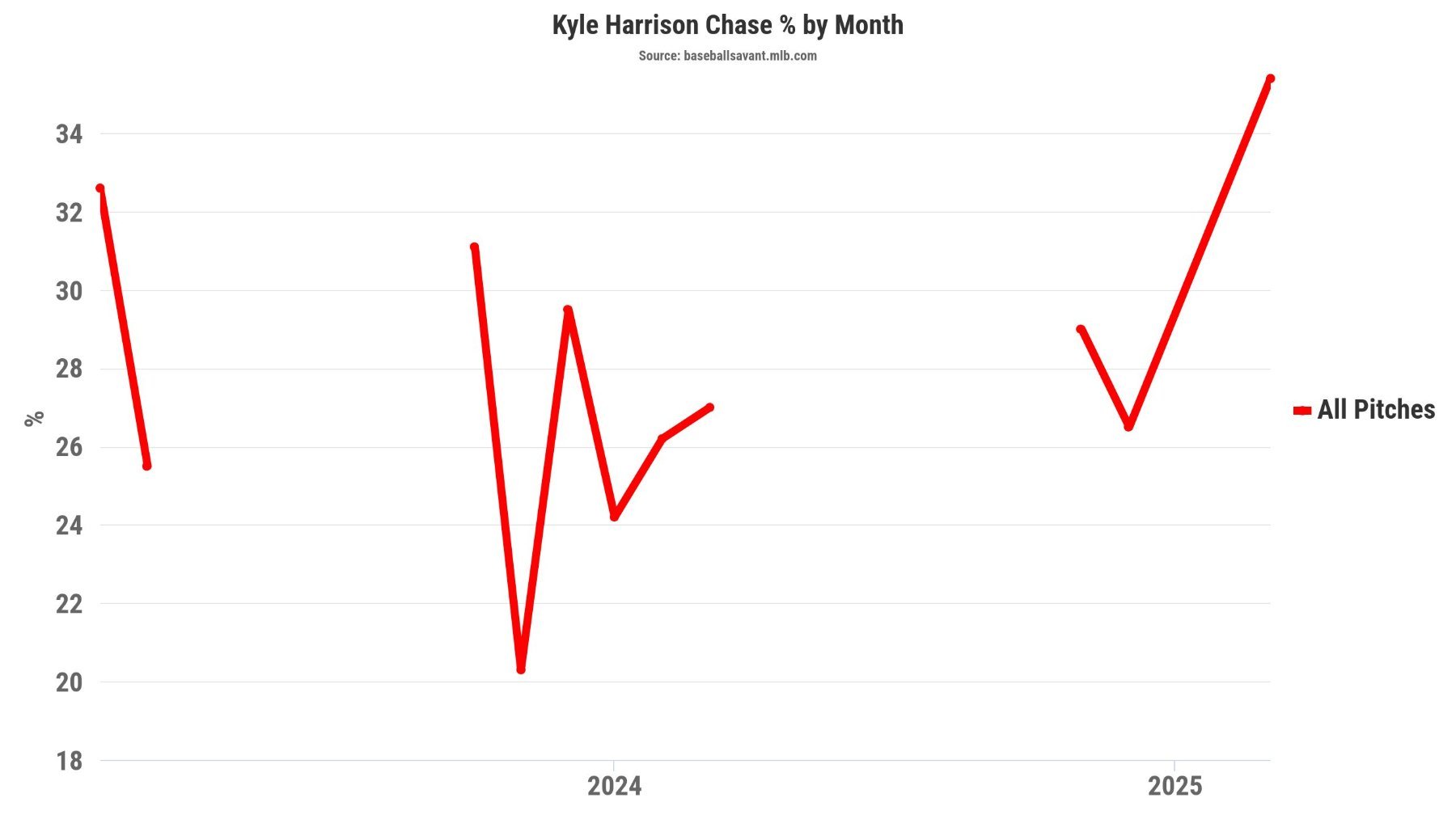
Harrison pitched only 12 innings for Boston down the stretch last year, but in that time, he looked like a more well-rounded starting pitcher with a complete arsenal. With those new pitches in his mix, his chase rate spiked to 35.4%, a career-best for any month of his big-league career.
None of that means he’s a finished product, though. Harrison said it took an offseason to start locating a changeup with more movement, and he’s still searching for the most comfortable cutter grip. That’s where Chris Hook, Jim Henderson, and others can accelerate his evolution.
“We’ll see what their plans here are for me with my pitch mix, but I love how they’ve just been laid back,” Harrison said. “They’ve let me kind of run the show, and ultimately, I think they’re going to let me know what they want me to keep and what I can get better at. So I’m just all ears and looking forward to getting better here.”
Any work the Brewers have done with Harrison’s arsenal may come to light on Tuesday, when he’ll make his spring debut against Great Britain in their World Baseball Classic tuneup game. He could join Quinn Priester as another young starter to improve his arsenal in Boston and perfect it in Milwaukee.