
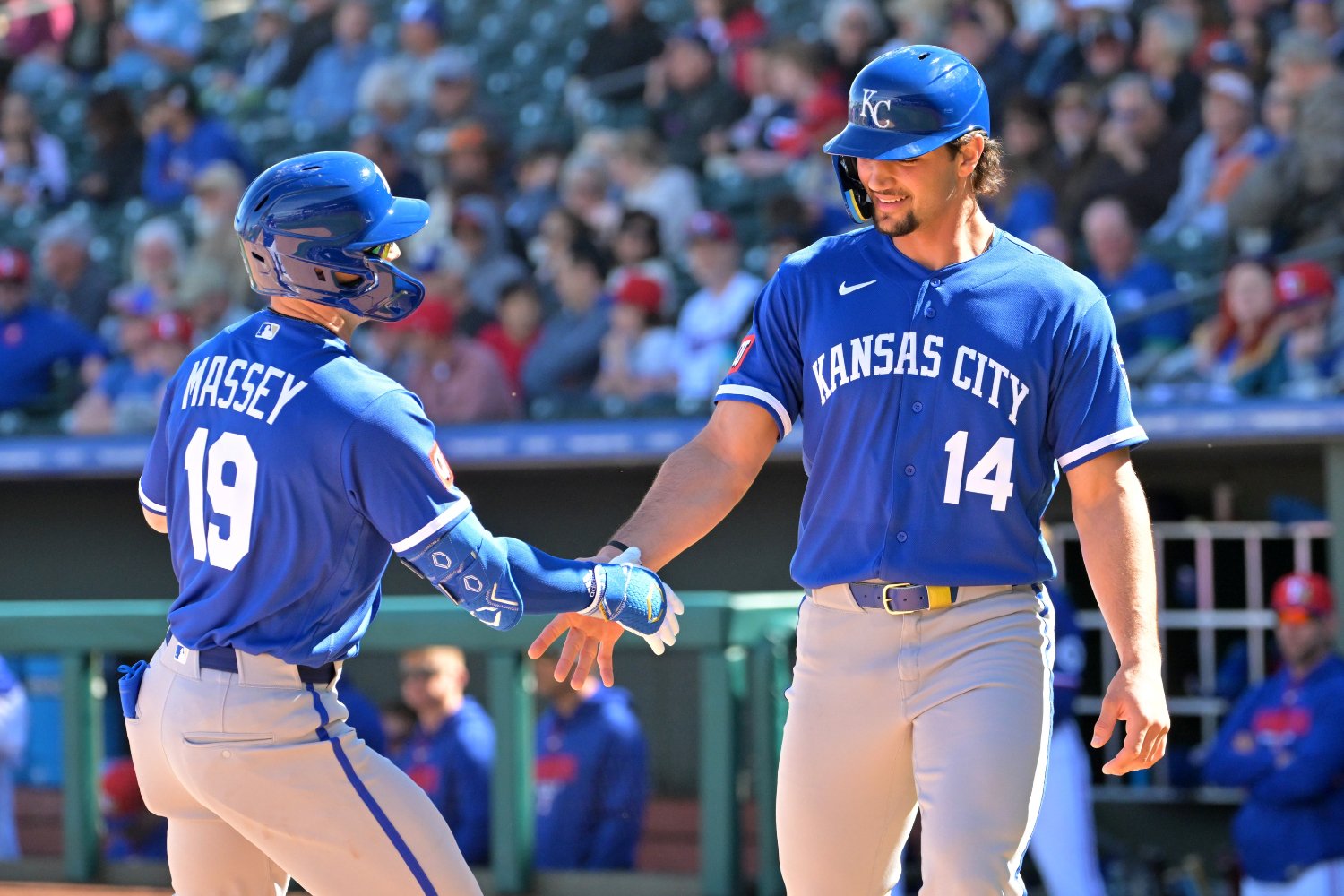
The Royals are 10 games into Spring Training and have a 5-5 record after their loss today to the Angels.
Granted, Spring Training results always have to be taken with a grain of salt. After all, Kansas City has plenty of Cactus League success in the past, only for those accolades not to carry over into the regular season. Thus, while more wins in Arizona would be nice, the more important aspect of Spring Training for this team is staying healthy and getting warmed up for Opening Day against Atlanta on March 26th.
One interesting thing to watch in Spring Training is how players perform and if there’s any underlying data that can hint at a solid upcoming season. With Statcast now fully functional and public in every Spring Training facility, baseball fans, including Royals fans, have access to a range of metrics on hitters and pitchers that weren’t available publicly before.
Thus, in this post, I am going to look at five Royals players who are standing out in Cactus League play due to a particular metric. I will focus on three hitters and two pitches, explain what those metrics mean, and what those metrics could hint at for the upcoming season for that particular player. All metrics are courtesy of TJ Stats’ MLB Batter Leaderboard, available on his site.
Much has been made about Caglianone’s power this Spring. After all, his Statcast metrics are pretty ridiculous right now, especially in terms of batted-ball quality.
Over 12 BBE (batted-ball events), he is producing a .522 xwOBA, a 25% barrel rate, a 66.7% hard-hit rate, a 116.5 MPH 90th EV, and 120.2 MPH Max EV. Safe to say, he looks a lot more comfortable at the plate this spring than he did in his call-up last season.
Past the Eye Test highlighted Caglianone’s spring with his app tool, and everything seems aligned for the former Royals first-round pick to break out in 2026.
While the hard-hit and exit velocity metrics are impressive, as well as the lack of whiff, the plate discipline Caglianone has demonstrated this spring has been the most eye-popping.
In 20 plate appearances, he has only had an 18.5% chase rate. For context, he had a 38.5% chase rate in 232 plate appearances last year. Thus, a 20% positive difference is a good sign that Caglianone is not only coming to the plate with a better plan, but that the hitting coach team, with new assistant hitting coaches Connor Dawson and Marcus Thames, is having an impact.
Granted, it’s only 20 plate appearances, and it’s Spring Training. Thus, Royals fans shouldn’t be putting down their “Caglianone for MVP” bets just yet. Pitchers are often rusty at this point in Spring Training, and so the lack of chase may be more due to pitchers’ shoddy control than Caglianone’s plate discipline.
Nonetheless, he’s looking confident at the plate, and his ability to lay off waste pitches that he swung at a year ago is a promising sign for him as a hitter, even if it’s just Spring Training. If this approach carries over to the World Baseball Classic (he will be playing for Italy), then the Royals have to feel really good about his outlook this season.
Josh Rojas: 63.6% Hard-Hit Rate
The addition of Starling Marte makes it a little more challenging for Rojas to make the Royals’ Opening Day roster as a non-roster invitee. However, the 31-year-old infielder is doing all he can to prove that he deserves a chance to show Kansas City what he can do after a down season with the White Sox in 2025 (.180 average and .511 OPS in 189 PA).
In 14 PA and over 11 BBEs, Rojas has a .555 xwOBACON, a 36.4% barrel rate, and 106.6 MPH 90th EV. Furthermore, the most impressive Statcast metric? His 63.6% hard-hit rate. That has helped him hit two home runs and generate a .615 ISO in his small Spring Training sample.
Over the past two seasons, Rojas has hovered around a league-average hard-hit rate, which is around 38%. In 2024, his hard-hit rate with the 38.2%. His hard-hit rate last year? 36.8%, which is 1.4% lower than what he did in 2024 with the Mariners.
Thus, he’s obviously not going to sustain a 60+% hard-hit rate into the regular season. That said, could he hit that 38% hard-hit rate or slightly above? If so, he could be a .670-.700 OPS hitter with stellar defense in the infield, which would be a nice asset to have off the bench.
Massey is entering a crucial season in 2026. He showed promise in 2024, hitting .259 with 14 home runs and a .743 OPS in 332 plate appearances. Unfortunately, he took a step back in 2025, hitting .244 with only three home runs and a .581 OPS in 262 plate appearances. MJ Melendez was entering a crucial season last year and couldn’t produce. The Royals are hoping that Massey can avoid Melendez’s fate.
So far, the 27-year-old is off to a great start this spring.
In 15 PA, he’s hitting .538 with a .606 wOBA and one home run. What’s interesting about Massey’s profile is that he isn’t hitting the ball all that hard. He doesn’t have a barrel, and his xwOBA is only .379, a significant gap from his actual wOBA. That said, what has made Massey successful this spring has been his ability to launch the ball. Not only does he have an average launch angle of 14.5 degrees, but he also has a Sweet Spot% of 70%. That shows that Massey can launch the ball effectively, even if he’s not producing consistent premium exit velocity.
Launching the ball has always been a strength of Massey’s. Even though he struggled to produce decent exit velocity, barrel, or hard-hit rates in 2025, he did rank in the 58th percentile in Sweet Spot%, according to his TJ Stats summary.
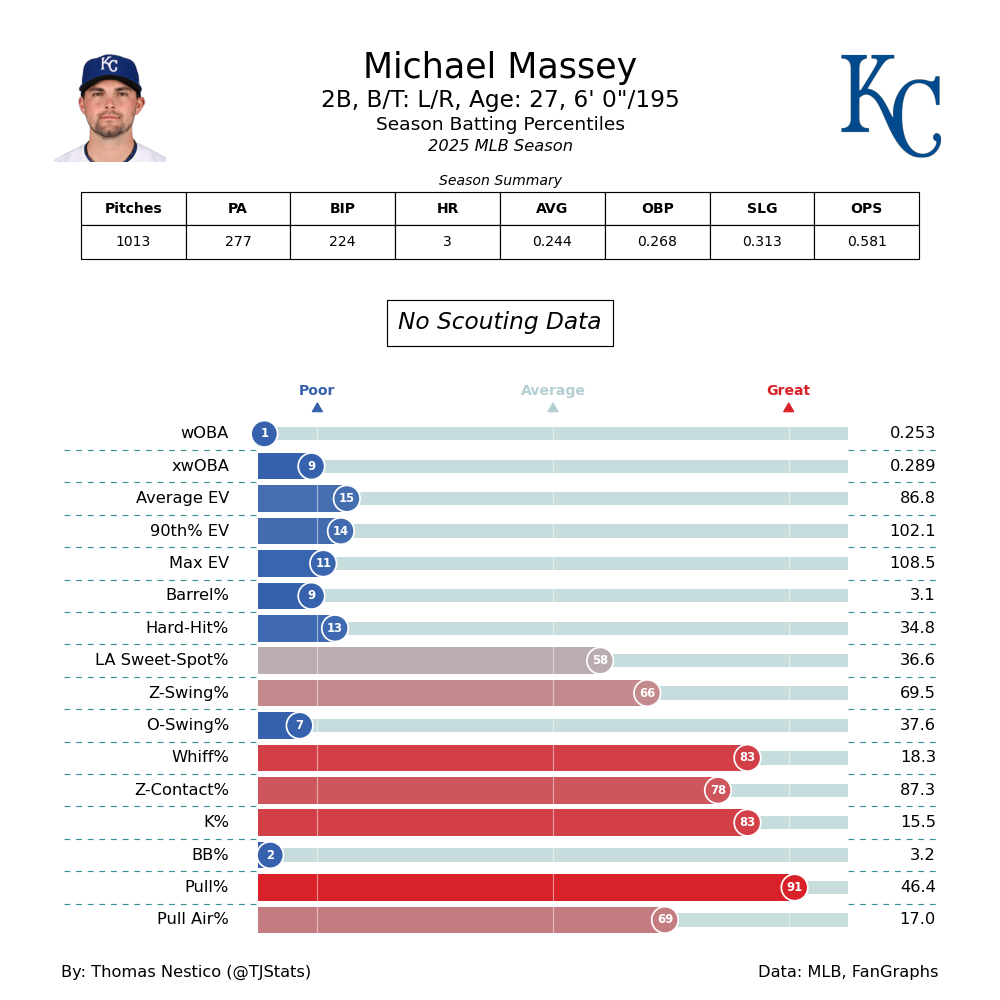
I think there is still something left in the tank with Massey, and his 2025 may have been more injury-plagued than fans were led to believe. The fact that he’s launching the ball effectively this spring and producing some hard hits occasionally with that consistent launch angle could be a sign that he’s ready to bounce back to his 2024 numbers.
Much has been said about the Royals’ starting pitching depth this spring. However, things got off to a rough start this spring, with Stephen Kolek initially shut down due to a grade 1+ oblique strain (which should put him out for around five weeks).
Thankfully, the depth the Royals have built has come in handy, especially with Bergert, also acquired with Kolek from the Padres at the Trade Deadline last year, off to a stellar start in Cactus League play. In two outings and three innings pitched, he has a 0.00 ERA and 0.67 with two strikeouts and a walk allowed.
The results haven’t been eye-popping on a strikeout (18.2% K%) or whiff (26.3%) end, but he’s demonstrated excellent stuff so far through two starts. His 104 overall TJ Stuff+ leads all Royals pitchers, and five of his six pitches have a TJ Stuff+ mark of 100 or higher. Below is a breakdown of his TJ Stuff+ profile via TJ Stats.
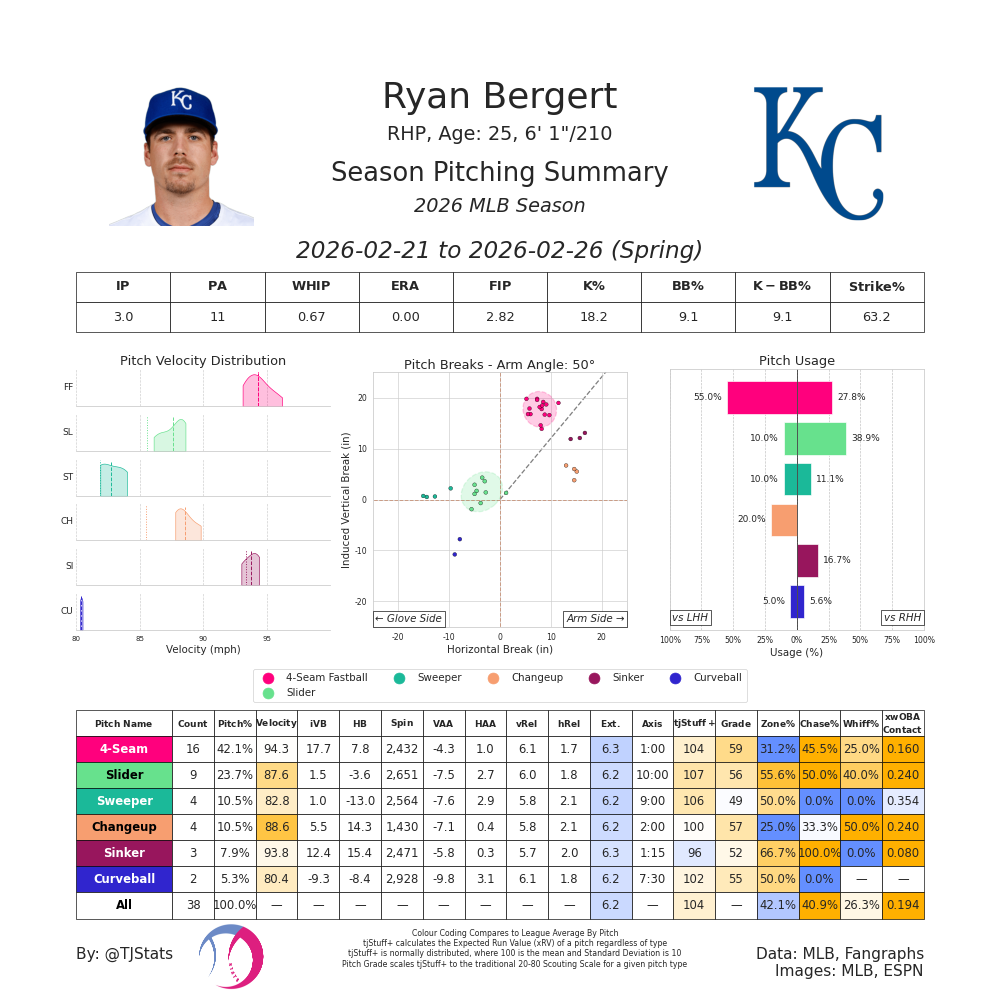
Granted, Bergert has struggled a bit finding the strike zone (42.1%) in his first two outings, but his ability to generate chase (40.9% chase rate) and limit hard contact (.194 xwOBACON) has helped him succeed this spring. He may still be on the outside looking in when it comes to a rotation spot (Noah Cameron holds a slight edge for the 5th spot). However, if he keeps showing this stuff in Cactus League play, he’ll make it tough for the Royals to keep him off the Opening Day roster.
Dennis Colleran: 39.4% CSW% (Called-Strike-Plus-Whiff)
CSW can be a good stat for evaluating how effectively a pitcher generates strikes overall (read this piece from Alex Fast on Pitcher List on the creation and breakdown of this relatively new statistic). The better the CSW, the more dependable a pitch can be when it comes to getting strikeouts and putting hitters at a disadvantage.
When it comes to the Top 5 Royals pitchers this spring in terms of CSW, Andrew Perez, who pitched in the Independent League last year, leads with a 56.3% CSW (though he has only seen five batters). Cole Ragans is second with a 44.4% CSW, and Kris Bubic is third with a 41.9% CSW. The fourth? Colleran, who has a CSW of 39.4%.
Colleran may be one of the most underrated pitching prospects in the Royals system, mostly because he’s a reliever. However, he posted a 2.85 ERA, 3.52 FIP, and 27.1% K% across three levels and 66.1 IP last year. In Cactus League play, he’s been dominant, not only sporting a near 40% CSW, but a 0.00 ERA, 33.3% K%, and 1.10 FIP in three innings of work. While the sample size is small, his Statcast percentiles have been impressive, as seen below.
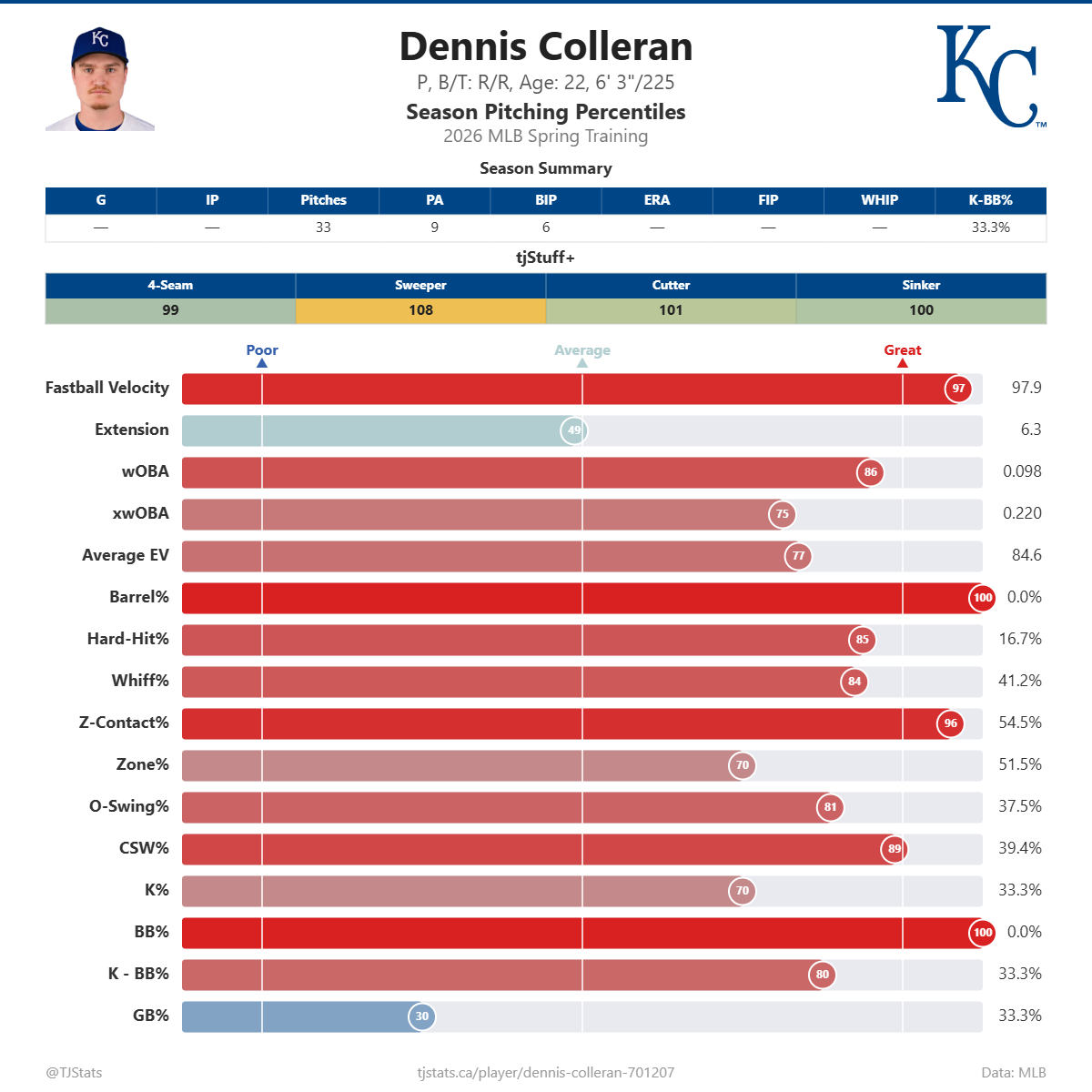
There’s a lot of red in his profile, which is an encouraging trend. He ranks in the 84th percentile in whiff rate, 85th percentile in hard-hit rate allowed, and 89th percentile in CSW. Lastly, he also ranks in the 97th percentile in fastball velocity, and three of his four pitches have TJ Stuff+ marks of a 100 or higher (his four-seamer is just below that threshold at 99).
It’s still early in Cactus League play. However, Colleran has a Major League reliever profile and is pitching well enough to earn a midseason call-up at the latest (earlier if one believes in the TINSTAAPP principle).