
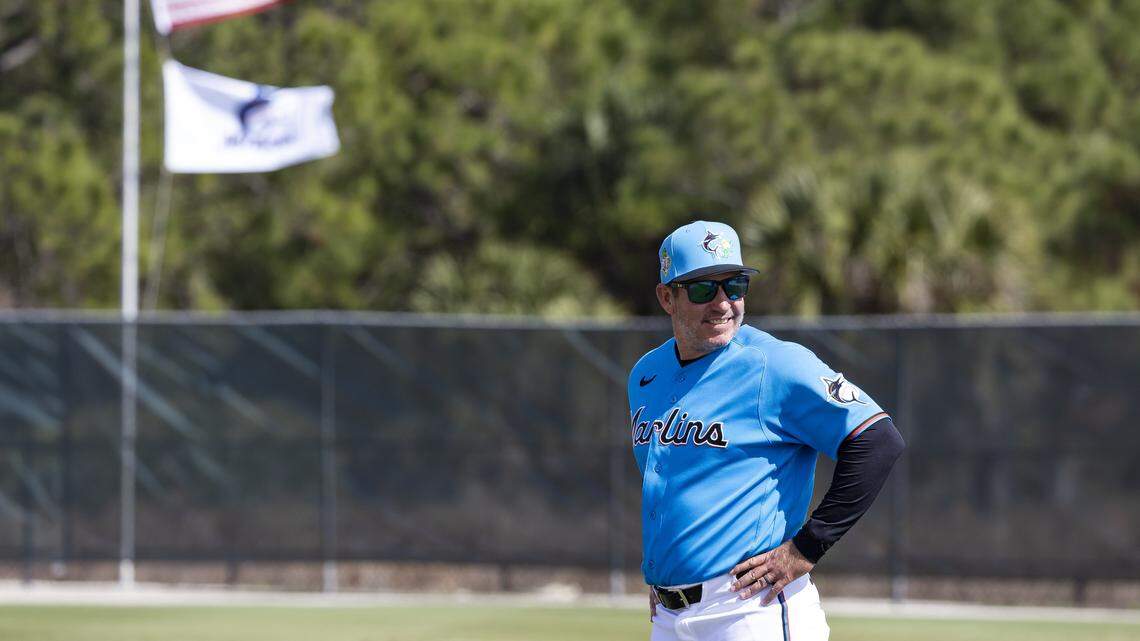
Miami Marlins manager Clayton McCullough (86) looks on during the team’s first full-squad spring training workout at Roger Dean Stadium on Monday, Feb. 16, 2026, in Jupiter, Fla.
Photo by Matias J. Ocner
mocner@miamiherald.com
JUPITER
Miami Marlins pitcher Josh White was ahead in the count 1-2 to St. Louis Cardinals right fielder Joshua Baez with one out, two runners on base and a one-run lead in the seventh inning on Monday at Roger Dean Chevrolet Stadium. White’s fourth pitch was an 86.1 mph slider that appeared to clip the lower inside corner of the strike zone for a strikeout.
Not so fast.
Baez tapped his helmet and attention shifted to the video board in left-center field. The ball was outside the strike zone by one-tenth of an inch.
Call overtuned. Ball 2.
White got in position again. He fired another slider. This time placing it near the lower outside corner of the strike zone. Once again called Strike 3.
Except … Baez tapped his helmet again.
Another review. Baez was right again, with White’s pitch missing outside by three-tenths of an inch. Ball 3.
Two pitches later, Baez drew a walk. The Cardinals’ Jeremy Rivas hit a game-tying sacrifice fly in the next at-bat. The Cardinals went on to win the spring training contest 3-2 in walk-off fashion.
Two taps of the helmet on back-to-back pitches changed the course of the game.
And it served as a prime example in real time of how beneficial Major League Baseball’s latest initiative can be when used right.
“That,” Marlins manager Clayton McCullough said postgame, “was probably MLB’s dream scenario right there.”
The Automated Ball-Strike (ABS) Challenge System is coming to MLB this season after being tested in the minor leagues since 2022 and in big-league spring training last year. It gives players a formal, effective, efficient — and, when done right, strategic — way to ensure key calls are made correctly while also not completely eliminating the human element of home-plate umpires.
And count McCullough among those embracing the addition.
“We’re having a lot of fun conversations in the dugout with staff and players, just on timing of things,” McCullough said. “Those will continue to be ongoing and be very fluid as more information comes and everyone just gets more used to them. This is kind of the new normal, and it’s just a part of strategy, like anything else.”
So how does the whole system work? Here’s a quick primer:
Each team will start with two challenges apiece. Pitchers, catchers and batters all have the ability to challenge a call. If a team successfully overturns a call, the challenge is retained. If a game goes to extra innings, they will be given one challenge per inning.
Challenges must be made immediately after the umpire’s call. The challenge is initiated with the tap of a cap or helmet.
From there, an animated pitch result graphic is shown on the stadium’s video board and on the television broadcast and a decision is quickly made. The whole process takes about 15 seconds. It’s similar to the challenge system in tennis with the quickness from initiation to result.
So far in spring training, Marlins catchers have done the majority of the challenging — and have overall been successful. Agustin Ramirez is 4 for 5. Liam Hicks is 4 for 6. Joe Mack is 1 for 2.
McCullough and Mack credited Marlins director of catching Maxx Garrett and first base coach Craig Driver for helping the catchers get valuable reps with the challenge system in practice that are translating into games.
“They’ve been in the stadium using the technology we have there to try to gamify as much as we can their practice settings,” McCullough said. “We’ve continued to encourage them to trust that training. We believe that, ultimately, they’ll be, we hope, the best at doing this.”
Mack, who has experience with the challenge system from his time in the minor leagues, said the Marlins have strategies in place on when best to use their challenges but added that catchers “are usually allowed to just rip them whenever we think that a ball is a strike or a strike is a ball.”
The main adjustment for Mack this year is how the strike zone is adjusting for each hitter. While the width of the strike zone remains unchanged at 17 inches over home plate, the height will vary by player. The top end of the strike zone is at 53.5% of a hitter’s height. The bottom is at 27% of the player’s height.
“Instead of just having one set zone for everybody,” Mack said, “it’s pretty much custom to that person. So I guess [the main challenge is] just kind of like figuring out each person’s zone and really just being intentional with that.”
Injury and roster updatesOutfielder Kyle Stowers (right hamstring strain) took about 30 swings and played catch on Sunday. McCullough said the plan is for him to get live at-bats on the back fields and start a running progression in the next few days.Right-handed pitcher Janson Junk (right ankle sprain) is scheduled to make his first Grapefruit League appearance of spring on Saturday. He is set for one inning in that game.Right-handed pitcher Anthony Bender (shin) is scheduled to do a couple more live batting practice sessions before appearing in Grapefruit League games.Left-handed pitcher Thomas White (right oblique strain), MLB’s No. 17 overall prospect, is sidelined for the remainder of spring.White and six other players — fellow pitchers Patrick Monteverde, Dale Stanavich, Stephen Jones, Evan McKendry and Samy Vasquez plus catcher Sam Praytor — were reassigned to minor-league camp on Tuesday.
.JPG)
Miami Herald
Jordan McPherson covers the Miami Hurricanes and Florida Panthers for the Miami Herald. He attended the University of Florida and covered the Gators athletic program for five years before joining the Herald staff in December 2017.