
This story is part of Peak, The Athletic’s desk covering the mental side of sports. Sign up for Peak’s newsletter here.
On Tuesday, Aaron Judge, the New York Yankees outfielder, was asked to give a speech.
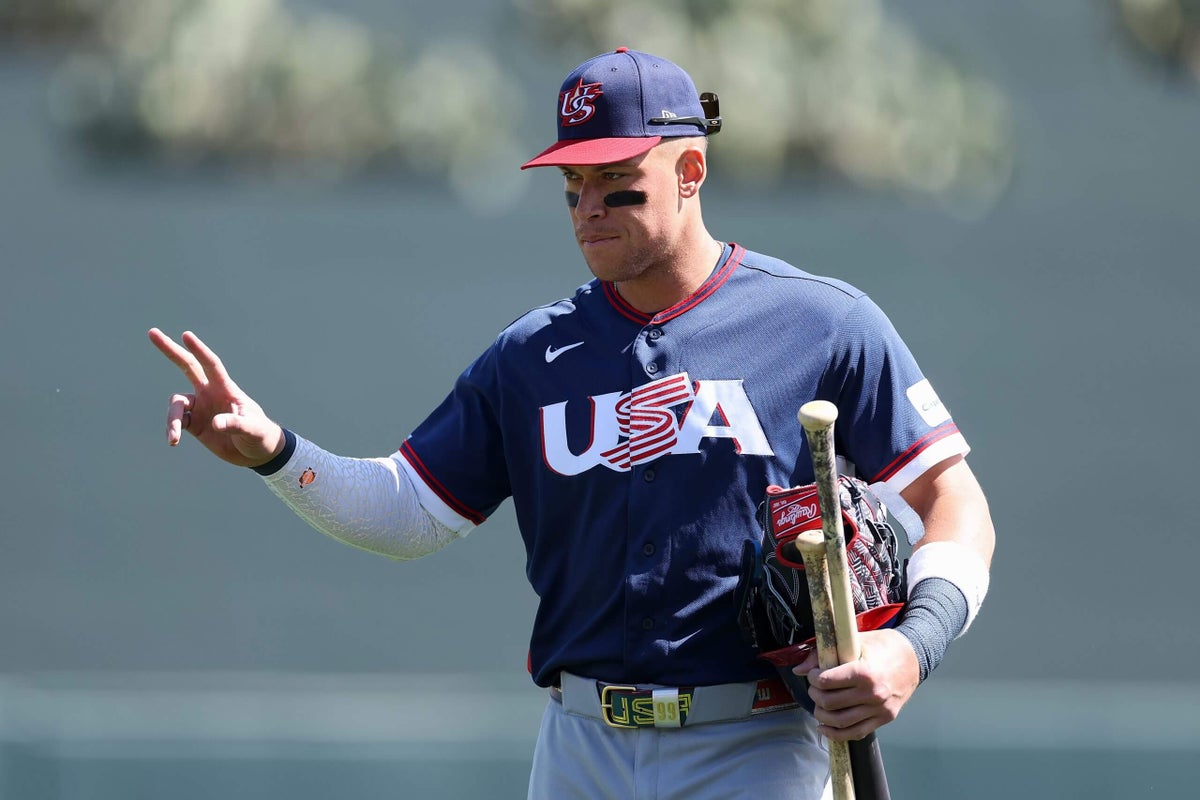
The task came in a meeting room in Arizona, where Team USA is preparing for this month’s World Baseball Classic. Judge, the team’s captain and biggest star, stepped to the front.
“We’re down, we’re beat up a little bit, man,” he said. “You know, lean into each other, man. We’re going to lay it out on the line.”
His remarks were short, and the clip released by Major League Baseball even shorter — 20 seconds in all — but the court of public opinion was harsh and swift: Judge’s speech swung and missed.
“Aaron Judge’s WBC speech will have you ready to go for a brisk walk,” read one representative evaluation.
For the last year, our team at Peak has developed a minor obsession with speeches in the sports world. We’ve analyzed Roger Federer’s viral commencement address, the fiery locker room speeches of Detroit Lions coach Dan Campbell, and the legendary ESPYs speech from Jim Valvano, the late North Carolina State basketball coach.
But this was something different — a widely panned, instantly derided speech from one of baseball’s best players. The delivery was a little flat, the energy somewhat staid. But was it really that bad?
“I’m really angry at the response to this speech,” said Allison Shapira, an adjunct lecturer at Harvard and the CEO of Global Public Speaking. “The internet frenzy over this is exactly why people hate public speaking: Because they’re afraid of (a) 20-second clip of their speech being made public and becoming the object of ridicule. It’s this kind of fear of rejection that makes people not want to speak in the first place.”
Shapira was among the speech and rhetoric experts we contacted, asking a simple question: What did you think of Judge’s speech? (To give her response even more crucial context: She’s also a lifelong Red Sox fan.)
“Is it the most inspiring speech in the world? No,” she said. “Is it Jimmy V’s speech? No. Is it the worst speech in the world? It’s not even close. And it can’t even be the worst speech anyone has ever heard because they didn’t hear it. They saw a 20-second clip that was itself a compilation of clips. We didn’t hear a speech.”
That was true. It was, in some ways, a version of what academics call “contextomy,” or the practice of altering a sound bite or quote to create a negative view. Nobody was trying to make Judge look bad, said Steven Cohen, a professor at Johns Hopkins, but it was still an example of the “the power of a sound bite at work.”
“We don’t get the important context,” Cohen said. “And what happens when listeners lack context is they fill in the blank themselves. They make assumptions about what came before and what came after. And given that we live in a soundbite culture, there is so much focus on mastering every moment.”
In this case, the criticism seemed to be more about the delivery than the content. Judge, 6-foot-7 and 282 pounds, is perhaps the most physically imposing presence in baseball. He speaks to reporters regularly. He is, inside the Yankees clubhouse, a respected leader.
For young teammates, Judge is a surprising source of comfort. Former Yankees pitcher Michael King recalled the first day he arrived in New York, when he knew almost no one. Judge was one of the first people to come over and greet him. offering encouragement, validation and connection.
Yet the clip of his Team USA speech seemed to illustrate the inherent difference between connecting with a teammate and standing before a room of co-workers and strangers and trying to inspire.
Judge is not the first athlete to be vexed by the challenge. Former Cincinnati Reds star Joey Votto took improv classes in his hometown of Toronto to improve his communication with teammates. American sprinter Lauryn Williams, an Olympic gold medalist, signed up for Toastmasters International, the public speaking and leadership organization. And before the Seattle Seahawks won the Super Bowl, their head coach, Mike Macdonald, began the season by telling his players that public speaking wasn’t his specialty; it was something he wanted to improve.
“Nobody is born a great public speaker,” Shapira said. “Some people are naturally better at it than others, just like some people pick up a baseball bat and they’re naturally better. But it’s a skill that we hone over time. We saw a world-class athlete who looked uncomfortable being the center of attention for something he hasn’t trained his entire life for.”
Added Jim Holtje, a speech writing and delivery professor at Columbia University: “It’s like getting to Carnegie Hall: practice. The more experience you have delivering these types of remarks, the easier it gets.”
It’s possible that Judge’s speech still offered something useful: a learning experience. Cohen likes to tell students that the best way to connect with an audience is to start with a simple question: What’s keeping your audience up at night?
“The best speakers make it all about the audience,” Cohen said.
Another way: Be vulnerable. Don’t be afraid to show weakness.
For the best speakers, Cohen says, the voice is a musical instrument, which makes it a strategic tool in rhetoric — a way to provide vocal variety and rhythm.
“I listened to an interview that he gave earlier because I wanted to get a sense for how he was in other situations,” Shapira said. “When I saw Aaron in other situations, I heard him speak with a natural expressiveness, conversational style. I heard him speak with passion and energy in his voice.
“When we get up in front of an audience, all that natural enthusiasm gets flattened by our fear and nervousness because our fear and nervousness makes our voice constrict. It flatters our voice. It’s not that that’s how we are as a speaker, it’s that we don’t show up as who we truly are.”
Another tool that Shapira recommends: When you’re giving your speech, pretend to be speaking to one person at a time.
“When we stop trying to scan the room and just connect with one person at a time, it usually feels more natural because we have one-on-one conversations all the time,” Shapira said.
On Wednesday, Shapira sat and watched the clip 50 times in a row. What fascinated her most was the reaction.
“It demonstrates what we expect of leaders who have the title of leaders,” she said. “Everyone is like: Oh, not much of a leader if he gave that speech, which shows our societal expectations of what a leader looks like and sounds like, regardless of their expertise and industry.
“He’s the captain of Team USA, he’s the leader of that team; we snap our fingers and expect that person to be able to motivate and inspire as a leader. It demonstrates what society expects leaders to be good at, which is communication.”
The way Shapira sees it, a simple definition of leadership is bringing people together to achieve a shared goal. Sometimes that may include the language of a speech, verbalizing a vision and motivating others to move toward it. Sometimes that may include a one-on-one conversation or another way to connect.
On Wednesday, as Team USA played the Colorado Rockies in another exhibition game, Judge got back to doing what he does best.
He stepped to the plate and hit a home run 453 feet.