
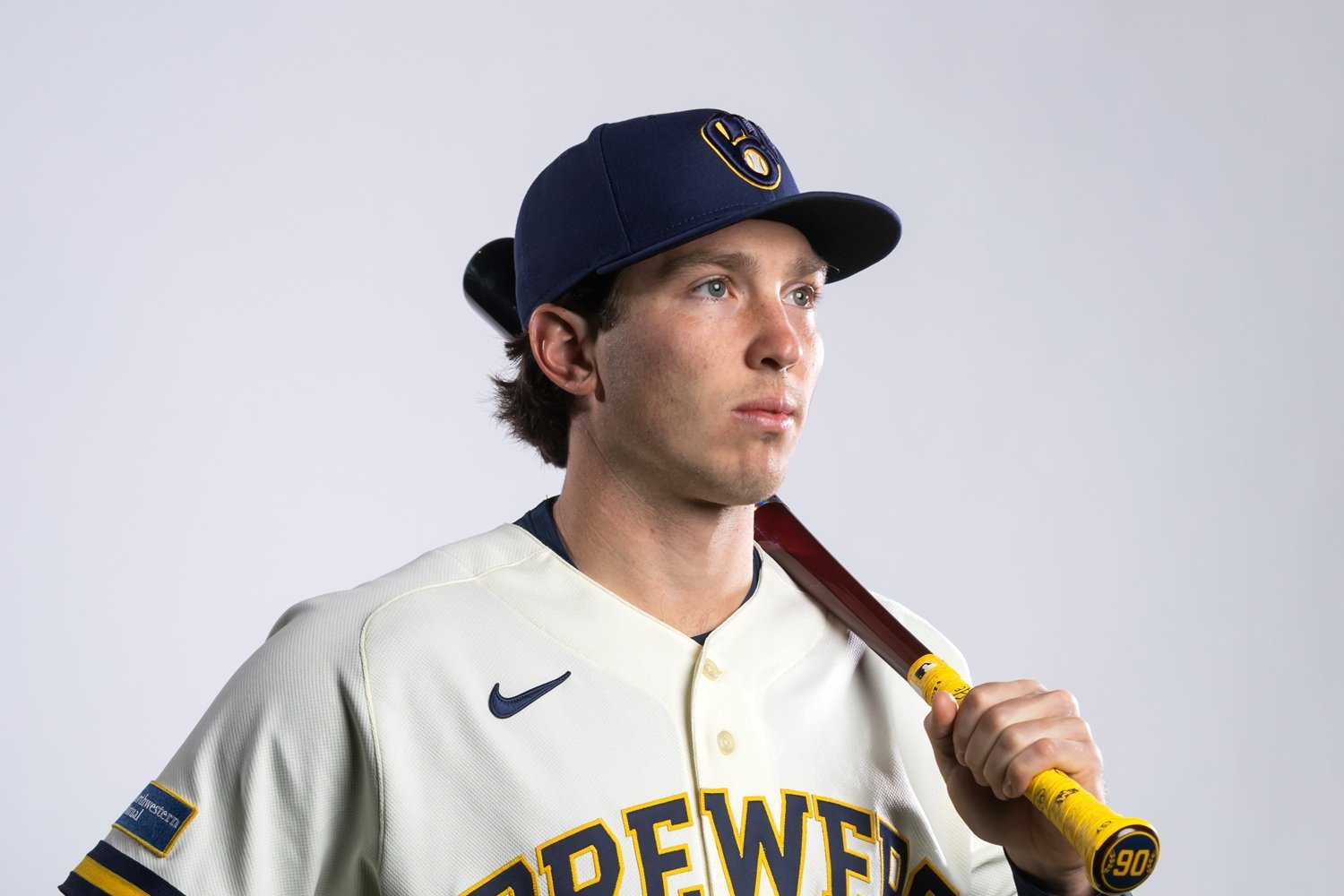
Darrien Miller has long been an under-the-radar prospect at catcher in the Milwaukee farm system, without the 40-man roster spot or prospect luster of Jeferson Quero, or the high offensive ceiling of Marco Dinges.
Miller’s been dinged at times for having merely acceptable defense, with the biggest knock being his relative inability to keep baserunners honest compared to the pre-injury form Quero displayed. However, this year, Major League Baseball’s new Automatic Ball-Strike (ABS) system and the new rule allowing challenges to ball-strike calls may make Miller’s offensive skill set more valuable behind the plate.
Throughout his professional career, Miller’s carrying skill has been his on-base skill. Miller’s drawn 271 walks, and he’s also gotten on base the painful way 102 times. A secondary feature has been some pop in his bat, in the form of 37 homers in his professional career.
One at-bat from the Brewers’ February 27 Cactus League game against the White Sox points to how Miller’s offensive skillset may increase his defensive value behind the plate. Specifically, it was the last pitch of the showdown in a high-leverage situation.
It was the top of the eighth inning, and the Brewers were clinging to a 5-2 lead when Will Childers was called in to relieve Drew Rom, who’d been pretty wild, allowing three walks and a wild pitch in two-thirds of an inning. When Childers came in, the bases were loaded with two outs, with White Sox third baseman Jordan Sprinkle, their fourth-round pick from the 2022 MLB Draft, coming to the plate.
Sprinkle’s primary offensive tools are the ability to get on base (137 walks as a pro) and a lot of speed (he stole 80 bases between three minor-league stops in 2025). He doesn’t have a lot of power, though, and prior to 2025, he tended to strike out a lot (260 times in 1,046 professional at-bats) for a player who has only hit seven baseballs into the stands throughout his professional career.
According to the MLB Gameday recap of the at-bat, Sprinkle didn’t swing once, with Childers’s first three pitches being pretty clear balls. Then, Childers settled down, getting two called strikes. On the sixth pitch, home plate umpire Brian Van Vracken called it “ball four,” which meant Sprinkle would walk and the runner on third would come into score.
Here’s where we need to explore the rules of the ABS challenge system. Only the batter, pitcher, or catcher can challenge the call. The call also has to be challenged right away. To challenge or not will be a split-second decision, almost as fast as deciding whether or not to swing the bat as a hitter.
The stakes are high. If the call being challenged is upheld, the team loses its challenge; they only get two for the first nine innings of the game. On the other hand, if the challenge leads to the call being overturned, the team keeps it. This can have implications late in a game: blowing the challenges early can leave a team helpless when it really needs to get a second look at a borderline call.
In this case, Miller challenged the call, and Van Vracken’s “ball four” was overturned, becoming a called strike three. The ABS showed that Childers’s pitch had caught the bottom edge of the strike zone for the third out of the inning, and Miller’s eye was at a level where he decided the challenge was worth it. The White Sox got nothing to show for all the ducks on the pond from Rom’s earlier struggles in the inning, and the Brewers went on to win.
What does this pitch mean going forward? On the one hand, it is just one pitch, the smallest of small samples. But on the other hand, Miller’s eye for the strike zone is arguably one of the best in the organization, based on his entire professional career to date. With the rules surrounding the ABS challenge system, Miller’s eye has potentially become not just a weapon at the plate, but behind it as well.