
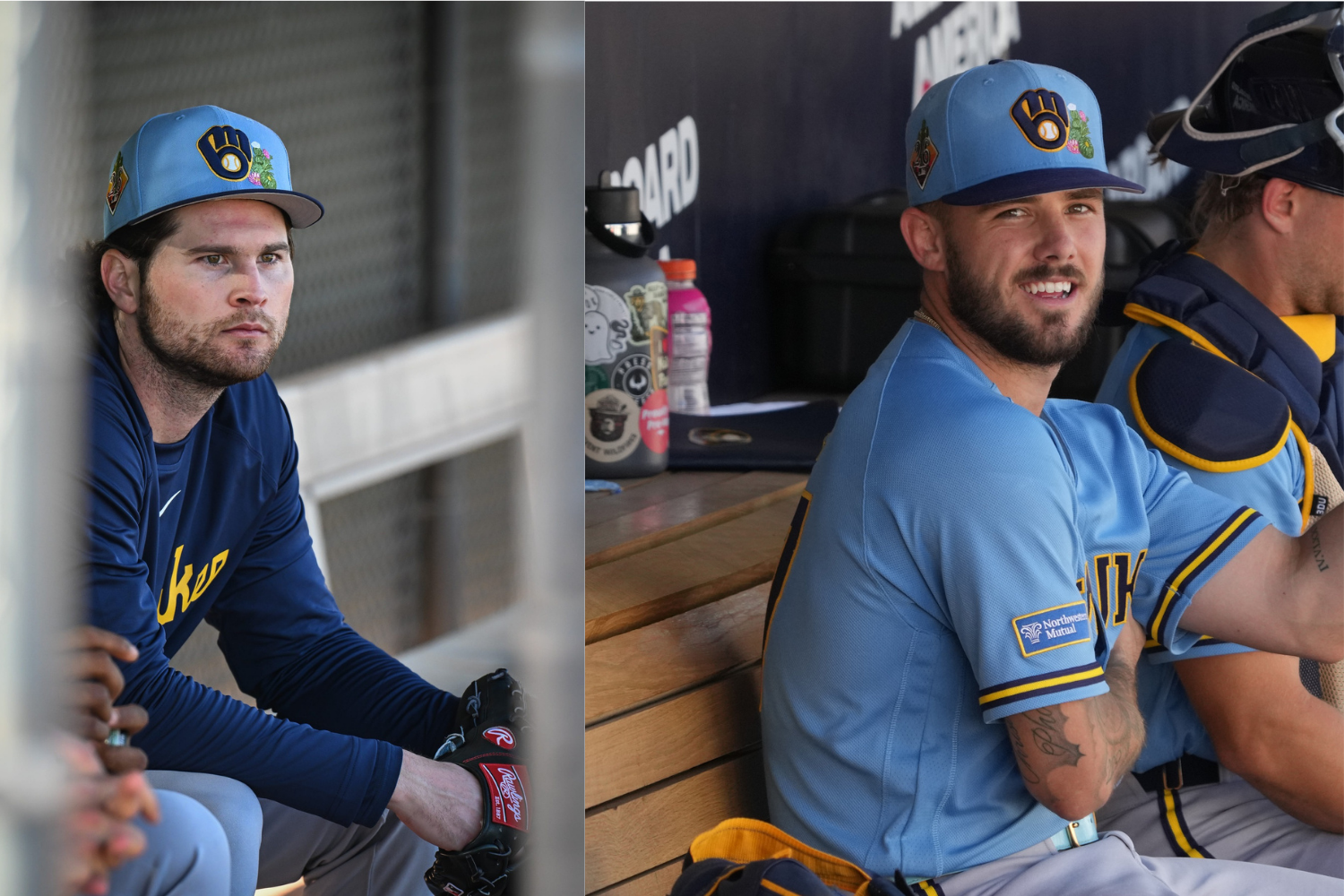
In matters of personality, DL Hall and Shane Drohan couldn’t be much more different. Drohan is the player most likely to be found, during each morning’s open clubhouse period, sitting quietly at his locker with his phone. He’s happy to talk, but volunteers little to the team’s ongoing patter. Assigned to the bank of three lockers set apart from any others (with an empty stall next to him and equally quiet prospect Luke Adams on the other side of that gap), Drohan is easy to see but hard to hear—sometimes, even when you talk to him.
Hall, who has lockered next to Brandon Woodruff since his first spring with the Crew, could be found on his knees at one point this week, reenacting his inglorious role in some past baseball brawl for laughing teammates. His South Georgia drawl erupts from him, whereas Drohan’s words seem to come only with effort and thought. Hall is the Brewers’ resident sneakerhead; Drohan professes to love history documentaries. (“Amazon Prime; that’s the spot for documentaries that I’ve found, so far.” But: “You do have to kind of filter out, because there are some crazy documentaries that I’m like, ‘I don’t know how much truth there was to that one.'”)
Yet, in the context of this team and beyond, the two have a great deal in common, too. They were born just four months apart: Hall in September 1998, and Drohan in January 1999. Though it says ‘6-foot-3′ on Drohan’s Baseball Reference page, the Brewers measured him at 6-foot-2 this spring; he weighs 202 pounds. Hall is 6-foot-1, 209 pounds. The cultural distance between Hall’s native Valdosta and Drohan’s birthplace in Fort Lauderdale is large, but they’re really only about 400 miles apart. Each has spent some time on the prospect radar, but both are now optionable arms entering their age-27 season, sidetracked by injuries and not yet having established themselves in the majors. Each has an arsenal too wide and too promising to make you feel good at collapsing their value down to that of a left-handed short reliever, but each has had enough trouble with durability and/or control to make you wary of trusting them with a starting gig. This spring, these equal opposites are in a quiet competition for priority position in the Brewers’ pitching plans.
For Hall, the big spring project is trying to get his velocity back. He still believes he can tap back into the upper-90s heat he showed before injuries shook him loose and dropped him out of the top prospect firmament. However, he knows much better than to sit and wait for that to happen. Instead, he spent the winter adding a sweeper to his arsenal, giving him up to seven pitches to which he can turn when the situation calls for it. Since the four-seamer still isn’t doing what he needs it to do in order to dominate with it, he’s also favoring his sinker more—especially to lefty batters.
“It’s just been a progressive thing over the last eight months,” Hall said. “After coming off the injury last year, things change, your body starts moving differently and the four-seamer wasn’t riding as much as I want it to, so let’s try the sinker.”
So far, that pitch grades out well. Utilizing it against right-handed batters is more difficult, of course, but manager Pat Murphy chose Hall to pitch for Team Great Britain against a lefty-loaded Brewers lineup on Tuesday specifically to get him work in left-on-left matchups. While Murphy insists that any reliever in his bullpen have some way to get out both lefties and righties, that’s not a huge problem for Hall. For one thing, his changeup flashes plus, and has enough separation to be useful even in tandem with the sinker, rather than the four-seamer. For another, Hall also has a cutter he can use to get in on the hands of righty batters.
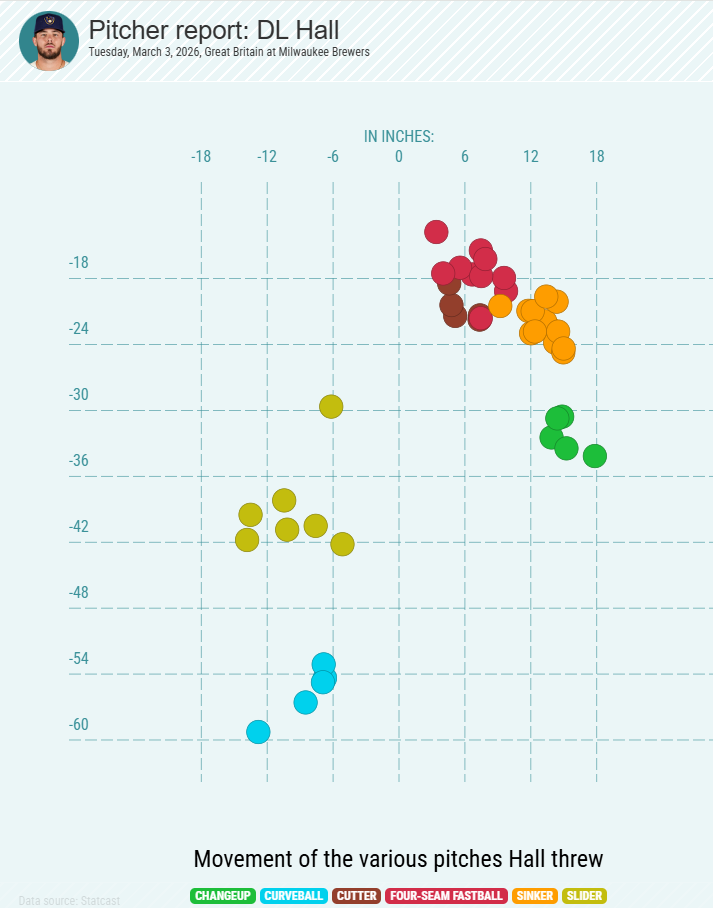
The cutter isn’t as distinct from his four-seamer as Hall would prefer, but that’s more because the four-seamer isn’t showing the good carry it once did than because of the cutter’s deficiencies. He has enough pitches he’s comfortable with to gut his way through showdowns with righty batters, and the new sweeper (along with the newly prioritized sinker) can stand him in good stead against lefties.
Drohan bears some similarities to Hall, but his stuff is much more oriented toward glove-side movement and manipulating the ball with spin. His four-seamer has the carry missing from Hall’s, and his cutter has more separation from it. He has a true, tight, vertical slider and a curveball, such that he can focus on a simple set of what the Brewers call “start lines”: the visual targets he uses for each pitch, letting the movement carry them to a different destination but ensuring consistent execution. The flip side of being so good at those glove-side offerings and having the carry on the heater is that Drohan’s changeup is not as good as Hall’s. To get righties out in the majors, he’ll need to execute well with his other four offerings.
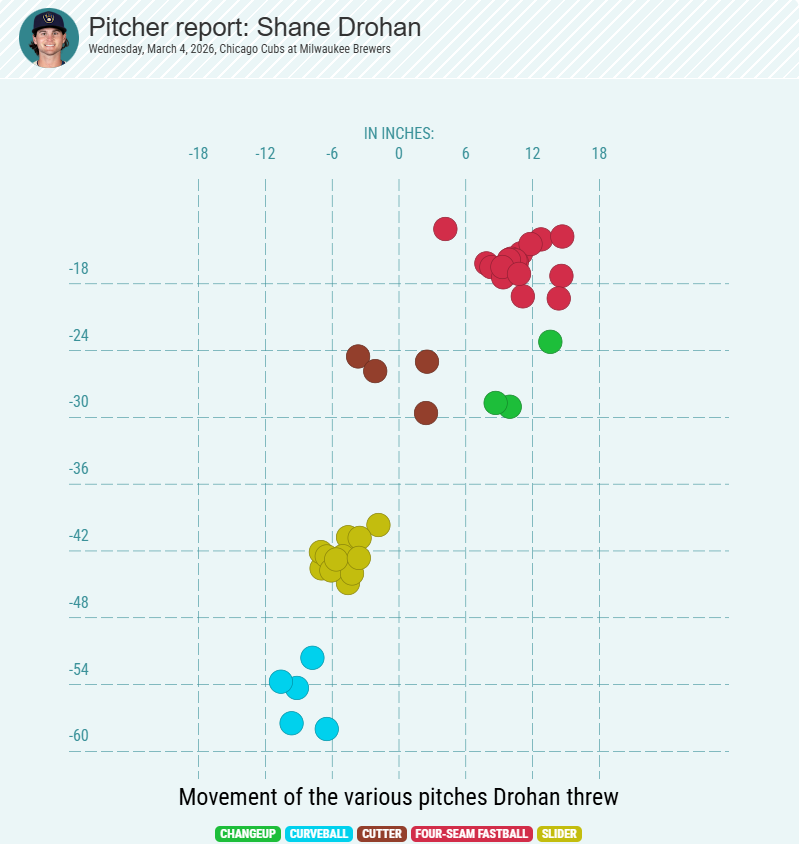
Both pitchers are stretching out and trying to keep themselves available for starting roles. Hall worked the first three innings of the game on Tuesday; Drohan took the final three on Wednesday. Both hurlers said they’ll adjust to relief work if needed, but that the team has kept them on plans consistent with starting.
“I just wanna pitch in the big leagues,” Hall said. He’s ready to do whatever the team believes will help them win, but is “trying to win a spot in the rotation.”
Now, tell me if this sounds familiar.
“I don’t really have a mindset on it,” Drohan said. “I wanna pitch in the big leagues, so whether that’s starting or in the bullpen, I’m willing to do either.”
Drohan said he doesn’t want to concede the chance to eventually start by turning away from it, and that there’s probably no benefit for him or the team in his switching lanes mentally before the time comes. For now, he and the team are working not on the installation of any new offerings or on rediscovering velocity—Drohan throws a couple ticks harder than Hall right now, anyway—but on matters of pitch mix. The lefty said most of the suggestions he’s gotten from Chris Hook and company have been along the lines of introducing pitches he would normally eschew in given situations, within an at-bat or an inning, rather than doing anything truly novel. That’s in keeping with the Brewers’ preference to let players who are new to the organization come in and familiarize themselves with the environment, before pushing any more significant changes.
To open the season, both pitchers are likely to be on the outside of the rotation battle, looking in. One might make the team as a reliever, but it’s also possible that both find themselves in Nashville, starting and awaiting an opening in Milwaukee. They’re different in appearance and sensibility, but so similar in skill set and circumstance that they could be on the same track for much of this season. The Brewers have an almost redundant pair of southpaws with very different personalities—as good an illustration of their superb depth as any.