
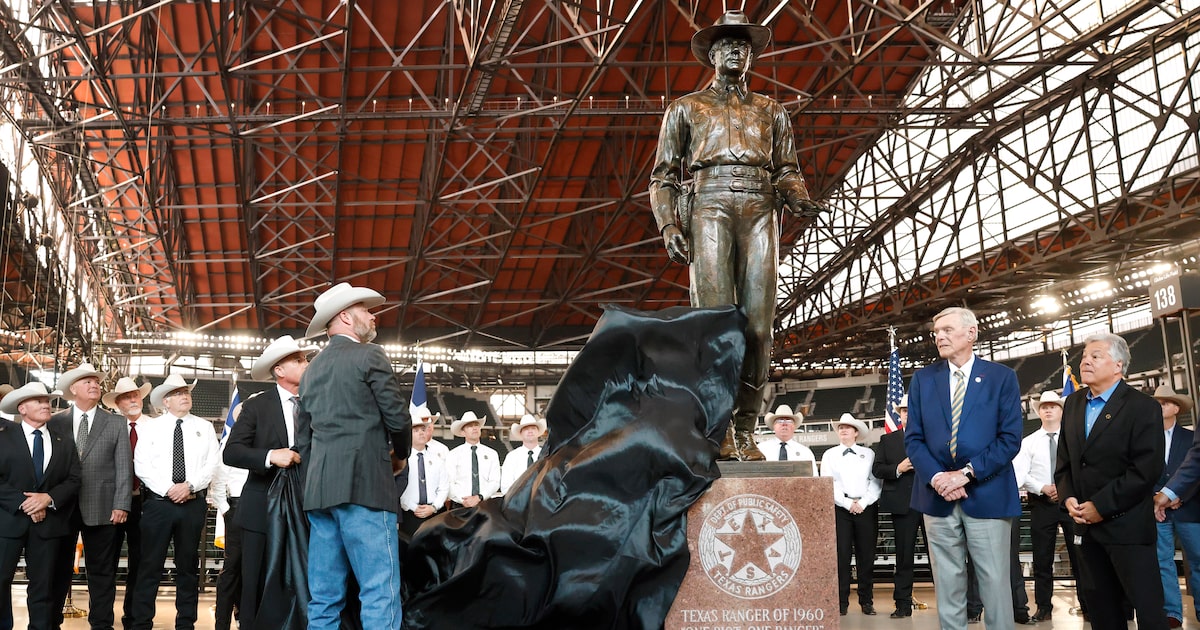

To quote a great archeologist: That belongs in a museum. And by that, I mean One Riot, One Ranger, the statue of Texas Rangers Capt. E.J. “Jay” Banks that was escorted out of Dallas Love Field six years ago.
Actually, that was once the plan – to eventually display Banks in a museum that might provide context about the face, and everything else, of the 203-year-old law enforcement agency. Banks was once so famous he appeared on the Today show, and eventually so infamous airport officials wheeled him out of sight lest protestors descend on Love Field in the days following George Floyd’s murder in 2020.
But so much for context.
The Texas Rangers welcomed Banks’ statue to Arlington this week during a ceremony befitting a conquering hero. It’s like he just casually sneaked back into plain sight. I was curious how – and why, especially as the headlines piled up lamenting that the “Texas Rangers are going out of their way to exclude fans—again.”
Banks was one of the Rangers’ “most esteemed lawmen,” Doug Swanson wrote in his 2020 book Cult of Glory: The Bold and Brutal History of the Texas Rangers. He was also, Swanson wrote, “the face of uniformed, armed, and officially sanctioned white resistance to court-ordered civil rights” when, following the orders of segregationist Gov. Allan Shivers in the summer of 1956, the Ranger went to Mansfield to stop the integration of the high school.
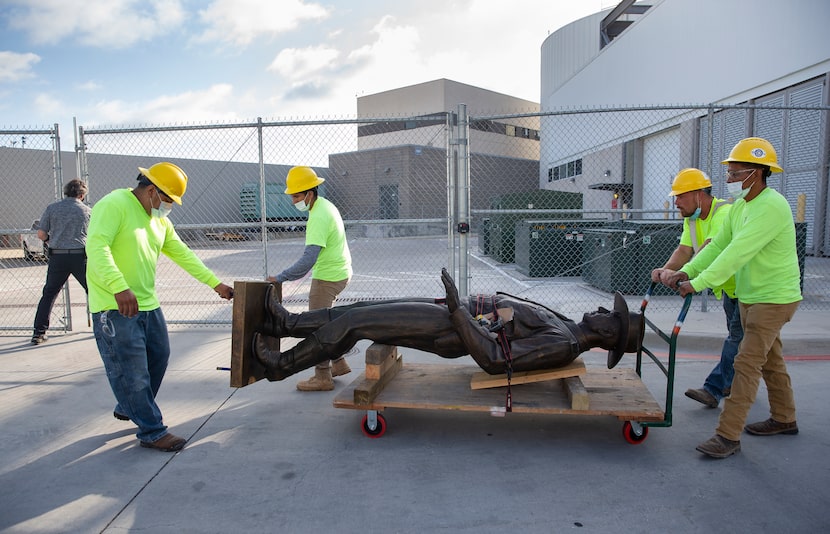
A Phoenix 1 Restoration & Construction crew wheeled out the “One Riot, One Ranger” statue after it was removed from the Love Field lobby on June 4, 2020.
Juan Figueroa / Staff Photographer
He was also photographed leaning against a tree while an effigy of a Black person hung from the school’s entrance, shortly before he went to Texarkana to stop Black students from enrolling in a junior college.
Opinion
“It would have been great to have that statue in a museum with a plaque, at least, something that explains the history behind it,” Swanson, a former Dallas Morning News reporter, told me this week. “I am not in favor of taking down these things and sticking them in a warehouse, because what does that do for anyone? But if you’re the Rangers, why borrow that kind of trouble?”
Banks’ statue is still owned by the city of Dallas, still part of our public art collection. But it will remain in Arlington indefinitely, a silent spectator planted in Globe Life Field’s left-field concourse. Absent any history lesson, it’s now little more than a prop, a photo op for the unsuspecting between beer and hot dog runs.
Which, I guess, is only fitting, as the $25,000 sculpture was paid for in 1959 and donated to Dallas by Earle Wyatt, and his wife Mildred, namesake of my grandparents’ favorite cafeteria chain.
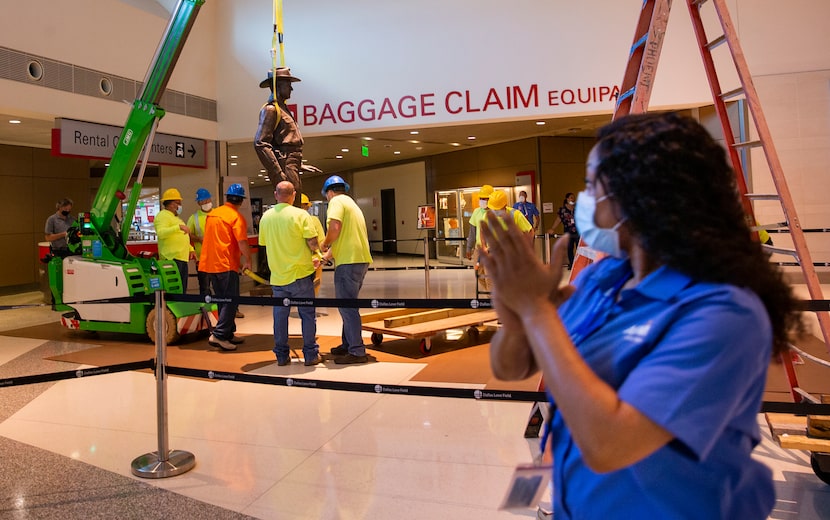
Tiffany Anderson clapped as a Phoenix 1 Restoration & Construction crew removes the “One Riot, One Ranger” statue from the Dallas Love Field lobby on June 4, 2020 in Dallas. “He’s racist, he’s got to go,” Anderson said as she celebrated its depature.
Juan Figueroa / Staff Photographer
The Rangers aren’t commenting beyond their official statement. But I’m not exactly stunned by Rangers ownership’s decision to give Banks a new home.
Ray Davis speaks of having pride in the team’s namesake, while still co-owning the only Major League team without a Pride Night. He also co-founded Energy Transfer with Kelcy Warren, who has another one of Dallas’ unwanted statues, Alexander Phimister Proctor’s 1935 Robert E. Lee and Young Soldier, keeping watch over his Lajitas golf course on the border, for those keeping score in the competition among local billionaires collecting controversial statuary.
The only difference: Dallas sold Lee for $1.4 million at auction to an attorney who apparently donated it to Warren’s resort, while the city got nothing for Banks’ move to Arlington.
I wanted to know how. Because last I’d heard, back in 2020, One Riot, One Ranger was going into storage, with Mayor Eric Johnson suggesting that the Dallas City Council should discuss its future. That never happened.
The story actually begins in August 1959, when Mayor Robert Thornton accepted a then-anonymous donation for a Ranger statue to be installed at Love Field. In November 1960, a photo of San Antonio sculptor Waldine Amanda Tauch and the 8-foot-5-inch-tall model appeared in this newspaper above a story that said the Ranger had been approved by the Dallas Historical Monuments Commission.
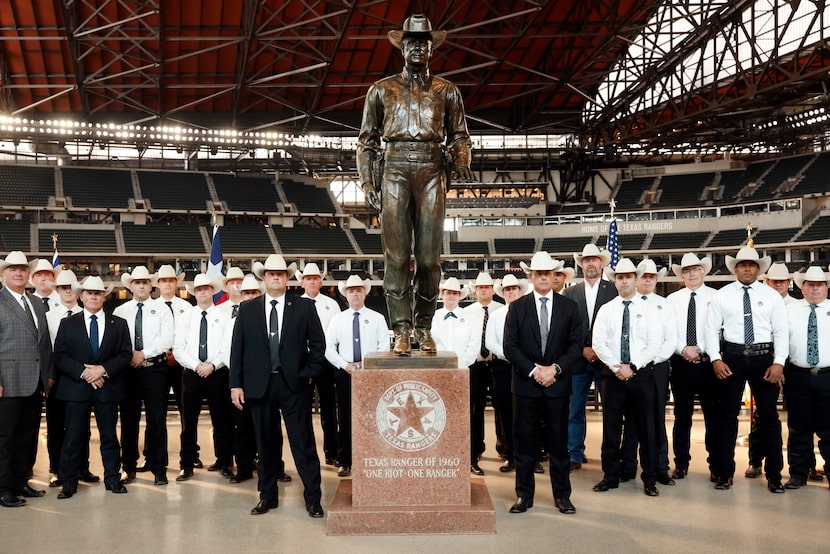
Current and retired Texas Rangers posed Monday for a photo with “One Riot, One Ranger” on the left field plaza of Globe Life Field in Arlington
Tom Fox / Staff Photographer
Five months later, One Riot, One Ranger landed at Love, with Wyatt revealed as the donor. Save for the occasional visit to Hall of State at Fair Park or the Frontiers of Flight Museum, there he stood until June 2020, when D published an excerpt from Swanson’s book accompanied by the headline “The Horrible Truth of Love Field’s Texas Ranger Statue.”
Mark Duebner, at the time the city’s director of aviation, told me he alone ordered the statue’s removal shortly after the piece appeared.
“It was 100% to keep any disruptions from happening at the airport,” he said. “Protests at an airport present too much risk.”
As a result, Duebner said, he received angry phone calls for a year.
On June 4, 2020, Jennifer Scripps, then director of the city’s Office of Arts and Culture, sent a memo to arts commissioners and public art committee members informing them of the statue’s removal, echoing Duebner’s concerns that it could be a “flashpoint” for protestors. She wrote that its relocation “will allow us to have a community discussion,” and closed by saying that the statue “sends a message inconsistent with the City of Dallas’ values as a welcoming community.”
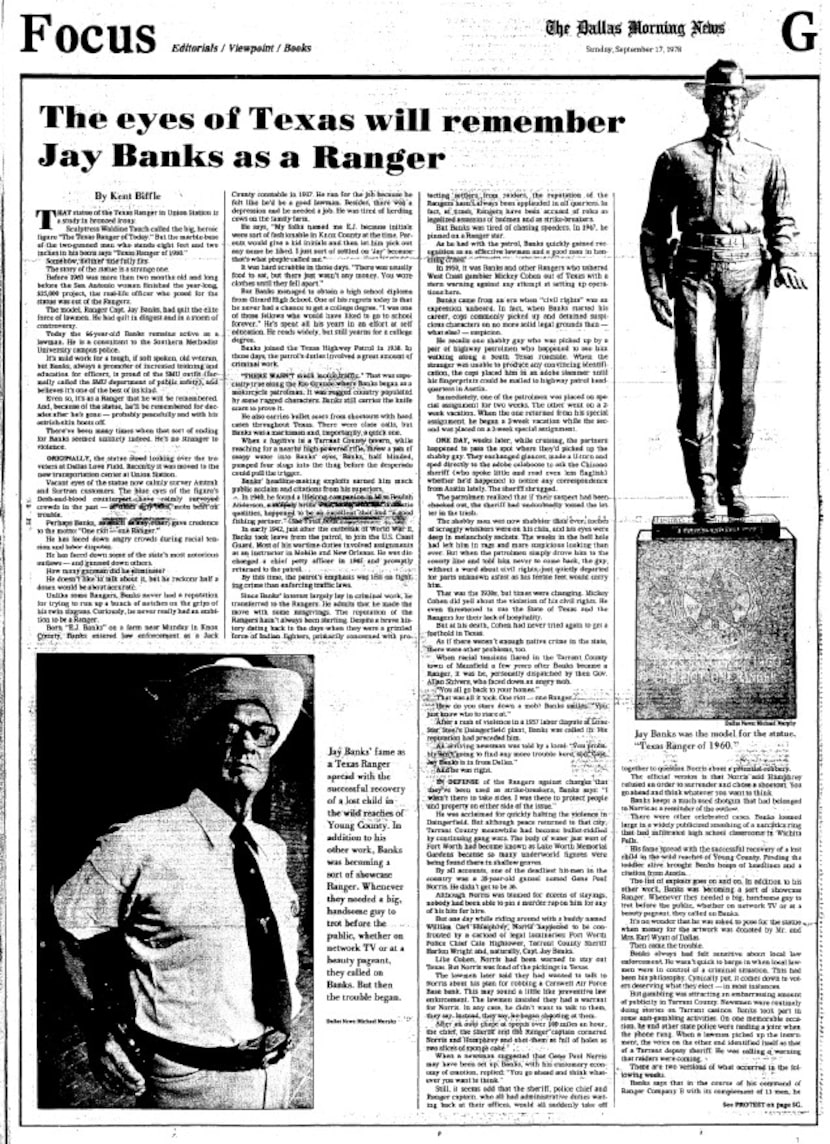
A flattering profile of Jay Banks appeared in this newspaper on Sept. 17, 1978, in which the Texas Ranger said he kept the peace in Mansfield in 1956 by staring down the mob. He was asked, how do you do that? “You just know who to stare at.” Years later, Doug Swanson’s book would tell a very different version of that story.
The Dallas Morning News
A few days later, it became a national story; reported NBC News: “A removed statue dredges up racism against blacks, Latinos in Texas Rangers’ history.” Shortly thereafter Banks was shipped to Hensley Field, the city’s traditional hidey-hole for contentious objets d’art such as the Lee statue.
There he sat until Feb. 9, 2023, when the city’s Office of Cultural Affairs agreed to a long-term loan with the Waco-based Texas Ranger Association Foundation (TRAF). Using an administrative action, which requires no City Council approval or notice, OCA director Martine Philippe handed off Tauch’s bronze monument with a single line noting it had been removed “due to concern about damage to the Airport during the 2020 protest.”
According to a loan agreement provided by a city spokesperson, TRAF was to take the statue to Waco, where it would be displayed in or adjacent to the city-owned Texas Rangers Hall of Fame & Museum. But that agreement says the original location was “indefinitely delayed,” so TRAF requested to relocate the artwork to the Rangers’ ballpark.
A spokesperson for Waco told me Thursday the city has asked the state for funds to rehab or relocate the museum, but nothing has been yet confirmed or approved. She also said there was “no official plan” to include One Riot, One Ranger in the museum.
Russell Molina, a TRAF board member, told me the pivot to Arlington was facilitated by Neil Leibman, chairman of Rangers Sports Media and Entertainment.
“So I would say a little luck and timing,” Molina said.
Molina, incidentally, also sent me an email stuffed with documents he said show Banks wasn’t the model for the sculpture – just “a model,” he said, “one of many.” But Banks never disputed it in numerous Dallas Morning News profiles, including a lengthy 1978 story in which the statue serves as the main art. And Banks’ daughter wrote in her father’s biography that he posed for it.
Dallas’ Public Art Committee, made up of City Council appointees, was informed of the Arlington move during its Feb. 3 meeting. Lynn Rushton, the city’s Public Art Program Manager, spent about a minute explaining that plans for One Riot, One Ranger’s original destination had been delayed. She said it would be sent instead to the “museum-like setting of the Texas Rangers’ ballpark” as “part of that museum that tells the story of the Rangers and how the Rangers baseball team got their name.”
When you think about it, maybe the ballpark in Arlington is the best place for Banks’ statue, seeing as how Mansfield is a 14-mile straight shot south on Texas State Highway 360. Since, you know, it’s all about context.