
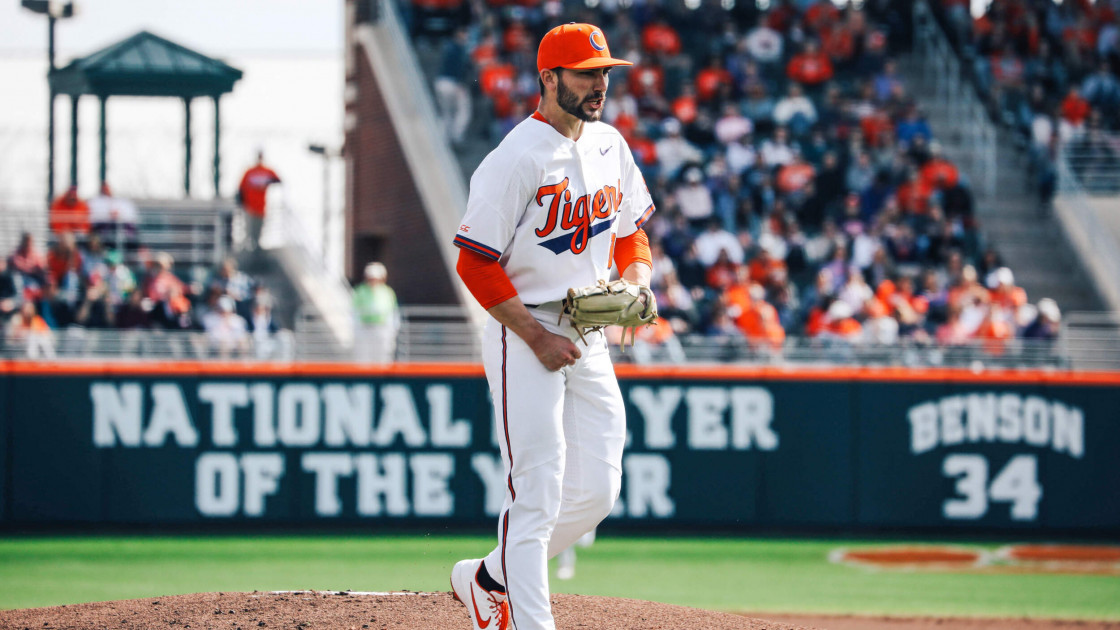
Amid mounting injuries and setbacks in the Atlanta Braves’ starting rotation, the team is once again looking to Clemson alumnus Spencer Strider to return to the dominant form that once made him one of baseball’s most feared pitchers.
Strider made his Grapefruit League debut on Saturday in the Braves’ 7-5 win when he pitched two innings, giving up one run while striking out two.
The concern for fans? His fastball averaged 93.1 mph.
Questions about his velocity had already surfaced during spring training. People noticed that the radar gun was turned off while Strider was throwing during a recent live batting practice session.
Braves reporter Mark Bowman later clarified that the team said the radar gun outage was a technical issue, not an intentional move.
Despite this, the former Clemson standout has become one of the most successful Tigers in the league in recent memory.
Strider emerged as one of the MLB’s top-tier arms during the 2022 and 2023 seasons. In 2023, he earned an All-Star selection and finished No. 4 in the National League Cy Young award race after setting a Braves franchise record with 281 strikeouts in a single season.
However, his quick rise was interrupted early in the 2024 season. An MRI in April showed significant damage to Strider’s UCL and required season-ending elbow surgery that cast doubt over his future.
Before the injury, Strider was known for overpowering hitters with his elite fastball, which regularly reached triple digits, averaging 97-98 mph. Following surgery, that velocity dipped closer to 95 mph and raised questions about whether he could ever return to his pre-surgery form.
Overall, those concerns were correct and carried into last season. Strider finished the 2025 season 7-14 with a 4.45 ERA and 131 strikeouts in 23 starts, a noticeable drop from his numbers that Braves fans were accustomed to.
Meanwhile, the Braves’ pitching hierarchy had shifted. After longtime ace Max Fried departed following the 2024 season, veteran Chris Sale stepped in after his 2024 Cy Young award campaign.
When fans expected Strider to be the ace, Sale instead quickly filled in during his absence.
On paper, however, the combination of Sale and Strider gave Atlanta what many believed could be one of the most dominant one-two punches in baseball. With Strider struggling to find his form, the pairing never quite came to what Braves fans hoped for.
Within the organization, the common belief had been that the 2025 season would serve as a gradual comeback year for Strider — a chance to rebuild his strength and confidence with hopes that he could fully return to form in 2026.
That timeline has suddenly become very important.
The Braves’ rotation has already endured major blows before the season has even begun. Young starters and projected members of the rotation after strong 2025 seasons, Spencer Schwellenbach and Hurston Waldrep, suffered long-term elbow injuries just days apart.
With two projected starters sidelined for months, and possibly the entire season, Atlanta’s rotation now features a handful of question marks: 37-year-old Sale, Reynaldo Lopez, who made just one start in 2025 due to shoulder surgery, Grant Holmes — who ended 2025 with multiple elbow tears — and the incredibly inconsistent Bryce Elder.
That uncertainty makes Strider the most important pitcher in the Braves’ rotation — and likely the most important player on the team — heading into the season. His performance could determine whether the group is able to get ahead in a difficult division early on, or struggle to stay competitive while it waits for reinforcements.
Strider himself has downplayed the concerns about his velocity, saying he was so unconcerned that he didn’t closely track it during offseason workouts and that he has been pleased with his overall results.
“Every year you throw your first bullpen in the offseason, you throw your first bullpen in the spring, you throw your first game in the spring,” Strider said. “They’re all data points. You’ve got to start somewhere.”
For Atlanta’s sake, let’s hope he’s right.