
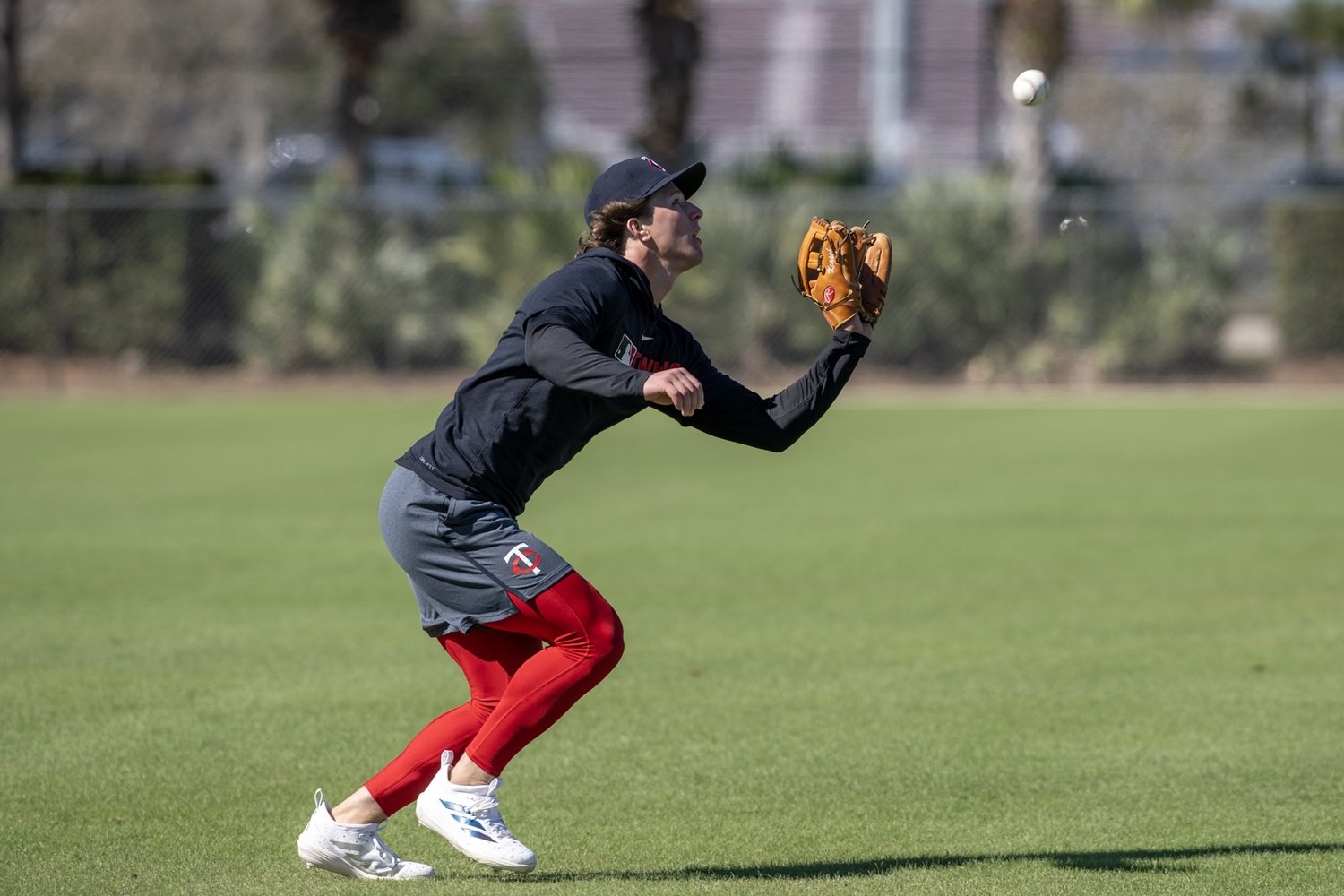
Flexibility is crucial on a modern baseball roster. The more positions a player can cover, the more likely a manager is to keep a strong bat like Luke Keaschall’s in the Minnesota Twins’ lineup.
On Thursday, Keaschall made his first start in the outfield since injuring his elbow two seasons ago. The appearance marked an important step for a player who was expected to see time in the grass last season before injuries altered those plans.
The Twins originally envisioned Keaschall as someone capable of bouncing between the infield and outfield in 2025. Instead, a hit by pitch broke his arm early in the season and complicated his defensive development. When he returned later in the year, Minnesota chose not to rush him back into the outfield. He finished the season working exclusively in the infield.
This spring serves as a fresh opportunity for Keaschall to resume his transition between positions. Manager Derek Shelton explained that the Twins have always intended for him to build experience at both infield and outfield, now possible with his recovery.
“We had said he was going to play both. We prepared for it this winter. Just wanted to make sure that he got his feet on the ground at second.”
The Twins also have a crowded outfield this spring, making it a challenge to find innings for everyone.
“And honestly, we are heavy outfield-wise. Trying to get a look at Gabby (Gonzalez) and trying to get a look at (Hendry) Mendez and Emma (Rodriguez), Rosie (Kala’i Rosario), it’s been a little bit hard, but we will get him out there.”
For Keaschall, being in the outfield does not mean giving up second base. Instead, it expands his opportunities, letting the Twins move him between positions as needed to keep him in the lineup. Shelton highlighted the advantages of this flexible approach during games.
“I think the impetus would be, like if Kody (Clemens) was going to play second and Josh (Bell) was going to play first and (Victor) Caratini was going to DH, I think more positional flexibility we can have is good, especially in Luke’s case, the fact that he can do both and keep his bat in the lineup.”
“So the functionality of being able to move around. And then, just quite honestly the in-game portion of it. He starts the game at second and then all of a sudden, we pinch run for Josh and Kody’s at first, and he comes in, being able to move around, I think is really important.”
Keeping Keaschall’s bat in the lineup is a priority after the impression he made last season. In just 49 games, he slashed .309/.382/.445 (.827) across 207 plate appearances. The sample size was limited, but it was still enough to land him ninth in American League Rookie of the Year voting.
His strong showing was not a fluke, given his track record. From 2023 through 2025 in the minor leagues, Keaschall posted a .294/.411/.458 (.869) slash line with 19 home runs. He has consistently controlled the strike zone while finding ways to reach base.
When a rookie makes an immediate impact, the mental image is usually of someone bursting onto the scene to change the team’s long-term outcome. A late-season call-up arrives and suddenly becomes a spark for the team. Keaschall’s debut followed a different path.
He was called up in April and immediately flashed his speed, stealing five bases in his first seven games before the hit-by-pitch broke his arm. When he returned in early August, he picked right back up, swiping nine more bases before a thumb injury ended his season a bit early.
There will be adjustments ahead. His .340 BABIP from last season will likely drop, although his speed should help keep that number comfortably above .300. Pitchers will also challenge him more often after getting a better look at his tendencies.
Still, there are encouraging signs in his profile. At Triple-A last season, he posted identical 14.4 percent walk and strikeout rates. That kind of plate discipline suggests a hitter capable of maintaining a strong on-base percentage even as the league adjusts. The Twins believe the bat will play. Now they are simply looking for more ways to use it.
If Keaschall proves capable of handling both second base and the outfield, Minnesota gains another versatile piece. More importantly, it gives the Twins more chances to keep one of their most promising young hitters in the lineup every day.
What role do you see Keaschall playing in the Twins’ outfield this season? Leave a comment and start the discussion.