
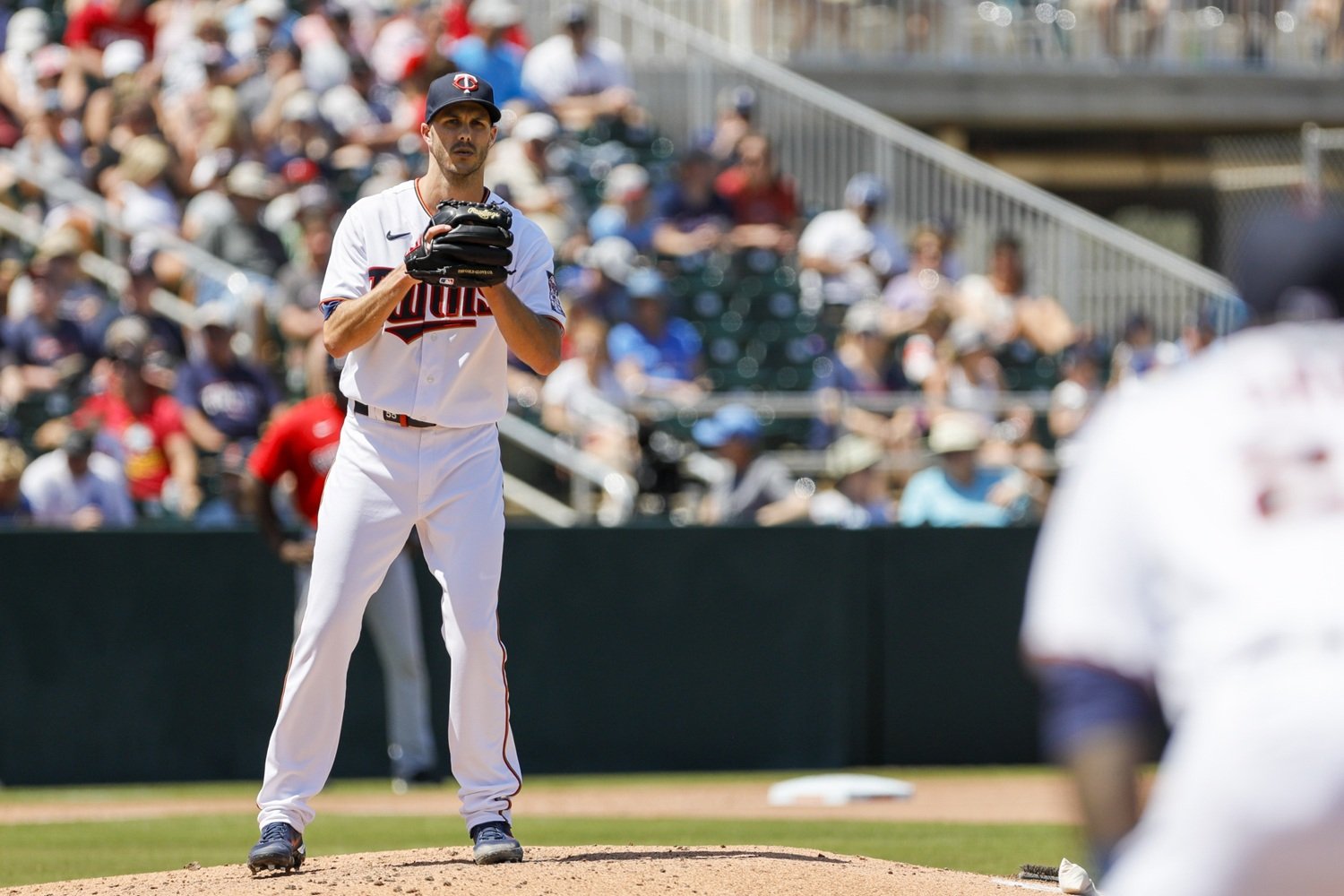
The Minnesota Twins bullpen has a left-handed problem. At least, that’s the question worth asking as Opening Day approaches.
On paper, the Twins are lined up to carry a perfectly balanced bullpen in 2026: four right-handed pitchers and four left-handed pitchers. Symmetry looks nice in theory. In practice, it’s almost unheard of.
This offseason the Twins added three left-handed relievers: Andrew Chafin, Taylor Rogers, and Anthony Banda. They join Kody Funderburk, who entered the winter with a presumed bullpen spot after a dominant finish to last season. Over the final two months, Funderburk posted a 0.75 ERA across 24 innings, pitching his way into high-leverage consideration.
Four lefties. Four righties. Balanced.
But balanced doesn’t necessarily mean optimized.
Across Major League Baseball, only the Twins, Dodgers, and Brewers are expected to carry four left-handed relievers to start the season. That’s not a coincidence. In the era of the three-batter minimum rule, roster construction has shifted dramatically. The days of the pure left-handed specialist are largely gone. A bullpen arm can’t simply exist to neutralize one dangerous lefty in the seventh inning. He has to get through a pocket of hitters, and that almost always includes right-handed bats. That’s where the concern starts to creep in.
Let’s look at the splits.
Rogers owns a career .746 OPS allowed against right-handed hitters compared to .569 against lefties. That’s a massive gap. He can still dominate same-side matchups, but righties have long presented problems.
Banda’s splits are even more pronounced. He has allowed a career .849 OPS to right-handed hitters versus .635 to lefties. That’s the profile of a pitcher you would prefer to deploy surgically, not someone you trust to navigate a mixed portion of a lineup.
Chafin has the most balanced career track record of the group, with a .671 OPS allowed to righties and .617 to lefties. But even he showed vulnerability last season, surrendering an .805 OPS to right-handed hitters. At 35, expecting improvement against opposite-handed bats may be optimistic.
Then there’s Funderburk. Despite his dominant finish last year, his career splits show a .768 OPS allowed to righties and .725 to lefties. He hasn’t displayed dramatic dominance over either side.
Individually, none of these pitchers are unusable. Collectively, the profile becomes more concerning.
Roughly three-quarters of hitters in today’s game bat right-handed. That reality makes stacking left-handed relievers risky unless those pitchers have the ability to neutralize right-handed bats consistently. The Twins did not go out and acquire elite, neutral-split lefties who can dominate anyone. They added a group of solid but unspectacular relievers whose biggest strength remains getting left-handed hitters out.
Under previous rules, a manager could leverage that skill. A lefty could enter to face one dangerous left-handed bat and exit. Now he must face at least three hitters unless the inning ends. That significantly increases exposure to the platoon disadvantage, especially in late innings when managers cannot always control the matchup pocket.
The construction also raises a broader roster-building question. The Twins waited deep into free agency to address the bullpen. By the time they moved, many of the premium right-handed options were gone. The arms available at their price point happened to skew left-handed, and the Twins leaned into it. Whether that was strategic or circumstantial is up for debate.
It’s possible the team believes the stuff will play up. It’s possible they trust pitch shapes and usage adjustments to minimize platoon splits. It’s possible they simply valued overall depth over handedness concerns.
But there’s no getting around the math. When half of your bullpen throws left-handed and most hitters bat right-handed, those pitchers are going to face tough matchups regularly. And with the three-batter minimum in place, there’s less room to hide.
A bullpen with four lefties is rare for a reason.
Are the Twins ahead of the curve, building flexibility others are ignoring? Or have they created an unnecessary vulnerability in a season where every late-inning edge matters? Do the Twins have a left-handedness problem? Leave a comment below and start the conversation!