
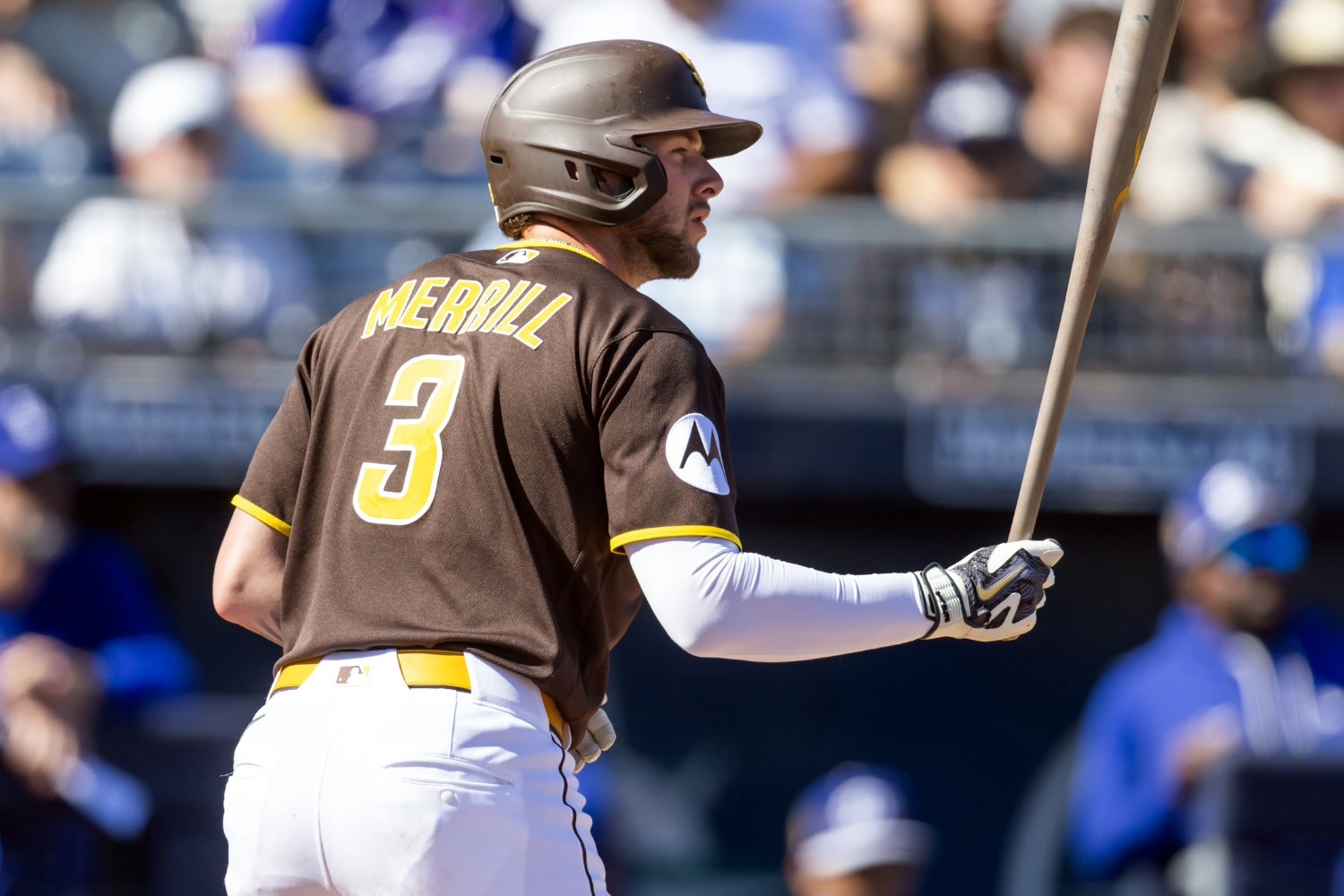
Jackson Merrill had a disappointing 2025 season by his standards, even when his reduced plate appearances last year are taken into account. Those higher expectations come from a brilliant 2024 campaign that nearly ended in awards glory. However, being the fourth player in Padres history to place second in the Rookie of the Year balloting may have been a blessing for Merrill, who won’t have the burden Benito Santiago did of matching his 1987 Rookie of the Year season.
The 2024 Rookie of the Year voters had to balance the pitching accomplishments of Paul Skenes against Merrill’s batting, baserunning, and fielding activity. Skenes was the first-place choice for 23 of the 30 voters, while Merrill obtained the other seven first-place votes. Merrill thus joined Ozzie Smith in 1978, Khalil Greene in 2004, and Jake Cronenworth in 2020 (Cronenworth actually tied for second in the balloting) as Padres who were beaten out for the Rookie of the Year award by only one player.
Three trips to the injured list in 2025 limited Merrill’s activity in general as well as his offensive output. He still led all National League center fielders with nine assists even though he only played 114 games in the outfield last year, and his .997 fielding percentage in 2025 actually exceeded his .993 mark in 2024 when he led the league with 155 games in center field and with four double plays while sharing first place with eight assists.
Merrill’s 2025 production at the plate declined to a noticeable degree, though. In 2024, his 593 plate appearances resulted in a .292 batting average, 162 hits, 31 doubles, six triples, 24 home runs, and 90 runs batted in. That earned Merrill a Silver Slugger award for National League outfielders. He also scored 77 times and stole 16 bases.
In 2025, Merrill had 483 plate appearances. He matched his six triples from the previous year and drew 33 walks, more than the 29 he had in 2024, but his offensive performance otherwise declined from his rookie year. When his 2024 statistics are multiplied by 0.8145 to reflect his plate appearance differential (and rounded to the lower integer) that equates to 131 hits, 25 doubles, 19 home runs, 73 RBI, and 62 runs. He had 25 actual doubles in 2025, but a .264 average, 116 hits, 16 home runs, and 67 RBI while scoring only 59 times and stealing only one base.
Had Benito Santiago not had a 34-game hitting streak at the end of 1987 and ended his season with a .300 batting average, his expectations for subsequent years might not have been as high. Santiago never matched that batting average later in his career other than when he batted .310 in 30 plate appearances for the 1998 Toronto Blue Jays. He did not exceed his 18 home runs after 1987 until homering 30 times for the 1996 Philadelphia Phillies. Santiago never subsequently matched or exceeded the 164 hits or the 21 stolen bases he had in 1987.
The only other Rookie of the Year in Padres history, Butch Metzger, shared the 1976 award. Metzger didn’t match his wins, saves, earned run average, innings pitched, or strikeouts total in any of his future seasons.
The Rookie of the Year ballots only included first-place votes and not position points through 1979. On three other occasions during that era did a Padres player received Rookie of the Year votes.
The first of those was in 1973, when Johnny Grubb received one vote. Gary Matthews received 11 votes as well as the award. One voter split his vote between Steve Rogers and Richie Zisk while Rogers received three full votes to place second. Elias Sosa, Bob Boone, and Dan Driessen each obtained two votes. Grubb, Davey Lopes, and Ron Cey received one vote apiece. Zisk, the only player on the list with a higher batting average than Grubb, did not receive a full vote.
Neither Zisk nor Grubb had the minimum 502 plate appearances to qualify for the batting championship, but Zisk’s .324 average trailed only the .338 of Pete Rose. Grubb batted .311 in 432 plate appearances, which including Zisk would have placed him seventh.
Grubb compiled a batting average of .286 during the Padres portion of his career, which currently ranks ninth in team history. When he was traded to the Cleveland Indians after the 1976 season it was the highest batting average in Padres history. Grubb, a September 1972 call-up, concluded his 16-season major league career with a .278 average. Since he only played four full seasons with the Padres, he is no longer in the top ten for any other statistic, but he had 513 hits in his 513 Padres games while scoring 235 runs, hitting 101 doubles, 11 triples, and 25 home runs, and driving in 145 runs.
Two other 1973 Padres rookies joined the major league team in June and didn’t have sufficient activity to merit any Rookie of the Year votes, but too much activity to be qualified as rookies for 1974. An 8-1 record in Class AA convinced the Padres to call up Randy Jones, who threw 139 2/3 innings with the big league club in 1973 while compiling a 7-6 record and a 3.16 ERA. The modest expectations allowed Jones to recover from an 8-22 season in 1974. He posted 20-win seasons in both 1975 and 1976, leading the National League in ERA for 1975 and in wins for 1976.
The Padres had the fourth overall pick in the June 1973 draft and chose University of Minnesota player Dave Winfield. Winfield was placed on the major-league roster immediately. He saw action in 56 Padres games and accumulated 154 plate appearances while batting .277 with three home runs. Winfield would bat .284 in his eight seasons with the Padres while hitting 154 home runs and winning two Gold Glove awards. In 1979 Winfield batted .308 for the second consecutive year and led the National League with 118 runs batted in.
Andre Dawson edged Steve Henderson to win the 1977 Rookie of the Year Award while Gene Richards received four votes to place third. Richards batted .290 and set a major league rookie record with 56 stolen bases. Richards improved his batting average to .308 in 1978 while increasing his best stolen bases total to 61 in 1980. In the strike-shortened 1981 season he shared the National League lead with 12 triples. Richards would spend seven seasons with the Padres. His .291 average with the team currently shares fifth in Padres history. His 994 hits with the Padres is the outright fifth-place total in team history and stood fourth until Manny Machado exceeded that last year. Richards’ 484 runs scored is the fourth-highest Padres total. His 782 singles constitute the third most in Padres history. His 242 stolen bases and 63 triples are exceeded only by Tony Gwynn.
Horner and Smith shared one Rookie of the Year vote in 1978. Horner received 12 others, Smith had eight full votes, and Don Robinson was the choice on the other three ballots. Horner had a .266 batting average compared to the .258 for Smith, although Horner didn’t join the Atlanta Braves until being drafted that June and wouldn’t have qualified for the batting championship. Horner hit 23 home runs compared to one for Smith, and in his partial season Horner drove in 63 runs while Smith batted in 46. Smith stole 40 bases while Horner had no swipes in his rookie year.
Over his career, Horner would bat .277 while Smith had a career batting average of .262. Horner only played ten seasons while Smith played 19 and joined the Baseball Hall of Fame after he retired. Although Smith didn’t exceed his 1978 batting average until after being traded to the St. Louis Cardinals, he stole 57 bases in 1980, when he also set a major league record with 621 assists. Smith led National League shortstops in assists eight times including in his final three seasons with the Padres, and he was a Gold Glove winner in 1980 and 1981.
The first Padres player to receive position points but no first-place votes in the Rookie of the Year balloting, Juan Bonilla, shared fourth place in 1981. An injury in 1982 and subsequent cocaine use kept Bonilla from matching his 1981 performance.
In 1982 pitcher Luis DeLeon was fifth in the Rookie of the Year voting while pitcher Eric Show shared eighth. Tony Gwynn had 209 plate appearances that year, and it could be considered his worst year since his .289 batting average was the only sub-.300 season of his career. That average was still higher than four of the five field players receiving Rookie of the Year votes that year including recipient Steve Sax and future Hall of Fame member Ryne Sandberg. (Willie McGee, who placed third, batted .296.) Gwynn would conclude his 20-year career with a .338 batting average, eight National League batting championships, 3,141 hits, 1,383 runs, 543 doubles, 85 triples, 319 stolen bases, 1,138 runs batted in, seven Silver Slugger awards, and five Gold Glove awards. Gwynn was selected to the Baseball Hall of Fame in his first year of eligibility.
A 7-3 record with a 2.65 ERA in 115 1/3 innings led to Mark Thurmond sharing ninth in the 1983 Rookie of the Year balloting. Thurmond posted a 14-8 record in 1984 but had no other winning seasons.
Kevin McReynolds was the Pacific Coast League’s Most Valuable Player in 1983 but struggled in his games with the Padres. He batted .221 with four home runs in 155 plate appearances which made him ineligible for the 1984 Rookie of the Year award. McReynolds improved his batting average to .278 in 1984 while hitting 20 home runs. Before being traded to the Mets after the 1986 season McReynolds batted .263 for the Padres with 65 home runs, 260 runs batted in, and 233 runs scored. In his final Padres season he batted .288 with 26 home runs. In 1984 McReynolds led National League center fielders with a .991 fielding percentage and with 422 putouts, and in 1985 his 430 putouts and 13 assists led the league’s center fielders.
A .250 batting average with 13 home runs and 66 runs batted in was worth sixth place for Carmelo Martinez in the 1984 Rookie of the Year voting. Martinez exceeded that batting average in each of the next three years, homered 21 times in 1985, and drove in at least 70 runs in two subsequent Padres seasons.
John Kruk batted .309 in 327 plate appearances during 1986. That allowed him to share seventh in the Rookie of the Year voting. In 1987, Kruk batted .313 in 527 plate appearances with 20 homers and 91 runs batted in. Although Kruk was traded during the 1989 season, he concluded his major league career with a .300 batting average and 100 home runs.
A trade also limited the Padres career of Roberto Alomar, who was fifth in the 1988 Rookie of the Year voting, though Alomar would eventually be voted into the Baseball Hall of Fame. He batted .266 for the 1988 Padres while increasing his average to .295 in 1989 and concluding his overall 17-year major league career with a .300 average. Alomar stole 24 bases in 1988 and 42 in 1989.
Greg Harris threw 135 innings for the 1989 Padres, compiling an 8-9 record with a 2.60 ERA, and was seventh in that year’s voting. He was 8-8 with a 2.30 ERA in 1990 and 9-5 with a 2.23 ERA in 1991. Although subsequent Padres seasons inflated his team career ERA to 2.95 that still ranks second all-time while his 7.9 hits per nine innings allowed ranks seventh.
Andy Benes began the 1989 season in Class AA but earned a berth on the major league roster in August. His 66 2/3 innings with the Padres made him ineligible for 1990 Rookie of the Year consideration, but his 6-3 record and 3.51 ERA resulted in sharing fifth in the 1989 voting. In each of the next four seasons Benes won at least ten games including 15 both in 1991 and in 1993. He won 69 games before being traded in July 1995. He had exactly 2,000 career strikeouts including 1,036 with the Padres to set a team record subsequently surpassed by Jake Peavy.
Frank Seminara didn’t subsequently match his 1992 win-loss record of 9‑4 with a 3.68 ERA which gave him a Rookie of the Year position vote to share seventh. A .251 batting average in 495 plate appearances gave Ricky Gutierrez a 1993 vote and a share of 11th although the 1994 players’ strike limited Gutierrez’ statistics and the trade which brought Ken Caminiti and Steve Finley to the Padres caused Gutierrez to exceed that .251 average nine times but with the Houston Astros and two other teams.
The 1994 strike also limited Joey Hamilton to 108 2/3 innings after he was called up to the Padres in late May. Hamilton was 9-6 with a 2.98 ERA and shared fifth in the Rookie of the Year voting. Hamilton would win 40 games between 1996 and 1998 before the Padres traded him to the Toronto Blue Jays.
The next Padres to receive Rookie of the Year votes, Khalil Greene and Akinori Otsuka, placed second and third in 2004. Although Greene never matched or exceeded the .273 he hit in 2004 he matched his 15 home runs that year both in 2005 and 2006 before homering 27 times in 2007. He concluded his Padres career with 84 home runs in 659 games. Otsuka wasn’t able to match the 7-2 record and 1.75 ERA he compiled in 73 relief appearances in 2004, but he was a 32-year-old rookie with seven previous Japanese league seasons.
In 2009, Everth Cabrera batted .255 and stole 25 bases, earning him a position vote and a share of eighth place in the Rookie of the Year balloting. Cabrera led the National League with 44 stolen bases in 2012. He stole 37 bases in 2013 and batted .283. He ranks sixth with 136 stolen bases during his Padres career.
Yonder Alonso received a position vote and a share of sixth place in 2012 when he batted .273 with 39 doubles. He batted .281 in 2013 and .282 in 2015.
A trade to the Cardinals limited Jedd Gyorko, who was sixth in the 2013 balloting, to three years with the Padres. Gyorko batted .249 in 2013 and exceeded that twice with St. Louis. He homered 23 times in 2013 and improved his personal best to 30 homers with the 2016 Cardinals.
A .263 average with 13 home runs and 17 stolen bases contributed to Manuel Margot placing sixth in the 2017 balloting. A trade limited Margot to three full Padres seasons along with 37 plate appearances in 2016, but he exceeded his rookie batting average three times with the Tampa Bay Rays. Margot stole 20 bases with the Padres in 2019. Although he never matched his 13 home runs in subsequent seasons he had 42 extra-base hits in 2018 compared to 38 in 2017.
Yonder Alonso and Pete Alonso are not related. Pete Alonso was the 2019 Rookie of the Year while Fernando Tatis Jr. was third. Tatis has not matched the .317 he hit in 2019 but has exceeded the 22 home runs he hit as a rookie three times including in 2021 when his 42 homers led the National League. Tatis stole 16 bases as a rookie and has stolen more in three of his subsequent seasons. He has homered 152 times and stole 124 bases during his first seven years with the Padres. After making the transition from shortstop to right field, Tatis won the Gold Glove award both in 2023 and in 2025.
The coronavirus-shortened 2020 season limited Jake Cronenworth to 192 plate appearances, although he batted .285 and shared second place in the Rookie of the Year voting with Alec Bohm. To date, Cronenworth has homered 80 times for the Padres while scoring 395 runs and driving in 365.
The utility role Cronenworth has had with the Padres may give Sung‑Mun Song sufficient playing time for Rookie of the Year consideration, and it is also possible that a rookie will earn a position unexpectedly. Merrill is the most recent Padres player to receive Rookie of the Year votes. The voters’ selection of Paul Skenes eliminated Rookie of the Year expectations for Merrill, and Merrill may be able to raise expectations with subsequent seasons.
Think you could write an article like this one? We’re looking for additional contributors, and we pay for all our content! Please click here, fill out the form, and someone will reply with more information.