
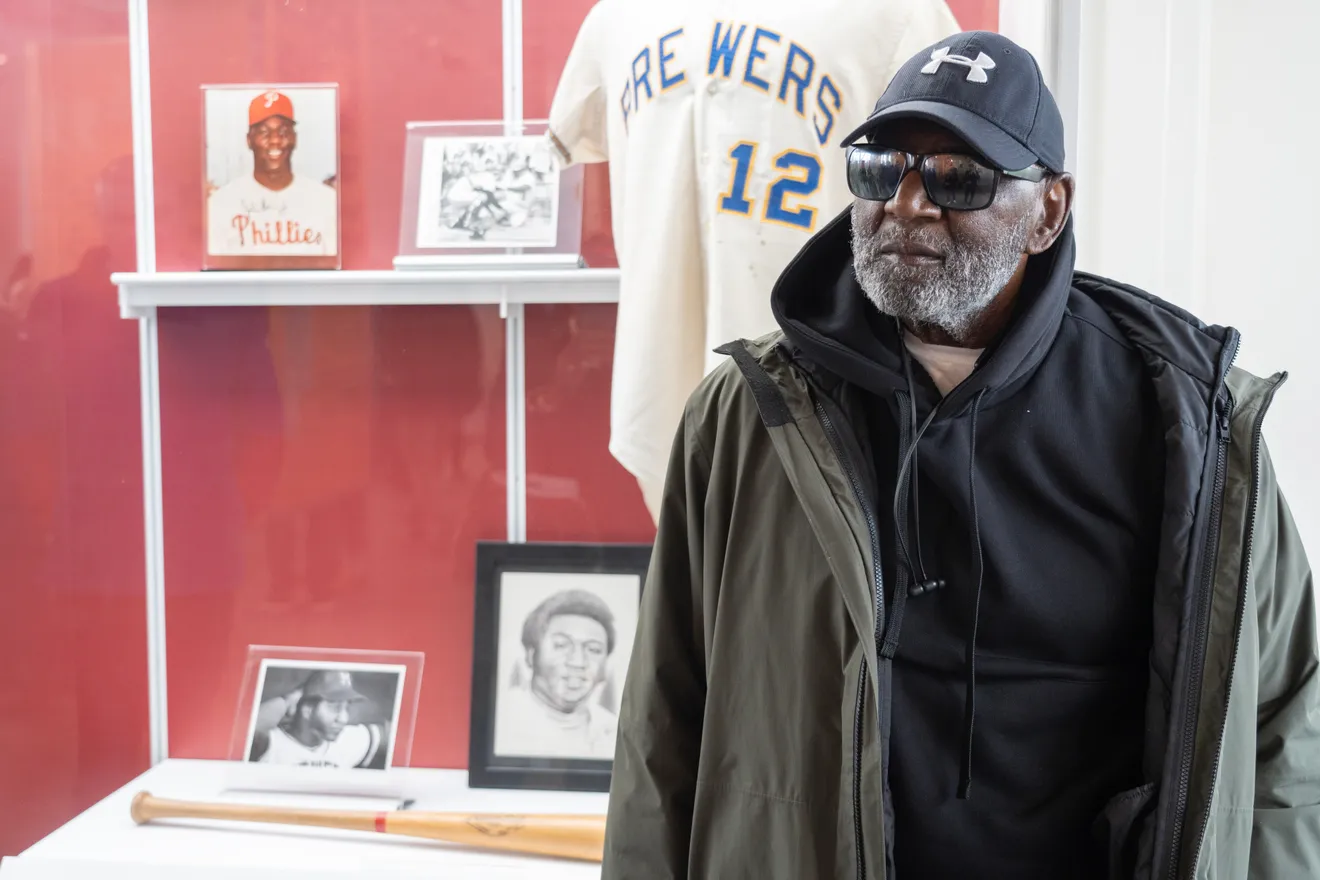
Trivia question: Other than the fact that they both played for the Brewers, what do Robin Yount and John Briggs have in common? (Answer at the end of this piece.)
John Briggs followed a slightly different path to professional baseball than most players. After he graduated from Paterson (NJ) Eastside High School in 1961, he was honored with the Dave Curtis Award (named for a Marine combat flyer who died in a plane crash) as the outstanding student-athlete at Paterson Eastside High School. Thanks to @JohnBriggs12, who prompted this retrospective after making a comment in our retrospective on the debut season of Robin Yount.
Briggs attended the Paterson satellite campus of Seton Hall University for a few semesters, but there is no record of him ever playing baseball for Seton Hall. He played amateur league basketball for a couple of seasons after high school, as well as playing American Legion baseball in the summer.
In September 1962, the Philadelphia Phillies signed Briggs to an estimated $8,000 bonus, with scouts Jocko Collins and Ben Marmo signing Briggs moments before a New York Mets scout arrived, albeit too late. “I never found out the kind of offer the Mets had in mind for me. I sure would’ve liked to have known, because I know the Mets’ scout, Pete Gebrian, liked me a heck of a lot,” Briggs said in a 2011 interview for a Society for American Baseball Research (SABR) bio.
Briggs, who batted and threw left, was originally scheduled to play in the rookie Pioneer League in 1963 but performed well in the minor league camp and was sent instead to Bakersfield in the Class A California League. In his rookie season, Briggs slashed .297/.379/.500 with 21 home runs and 20 steals. After the season, he was added to the Phillies’ 40-man roster. Even though Briggs had only two hits in the spring, he and pitcher Rick Wise were placed on the Phillies Opening Day roster in order to protect them from the ‘First-Year Player Draft.’
In those days, major league teams would keep the young player on the roster but not give him much playing time that first season. Briggs played in only 61 games and had 66 at-bats, slashing .258/.347/.333 with one home run. In only his sixth start, Briggs led off, playing center field against the Mets in the second game of a June 21 doubleheader. Batting against Frank Lary in the first, Briggs blasted a 430-foot shot over the center field fence for his first major league dinger.
As special as the day was for Briggs, it couldn’t compare to the performance pitcher Jim Bunning had in the first game. All he did was pitch a perfect game in a 6-0 victory against the Mets. Briggs played a part in the first game as well, making a nice running catch of a long drive to center field by the Mets’ Charlie Smith in the third inning to keep the perfecto intact.
Briggs also had a front-row seat for one of the biggest collapses in major league history. The Phillies were leading the Cincinnati Reds and St. Louis Cardinals by 6 ½ games with 12 left to play. Philadelphia promptly lost 10 straight games, including three each to the Reds and the Cards, before winning the last two games of the season. Unfortunately for them, it was too little, too late as the Phils finished one game behind the Cardinals. Briggs got into seven games during that 12-game stretch, going 0-for-5 in a pinch-hitting role.
Briggs would play six more seasons for the Phillies, splitting time in the outfield, never getting more than 361 ABs in a season. He started the 1971 campaign with the Phillies, but on April 22, he was traded to the Brewers for catcher/first baseman Pete Koegel and RHP Ray Peters in what was arguably one of the most one-sided trades in Brewers history, with Milwaukee coming out on top. Peters never again pitched in the bigs, and Koegel played in just 53 games over the next two years.
In his four-plus seasons with Milwaukee, Briggs hit 80 homers, which currently ranks 25th on the Brewers’ all-time list. He was also named the left fielder on the Brewers all-decade team for the 1970s. In an interview with SABR, Briggs said of Milwaukee, “The fans were great. I always had a great rapport with the fans.”
In 1972, Briggs hit two home runs (and six RBI) off Nolan Ryan in a 7-3 victory over California on July 14. On August 4, 1973, Briggs went 6-for-6 with two doubles in a nine-inning game against Cleveland. That year, he got down-ballot most valuable player consideration, ranking 23rd in the American League MVP.
In June 1975, the Brewers traded Briggs to Minnesota for outfielder Bobby Darwin. Briggs played his last major league game on September 28, 1975. Next spring, he asked for his release so that he would be free to pursue an opportunity in Japan. He signed a two-year contract in Japan but played only part of one season due to an illness caused by foodborne parasites, per his SABR biography.
After Japan, Briggs eventually moved back to his hometown of Paterson and worked as a corrections office from 1982-2007. He also worked as a recreation supervisor. In 2008, Paterson’s Little League 13-14-year-old division was named the ‘Johnny Briggs Division.’
In 2008, Paterson Little League’s Bill LaSala said of Briggs, “He’s regarded very highly as a ballplayer and a person, probably more important as a person.”
Trivia Answer: They both played just one year in the minors before getting called up to the major leagues.
What are your favorite memories of Johnny Briggs? Please add them in the ‘comments’ section.
Are you interested in Brewers history? Then check out the Milwaukee Brewers Players Project, a community-driven project to discover and collect great information on every player to wear a Brewers uniform!