
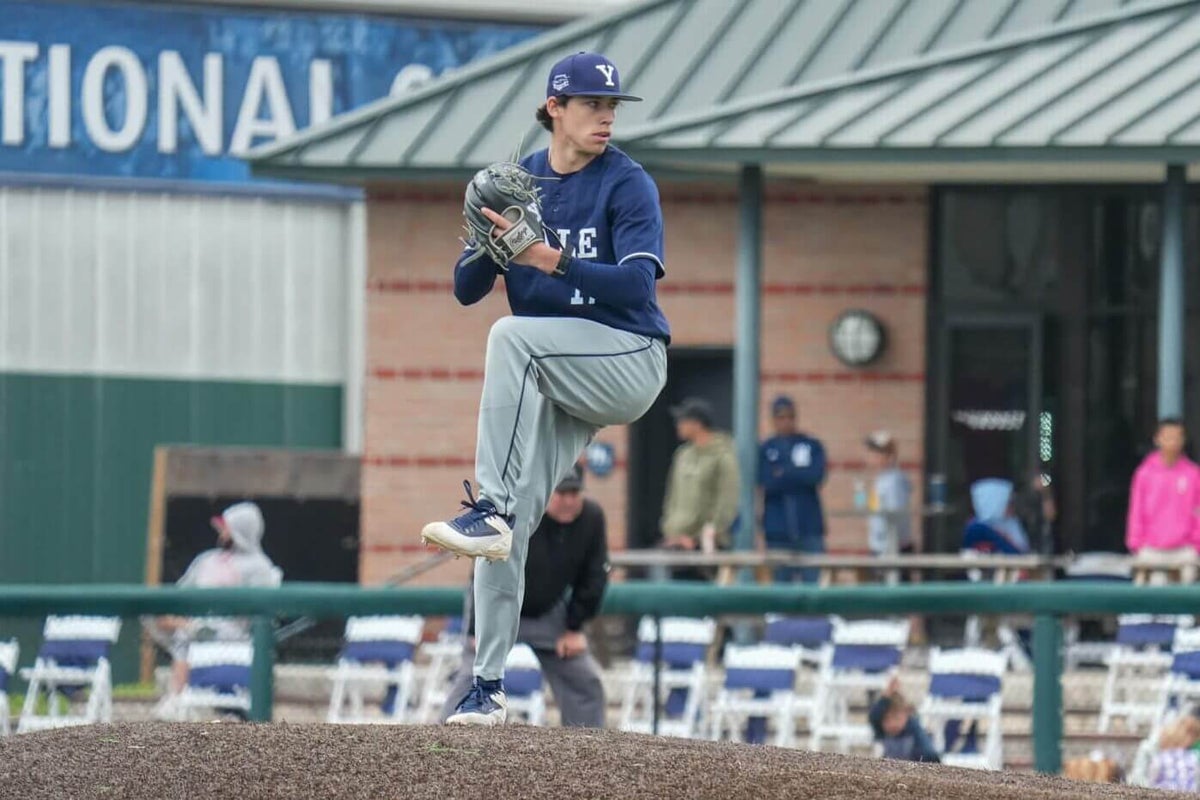
The Athletic has live coverage of USA vs. Great Britain in the 2026 World Baseball Classic.
On most Fridays, shortly before Jack Ohman toes the rubber, he’s hunched over a pitching report entrusted only to him. He fills the margins with revisions, then walks the report to Chris Wojick, where the two trade ideas and recalibrate the plan.
Conversations between Ohman and his pitching coach rarely remain tethered to baseball. Over coffee and Chipotle in Orlando, Fla., Ohman drifts from pitch sequencing to dissecting “Star Wars” canon or plotting a detour through Harry Potter World.
He can just as easily trace the architecture of Theo Epstein’s title teams as an executive with the Red Sox and Cubs as diagram the machine-learning infrastructure behind Divergent’s 3D-printed automotive systems — the factory-floor futurism Yale toured during a road series against Pepperdine in Los Angeles this past weekend.
He’ll point out that Yale’s scoreboard at Bush Field was salvaged from the hull of a decommissioned submarine, and just as casually recall sitting down with President George W. Bush and Florida Governor Ron DeSantis. It’s the sort of access that feels routine in his orbit. With Epstein as a mentor and Yale products Mike Elias and Craig Breslow — executives with the Orioles and Red Sox, respectively — as tangible proof points, Ohman studies the mechanics of a front office. After all, it’s his endgame.
“You can’t be a one-trick pony here,” Ohman said. “There’s always people here keeping you on your toes. … You have to bring something to the table that isn’t just your expertise.”
Jack Ohman’s career stats
YearRecordERAWHIPIPHitsK/BB
2025
8-1
1.34
0.882
73.2
45
87/20
2026
1-0
1.35
0.825
13.1
5
19/5
But before any front office future materializes, the 2025 Perfect Game College Freshman Pitcher of the Year is likely headed for the major leagues. He’ll travel there from Yale — an institution commonly defined more by its intellect than its athletes — which, to him, has always been the appeal.
Ohman, a National Honor Society alum who is as comfortable in classrooms as clubhouses, finished 2025 with the lowest ERA in the country at 1.34. He led the Ivy League with eight wins, suffocated hitters to a .171 average against and struck out 87 in 73 2/3 innings, earning Yale’s first All-American selection in nearly two decades.
Zoom out across college athletics, and that resume foreshadows a divorce. A non-Power 4 freshman ace is usually courted, compensated and gone.
For someone so comfortable with equations, Ohman had no interest in solving this one the usual way. With NIL offers stacking and Power 4 overtures circling, Ohman could have become the next transfer headline or remain something rarer: a student-athlete who never considered the “student” ornamental.
MLB DRAFT PROSPECT!
▶️Yale RHP Jack Ohman’s 99-mph fastball has him at top of draft boardshttps://t.co/aZbjw1vyWI pic.twitter.com/9xnSONOl73
— NE Baseball Journal (@NE_Baseball) February 3, 2026
When the attention permeated New Haven, Conn., it wasn’t confined to Ohman himself. It reached his coaches’ inboxes and his father’s orbit, too — Will Ohman, who spent more than a decade in the major leagues.
The volume of what Yale head coach Brian Hamm described as “illegal recruiting” grew so relentless that Will Ohman, his son’s lifelong baseball sounding board, nearly changed his phone number to escape the 30 to 40 calls flooding in each day. The efforts even turned clandestine, coaches calling from burner phones and agents offering representation should he enter the portal. Money even dangled in front of his high school coach as leverage.
Inside Yale’s clubhouse, though, there was stability in the understanding that Ohman wasn’t leaving. Whatever waited elsewhere, he said, had no appeal — something Hamm described as “incredible social maturity” and a testament to Ohman’s ability to manage a distraction “that the team didn’t need.”
“It was a thing of loyalty,” Ohman said. “The staff took a chance on me and … I would feel like I’m letting them down if I left after last season. You always want to put your team on the map, put your area on the map. If I could keep doing that, that would be awesome.”
Yale has largely sidestepped the churn reshaping college athletics. Of the 28 players on its roster, only one is a portal pickup. The Bulldogs went 31-14 last spring and claimed a share of the Ivy League regular-season crown. Not a single player left.
Ohman’s rationale for staying traced back to why he first chose Yale: a chance to chase both baseball and an elite education — something he had “worked too hard in high school to let all that go to the wayside.” The portal entered the periphery of Ohman’s thinking, before he weighed its future value against instant gratification.
“He’s like, ‘Coach, I have no interest in leaving. The Yale degree is worth $10 to $20 million more than any of these other places, so unless someone’s giving me $10 to $20 million in NIL money, I’m not going anywhere,’” Wojick said. “He really values how Yale is going to change his life after he’s done playing baseball.”
He knew, too, that at a traditional power program, he “wouldn’t have gotten time of day” as a freshman, let alone been afforded the latitude to experiment and recalibrate when things faltered. Yale offered him runway, and he used all of it.
At Brophy College Prep in Phoenix, Ariz., Ohman logged barely 40 innings across his entire high school career. He was a hitter first, a position player by trade; pitching, he said, was a “fun thing I do on the side.”
Though the fastball touched 94 mph, the limited workload tempered Power 4 interest, leaving him with just two offers out of high school.
“That lit a little bit of a fire,” Ohman said. “I want people to know who I am. I don’t want to be this guy who plays for a no-name school or is content with being mediocre.”
Wojick’s first in-person look came in the 2022 Arizona Fall Classic, where Ohman’s athleticism and competitiveness translated more vividly than his resume. At the time, Wojick profiled Ohman as an “above-average Division I pitcher,” penciled in as a midweek option rather than a frontline starter.
But did the thin sample size raise eyebrows?
“No,” Hamm said, “it’s something we really liked. It’s one of the things we target in our recruiting process, because it allows for a guy like him to fly under the radar.”
He added that typically, many of the game’s best pitchers were once high school shortstops.
But Ohman, who admitted to feeling “like an imposter” and “kind of a fraud” in his recruiting class, was surrounded by pitchers who arrived with ingrained routines and years of repetition — elements he was only beginning to construct. The learning curve was steep and, in the fall, unforgiving.
Early intrasquads offered the illusion of novelty. Hitters hadn’t seen him yet, and his arm jumped on them. But familiarity eroded the advantage. Once teammates timed him up, “blaring issues,” as he put it, surfaced — a breaking ball he couldn’t land often enough, a fastball too predictable, a delivery built on an exaggerated Bronson Arroyo-style leg kick that unraveled under pressure.
Wojick still has the numbers scrawled on his whiteboard. Across every internal metric — walks, hits allowed, runs conceded — Ohman ranked last. The coaching staff even toyed with utilizing him as an infielder rather than as a pitcher or lowering his arm slot to unlock something the current version couldn’t.
“He was terrible as a freshman pitcher in the fall,” Wojick said, “like, he was the worst pitcher on our team.”
Nothing about that fall suggested the All-American that Ohman would soon become. What changed?
Ohman returned home to Arizona that winter and stripped his mechanics down to the studs. With his father’s help, he eliminated the high leg kick, simplified his hand path and refined his delivery around efficiency and repetition. He studied film of Jacob deGrom, first imitating, then gradually personalizing it.
By January, the fastball cut sharper through the zone and the breaking ball landed with more regularity. Better? Yes. Enough? No.
Wojick called Ohman into his office and laid out a choice: remain a midweek option or commit fully to becoming the staff’s Friday night starter. The promotion would come with conditions: add another weapon and abandon the tinkering that defined his fall.
It wasn’t hard to predict which route the “vicious competitor” took. Ten minutes in, the new pitch began eliciting whiffs, altering the conversation in the coaches’ room.
“He threw a couple, and we’re like, ‘Hey, we’re close,’” Wojick said. “Three pitches later, it was there. When he threw at intersquad, right off the bat, you’re like, ‘There it is.’ It’s just another testament to how cerebral he is.’”
The new version of Ohman surfaced in his first collegiate outing. In relief against Queens, he struck out the side en route to four strikeouts in 2 1/3 innings.
The separator wasn’t simply how Ohman threw, but how he processed. Growing up inside the architecture of the game, Ohman and his dad treated MLB: The Show as a laboratory in calling pitches and scripting sequences.
Two starts into 2026, Ohman has surrendered just six hits and two earned runs across 13 1/3 innings, striking out 19 against five walks. In an 8 1/3-inning win at Pepperdine on Friday, he fanned nine and walked two.
In the arc of his ascent, Ohman has reinforced Yale’s wager on projection. Wojick, who calls Jack the “best pitcher I’ve ever been around,” said interest in the program has ballooned and shows that Yale can function both as an academic and baseball heavyweight while embodying the staff’s “development process.” Ohman’s starts draw scouts from all 30 MLB teams, and he is emerging as a likely first-round pick in the 2027 draft.
“It puts you on the map having that level of talent,” Wojick said.
Ohman’s wiring trained him to see baseball as a system of leverage and foresight rather than a sequence of swings. Yale sharpened that lens, placing him in regular conversations with his mentor, Epstein, or Ron Darling — a Yale alum who pitched 13 seasons in the majors — lingering in the stands postgame.
So for Ohman, Yale isn’t scenery to a baseball ascent. For someone intent on reaching the major leagues — and subsequently governing one of its teams — the university is less compromise than it is alignment.
“Jack’s thing is like,” Wojick said, “‘I’m cool because I go to Yale. I’m not cool if I was in the SEC.’”