
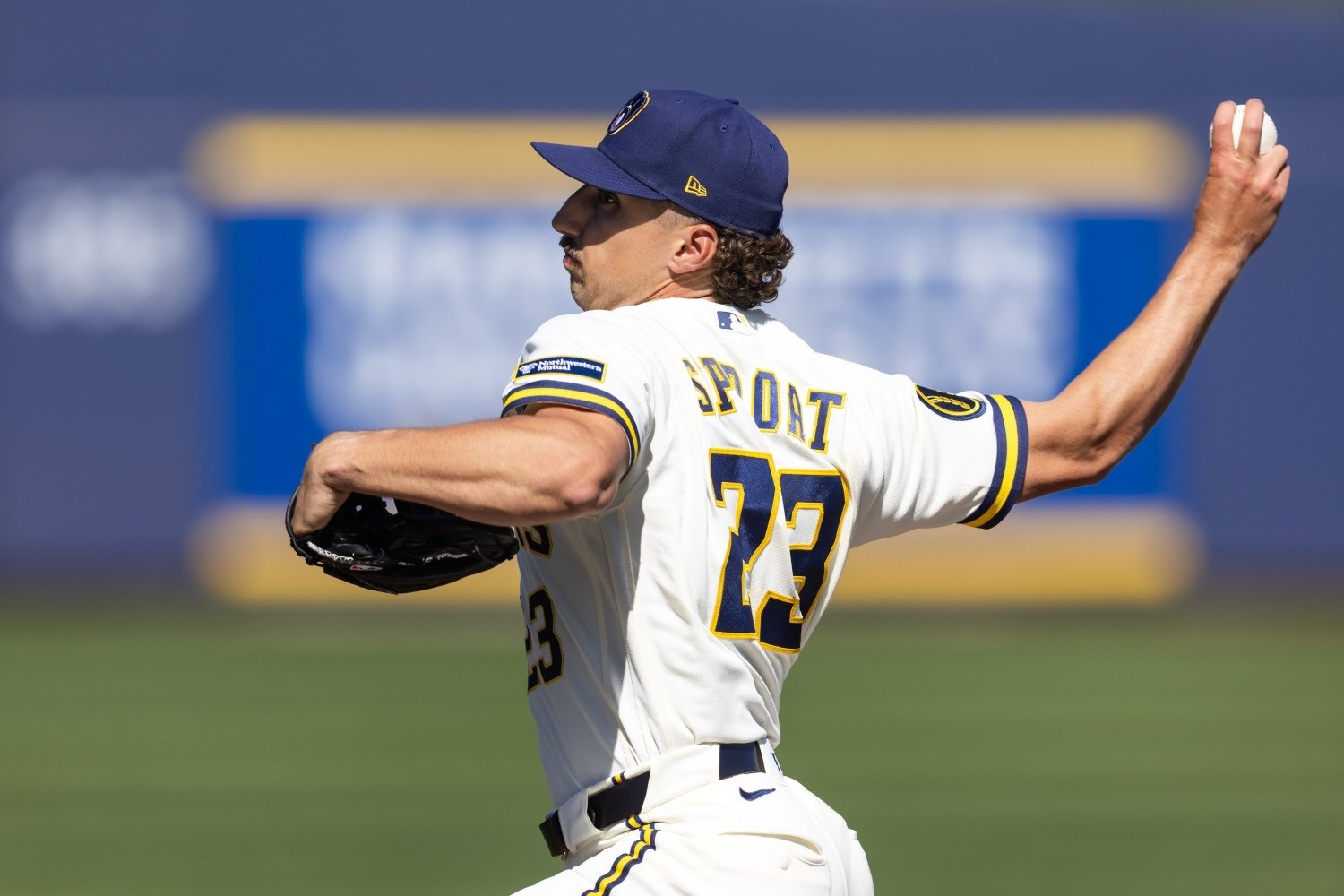
You can never have too much starting pitching. The Brewers have experienced that adage firsthand in each of the last two seasons.
Including openers and bullpen games, both the 2024 and 2025 Brewers used 17 different starters during the regular season. Last season, an immediate bout of injuries left them starting Elvin Rodríguez and Tyler Alexander in April.
Given that history, the length of Milwaukee’s depth chart entering 2026 is no coincidence. The Brewers are poised to open the regular season with up to 14 capable starting candidates on their 40-man roster. Non-roster arms like Tate Kuehner, Drew Rom, and (eventually) a healthy Gerson Garabito bring the count to 17.
Over the winter, the club traded away Freddy Peralta and Tobias Myers and lost Jose Quintana to free agency, but it added nearly twice as many starters. Brandon Sproat came over in that Peralta trade, and the club traded its entire big-league depth chart at third base to the Boston Red Sox for southpaws Kyle Harrison and Shane Drohan. Meanwhile, Logan Henderson and Robert Gasser worked their way back to full health, and Rom and Gerabito joined waiver claim Sammy Peralta as upper-minors depth.
As spring training got underway, it seemed that the organization would have more starters than starts, both in the big leagues and in Triple-A. Matt Arnold welcomed that potential logjam, but did not expect it to arise.
“We know we’re going to have injuries,” Arnold said after the Brewers acquired Harrison and Drohan. “You guys saw what we were dealing with at the start of last year, when not everybody’s 100%. That’s going to happen again, and we know that.”
It’s not a Brewers-specific trend brought on by an unusual number of injuries. The modern starter works fewer innings, meaning teams need more starters to cover a season. In 2010, 273 pitchers started an MLB game, 74 made at least 30 starts, and 45 pitched at least 200 innings. Last season, there were 369 different starters; 53 made at least 30 starts, and three logged at least 200 innings.
“The game today, it takes a lot,” Pat Murphy said last month. “200 innings? Unheard of. It takes a lot. 150 is a lot. So you need depth.”
That means clubs must construct rotation mixes of more than six or seven pitchers. Seventeen starters may have seemed like aberrations in back-to-back seasons, but it’s more likely to become the new normal. The Brewers are planning accordingly.
“It’s no longer a five-man rotation, all five guys are getting 30 starts,” Murphy said. “That didn’t happen anywhere [in 2025], I don’t think … I don’t think it’s being built to be that way. I think it’s more about, ‘Hey, we’re going to use 20 pitchers, and all 20 are going to contribute.’ That’s kind of how staffs are being built.”
Murphy has also made a spring mantra of reminding media that pitching injuries are seasonal, on which the data back him up. Here’s a month-by-month three-year survey of injured list placements, for position players and pitchers, via Baseball Prospectus.
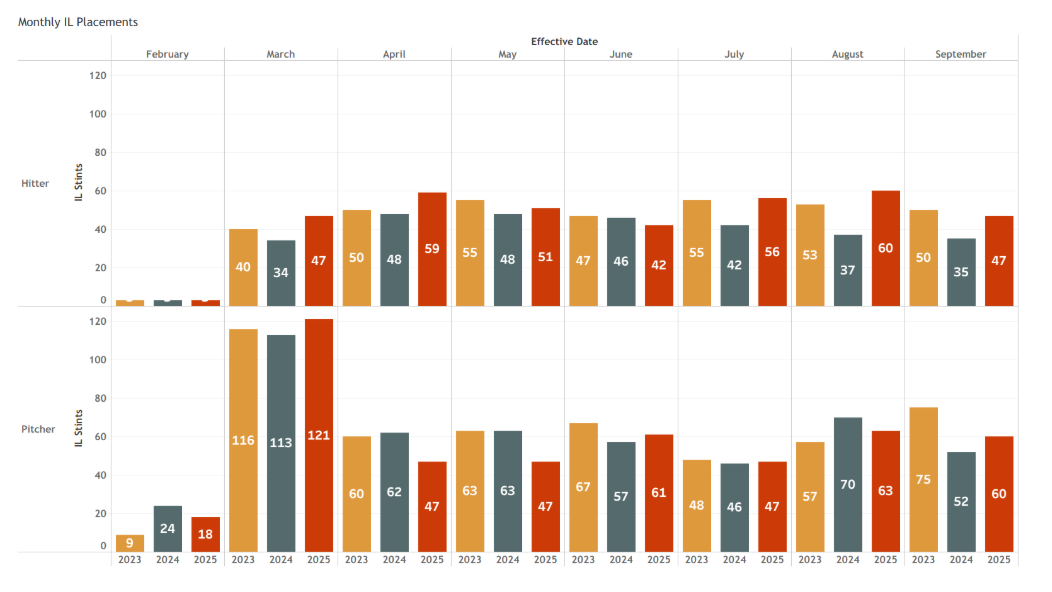
The need for that many arms is already playing out as the Brewers anticipated, partially because they’re being so cautious to combat the springtime pitching injury risk. Brandon Woodruff purposely slow buildup has him questionable for Opening Day, and Quinn Priester appears likely to begin the year on the injured list due to a nagging wrist injury that has muddied his outlook in camp. That means there could be at least two rotation spots up for grabs.
Several of the Brewers’ younger and newer arms have initiated solid bids early in camp. Logan Henderson’s new curveball has looked like a legitimate breaking ball that could add needed balance to his arsenal. Sproat has flashed an extra tick of velocity and turned his short slider into a mid-90s cutter that he can throw in the strike zone as a secondary pitch. A new grip has given Harrison’s kick changeup outlier depth. Drohan induced whiffs on 38.3% of swings in his Cactus League debut.
The Brewers didn’t just prepare an emergency plan for hits to their rotation depth; they expected those hits to come. They could quickly be rewarded for that planning.