
78 Years of Solitude (Part 2)
A Palestinian flag proudly waves in the corner of Atanasio Girardot Stadium in front of a portrait of Che Guevara. The hooligans brandishing their green scarves and banners surge forward as one, and the entire stadium becomes a turbulent sea of verdant chaos as Atlético Nacional take the field. The stakes couldn’t be higher: an elimination game against arch rivals Millonarios in the Copa Sudamericana — a Colombian Clásico.
I am swallowed by that emerald wave. I do not resist. This is what I came for: to be consumed by the madness that intoxicates everyone here whose blood runs green. To lose myself in something so powerful that it demands you become a part of it, or be destroyed.
The stadium is ringed by police on horseback and officers in riot gear — a constant reminder that you are entering a madhouse, one that strips away the social masks and common proprieties. What lies underneath is raw and shameless. The epithets rain down the moment Millonarios take the field. Old men who haven’t been able to get it up in years suddenly find enough virility to turn their faces red and bulge veins on their wrinkled necks. Next to me, a timid woman — the type who shelters in a corner on the metro and never makes eye contact with anyone — unleashes a torrent of spitting invectives that will require no fewer than fifty Hail Marys to absolve. She shows no sign of repentance.
I am still finding my footing in the stands when shouts of a pirata ring out from the section next to ours. The whole section stands as a man comes tearing through the crowd directly in front of us. His eyes are wild as he cuts through bodies. My first instinct is that he has a weapon, but before I can act, he is gone — swallowed by the sea of green around him. My heart is still catching up when the woman next to me explains he was a Millonarios supporter who had snuck in.
In the madhouse, that is not a prank, and the sentence is handed down immediately without appeal. Flying fists that aim to disfigure send the piratas running into the outstretched arms of the police as the armed guards storm the stands to enforce control. At some points you become normalized to the intensity of the intoxication — and then a sudden explosion of confrontation shatters the hypnosis that the hysteria had cast and brings you back to the asylum, its inmates, and the guards.
The ref prods the Nacional contingent with calls that would make any casual viewer yell corrupción at the TV, and sends the police scrambling to surround the pitch as security guards clean up the barrage of objects that are hurled down onto the field. And when it becomes clear Millionarios will knock Nacional out of the Copa Sudamericana, fans begin to leave — not to escape the traffic, but to escape what happens after a Nacional loss.
I stay. I always stay. The inmates were not finished with me yet.
Outside, the pressure finally finds its release. Fights break out in clusters — most of them between Nacional fans, the anger having nowhere to go but inward. The police move through the crowd with purpose: radios crackling, boots hitting pavement. I move through the narrow corridor between the stadium and the perimeter gate when shouting erupts in front of me. Suddenly, everyone scatters in a panic, and one of the men at the center of the commotion comes running straight at me, hunched over — cornered animal or aggressor, I couldn’t tell. In the madhouse, you don’t wait to find out. I sidestepped, slipped through the gate, and was gone.
I took the metro home and pulled up the first game of the World Baseball Classic on my phone with Travis Bazzana leading Australia into battle. The beautiful game had broken my heart; it was time for a different one. Medellín slid past the windows in the dark, the stadium’s hysteria replaced by the low hum of the electric rails. Around me, the inmates had become ordinary civilians again — slumped in their seats, the fever gone, leaving only the hollow quiet of a loss. The madhouse had closed for the night.
As the train rocked through the valley, I watched Bazzana take on the world stage. In his second at-bat, he waged an eight-pitch battle and drew blood with a single to right. In the fourth inning, he ranged to his left, dove to stop a sharp grounder, and threw out the runner. It was enough to make me lurch forward on the train and grab the handrail.
By the time I reached the hammock on my rooftop apartment, Australia had already built a 2-0 lead. I sank into the hammock’s familiar embrace, feeling the Nacional loss drain out of me into the Andean night. Below me, the lights of Medellín glinted, rising up the sloping hillside of the Aburrá Valley. The screen glowed gently on my phone. My eyes grew heavy.
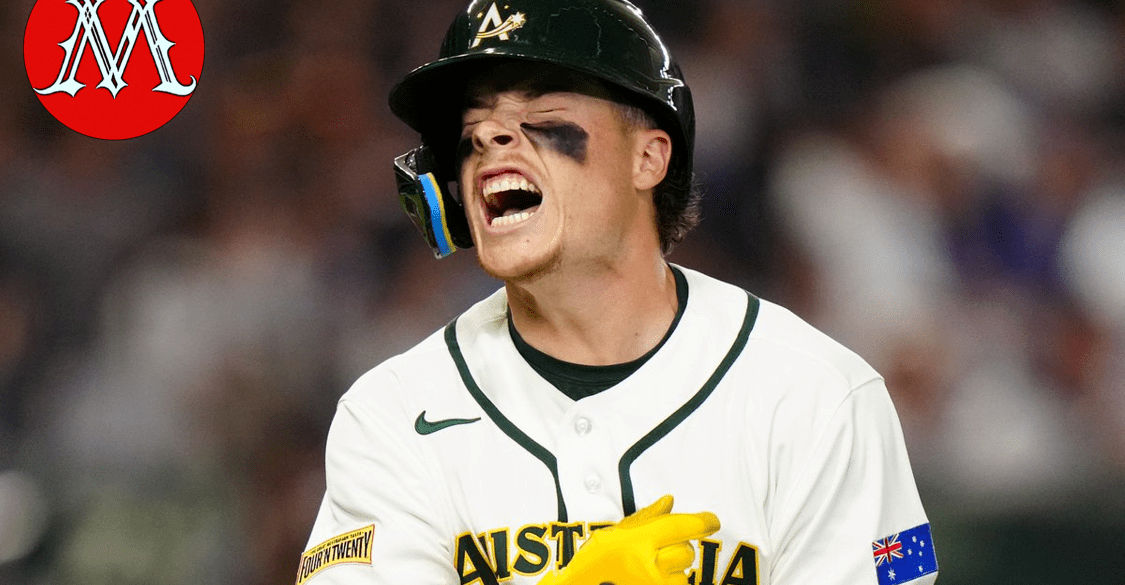
Then Bazzana woke me up with a violent swing that showed why some pundits are arguing he should break spring training with the major league team. The Bazzana-bomb was the first home run of the tournament — and when he turned toward the Australian dugout, what erupted out of him was the same unfiltered emotion I had seen in El Atanasio. Bazzana had the fever too.
Australia won the game 3-0, and I fell asleep in the hammock with a victory, the Nacional loss dissolving somewhere between the last out and the first dream.
The next day against Czechia, Bazzana didn’t need to be the main attraction. In the third, he took a four-pitch walk, a clinical bit of business that kept the inning alive just long enough for Curtis Mead to launch a three-run bomb, the deciding runs in a 5-1 victory. Australia was 2-0, and the stage was set for the collision everyone had been waiting for: Japan. Shohei Ohtani. The Tokyo Dome.
The Dome is its own kind of asylum, but one built on the terrifying weight of Japanese pride. With Emperor Naruhito watching — the first sitting Emperor to attend a game in sixty years — the atmosphere was suffocating. Yet, for six-and-a-half innings, Australia committed heresy holding Japan scoreless. Connor MacDonald — a guy who only picked up pitching three years ago and had never thrown a pitch above the Australian Baseball League — paralyzed the Samurai lineup. In the sixth, Australia clawed a run across the plate and took a 1-0 lead that felt like a defiance of the natural order of baseball. But you don’t kill a king that easily.
In the bottom of the seventh, with two outs and Japan’s national pride flickering, Masataka Yoshida turned on a pitch and lit the building on fire with a two-run homer. The stadium was no longer a cathedral; it was another ward of the infected. Japan added two more in the eighth, and though Australia answered with two homers of their own in the ninth to cut the lead to 4-3, they fell just short of a miraculous victory. No one beats Japan.
Australia now sits at 2-1, good enough for second in the group with only Korea standing between them and the knockout round. A win punches Australia’s ticket, and after holding Ohtani’s squad scoreless for six innings in front of the Emperor, you have to think Bazzana and the Australians are walking into the Tokyo Dome carrying that contagion.
Because the fever hasn’t broken. The madhouse is open for business. Atlético Nacional’s tournament may have ended. But Bazzana’s is just beginning.