
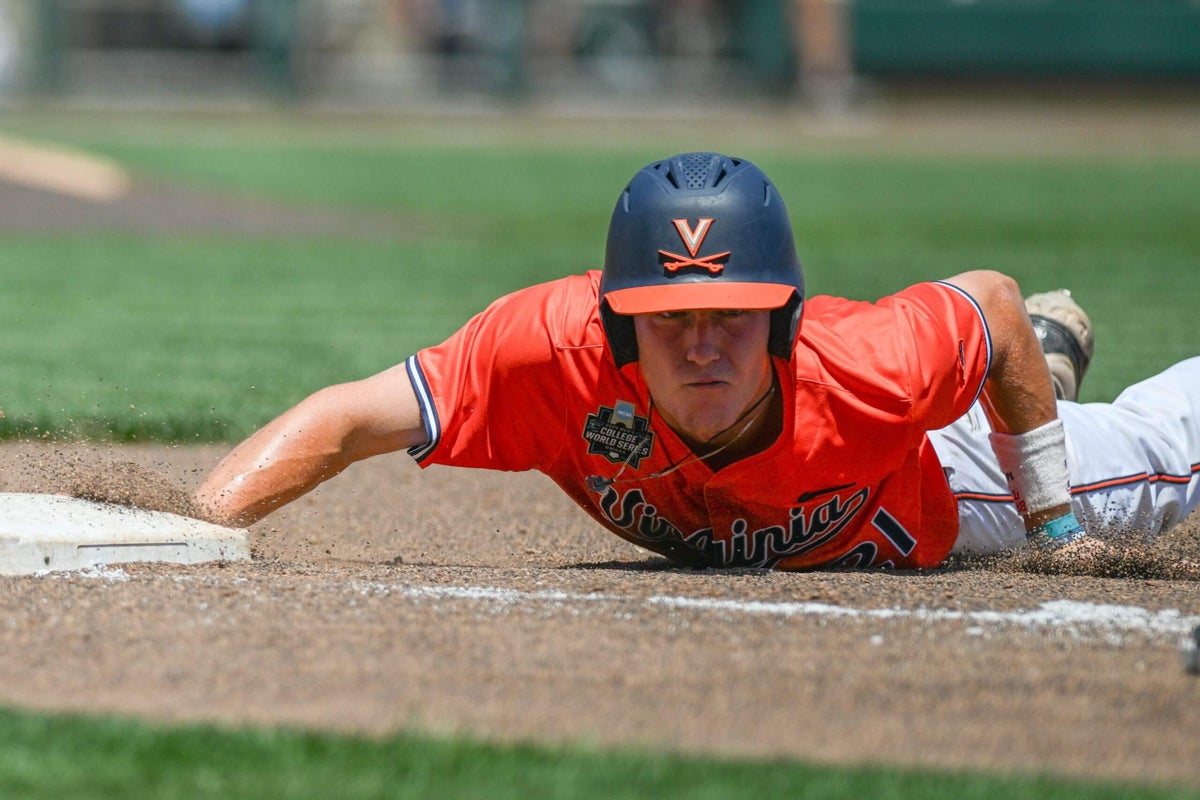
Weekend No. 4 of the college baseball season is usually the final series of nonconference competition for the best teams in the country, but several ACC schools began their conference schedules this past weekend. Virginia and North Carolina squared off at the Bosh for three games, with a solid crowd of scouts in attendance, including at least seven MLB scouting directors, to see the two potential first-rounders in UVA’s lineup and a half-dozen other potential Day 1 picks on the two rosters.
(Note: Scouting grades are on the 20-80 scouting scale.)
Virginia shortstop Eric Becker sits in fifth on my draft board, behind what I think is the broad consensus for the top four and atop the large next tier of college position players. I caught two games of Becker as the Cavaliers steamrolled North Carolina before losing the third game of the series, with Becker going 4 for 8 and showing the swing and hard contact that make him one of this year’s top hitting prospects.
Becker’s entire operation at the plate is very simple. His hands are quick, he’s very direct to the ball, and he’s strong enough to hit the ball hard more often than not, with a 55 percent hard-hit rate last year. It’s not big power, as he has an all-fields approach and isn’t lifting the ball enough to project more than 12-15 homers a year, but he might have a plus hit tool if he can develop a real two-strike approach; he goes from chasing 21 percent of pitches out of the zone with none or one strike to 39 percent when he gets to two strikes.
He’s going to move to second base in pro ball as his arm is light for shortstop, but he has good hands and a quick first step to stay on the dirt. He may not have the upside of a Justin Lebron, but he offers more probability with the stick, and in this draft class, I don’t see how he goes outside of the top 10.
Becker will be joined in the first round by Virginia outfielder A.J. Gracia, who followed head coach Chris Pollard up from Duke (no offense to UVA, which is a wonderful school, but I would love to hear the sentence that comes in response to “Mom, Dad, I’m transferring out of Duke”). Gracia already has six homers this year for the Cavaliers. He has 60 power and showed real discipline at the plate in these two games. The swing is very uphill, though, and he was getting under the ball for most of these two games. He did struggle Saturday, when UNC starter Ryan Lynch (more on him in a moment) ate him up with 95-96 mph fastballs at the top of the zone.
UNC shortstop Jake Schaffner transferred in this year from North Dakota State, and props to anyone who can name NDSU’s mascot without looking it up. While there, he showed exceptional contact skills, with an overall whiff rate of just 10.1 percent (putting him in the top 4 percent of all qualifying Division I hitters) and plus speed with very little power. He then followed up with a strong showing in the Cape Cod League, hitting .281/.391/.371 with just a 15 percent whiff rate.
He came out hot against UNC’s early-season schedule of assorted cupcakes. Against UVA, he did show he could put the ball in play, at least. He was 0 for 8 in the two games I saw, with one strikeout, showing excellent bat speed without any juice to it, so it was all soft to medium contact. It’s not a bad swing, certainly not what you’d expect from someone with his stat line and fairly low exit velocities, so I’m a little more intrigued by him than I typically am by these Punch-and-Judy sorts.
He showed good range at short, but the arm isn’t there. He’s a 60 runner, so perhaps he could move to center.
UNC second baseman Gavin Gallaher hit 17 homers last year, behind only catcher (and now Mariners prospect) Luke Stevenson. He hits the ball reasonably hard, coming with a fairly quiet approach, and smoked several balls in UNC’s two losses, including a loud homer to left on a slider that sat middle-middle; you might say the pitch had it coming. He was robbed of another homer, or maybe a double, on a catch at the top of the left-field wall, and generally showed good feel to put the ball in play even when his teammates couldn’t.
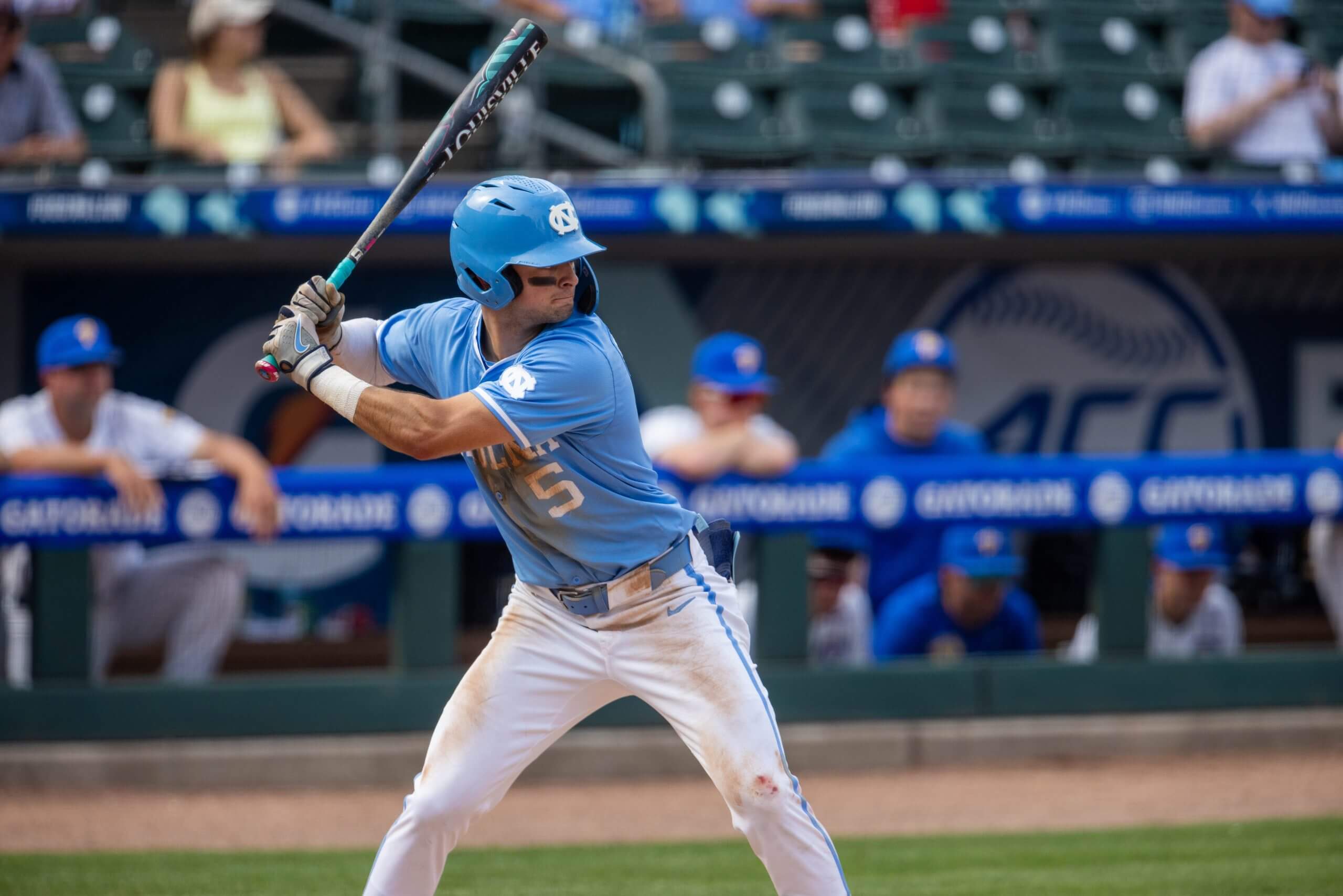
Gavin Gallaher has power but could improve on his swing decisions. (Scott Kinser / USA Today)
Gallaher is a little bit of a tweener at the plate in that he whiffs too often to give him more than a barely average hit tool, and the power is more grade 55 than 60. If he could play a more valuable position, he’d be in that Wehiwa Aloy category — Aloy went at pick 31 last year to Baltimore, even with concerns about his poor swing decisions, because he’s a true shortstop who makes hard contact. Instead, Gallaher is more of a third-rounder for me, although teams that value makeup highly might have him in the second.
Right-hander Lynch, the Tar Heels’ Saturday starter, was 94-97 with a promising changeup that really looked like the fastball out of his hand and a fringy slider that he kept trying to backdoor to lefties with limited success. He didn’t have much command and was consistently missing to his arm side.
He’s online to the plate despite an early landing that has him coming a little across his body. His pitch spray charts from his first two outings show much better ability to get inside to lefties, and if anything, his biggest location issue — aside from not locating at all — is getting something in under righties’ hands. I clearly didn’t get a great outing, and in general, I’d say he should use that changeup more, as it could be a 55 if he develops more feel for it.
It was not right-hander Jason DeCaro’s day, as UNC’s Friday night starter was wild from the start and only got worse after landing awkwardly on one first-inning pitch. He sent at least two fastballs sailing to the backstop, and in his three innings, he walked three and hit a batter, allowing half the batters he faced to reach safely. I saw him pitch better last year.
Erik Paulsen transferred to UNC from Stony Brook, where he hit .358/.452/.585 last year with just 12 strikeouts in 230 PA, playing in the lower-tier Coastal Athletic Association. He’s fattened up this spring against weak competition, with a .339/.486/.661 line through the weekend, although he’s already at nine strikeouts and didn’t have a hit in the UVA series (0 for 10, two walks, three Ks). Defensively, he’s first base only, as he’s probably a 20 runner, and I don’t see the plus power or elite hit tool for him to profile there, making him a Day 2 pick or maybe a better senior sign for next year.
UVA second baseman Joe Tiroly transferred from Rider, where he hit 18 homers and walked more than he struck out last year. I only saw middling contact from him against UNC, even though last year he got over 112 mph exit velocity, and he benefited at least twice from mistakes by UNC in the field. (The Tar Heels brought the infield in, and sure enough, he hit what would have been a routine grounder that ended up a run-scoring single.) He has just one homer this year, and is only slugging .403, even with the soft early-season schedule Virginia played. I’m not ruling out that he’s better than what I saw, but what I saw was ordinary.
Outfielder Owen Hull transferred to Chapel Hill from George Mason, where he stole 42 bags in 48 attempts last year. He had one of the best weekends of any Tar Heel, going 3 for 6 in the two games I saw and 2 for 6 in the final game, with a homer that he golfed out off a mop-up pitcher for the Cavs. He gets his hands in a good position to drive the ball, but the swing is very flat, and he hits the ball on the ground more than half of the time. Hull is probably an extra outfielder and a Day 2 pick, but there’s some juice in there, and someone has to at least try to help him get the ball in the air.