
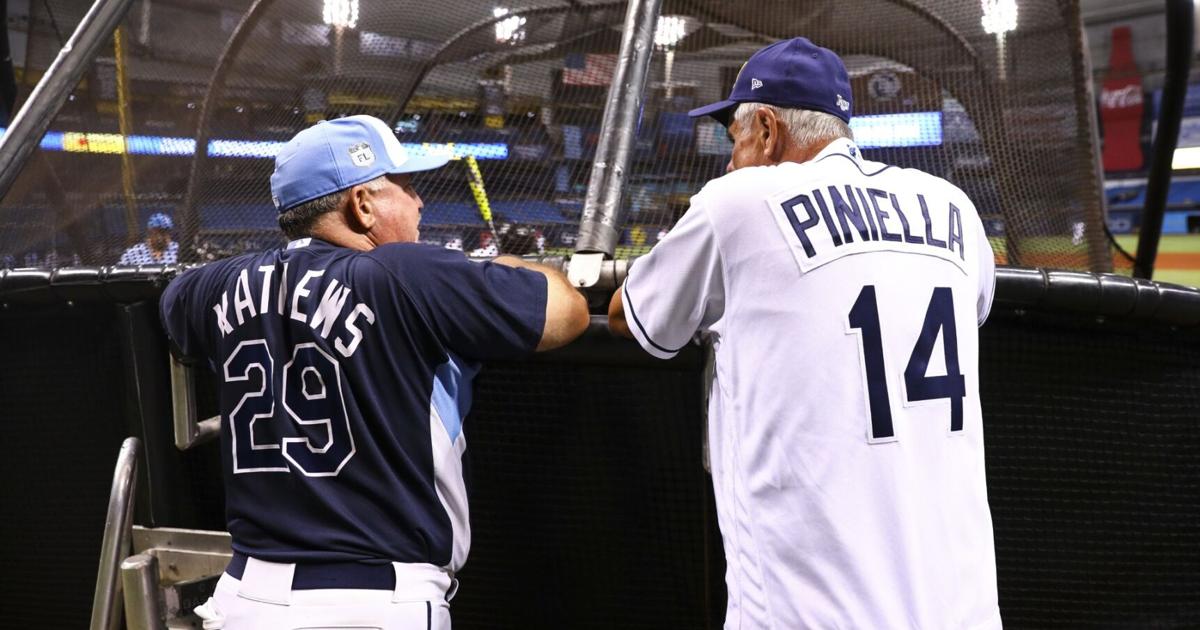
TAMPA — Is it a hit? Or an error? It’s a decision Bill Mathews has made thousands of times over more than 20 years. As the official scorer at most Tampa Bay Rays home games, Mathews is the one who makes the call.
“The words ‘should’ and ‘could’ do not exist with an official scorer,” said Mathews, the former longtime head coach at Eckerd College. “Millions might be watching, but I am the one scoring the game. Once a call is announced, that’s it. You aren’t trying to invent new rules. You only feel pressure if you let it. I don’t use analytics. Objectivity is my truth.”
Mathews is the official scorer for about 60 Rays games a year. In many others throughout the season, he watches on TV while supervising other official scorers.
One of only 90 MLB official scorers, Mathews’ duties have extended beyond the major leagues. This month, he’ll serve as the official scorer at World Baseball Classic games in Miami — his third WBC assignment, having also worked in Panama in 2017 and Miami in 2023.
Mathews, who won 504 games as a college coach and was inducted into Eckerd’s Athletic Hall of Fame in 2017, is taking his expertise to another level. At the end of May, he’ll present a paper — “The Official Scorer: Identity, Judgement, and the Moral Labor of Baseball’s Record Keepers” — at the annual Cooperstown Symposium on Baseball and American Culture. He wrote the paper with Gina Chambers of Nebraska Wesleyan University.
“I’m published!” he proudly declared at a Society for American Baseball Research event at the Tampa Baseball Museum in February.
Years ago, official scorers at MLB games were typically hometown sportswriters who, as one might imagine, sometimes leaned their decisions in favor of the team they covered. MLB sought to change that, and Mathews became a beneficiary. In 2004, Rick Vaughn, then the Rays’ vice president of public relations, approached Mathews about becoming one of the team’s official scorers. The two already knew each other through Mathews’ work with the Rays’ summer clinics.
“I said I didn’t have any experience and had never scored a game before,” Mathews said with a laugh. “But I was used to being second-guessed as a coach for 28 years at that point. I heard plenty of screaming and nasty things said at me. It was another challenge, but an easy adaptation since my skin was already thickened from coaching.”
In 2008, he became a full-time official scorer. Through his affiliation with MLB, he has also coached teams overseas, from Poland to Russia to Sweden.
“This is such a great gig,” said the 69-year-old Mathews, whose son Zach is a part-time groundskeeper for the Rays. “It keeps me active.”
With his coaching connections, Mathews probably could have landed a job with a minor league or major league team. But, he said, “No way I was going to leave Karen” — his wife — “and the kids for seven months out of the year.”
The St. Petersburg area has been his permanent home since 1990. A native of Rhode Island, Mathews first came to the area in 1975 as a freshman on Eckerd’s baseball team, a class that also included power-hitting first baseman Steve Balboni, outfielder Joe Lefebvre and Brian Sabean. Balboni and Lefebvre played 10 years in the majors, while Sabean went on to become general manager of the San Francisco Giants.
As a coach, Mathews has seen his share of success stories.
“Craig Albernaz, who recently was named manager of the Baltimore Orioles, graduated from Eckerd in 2005 and played for me for four years,” Mathews said, noting that Albernaz “then went on to a distinguished career as a minor league player and manager.”
Albernaz won six rings as a manager and coach in the Rays organization before becoming bench coach with the Guardians for two seasons. He was then named manager of the Orioles. Another of Mathews’ players, 1993 graduate Jim Mecir, pitched in relief for 10 years with the Yankees and Athletics.
Mathews’ coaching career began in earnest in 1978, when he became an assistant under future major league coaches Carlos Tosca and Brian Butterfield. After leaving Eckerd for a teaching and coaching job at Canterbury School of Florida, he returned in 1990 as head coach. When he retired in 2014 after 24 years at the helm, later becoming an administrator, he had amassed more than 500 wins and claimed a Sunshine State Conference Coach of the Year title. His number was retired in 2016.
Being an official scorer is not without its moments. In a game last year, Yankees hurler Max Fried was working on a no-hitter against the Rays. In the sixth inning with two outs, Chandler Simpson hit a slow dribbler that first baseman Paul Goldschmidt had trouble handling. Simpson beat it out, and Mathews initially called it an error. Two innings later, after careful review, he concluded Simpson would have beaten the throw regardless and changed the call to a single, upending the no-hit bid. As it turned out, a clean single by Jake Mangum in the eighth would have ended the no-no anyway. But in the meantime, Mathews caught heat, particularly from Yankees fans.
“My cell phone was lighting up,” he said. “I got death threats. The FBI got involved. You are the official record keeper. You cannot be influenced.”
It’s not only hits and errors that official scorers rule on. They also decide whether a pitch was a wild pitch or a passed ball, or whether a stolen base was truly a steal or the runner advanced on defensive indifference.
All in all, Mathews finds that players, managers and sportswriters generally do not get worked up over a call.
“You are watching the same game as everybody else,” he said. “As long as you are fair and equitable, you are respected.”
Mathews goes the extra mile before each game, spending a few minutes on the field to check conditions — sun, lighting and anything else that might affect play.
Does he ever second-guess himself?
“Once I leave the park, I am done,” Mathews said, noting that a call can be re-evaluated for up to 48 hours if a scorer feels a change is necessary. “I’m not bringing it home with me.”
When it’s game time, give Mathews a pencil and a scorebook and he’s ready to go to work.