
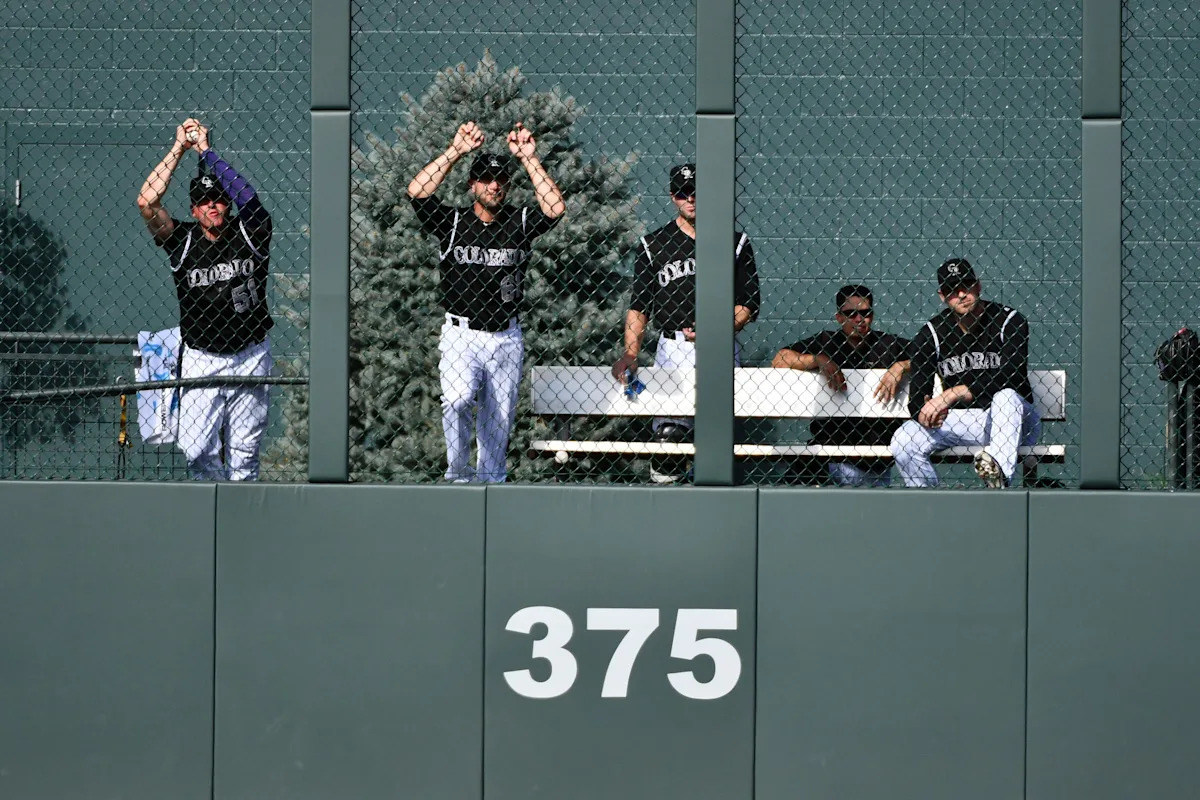
Bullpens are funny things.
They can be invisible when everything is working and painfully obvious when they’re not. Over the course of a long season, though, they quietly shape the outcome of dozens of games.
Advertisement
And for a rebuilding team like the Colorado Rockies, they matter more than ever.
The Rockies’ bullpen in 2025 was… not great.
Colorado finished 29th in MLB in reliever ERA, and if you’re wondering who finished 30th, yes — somehow the Washington Nationals were worse. The group pitched a heavy workload and struggled in several key areas that tend to matter a lot at Coors Field. Rockies relievers ranked 28th in strikeouts per nine innings (7.86); walked the fifth-most batters in baseball; and allowed the most home runs of any bullpen in the league.
That combination is difficult to survive anywhere. At Coors Field, it is especially unforgiving. Walks create traffic. Traffic plus home runs create crooked numbers. Without a strong strikeout rate, escaping those jams becomes even harder.
Advertisement
But here’s the thing: The bullpen might actually be one of the more interesting areas of the roster right now.
There’s real talent here. Several arms can touch the upper-90s. There are intriguing young pitchers trying to establish themselves. And perhaps most importantly, the organization appears to be rethinking what a successful bullpen at Coors Field should actually look like.
Does high velocity play at altitude? Can a swing-and-miss monster survive at Coors? Or does the ideal Rockies reliever look more like Jimmy Herget — command, deception, and controlled contact?
Those questions may start getting answers this season.
Advertisement
A lot of turnover
The bullpen looks very different as we head into the 2026 season.
Five of the top ten relievers by innings pitched in 2025 are no longer on the roster:
Bird and Kinley were traded at the deadline, while Chivilli was moved over the winter in a trade for first baseman T.J. Rumfield. Molina and Rolison were both designated for assignment this offseason and subsequently landed with other teams.
That’s 234 innings of work walking out the door.
Turnover like that creates opportunity. A bullpen in transition is uncomfortable, but it also gives the organization a chance to reshape its identity.
Advertisement
Currently on the roster
Jimmy Herget was the clear standout last season. His funky delivery creates deception, but more importantly, he throws strikes and limits self-inflicted traffic. That profile actually fits Coors Field surprisingly well. He might not light up the radar gun, but he consistently drives results. In 2025, Herget logged 83.1 innings with a sterling 2.48 ERA, striking out 81 batters while maintaining a solid, if unspectacular, 2.81 BB/9.
For a Rockies reliever working that many innings, a combination of durability, strike-throwing, and run prevention was quietly one of the most valuable performances in the bullpen last season. Given the turnover and uncertainty elsewhere in the relief corps, the Rockies will likely look to Herget to shoulder a similar workload again in 2026, serving as both a stabilizing presence and a reliable bridge in the middle and late innings.
Victor Vodnik, Juan Mejia, and Seth Halvorsen represent the power side of the bullpen. The velocity is there — upper-90s fastballs and the kind of raw stuff that can miss bats in high-leverage situations.
Advertisement
Vodnik in particular showed flashes of becoming a late-inning option in 2025. He finished the season with 10 saves, a 3.02 ERA, and 50 innings pitched, though his fastball was occasionally hit hard and his walk rate remains something to watch. His changeup, however, has proven effective at generating ground balls and limiting damage.
Halvorsen might possess the loudest raw stuff in the bullpen. His fastball velocity ranks near the top of the league, touching triple digits, but like Vodnik, the command has been inconsistent. Despite that, he still finished an uneven season with 11 saves, showing the kind of late-inning upside that power arms can provide.
And that’s part of the current evaluation process: The Rockies still appear to be sorting out who ultimately handles the highest-leverage innings. Vodnik and Halvorsen both saw time closing games last year, and neither has definitively locked down the role yet.
Mejia has primarily leaned on a two-pitch combination — a fastball and slider — which allows him to attack hitters aggressively without overcomplicating pitch sequences. That approach helped him carve out a role last season, but he’s working to expand his arsenal heading into 2026. Mejia has been developing a changeup, a pitch he admitted he didn’t have much confidence throwing last year but is now beginning to trust more as he continues refining it this spring. If that third pitch becomes a reliable option alongside his power fastball and slider, Mejia could take another step forward and emerge as one of the bullpen’s more dependable high-leverage arms.
Advertisement
Brennan Bernardino was brought in via trade to anchor the left-handed side of the bullpen. Bernardino isn’t a strikeout-heavy reliever, but he features a diverse pitch mix and excelled last year at generating weak contact on the ground. Behind him, the left-handed depth is thin, making that side of the roster one of the more interesting battles to watch this spring.
R.J. Petit (No. 23 PuRP), a Rule 5 selection, will need to remain on the roster, works with a mid-90s fastball and a gyro-spin slider — a pitch type that tends to play well at Coors Field due to its movement profile. However, some recent forearm tightness calls his near-term future into question.
Keegan Thompson was claimed off waivers to provide depth and potential bulk innings, and Antonio Senzatela could also see time in multiple roles as he continues expanding his pitch mix.
Zach Agnos, Jaden Hill, and Luis Peralta are all vying for innings. The stuff flashes with all three, but consistency remains the question.
Advertisement
Non-Roster Invitees
The Rockies also have several non-roster arms competing for bullpen opportunities worth monitoring.
John Brebbia brings the most big-league experience of the group. He has had an up-and-down major league career, but he has looked sharp this spring and could provide veteran stability if the Rockies want an experienced option in the middle innings.
Parker Mushinski is an intriguing left-handed candidate. He features a deeper pitch arsenal than many relievers and tends to generate weaker contact rather than relying purely on strikeouts. His spring has been uneven — including a rough outing against Texas — but he has also flashed swing-and-miss ability.
Advertisement
Evan Justice, a left-hander drafted by Colorado in the fifth round in 2021, offers a fastball-slider combination and familiarity with the organization. His 2025 performance was largely uninspiring, but as a left-handed arm he could still factor into the depth picture.
The prospect angle
Welinton Herrera (No. 17 PuRP) is one of the more fascinating arms in the system. The left-hander dominated in the Arizona Fall League and has real bat-missing ability. In 46.1 innings at Double-A, he posted a 13.6 K/9 with a 3.50 ERA.
The strikeout ability is real. The walks and fly-ball tendencies will be something to monitor in a Coors Field context, but if a left-handed prospect forces his way into the picture quickly, Herrera has the type of stuff that could do it.
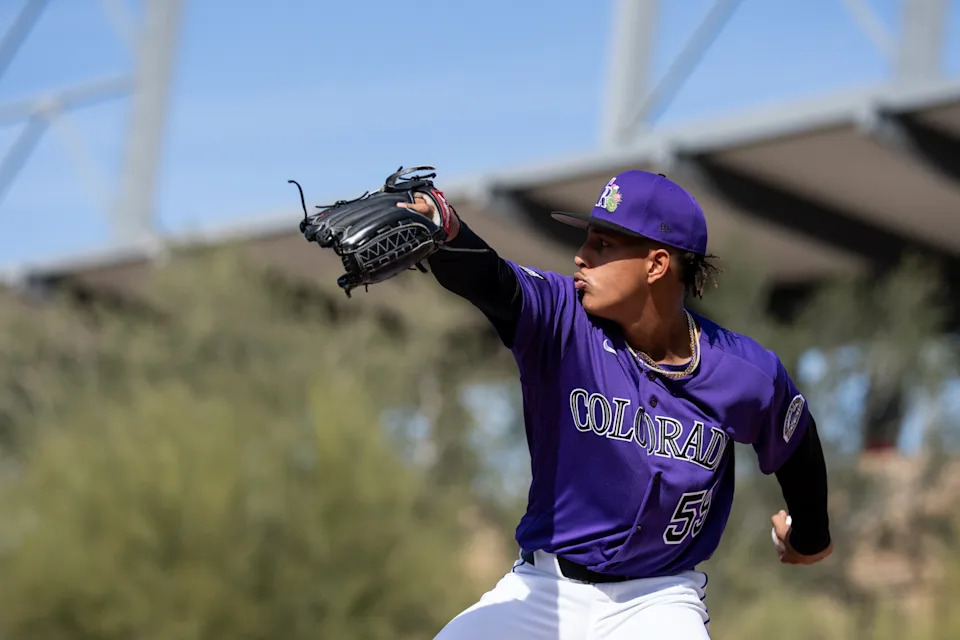
Carson Palmquist (No. 19 PuRP) is another intriguing variable. He has developed primarily as a starter, but his path to impact in Denver could ultimately run through relief. In shorter outings, a modest velocity bump and a simplified arsenal could change the profile of his fastball and breaking pitches. A left-handed arm capable of throwing strikes and navigating multiple innings could be extremely valuable in this environment.
Advertisement
Both were optioned to Triple-A Albuquerque on Sunday, but could still potentially make it to Coors Field in the not-too-distant future.
Velocity, command, the the “Coors Equation”
The Rockies bullpen does not lack velocity.
Several arms — including Vodnik and Halvorsen — can reach the upper-90s, and that kind of power arsenal should theoretically translate into strikeouts and late-inning dominance. But velocity alone does not solve the Coors Field equation.
Poorly located velocity combined with walks is a dangerous formula anywhere, and at altitude it becomes even more volatile. Walks create traffic, and traffic paired with a misplaced fastball often turns into multi-run innings.
Advertisement
That dynamic defined much of the Rockies’ bullpen struggles in 2025.
Rather than chasing velocity alone, the organization appears to be placing greater emphasis on command and inducing weaker contact. That approach matters even more at Coors Field, where the expansive outfield and elevated batting averages on balls in play can quickly turn hard contact into extra bases.
A successful Rockies bullpen may ultimately look less like a group of pure strikeout specialists and more like a balanced mix of power arms, command-focused pitchers, and relievers capable of generating ground balls.
Another useful way to evaluate bullpen stability is inherited runners scored. In 2025, Rockies relievers allowed roughly 37 percent of inherited runners to score, placing them near the bottom third of MLB. League average typically sits closer to 30-31 percent.
Advertisement
That gap may sound small, but over a full season it represents dozens of additional runs allowed — many of them in high-leverage moments.
One way to see how much bullpen stability matters is through win probability. When a team enters the seventh inning with a lead, the game is largely in the hands of the bullpen. Across MLB, teams win roughly 85-90 percent of games when leading after seven innings. When that lead disappears, it is often because the bullpen allows traffic through walks, poorly timed hits, or inherited runners scoring.
For the Rockies, improvement doesn’t require perfection. It simply requires finishing games more consistently.
Even modest improvements in walk rate and strand rate could turn a handful of late losses into wins over the course of a season.
Advertisement
The big picture
This bullpen is not without talent.
Rather, it’s a group still defining itself.
Herget provides a command-forward template. Vodnik, Halvorsen, and Mejia bring velocity and strikeout potential. Hill, Agnos, and Peralta represent the next wave of development.
The late-inning roles — including who ultimately claims the closer’s job — are still being evaluated, and that competition may be one of the more interesting storylines of the season.
If the walk rate drops and a couple of the power arms harness their command, the bullpen could stabilize faster than expected.
Advertisement
And in a rebuild, stabilization matters.
But it also raises an interesting question for Rockies fans: What should a successful Rockies bullpen actually look like at Coors Field?
Should Colorado lean into velocity and strikeouts? Should it prioritize command and weak contact? Or is the answer somewhere in the middle?
The next season or two may provide that answer — and the comment section will probably have a few ideas in the meantime.
Please keep in mind our Purple Row Community Guidelines when you’re commenting. Thanks!