
SURPRISE, Ariz. – Baseball embraces change with the same reluctance as the Rangers fan who showed up at Sunday’s game in a Charlie Hough jersey. “Leave well enough alone” has been MLB’s default mode both in Charlie’s day and over most of the eons since.
But, lo and behold, the game survived the pitch clock without Kenesaw Mountain Landis bolting from his slumber, so now comes the ABS challenge to stir the pot even more.
If the early returns in spring training are a mixed bag and MLB still needs to iron out a few rough edges, three things seem obvious, even to yours truly:
First, everyone except the strict constructionists will like it.
Rangers
A challenge with the bases loaded looks like a good idea.
And, as usual, teams are already looking for loopholes.
Before getting to the matter at hand, the terms, if you hadn’t heard, allow up to two unsuccessful challenges per nine innings. Only the hitter, pitcher and catcher are allowed to do so. Once any of the three feels so inclined, he must tap the top of his head immediately after the umpire’s call for a review. An image then pops up on the scoreboard rendering a final verdict.
Takes no more than eight seconds, tops.
The hitters’ reaction so far?
“Personally, I like it,” Josh Smith said. “If you think you got hosed on a call, then you can argue it. Just kind of gives you that peace of mind.”
And the pitchers?
“I think guys are coming around to it,” Jacob Latz said, “because, personally, I think it gives you a real clear idea of where the strike zones are every day.”
Of course, it can get a little more complicated than either of those takes. Like when the Brewers held up cards in the dugout the other day telling players if it’s a good or bad time to challenge, should the situation come up. Green for go; red for no. Skip Schumaker even mentioned it in a media session Saturday.
Except it turns out the cards are a no-go. MLB informed the Brewers of as much over the weekend, reminding them the decision to challenge remains solely with the hitter, pitcher or catcher, who get no help from other sources.
The league can lecture all it wants, but it won’t stop teams from working around the margins of the rules. For instance, if a manager wants his hitter to know it’s a good time to challenge, what’s to stop a base coach from signaling?
Or the Astros from banging garbage cans?
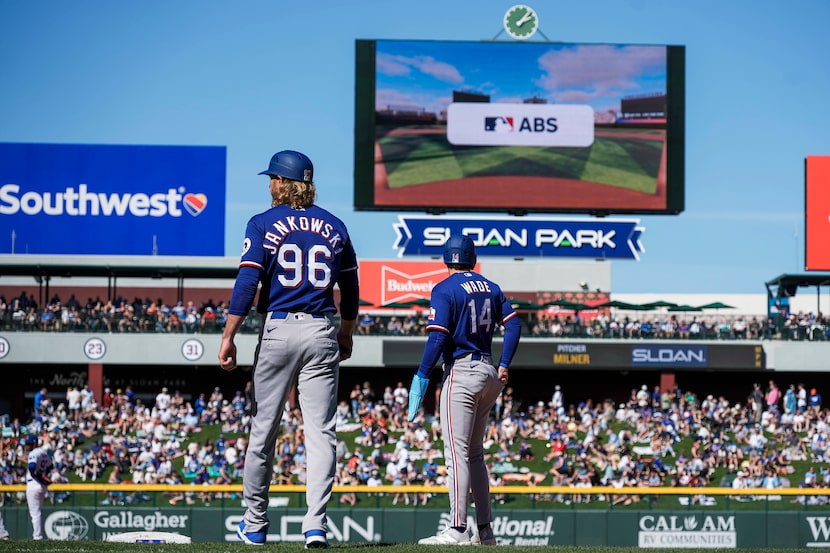
Texas Rangers first base coach Travis Jankowski (96) and infielder Tyler Wade (14) look up to the scoreboard during a Chicago Cubs replay challenge using the Automated Ball-Strike (ABS) Challenge System during the fourth inning of a spring training game on Saturday, Feb. 21, 2026, in Mesa, Ariz.
Smiley N. Pool / Staff Photographer
But, seriously, let’s not quibble about what should be a good thing once teams figure out how to use the challenges. Time and circumstances rule. In other words, it’s not a good idea with two outs and no one on.
“That’s the selfish move,” Schumaker said.
According to Baseball Savant’s data going into Monday’s games, the best time to challenge is with the bases loaded, when pitchers and catchers are winning at a robust 67% clip.
By the way: Bet on challenges by pitchers and catchers, not hitters. The numbers say the latter don’t see the ball nearly as well as they think.
Smith went 0-for-2 on challenges against the Giants. He’d have gone 1-for-3, but he didn’t call for the review in time.
“I’m the worst at it,” he said of challenges, “because I think everything is a ball.”
And here we thought he just had good plate discipline.
Schumaker’s only problem with the technology is the universal objection from those who object to the encroachment of technology on a pastoral sport.
“I like the human element,” he said. “I think that’s the beauty of the game. I think that’s going away with all these things. You don’t see a manager come out too often debating a play because it’ll just be a challenge. There’s no back and forth, and you’re going to lose maybe a lot of that if there’s a full ABS system.
“I also think the results so far show the umpires are pretty good. They are missing by this much. That shows you they’ve been doing a really good job.”
But if you can do better, shouldn’t you?
“Probably, yeah,” he said. “I think that’s the goal, to try to get every play right.”
Especially in an era when fans can look at a rectangular box on their TV and tell if the umpire is right. Miss enough of those, and they start to wonder if, say, gambling interests play a part. Mistakes drive conspiracies, a booming business in our society. You can’t have customers questioning the integrity of the product.
Judging by their reactions, fans here in Arizona seem to enjoy watching the results of the challenges.
No one’s picketing, anyway.
The challenge system has come a long way from where it was when I visited Round Rock three years ago to check it out. Back then, pitchers really disliked it. They’re taught from an early age to avoid the beefy part of the strike zone. Working the edges means that, at some point, they hope to get calls on pitches just off the plate.
Problem is, ABS doesn’t fudge.
Latz said his experience with ABS in Triple A has helped his adjustment this spring. The system is better than it was then, he said, even if the top and bottom of the strike zone remain “finicky.” MLB, in fact, has yet to figure out how to adjust the zone for a hitter’s actual stance instead of his height.
In Latz’s last start against the Giants, the system worked against him. He lost both challenges, one of which cost him a strikeout. To make matters worse, that hitter ended up scoring. These things tend to pile up when you’re trying to make a rotation.
Just the same, Latz remains a fan of the technology. He understands that MLB is trying to help out hitters in an era when averages are down across the board. He’s also seen videos of what used to be called balls and strikes back before that little rectangle appeared on your screen. Umpires adjusted then. Nothing says they won’t again. Keeps everyone “accountable,” as Latz put it.
But what about those pitches just off the plate that you used to get?
“I mean, strikes should be called strikes,” Latz said, “and balls should be called balls.
“That’s how I feel about it.”
If this pitching thing doesn’t work out for him, I’m thinking about nominating him for public office.
Find more Rangers coverage from The Dallas Morning News here.