
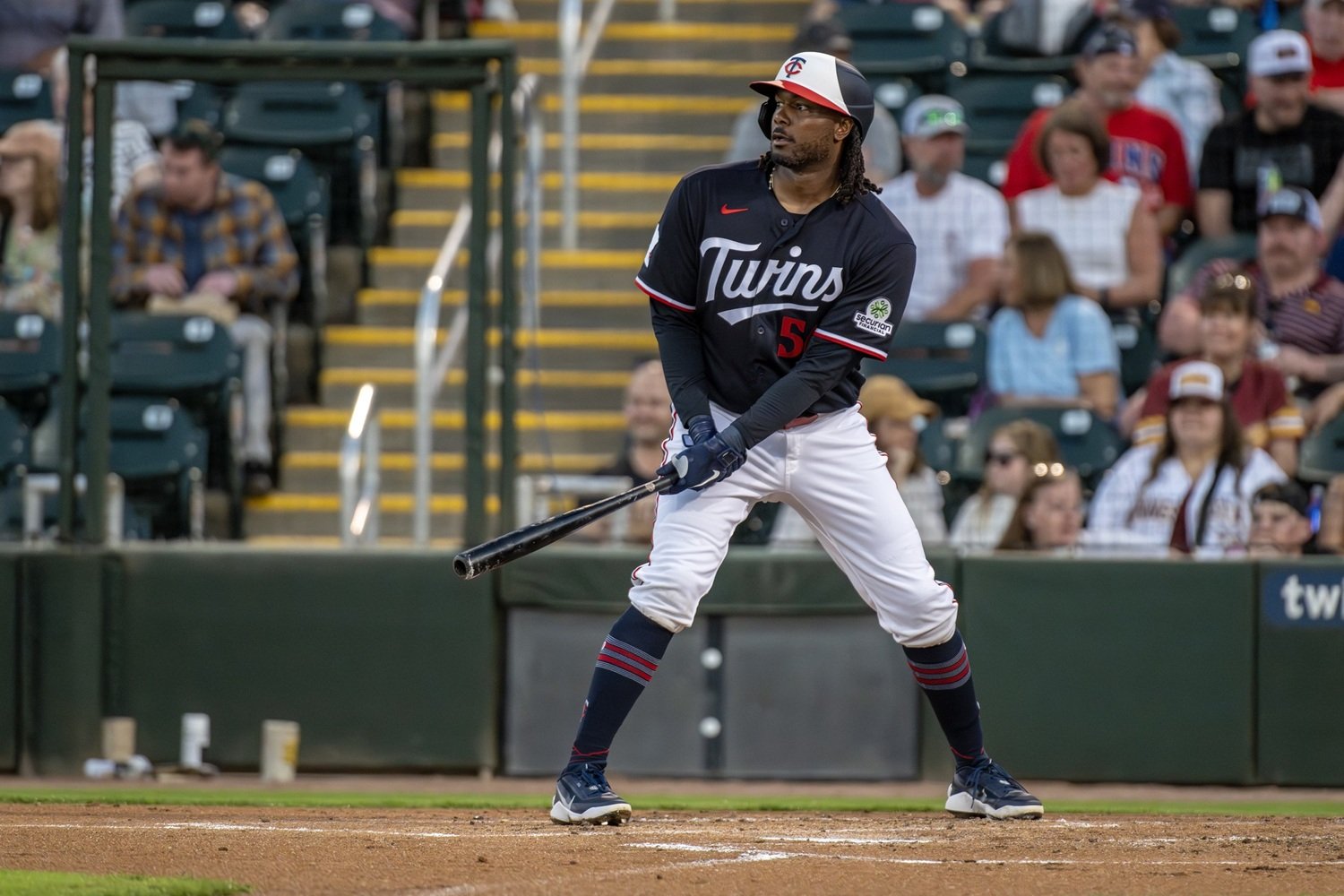
The biggest addition to the Minnesota Twins lineup this offseason came when they signed switch-hitting first baseman Josh Bell. Minnesota added the veteran to provide stability in the middle of the order, and if his recent track record holds, he could be exactly what the lineup needs.
Over the last four seasons, Bell has quietly delivered steady offensive contributions. He’s averaged a 109 OPS+ during that span, while hitting roughly 20 home runs and 24 doubles per year. That level of production offers valuable support for a team looking to create more run-scoring opportunities—and capitalize better when they arise.
Bell has never excelled on defense. His glove grades out below average (-4 OAA in 2025), but the Twins have built flexibility around him. Players like Kody Clemens and Victor Caratini can cover first base if needed, giving manager Derek Shelton different lineup options.
In recent seasons, Minnesota has taken a similar approach, repeatedly bringing in veteran first basemen on short-term deals. The results have varied. Ty France held down the position in 2025, while Carlos Santana did so in 2024 and Donovan Solano in 2023. France and Santana both delivered strong defensive seasons that earned American League Gold Glove honors, but the offensive production from the position has fluctuated.
Bell is a different style and caliber of player, at least after one adjusts for the stage of each player’s career at which they arrived in Minnesota. His value is tied more closely to what he can do with the bat. Early in camp, Bell has focused on settling into a new clubhouse and getting back into the rhythm of spring training.
“Definitely a good first couple of weeks, shaking hands, meeting different people,” Bell said. “I think spring training, for the most part, is the same, no matter what camp you go to. It’s like shaking the cobwebs off. Try to establish your routine. Obviously, stay healthy out there as more and more innings get put onto your plate. But I’m definitely happy to be here and excited for the opportunity ahead.”
With a roster that blends veterans and younger players, Bell also understands the leadership role that often comes with experience. For him, that responsibility starts with communication.
“I think it all starts with conversation, getting to know different people,” Bell said. “People come to me with different questions. And for me, it’s just about being honest about my experience. I’ve had a few more reps than other people in this clubhouse. But we all have the same love for the game. We’re all trying to get to the pinnacle: postseason. See what we can do here collectively to do that.”
He believes leaders show themselves in small moments, rather than grand speeches.
“So that’s the goal, lead by example, lead by a conversation here or there,” he said. “That’s what Shelty wants out of me, so I’m happy to do that.”
Bell’s offensive approach evolved throughout last season. After making adjustments entering the year, he initially struggled to produce the type of contact he expected. Through June 12, he was hitting .178 with a .605 OPS, but posted an .839 OPS from then on.
“Yeah, I thought I was in a great position leaving camp (in 2024),” Bell said. “I had a homer that first series, you know how that goes, I felt like I was on top of the world. Lot more fly outs than I was used to, a lot more soft contact than I was used to. Ball flight was there, but it wasn’t crushed the way I normally do when I get balls in the air.”
As the season progressed, Bell simplified things at the plate and focused on driving the ball with authority again.
“So, I kind of honed things down and got back to squaring up the baseball and reestablished myself in the box and [was] able to drive the ball to all fields,” Bell said. “Then, as the season went on, I got a couple hot streaks to increase the power numbers and leave the yard a few times. So definitely a learning experience, not the start that I wanted, but hoping for a better start this year.”
That late-season adjustment has shaped his preparation heading into 2026. Rather than reinventing anything, Bell is sticking with the routine that helped him finish strong.
“Yeah, you got the same routine as I had the last four months, pretty much the same thing in the cage,” Bell said. “So you feel good, feel good for both sides about getting the reps now and addressing it, and getting out there and competing.”
For Bell, the key to unlocking power is surprisingly simple. Focus on hitting the ball hard and let the strength take care of the rest.
“I think it was just about not missing balls in my zone,” Bell said. “When I focus on driving balls to all fields, the at-bat tends to end when it needs to. So I’m not up there fouling balls off and grinding. Balls coming in my zone, at-bats over. If I screw it up, it’s 100 plus, and if it’s in the air, better things happen.”
That mindset allows the power to show up naturally.
“I think it was more just that, not trying to do too much pre-pitch, understanding if it comes into my zone, I have the strength to get it out of the ballpark, not trying to force that issue.”
Ultimately, Bell’s role in the lineup will be determined by performance. He views the situation in straightforward terms.
“I feel like if I’m playing well, I’ll be in the lineup,” Bell said. “That’s the way I see it.”
For the Twins, that may be exactly what they’re hoping for. While Minnesota has cycled through several veteran first basemen over the last few seasons, Bell brings a different offensive profile. If his approach continues to yield consistent power and run production, the Twins may finally get the middle-of-the-order impact at first base they’ve been seeking.
What are realistic expectations for Bell in 2026? Can he replicate his numbers from the second half of last season? Leave a comment and start the discussion.