
Here’s a look back at what happened in the Chicago area on March 10, according to the Tribune’s archives.
Is an important event missing from this date? Email us.
Front page flashback: March 11, 1948
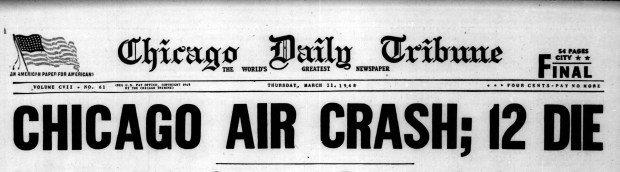 There was one survivor in the crash of a Delta Airlines DC-4 just after takeoff from Chicago’s Midway airport on March 10, 1948. Tripolina Mio, who was badly burned, was taken in critical condition to Holy Cross Hospital, the Tribune reported. (Chicago Tribune)
1948: A Delta Air Lines DC-4 crashed and burned on takeoff from Chicago’s Midway International Airport.
A gust lock, intended to prevent wind damage to the tail’s control surfaces when the plane was on the ground, was suspected. Twelve of the 13 people on board died.
“Witnesses at the airport said the huge plane took off into a north wind and had a clear field ahead,” the Tribune reported. “The first hint of trouble was the flare-up and explosion when the plane hit the earth.”
Vintage Chicago Tribune: Plane crashes that stunned our city
Weather records (from the National Weather Service, Chicago)
High temperature: 70 degrees (1955)
Low temperature: 2 degrees (2003)
Precipitation: 0.87 inches (2013)
Snowfall: 2.6 inches (1943)
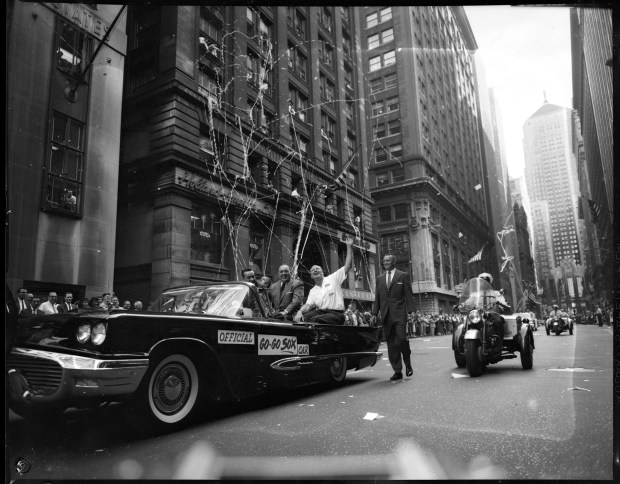 Charles Comiskey, in car from left, Mayor Richard J. Daley and Bill Veeck in a Chicago White Sox ticker-tape American League victory parade down LaSalle Street heading for City Hall on Sept. 24, 1959. (Chicago Tribune historical photo)
1959: Bill Veeck and investors bought the Chicago White Sox.
The “Go-Go” White Sox clinched the American League pennant in Cleveland against the Indians that season.
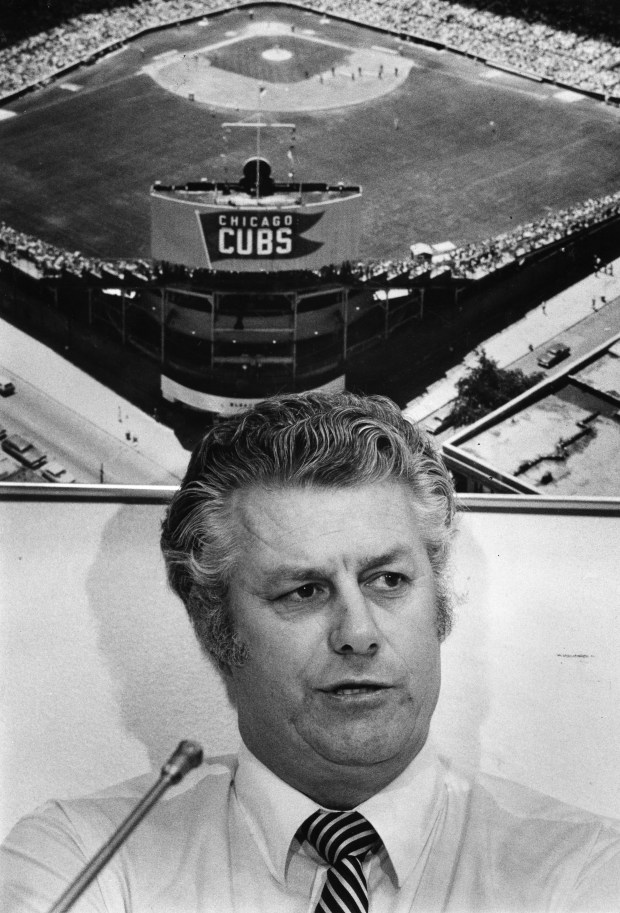 Dallas Green, vice president and general manager of the Cubs, speaks at a press conference on Jan. 26, 1983, at Wrigley Field in Chicago. (Carl Hugare/Chicago Tribune)
1982: Chicago Cubs general manager Dallas Green told reporters lights would have to be installed at Wrigley Field, “or we’ll have to think about playing in another ballpark.”
Though Green quickly followed that up by saying lights “are not a priority at this time,” his words prompted protests from Citizens United for Baseball in Sunshine and other Wrigleyville neighbors opposed to night games.
Green resigned as general manager and team president in 1987, when the Cubs finished last in the National League East and accused the team of quitting.
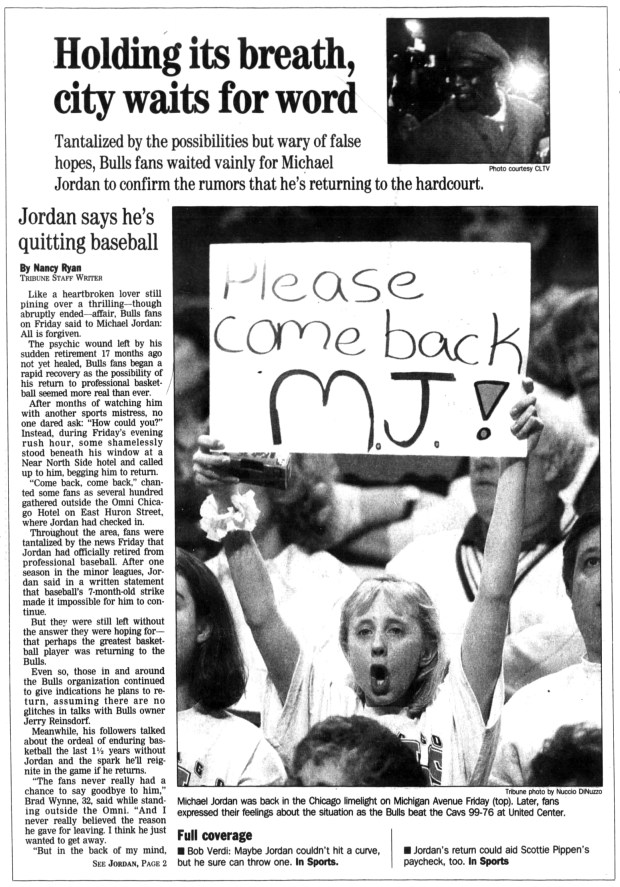 Michael Jordan quit the Chicago White Sox on March 10, 1995, and many Chicago Bulls fans hopes it signaled his return to basketball. (Chicago Tribune)
1995: Michael Jordan quit the Chicago White Sox, citing the MLB labor dispute’s effect on his development.
“As a 32-year-old minor leaguer, who lacks the benefit of valuable baseball experience over the past 15 years, I am no longer comfortable that there is meaningful opportunity to continue my improvement at a satisfactory pace,” Jordan wrote in a statement.
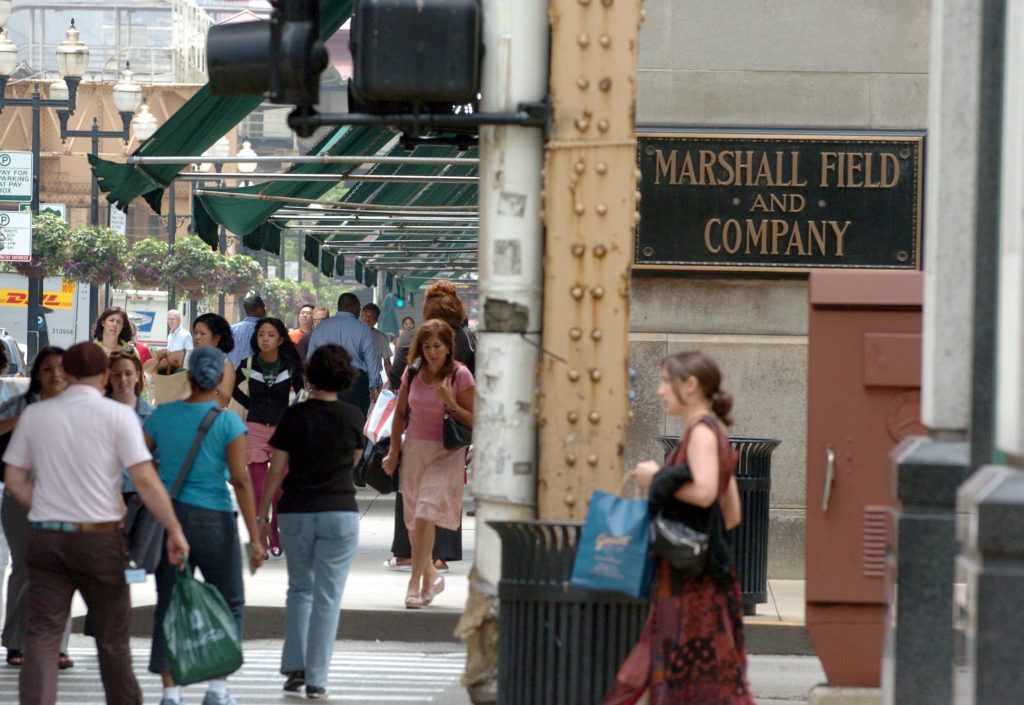
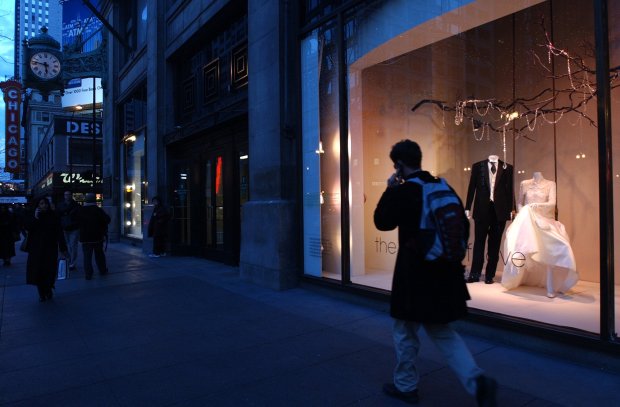 Marshall Field’s State Street store on March 10, 2004. (Abel Uribe/Chicago Tribune)
2004: Target Corp. announced it was putting Chicago retailing icon Marshall Field’s up for sale.
Field’s was sold to May Department Stores Co. in June 2004, for $3.24 billion. Then, May’s was acquired by Federated Department Stores Inc. — the parent company of Macy’s — in 2005.
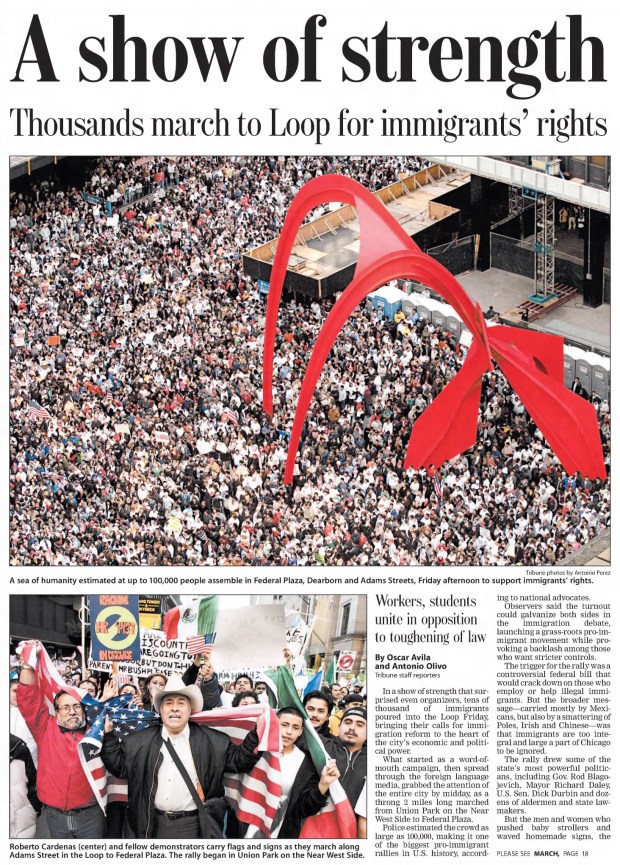 Urgent chants of “Si, se puede,” or “Yes, you can,” echoed off the walls of downtown skyscrapers, with drums adding a festive backbeat during a rally for immigration reform in Chicago on March 10, 2006. (Chicago Tribune)
2006: An immigration reform rally drew up to 100,000 people to the Loop.
The trigger for the rally was a controversial federal bill that would crack down on those who employ or help immigrants in the U.S. without legal permission. But the broader message — carried mostly by Mexicans, but also by a smattering of Poles, Irish and Chinese — was that immigrants are too integral and large a part of Chicago to be ignored.
The rally drew some of the state’s most powerful politicians, including Gov. Rod Blagojevich, Mayor Richard M. Daley, U.S. Sen. Dick Durbin and dozens of aldermen and state lawmakers.
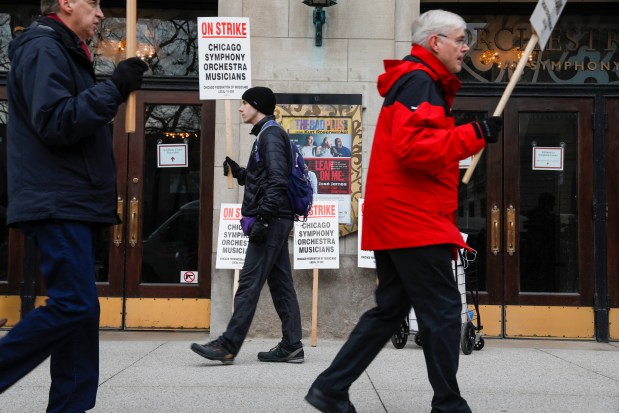 Members of the Chicago Symphony Orchestra musicians union picket on March 11, 2019, outside Orchestra Hall on South Michigan Avenue in Chicago. (José M. Osorio/Chicago Tribune)
2019: The Chicago Symphony Orchestra went on strike over pension and salary concerns, which caused the cancellation of some performances. Conductor Riccardo Muti joined his striking colleagues saying, “I am with the musicians.”
The musicians voted unanimously in late April 2019 to ratify a contract that settled the matters.
Want more vintage Chicago?
Subscribe to the free Vintage Chicago Tribune newsletter, join our Chicagoland history Facebook group, stay current with Today in Chicago History and follow us on Instagram for more from Chicago’s past.
Have an idea for Vintage Chicago Tribune? Share it with Kori Rumore and Marianne Mather at krumore@chicagotribune.com and mmather@chicagotribune.com