
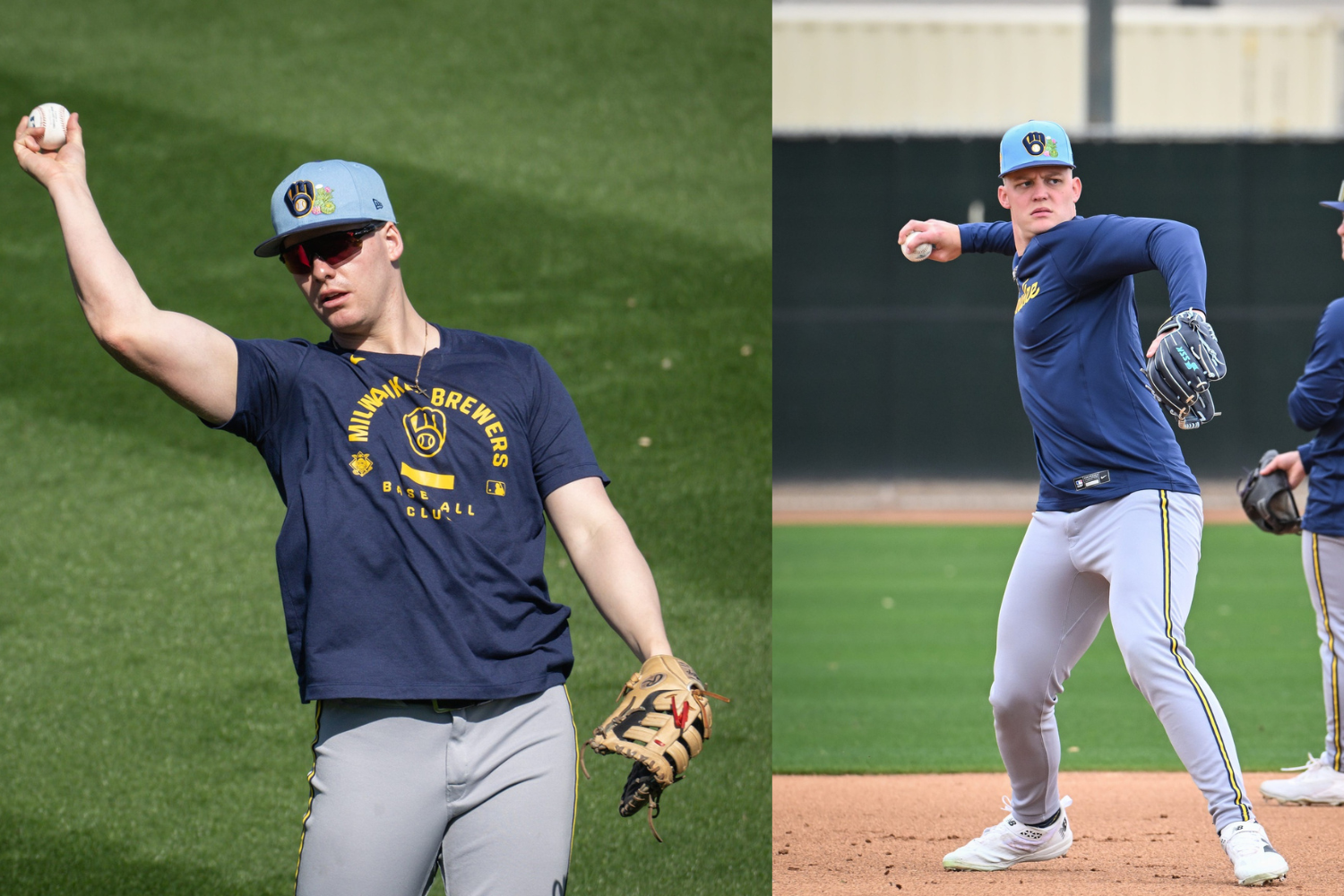
In the Brewers’ spring training clubhouse in Maryvale, there’s a back exit that takes players to the weight room, batting cages and other key areas for morning work. It’s in the lefthand corner of the large room, which creates a high-traffic corridor between an island of three lockers just in front of the bathroom and the row that lines the back wall. There’s plenty of space to pass through, though—unless Luke Adams and Brock Wilken are getting dressed at the same time.
Adams, 21, occupies the last locker in that little row of three, putting him on one side of the aperture through which players and coaches must pass to get to their next destination after the clubhouse. Wilken, 23, happens to be assigned the locker just on the other side of that gap, against the back wall. The two are each listed at 6-foot-4, with Adams tipping the scales at 233 pounds and Wilken coming in at 237. Right next to Wilken is Garrett Mitchell (6’2″, 229), and the last locker in the corner belongs to Cooper Pratt (6’4″, 210). For a team famous for their diminutive stars, that cluster is a reminder that they have some bigger, stronger could-be stars on the way.
Adams and Wilken each put up stellar numbers in 2025. Each spent the entire season at Double-A Biloxi, though neither actually played the full season. Adams was sidelined by a shoulder contusion for nearly two months; Wilken injured his knee in a celebration of the team’s first-half championship. However, when on the field, Adams batted .231/.417/.436 in 72 regular-season games, and then .333/.471/.569 in 16 games and 68 plate appearances in the Arizona Fall League. Wilken batted .226/.387/.489 in 344 plate appearances over 79 games.
Those batting averages aren’t especially encouraging, for minor-league competition. However, the Southern League is a tough hitting environment, and neither player had a catastrophic strikeout rate. Wilken’s (27%) was a bit higher than you’d like, but his power and plate discipline more than made up for it. Adams, meanwhile, struck out just 20% of the time.
More importantly, look at those on-base percentages, and the walk (and hit-by-pitch) rates that powered them. Wilken walked or was plunked in a whopping 20.9% of his plate appearances, but Adams somehow topped that, at 23.9%. The two have almost unimaginably low swing rates, each coming in under 35% last year in Double-A. In their fistfuls of plate appearances in the Cactus League this spring, each is swinging even less—around 30% of the time. That’s untenable, but it might also be what makes each a productive big-leaguer.
Wilken doesn’t shy away from the fact that his patience is integral to his approach.
“It’s just kind of how it panned out,” he said, reflecting on the significant drop in his swing rate from 2024 to 2025. “Some guys like to swing a lot. I’m a guy that doesn’t need to swing a lot—in-game, out of game, whatever. So I just kind of took that and was having some success with it, so I kept rolling with that.”
Being that reluctant to swing, paradoxically, means lots of two-strike counts, as called strikes balance out balls and lead hitter and pitcher together into the deep water of a long at-bat. Wilken believes dynamic favors him, even if it means a good number of strikeouts to go with his big walk and extra-base hit totals.
“I don’t really have an issue hitting with two strikes,” he said. “I think hitting with two strikes helps me ultimately be a better hitter. I have a lot of homers with two strikes, so I’m not scared to hit with two strikes; I’m not scared to get in those deep counts.”
The less powerful Adams can’t afford to strike out as much as Wilken does, but he also shows a better feel for the zone—and gets a big added boost from getting hit by pitches at a shocking rate. Last season, he was plunked 28 times. In his professional career, he’s been hit in over 7% of his plate appearances, a higher rate than any big-leaguer in the history of the game.
“It’s just being smart about where you’re getting hit,” Adams said, discussing the challenge of staying healthy while being hit so often. “If it’s below the knees or above the shoulders, probably not, but anywhere else is ok.”
Watching Adams this spring, it’s easy to see how he’s hit so often; his load phase takes his hands and arms almost into the strike zone even when he doesn’t ultimately swing. Pairing that trait with an extraordinarily patient approach has kept his on-base percentage over .420 as a professional; the only question is whether that success can translate against the best pitching in the world.
Wilken remains a viable third baseman, while Adams has essentially transitioned to first base. The two will each have to be productive hitters to thrive in the majors, though, because neither is likely to deliver much defensive value. With Wilken’s power beginning to blossom and Adams establishing such a high floor for OBP, there’s real hope for each—but this season will determine the directions of their careers.
This fall, the Brewers will have to decide whether to add both players to the 40-man roster, or expose them to the Rule 5 Draft. Thus, they’ll need both of them to get significant time at Triple-A Nashville, and if either has the breakout the team is hoping for, they’ll even be up for a late-season audition with the parent club. On the other hand, another injury-disrupted year (or a major struggle to adjust as they face tougher pitching and dial up the aggressiveness in their respective approaches) could leave one or both on the outside looking in come November.
Pat Murphy has liked what he’s seen from each of his young sluggers this spring, but he tries to stay in the present and focus on the players who will be vital to the team in the coming year. Though he expects to have some input when the front office makes the decision about each player after the season, he hasn’t focused on either during camp. Although this might be his best opportunity to evaluate them, it’s not in his nature to look that far down the road. For Adams, that’s just fine.
“I’m not really thinking about that,” Adams said. “Just trusting God every day, just going out, competing, and then just letting whatever happens be up to Him.”
Watch these two sluggers’ swing rates this year. They’ll have to tweak their approaches to prepare themselves for big-league pitching. For now, though, they’re uniquely disciplined and fascinating hitters, and if either has a full year of good health in 2026, they could put themselves back into the top tier of Brewers prospects, thanks to those marvelous on-base skills. As is true in the clubhouse, out on the field, it’s hard to miss them.