
You can go into your fantasy baseball draft with a plan, but it had better be flexible. You are but one of roughly a dozen competitors navigating the same terrain, and each action of each fantasy manager changes the landscape. That’s why, instead of a plan, I prefer a map. Knowing the shape of the player pool allows you to stay flexible and zag when your league zigs.
Here, we’ll look at projections for each hitter position and identify its peaks, valleys and unicorns — the players who can provide an outsized impact in a particular category in a way that makes them unique to their positional peers (i.e., catchers who steal).
We’ll use ATC, a projection system that creates a weighted average of other systems. It smooths out the quirks of other systems and consistently performs well on projection evaluations. The other tool we’re employing is FanGraphs’ auction calculator, which provides dollar values for each player based on your league parameters and chosen projection system. This will allow us to see not just the projected order of players, but where the value clumps and gaps are.
A couple of other notes:
The league settings I’m running through the calculator are standard 5×5 categories, 12 teams, one catcher, a CI and MI, and four outfielders (I know four is rarer than three or five — I’m splitting the difference so we’re close to everyone’s league settings).
This flattens the positional adjustments that the calculator assigns to each position based on the player pool, from $12.1 for DH to $13.7 for 2B.
I go back and forth on the best way to use these adjustments. In a way, I prefer to just look at the unadjusted values and use my own judgment to determine how much to prioritize different positions. Here, I’ll leave them in so that we get the full wisdom of the calculator, and the values look recognizable.
I’ll mention each position’s adjustment and any notable changes based on league settings. The players listed are those with positive value according to the calculator under those settings, with a handful of exceptions.
Finally, hover over the dots on the charts below to see player names, ADPs and auction values.
Let’s begin!
First base
Positional adjustment: $12.4 (with no MI/CI: $10.2)
Nick Kurtz is ascendant and often going just ahead of Vladimir Guerrero in drafts, but ATC still gives Vlad a $4 edge based on a huge difference in batting average. Every system dials back Kurtz’s average from the .290 he posted last year to the .250s or .260s, because even when you have top-shelf power, no one is expected to hold a .364 BABIP. Pete Alonso boasts similar power to Kurtz with a more pedestrian average.
By projections, Alonso is the big ADP reach. If you trust Bryce Harper and Freddie Freeman to hold up, you can get similar value several rounds later. The “Polar Bear” has a better health track record, however, which is only partly captured in the projections.
From there, we get the kind of descent you only notice on wheels. Rafael Devers, Matt Olson and Josh Naylor represent near-equal value to Harper and Freeman, and it’s a small step from there to Vinnie Pasquantino and perennial projections favorite, Yandy Diaz. If you still don’t have a guy, projections say you’re doing fine with Michael Busch and Tyler Soderstrom (I’m skipping Ben Rice and Salvador Perez, who also show up in this group, on the premise that you’re using them at catcher).
After that, we get one of our only significant gaps in the position from Soderstrom ($12.9) to Alec Burleson ($9.9) to Willson Contreras ($7.8). A full season of playing time could nudge those values up a bit, especially for Contreras, whose projections are being influenced by his time at catcher.
It doesn’t truly bottom out unless you’re in a really deep league. You’ll get workable production out of the next 10+ guys. I like grabbing one from the Olson/Naylor/Pasquantino group with Busch/Soderstrom as a backup. I’d love to get Sal Stewart as my CI — he could be a beast — but if I get scooped there, I’m content to hunt for value elsewhere and pick up a Spencer Torkelson or a Jonathan Aranda later.
1B draft targets
Matt Olson
Vinnie Pasquantino
The solid second tier is a great place to shop here. Olson and Pasquantino don’t have the pedigree of the names above them, but can offer similar production. In the later rounds, I have my eye on Michael Busch and Sal Stewart.
Category unicorns
These guys can give you an atypical category boost for the position, with the caveat that you typically trade each boost for a decrease elsewhere.
AVG: Luis Arraez (.299), Guerrero (.294), Diaz (.287)
RBI: Alonso (103)
R: Guerrero, Kurtz (94 each)
HR: Kurtz (37), Alonso (36)
SB: Naylor (17)
For a while, Arraez was so consistently overvalued in drafts that I started completely ignoring him, but now the market seems to have adjusted to who he is, and he can duct tape over a batting average deficiency.
The real question is how many steals Naylor picks up after tripling his career high to 30 last year. ATC gives him 17, which is still the position leader by a wide margin. Everyone else is projected for single digits. It’s a little different over at …
Second base
Positional adjustment: $10.5 (with no MI/CI: $14.4)
We have two studs, a 2025 breakout, and then second base gets squirrelly fast.
Projections still give Ketel Marte the top spot, on the strength of high-20s homers, a .275 average and strong counting stats. How does Jazz Chisholm not top Marte after the former’s 30-HR/30-SB season? It’s all in the batting average, where Marte has nearly 40 points on him. Neither has an amazing health history (which is partially baked into their projections), but they are still the easy position leaders.
Brice Turang, however, was the top earner at the position last year, due to his power breakout and excellent, five-category production. Projections dial him back on everything except steals, but I think he might be the safest option at the position. He plays every day, and if one part of his game slips, he has other ways to make up the difference.
The projections say he’s in a mini-tier with Jose Altuve, who annually outperforms my expectations. I keep seeing an aging player with little raw power and an aggressive approach who has to fall apart at some point, yet he keeps putting up really good seasons. Altuve is projected for 20 homers, 12 steals and a .265 average, which is basically in line with what he’s done the past two years. That looks pretty achievable for him, and that he projects as the fourth-best second baseman says something about the position. (Note: Maikel Garcia played 11 games at second and is eligible there in Yahoo leagues. He offers a Turang-esque profile and projection. We’ll discuss him further in the 3B section.)
Drafters have taken Nico Hoerner just ahead of Altuve, but by the calculator, his deficit in homers and RBIs puts him behind the Astro, despite Hoerner’s strong contributions in average and steals. That said, it’s not a huge reach and is understandable, given that those are two categories many people invest in protecting. Also, the position gets weird from here.
Once you get into the murky middle of this position, projections show a slow slide down, but when you look at ADP, the value is in going the boring route. While drafters have looked for upside, going for Luke Keaschall and Ceddanne Rafaela as the next two, followed by a mix of mostly low-average guys with some speed, projections say you can wait and wait and get the sixth-best second baseman after pick No. 200 in Gleyber Torres. He’s the crawlspace of fantasy players: the ceiling and floor are very close to each other, and he’s much more useful than exciting. His surface stats were nearly identical the past two seasons, though he actually showed improvements under the hood with a career-best contact rate.
Keaschall could be a better version of Hoerner. He was a dynamo in 49 games last season, swiping 14 bases with a .302 average. Unfortunately, his game total (plus 28 in the minors) is representative of his history. At 23, injuries have already become a concern. He’s a risk, and not a guy where you can pay for the projection and hope for better (someone else will get him first), but he’s projected for 24 steals and could double that in a healthy season.
Rafaela rarely misses a game, and his excellent defense keeps him in the lineup. He has shown power growth every year, and 20 homers feels reachable. The .250ish average isn’t an asset but won’t sink you either. The floor is deceptively high here.
Or if you trust the projections, just wait 50 picks and get something similar with Bryson Stott. The risk with him is less about production and more that the Phillies eventually start mixing in Aidan Miller or other infield options.
From there, maybe you have a guy or two you like out of Ozzie Albies, Otto Lopez, Brandon Lowe, Xavier Edwards, Marcus Semien, Luis Garcia, Willi Castro and Jorge Polanco. That group covers 100 picks of ADP and $3 of projected value. If you don’t have a pick there, just wait and grab whoever drops. Oh, and there’s Matt McLain, who is completely buried by projections, but gets drafted in a cluster with Lowe, Stott and Edwards. Drafters have shown love for Brendan Donovan and Jackson Holliday, who ATC says you can forget about.
So, how to approach the keystone? It’s a real pick-your-poison position. In most leagues, there are maybe six or seven guys who are significantly higher than the position’s replacement level. If you end up waiting, you can just grab someone cheap, knowing that you might end up with someone from the wire by the midpoint of the year. That said, Marte, Chisolm and Turang all give you a big advantage over other teams.
2B draft targets
Brice Turang
Gleyber Torres
Ozzie Albies
Turang in the right builds, but more realistically, I’ll grab Torres or Albies and hunt for value elsewhere. I have a hard time finding a star at a price I like at this position.
Category unicorns
AVG: Arraez (.299) will qualify here before long, Hoerner (.278), Edwards (.277)
RBI/R: No real standouts. Marte (87 R, 89 RBI) leads the pack by a wide margin
HR: Marte and Chisholm are projected in the high-20s — by far the most of anyone at the position.
SB: Jose Caballero is projected to steal 38 in half a season (though he’s unlikely to be a regular once Anthony Volpe comes back, so league format will matter here). Chisholm and Turang have the next highest projections, but there’s plenty of speed at second base.
Shortstops
Positional Adjustment: $12.5 ($6.9 with no MI/CI)
Shortstop has one of the steeper drops, but unlike other positions, the slope is fairly consistent. After a big initial drop, it descends quickly, with no real plateau until we get into the double-digit rankings. There’s nothing wrong with springing for a big name. By projections, you’re basically getting what you pay for in the first seven picks, and there is clear separation between the top and the middle group. It’s in that middle group, however, where projections and ADP veer in different directions, and there is potential profit in waiting or shopping there for your middle infielder.
Bobby Witt is typically the third player off the board and the clear standout at the position at $45.9, compared to second-place Gunnar Henderson at $32.
Yes, I said second-place Gunnar Henderson. While drafters have shown a clear preference for Elly De La Cruz, ATC (and most other systems) has Henderson just ahead, mainly due to his better average and power. If you think De La Cruz can have 60+ stolen bases, as he did in 2024, then projections are underselling him.
After the top three, there is a mini-tier of Trea Turner, Francisco Lindor and Zach Neto. Drafters are putting a 30-pick gap between Neto and Mookie Betts, but ATC says that the Dodger is only a half step below.
It’s after Betts, however, that projections and drafters start telling very different stories. Geraldo Perdomo and CJ Abrams (along with Maikel Garcia, where qualified) all have ADPs in the 60s, followed by bat-forward veterans Bo Bichette and Corey Seager about 20 picks later, with Jeremy Peña going just after.
ATC says you can make some serious profit here: It likes Peña and Bichette the best of those just listed, but once you get past them, you can tune out on the position until pick No. 130 and get value equal to Perdomo, Abrams and Seager with the relatively forgotten Willy Adames. If you miss out on him, you can wait another 70 picks and only drop $1.5 to get Ezequiel Tovar.
Essentially, Adames makes up for his weak average with 27 homers, 11 steals and R/RBI production near the top of his position, due to his everyday presence in the middle of the lineup and decent OBP. Tovar has the flimsier profile, but projections still see a solid average and 20 homers. He’s sneaky productive at pick No. 200, but if you’re relying on him, hopefully you loaded up elsewhere on the way.
The resurgent Trevor Story is Tovar’s flip side — projections see him as essentially equal to the Rockie, but he’s being drafted nearly 100 picks earlier. ATC gives him 575 plate appearances, so he can out-earn that projection simply by reaching 650, like he did last year — his first time doing so since 2019. He’s too risky for me unless he falls, but he was a huge profit last year. If Tovar is too much of a reach for you, you can compromise with Dansby Swanson, who goes around pick No. 150 — he gives you a boring but solid $12 projection, just below the other two.
Finally, you’ll notice there was no mention of Konnor Griffin, Kevin McGonigle or other top prospects. They rarely show up as values in projection systems before they’ve played in MLB, but I’m all over Griffin at his 205 ADP, especially in shallow leagues.
SS draft targets
Gunnar Henderson
Willy Adames
Mookie Betts (if he falls enough).
I love Henderson, but if someone else beats me to him, Betts and Adames still provide excellent production, especially at the price.
Category unicorns
It’s hard to stand out in such a loaded position, but some players find a way. I won’t bother to list him in every category and just tell you that Witt ranks first in every category, except steals, where he’s third. He’s pretty good.
AVG: Jacob Wilson (.293 projected), followed by Bichette (.285) and Turner (.283)
RBI: Witt is the only standout (92), followed by Adames (84)
R: Here it’s mostly the big stars: Henderson (97), De La Cruz (93) and Lindor (91). In the mid rounds, you can get a boost from Perdomo and Betts (both 89)
HR: No mythic beasts here, but Witt, Adames, Seager, Neto and Henderson all project in the high-20s.
SB: De La Cruz (41), Caballero (38), Xavier Edwards (27) can give you a late-round boost without the full hit to your other stats that Caballero brings.
Third base
Positional adjustment: $13.8 ($17 with no MI/CI)
Third base has two superstars, followed by a drop and then a gentle decline, before another significant fall. There are, however, plenty of intriguing names in the later rounds.
We start, of course, with the phenomenal Jose Ramirez and fearsome Junior Caminero. From there, we get one of the bigger drops in any position from Caminero’s $38.5 to Manny Machado’s $24.3.
Machado to Maikel Garcia represents a solid second tier (which includes Chisholm, who was discussed above). Within that group, you have a few different profiles. Garcia and Chisholm are your multi-position-eligible speedsters. Machado, Austin Riley and Eugenio Suárez are the sluggers, but the latter hurts you with batting average while making up for it with gaudy power totals.
From there, we drop to Alex Bregman and Matt Chapman, who are your last solid options before we take another plunge into some bizarre territory. How do you like Alec Bohm’s chances of holding onto playing time and putting up decent numbers? I’m in on Sal Stewart, Kazuma Okamoto and Noelvi Marte, but it’s a lot to ask of them to hold down one of your fantasy positions, especially when their teams have plenty of depth (which, for Marte and Stewart, includes each other).
Then, it’s your standard mix of boring (Miguel Vargas, Nolan Arenado) and unreliable (Royce Lewis, Max Muncy). But there are guys I like here. Caleb Durbin could be a nice fit in Boston. Addison Barger didn’t make the chart with his -$7.4 projection, but that’s on 470 plate appearances. I could see him getting significant time against lefties and 100 more PAs than that projection.
3B draft targets
Austin Riley
Matt Chapman
I won’t say no to either of the two elite options here, but otherwise I’ll take these solid vets. I’m in on Stewart and Marte, but I don’t want to rely on them or anyone in their tier.
Category unicorns
AVG: No one? Your best projections are Ramirez and Durbin (.273), followed by Caminero (.270) and Garcia (.268)
RBI: Caminero (103), Suárez (95). Also, if you think the projection is too aggressive on Suárez, you should bump him down to the Bregman/Chapman tier.
R: Just Ramirez (92)
HR: Caminero (36), Suárez (34). Jake Burger (25) can be a late-round fixer.
SB: Ramirez (33), Chisholm (32), Garcia (26). Durbin (21) is your mid-round helper here.
Catcher
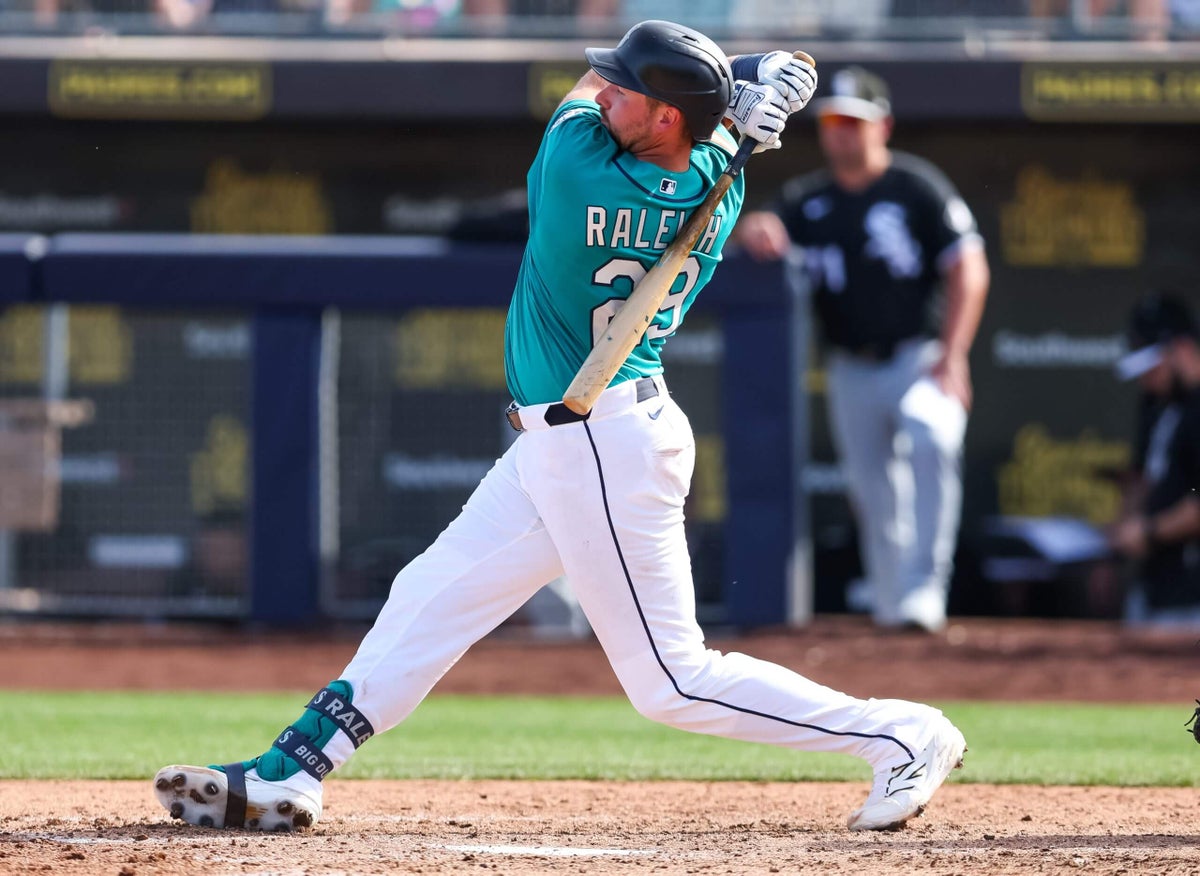
Your league settings matter a ton here. If you’re in a two-catcher league, the positional adjustment goes up $8, and Cal Raleigh is a potential first-rounder. Less intuitively, the adjustment is almost as large if you take out middle and corner infielders, because the replacement level on other infielders is a lot higher. If you’re somehow playing in a two-catcher, no MI/CI league, Raleigh is projected as the fourth-most valuable hitter and Hunter Goodman (!) is 13th.
Positional adjustment: $15.7 ($23.6 in two-catcher leagues)
Raleigh dominates his position like few others, but catcher is surprisingly robust after him. Goodman, with his power and Coors-inflated average and William Contreras, Shea Langeliers, Ben Rice and Salvador Perez provide a strong second tier. Comparing projections to ADP, Goodman and Perez are the values here. There are some equally good hitters in the next group, but this is where you want to shop if you want playing time. All of them will see some time at DH (Langeliers less than the others), and Rice is a first baseman now, though he could lose time against lefties.
But back to “Big Dumper.” His 60-homer 2025 is a season that every projection system will call an outlier. All of them dial him back to 37-44 homers, even with close to full playing time. Given the gains he made in barrel rate, pull rate and maximum exit velocity, that might be too conservative. It’s hard to put a 50-homer season on anyone, but if you think Raleigh has another one in him, there’s profit to be made with the top pick.
In a one-catcher league, you almost can’t go wrong. Raleigh is awesome, the second tier is solid, and the next group of Ivan Herrera (where qualified), Will Smith, Drake Baldwin, Yainer Diaz and Agustín Ramirez gives you plenty to work with too. Drafters haven’t been as high on Goodman or Diaz, so they’re the projection picks. I like Goodman, but I have a harder time talking myself into Diaz. Ramirez spends half his time at DH and throws in a good number of steals, though he gives back some of that value with his batting average.
Still don’t have a catcher? No worries! Adley Rutschman, Alejandro Kirk and Gabriel Moreno make for passable options further down (and with Rutschman, you can dream more), and you’ll get something from J.T. Realmuto and Ryan Jeffers.
If I’ve waited this long, as I so often do, I’m grabbing a cheap option and scouring the waiver wire. Kyle Teel, Carter Jensen, Samuel Basallo, Edgar Quero and Moisés Ballesteros all have breakout potential. Francisco Alvarez, Logan O’Hoppe and Tyler Stephenson are worth monitoring for bounce-back seasons.
C draft targets (two-catcher leagues)
For a first catcher who plays often:
Shea Langeliers
William Contreras
Hunter Goodman
For a second catcher:
Ivan Herrera
Adley Rutschman
Aleejandro Kirk
For one-catcher leagues, I’m more likely to see who falls in the draft and then scour the wire for breakouts.
Category unicorns
AVG: We need to lower the bar here. A little lower … lower … OK, that’s good. Moreno (.275), Diaz (.269), Kirk (.267). For deep-leaguers, Iván Herrera (.268)
RBI: Raleigh (101) — big gap — Perez (88), Goodman (86)
R: No real unicorns. Top projections are Raleigh (85), Contreras (76) and Rice (74)
HR: Raleigh (39)
SB: Ramírez (12)
Outfield
Because there are so many outfielders, there are no big drops in projected value across outfielders after the first few names. The excess supply also means that the calculator’s positional adjustment is almost as affected by the presence or absence of an MI/CI as it is by going from three to five outfielders. Either way, we’re talking about a $3 spread in the large majority of leagues.
Positional adjustment: $10.4 for three outfielders, $12.6 for four, $13.1 for five
I covered many of the top names in my article about navigating the first round, if you’re looking for a deeper dive. Because I’m usually not too worried about the drop from one guy to the next in the outfield, I usually draft OFs (and pitchers) in the middle rounds if I don’t like what I see in other places.
That said, you also don’t want to miss out on the big names because there is so much value at the top. Six of the top-10 projected hitters are outfielders.
There are a lot of tantalizing names. Wyatt Langford, Jackson Chourio, Roman Anthony and James Wood could become first-rounders next year. Projections don’t see breakouts coming and tend to see relative values in the lower-ceiling guys: Seiya Suzuki, Teoscar Hernandez, Taylor Ward and Brandon Nimmo are some of the high-floor OFs who fall a bit in drafts.
One approach is to balance a high-ceiling pick with some bankable value. Another is to pay for the exciting names and back those up with guys like Ian Happ and Heliot Ramos. In a shallow league, I’m more inclined to aim for ceiling. In a league with 60+ starting outfield spots, I’ll want more balance, while still saving space for high-ceiling dart throws.
OF draft targets
I’ll skip the first round here and give you some names I like at their price:
Roman Anthony
Brent Rooker
Seiya Suzuki
Kyle Stowers
Jac Caglianone
Anthony isn’t cheap, but I could see him launching into the top-15 hitters this year.
Category unicorns (I’m excluding first-round players here)
AVG: Yordan Alvarez (.292), Chandler Simpson (.285)
RBI: Rooker (96), Riley Greene (89)
R: There are no specialists here. The specialists are the Round 1 studs.
HR: Rooker (33), Jo Adell (30). For later rounds, Daulton Varsho (26), Matt Wallner (24)
SB: Simpson (42), Caballero (38), Jakob Marsee (34), Pete Crow-Armstrong (33), Victor Scott (33)
Good luck out there, and let me know how you’re navigating the trickier positions.