
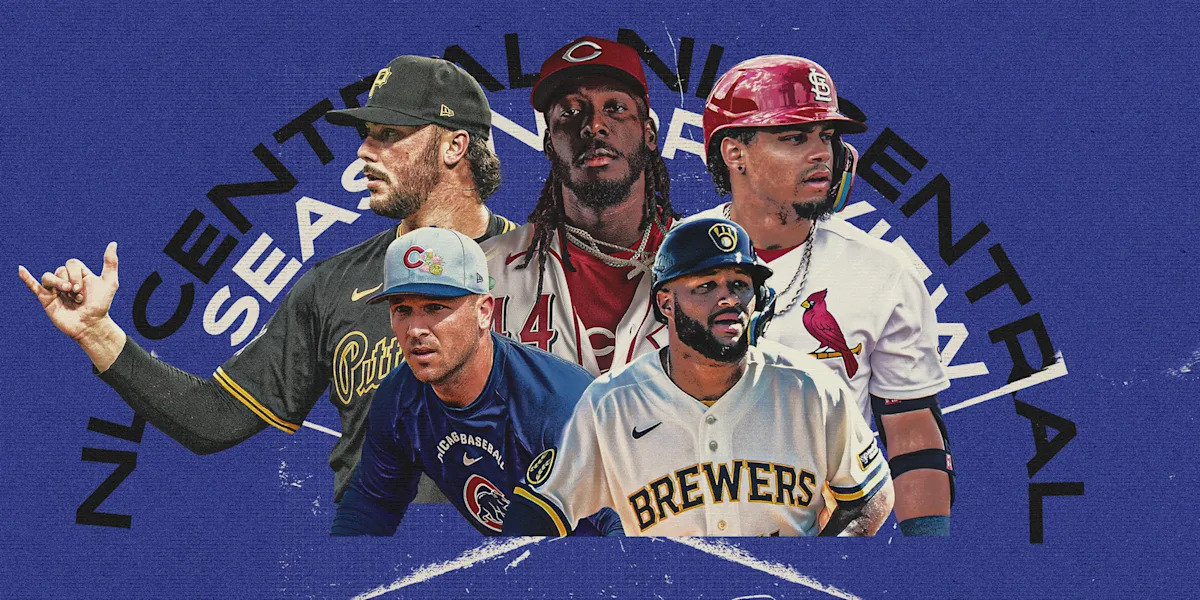
Although not regarded as baseball’s toughest division, the NL Central is stronger than many fans might think. After all, last year, the five Central clubs combined for more wins than any other division outside the AL East, and they were the only NL group to earn three postseason berths.
The NL Central has been dominated in recent years by the Brewers, who have finished first in three straight seasons and led the majors with 97 wins last year before bowing out to the Dodgers in the NLCS. After an offseason in which they made several moves but arguably took a small step backward, the Brewers will likely have the Cubs and Reds nipping at their heels in 2026. Chicago isn’t far off, having finished sixth in baseball with 92 wins last year, and the Reds have some young players with loads of potential. At the other end of the standings, the Pirates are trending in the right direction but are likely at least one more year from contending, and the Cardinals have fully entered a retooling phase.
Advertisement
Read more: AL East preview | AL Central preview | AL West preview | NL East previewMilwaukee Brewers
Projected record (per FanGraphs, as of March 10): 82-80, 37.8% odds to make the playoffs, 20.9% odds to win the division
What happened last season? The Brewers enjoyed their best regular season in franchise history, as they led the majors with a 97-65 record. The magical ride was sparked by a 14-game winning streak in August, which was part of a stretch from July 6 to Aug. 16 in which they went 29-4. The success stemmed from a total team effort, as Milwaukee finished second in baseball in ERA and third in runs scored despite having no one who placed in the top 10 in NL MVP voting and only a fifth-place finisher (Freddy Peralta) in the Cy Young race. Unfortunately, the lack of star power caught up with the Brewers in the postseason, as they needed five games to squeak past the Cubs in the NLDS and then got swept by the Dodgers in the NLCS. Milwaukee’s pitching staff held up reasonably well in October, but the offense produced just 26 runs across nine postseason contests.
Advertisement
What happened in the offseason? As an organization that typically competes with the elite clubs without being able to match their budgets, the Brewers are always creative with their transactions. True to form, in January they traded Peralta, who was one year from free agency, to the Mets for a pair of notable prospects, infielder Jett Williams and starting pitcher Brandon Sproat. This move might’ve been impacted by the decision of longtime Brewer Brandon Woodruff to accept the qualifying offer in November. In February, Caleb Durbin was shipped to the Red Sox in return for a package of three players that included left-hander Matt Harrison. The Brewers’ other moves were minor, including the signings of utilityman Luis Rengifo and backup catcher Gary Sanchez and a trade of outfielder Isaac Collins for reliever Angel Zerpa.
[Join or create a Yahoo Fantasy Baseball league for the 2026 MLB season]
Best-case scenario for 2026: Although repeating their 2025 excellence is a tall order, the Brewers still have their sights set on the World Series. The lineup could improve if future star Jackson Chourio takes another step forward in his age-22 season and catcher William Contreras puts a nagging finger injury behind him. In fact, there are no obvious regression candidates in Milwaukee’s lineup, as Brice Turang’s recent surge was well supported by skill improvements. The pitching staff should also remain excellent, as there are multiple arms who could make up for the loss of Peralta. Jacob Misiorowski is an emerging ace, and Logan Henderson was outstanding (1.78 ERA) in 25 1/3 innings last year. Woodruff, Quinn Priester and Chad Patrick are all effective, and Sproat is ready to debut. The bullpen, led by Abner Uribe and Trevor Megill, is deep and versatile.
Worst-case scenario: It’s hard to imagine the Brewers missing the postseason. The club has averaged 92.6 wins over the past five seasons and has a strong mix of veterans, youngsters and MLB-ready prospects. Still, there’s a scenario in which Milwaukee is passed by the Cubs in 2026. There will be holes at the bottom of the Brewers’ lineup if Garrett Mitchell and Joey Ortiz fail to improve. Priester and Patrick both exceeded expectations last year, and while Woodruff fared well (3.20 ERA) in 12 starts after missing all of 2024, his velocity trended sharply in the wrong direction.
Advertisement
Make-or-break player: Jacob Misiorowski. There’s a wide range of possible outcomes for Misiorowski in his first full season, and a rapid ascension from the 23-year-old would give this team a true ace. There were some terrific highs in Misiorowski’s rookie year, as he needed just one month of action to earn the starting pitcher nod for the All-Star Game and had some dazzling October moments while logging a 1.50 ERA over 12 innings. But there were also some significant lows, as he logged just one quality start in the second half and finished with a mediocre 4.36 ERA. Limiting walks should be Misiorowski’s focus in 2026.
Season prediction: Arguably the smartest organization in baseball, the Brewers will probably hold off the Cubs and win the NL Central for the fifth time in six years. Chourio and Misiorowski will show improvement, and prospects such as Sproat and Williams will make contributions in the second half. A bullpen that could include five southpaws will be a perfect compliment for an all-righty rotation.
Read more: NL Central offseason gradesChicago Cubs
Projected record: 86-76, 60.8% odds to make the playoffs, 42.5% odds to win the division
Advertisement
What happened last season? The Cubs enjoyed a stellar start to the season and were tied for the NL lead with a 36-22 record at the end of May. Unfortunately, they went 56-48 the rest of the way, which caused them to finish five games behind the Brewers. In October, the Cubs eliminated the Padres in the wild-card round and took the Brewers to the brink before bowing out in five games in the NLDS. Kyle Tucker was a major story throughout the season, as his offseason arrival and hot start fueled World Series expectations before his play fell off sharply in the summer. His strong start and poor finish were mirrored by similar performances from 23-year-old Pete-Crow Armstrong and veteran Seiya Suzuki. On the mound, Matthew Boyd and Danny Palencia emerged as the unlikely staff ace and bullpen anchor, respectively, and Cade Horton enjoyed an impressive rookie year.
What happened in the offseason? The offseason started in surprising fashion, as starter Shota Imanaga accepted a one-year qualifying offer. The return of the lefty didn’t deter the club’s search for rotation depth, as the Cubs also acquired Edward Cabrera from the Marlins in a deal that cost top prospect Owen Caissie. But the biggest winter decisions were made regarding the lineup. There was never an attempt to bring back Tucker, whose single season in Chicago ended on a sour note. Instead, the front office landed Alex Bregman on a lucrative, five-year contract. A steady performer who is known as a clubhouse leader, Bregman can’t match Tucker in pure hitting ability but should make up the gap in other ways. There was also significant attention paid to the bullpen, as Shelby Miller, Phil Maton, Hunter Harvey, Jacob Webb and Hoby Milner were all added to the mix.
Best-case scenario for 2026: Although the Brewers will be hard to catch, the Cubs are good enough to make that happen. The lineup lacks a true superstar but has several strong contributors and few holes, especially if Crow-Armstrong can recapture the form that led to an .847 OPS in the first half of 2025. Nico Hoerner and Dansby Swanson are underrated contributors, and Moises Ballesteros could make an impact as a DH and catcher in his rookie season. The rotation is similar to the lineup in that it lacks a headliner but has more quality options than weak spots, especially if Justin Steele returns in good form. Rolling out one starter with a 3.50 ERA after another has proven to be an effective way to win plenty of games, and that should be the recipe for the Cubs this year.
Advertisement
Worst-case scenario: If the Cubs fall short in 2026, it’ll likely be as a result of multiple letdowns on the pitching staff. An oft-injured 35-year-old with a career 4.57 ERA, Boyd is a major regression candidate, in terms of both the quality and the quantity of his innings. All of the key ERA estimators placed Imanaga over 4.00 last season, and Horton’s late-season surge was only partially supported by his skills. Cabrera is injury-prone, and Steele is a major question at this point. The bullpen depth has improved, but roles could become uncertain if Palencia can’t repeat his surprising campaign. A down year from a few hurlers could leave the Cubs scrambling to grab the last NL wild-card berth.
Make-or-break player: Pete Crow-Armstrong. Is the real PCA the player who produced 25 homers and 27 steals in the first half of 2025 or the one who tallied just six homers and eight steals after the All-Star break? One of baseball’s best defensive center fielders, Crow-Armstrong is a legitimate MVP candidate if he logs an OPS over .800. Unfortunately, his poor plate control continues to hold him back. Set to turn 24 the day before Chicago opens the season, PCA is young enough to make skill gains and become a superstar in a lineup that is already full of good hitters.
Season prediction: The Cubs should take the NL Central race down the wire, and even if they fall a couple games short of catching the Brewers, they should be one of the top wild-card teams. And they’ll be dangerous in October, as their rotation is built to handle a long postseason series.
Will the Brewers or Cubs take the division title this year? Can the Reds or Pirates get in the playoff mix?
(Amy Monks/Yahoo Sports)Cincinnati Reds
Projected record: 78-84, 17.6% odds to make the playoffs, 7.8% odds to win the division
Advertisement
What happened last season? Although the Reds deserve credit for making the postseason for the first time in a 162-campaign since 2013, the reality is they mostly treaded water in 2025. Their 83-79 record was one-game better than their record in 2023 and identical to their mark in 2021. They were average in run scoring and run prevention, and their winning percentage in the second half was slightly worse than before the All-Star break. The Reds snuck into the final wild-card spot mostly due to an epic collapse by the Mets, and they were outscored 18-9 while being swept out of the postseason by the Dodgers. Still, at the outset of October, there were 16 teams wishing they were in Cincinnati’s position, which means there were some positives. The rotation was a strength, as Hunter Greene, Nick Lodolo and Andrew Abbott each finished with an ERA under 3.35 and Brady Singer led the team in wins, innings and strikeouts. Emilio Pagan emerged as a reliable closer, and while he faltered in the second half, Elly De La Cruz led the club in homers, RBI, runs and steals.
What happened in the offseason? Through the end of January, Reds fans were disappointed with the lack of urgency to improve the team over the winter. Emilio Pagan returned on a two-year contract with hopes he can continue to stabilize the bullpen in his age-35 season. The bullpen was fortified with the signing of righty Pierce Johnson and a three-team trade in which the team gave up utilityman Gavin Lux for lefty reliever Brock Burke. There were also minor moves to alter the outfield, as JJ Bleday arrived on a one-year deal and Dane Myers was acquired from the Marlins. Then, finally, came a big move on Feb. 1, when Eugenio Suarez was signed to give the lineup the booming bat it desperately needs. Sure, it’s only a one-year deal, but that’s a problem for 2027. For now, Cincinnati has a true cleanup hitter. The bad news of the offseason came during spring training, when it was announced that ace Hunter Greene needs elbow surgery (though not Tommy John) and will be out until at least July.
Best-case scenario for 2026: The Reds have enough young talent to take a step forward. Last year, De La Cruz showed his commitment by playing through a quad strain and appearing in 162 games, but the injury clearly took a toll on his performance. With improved health, he could move into the MVP discussion in his age-24 season. Getting full seasons from Noelvi Marte and Sal Stewart should help the lineup, and Matt McLain could get his career back on track after struggling last season in his return from shoulder surgery. The rotation should be solid and could be elite if Greene comes back strong in the second half. And the No. 2 overall pick of the 2024 draft, Chase Burns, has massive breakout potential after getting his feet wet last year. The Reds might not be ready to catch the Brewers or Cubs, but they can remain in the wild-card race into September.
Advertisement
Worst-case scenario: The development of young players is rarely linear, and the Marte, Stewart and Burns are not guaranteed to improve. Offensively, if Suarez doesn’t pay immediate dividends, De La Cruz could be the only hitter who is notably better than an average player. The lineup could also have some holes if Bleday, McLain and Ke’Bryan Hayes can’t improve on disappointing 2025 seasons. On the mound, Greene’s absence is a huge loss, with reason to worry it’ll extend beyond the first half, and any improvement by Burns could be offset by expected regression from Abbott, who will be hard-pressed to repeat his 2.87 ERA. Lastly, Pagan, who entered last season with 33 career saves over eight seasons, is no sure thing to repeat his ninth-inning dominance.
Make-or-break player: Geno Suarez. Putting this much pressure on someone who joined the team last month might be unfair, but Suarez needs to have a big season to give this lineup the intimidating slugger it needs. Great American Ball Park should be an excellent fit for someone who has a pair of 49-homer seasons on his résumé. Still, there’s a reason Suarez sat on the market for a while and didn’t receive any multiyear offers. He strikes out as often as anyone, and things can get ugly when he slumps. He could hit 50 homers or bat .200 — or both.
Season prediction: The Suarez signing gives the Reds what they need to have a chance at a postseason spot. They still aren’t October favorites, as the Brewers, Cubs and multiple teams from the NL East and NL West have deeper rosters. But the Reds should have a winning record and carry postseason aspirations deep into September, as long as their young players continue to develop.
St. Louis Cardinals
Projected record: 75-87, 8.3% odds to make the playoffs, 3.5% odds to win the division
Advertisement
What happened last season? The 2025 Cardinals were a bit below average in nearly every way, including their record (78-84), run production (19th) and run prevention (21st). And their season trended in the wrong direction, as they were 47-39 at the end of June before going 31-45 over the final three months. They didn’t have a pitcher who logged an ERA below 4.20 over at least 100 innings, nor did they have a hitter with more than 20 homers or 80 RBI. There were holes throughout the lineup, as seven players logged an OPS below .700 over more than 350 at-bats. St. Louis did one thing well: Led by Masyn Winn and Victor Scott II, the team was among the league leaders in most key fielding metrics.
What happened in the offseason? After starting the process last season, president Chaim Bloom kicked the rebuild into high gear over the winter. The first move was to trade the team’s most effective starter, Sonny Gray, to the Red Sox for a package of prospects led by righty Richard Fitts. Bloom once again engaged his former team in December, when he dealt Willson Contreras to Boston for a haul of youngsters including righty Hunter Dobbins. In January, Bloom managed to unload Nolan Arenado to the Diamondbacks, though St. Louis needed to cover plenty of Arenado’s remaining contract to make it happen. While tearing down the core, Bloom signed one-year deals with a couple of pitchers who struggled in 2025: starter Dustin May and reliever Ryne Stanek.
Best-case scenario for 2026: A successful 2026 season would be one in which several of the team’s 20-somethings take steps forward. This includes Ivan Herrera, who fared well at the plate last season but needs to improve his catching skills, and Lars Nootbaar, who regressed as a hitter in 2025. It also includes Nolan Gorman and Jordan Walker, who were once considered notable prospects and are now barely hanging on as major-league players. On the mound, Matthew Liberatore and Michael McGreevy will hope to improve while Dobbins and Fitts aim to build on the promise they showed in limited opportunities in Boston. And JJ Wetherholt, the organization’s top prospect, should debut early in the season and show the fan base that he can lead the next generation of Cardinals.
Advertisement
Worst-case scenario: The last time the Cardinals failed to tally 70 wins in a 162-game season was 1978. They could revisit that lowly territory this year. The rotation is the most concerning area, as the St. Louis lacks a single arm that averaged a strikeout per inning last season. That collective inability to put batters away puts tremendous pressure on the defense and limits the starters’ ability to work deep into games, which is a big problem for a team that has a few effective relievers but lacks bullpen depth. And after the team traded away multiple veterans, the bottom half of the lineup could be abysmal.
Make-or-break player: Ivan Herrera, who could soon give the Cardinals something that most teams lack: a No. 1 catcher who can produce impactful offensive numbers from the heart of the lineup. The 25-year-old has already proven his offensive acumen by hitting .286 with an .806 OPS in 2025. Now he needs to establish himself behind the plate after an elbow injury limited him to designated hitter for most of last season. Herrera underwent surgery to remove bone spurs in his elbow in November, which should alleviate any physical limitations. The onus is now on him to lead a young pitching staff by improving his pitch framing and controlling the running game. Failure to do so could relegate him to DH duties, which would limit his overall value.
Season prediction: The 2026 Cardinals are likely to battle the Pirates to stay out of the NL Central basement. But staying ahead of Pittsburgh shouldn’t be the goal this year. Rather, the focus should be on setting up Wetherholt, Dobbins, Fitts, Gorman and Walker to be long-term contributors to the club. An iconic franchise with a dedicated fan base, the Cardinals can work through a few down years if the rebuild sets them up for a long stretch of success.
Advertisement
Pittsburgh Pirates
Projected record: 83-79, 43.8% odds to make the playoffs, 23.5% odds to win the division
What happened last season? The Pirates finished 71-91, marking their seventh straight losing season and the ninth year in a row that they finished fourth or fifth in the division. Their offense was abysmal, ranking last in baseball in scoring and hitting 31 fewer home runs than any other team. But there was still a reason to be excited in Pittsburgh, thanks to Paul Skenes. In the second season of what should be a Hall of Fame career, Skenes once again posted an ERA under 2.00 and won the NL Cy Young award. Led by Skenes, the pitching staff finished seventh in ERA, their first top-10 ranking since 2015. The other hurlers weren’t particularly special, but the likes of Mitch Keller, Carmen Mlodzinkski, Dennis Santana and Braxton Ashcraft did their part to stabilize the group.
Advertisement
What happened in the offseason? The low-budget Bucs were more active than usual, perhaps reacting to the need to build around Skenes while they can. In December, they were part of a three-team trade that cost them starter Mike Burrows but landed slugger Brandon Lowe, outfielder Jake Mangum and reliever Mason Montgomery. In January, they handed out the largest free-agent deal to a hitter in franchise history when they signed Ryan O’Hearn to a two-year, $29 million contract. And in January, they added DH Marcell Ozuna on a one-year pact. Overall, this was hardly the type of offseason that would create news in a major market, but for the Pirates’ front office, it was progress.
Best-case scenario for 2026: While the offseason improvements should help, the real potential for this team comes from the prospect group. Shortstop Konnor Griffin is regarded by many scouts as the best prospect in baseball, and he could join the starting lineup early in the season. Bubba Chandler, arguably baseball’s top pitching prospect, should earn an Opening Day rotation spot. Those two, along with prospects such as Hunter Barco and Jhostynxon Garcia, could join the current core of players and finally give the Pittsburgh fan base a winning team. There’s also substantial improvement potential within the current roster, as key catalysts Oneil Cruz and Bryan Reynolds are coming off disappointing seasons. Add the arrivals of Lowe, Ozuna and Mangum, and the Bucs might just have enough firepower to stay in the postseason race until September and even steal a wild card.
Worst-case scenario: Counting on prospects is always risky, and while Griffin and Chandler have exciting futures, there’s no guarantee they will make impacts as rookies. There’s also significant downside within the veterans. Cruz continues to strike out at an alarming rate, Lowe has a lengthy injury history, O’Hearn has a mediocre career .743 OPS, and Ozuna was benched at times by the Braves last year. Jared Jones, who is being counted on to make a successful return from 2025 elbow surgery, has already been placed on the 60-day IL. If the offense fails to make notable improvements, another 90-loss season will be on the table for the Pirates.
Advertisement
Make-or-break player: Oneil Cruz. While the offseason additions are nice, this organization desperately needs Cruz to get his career back on track. The 27-year-old is a Statcast darling who posts eye-popping numbers in key areas such as average exit velocity, barrel rate, arm strength and average sprint speed. Unfortunately, his incredible offensive potential has thus far been limited by an alarming strikeout rate. And despite his speed and throwing ability, he has been an average defensive player. While Lowe, Reynolds, O’Hearn and Spencer Horwitz can be productive and steady, Cruz is the member of the group who has the potential to singlehandedly change the look of this lineup.
Season prediction: Although the Pirates are trending in the right direction, they probably aren’t yet ready to join the wild-card contenders. A successful season in Pittsburgh would be one in which the team achieves a better than .500 record while getting contributions from Griffin and Chandler. If that happens, ownership will be under pressure to further invest in the roster next winter, rather than wasting another season with Skenes on the roster.