
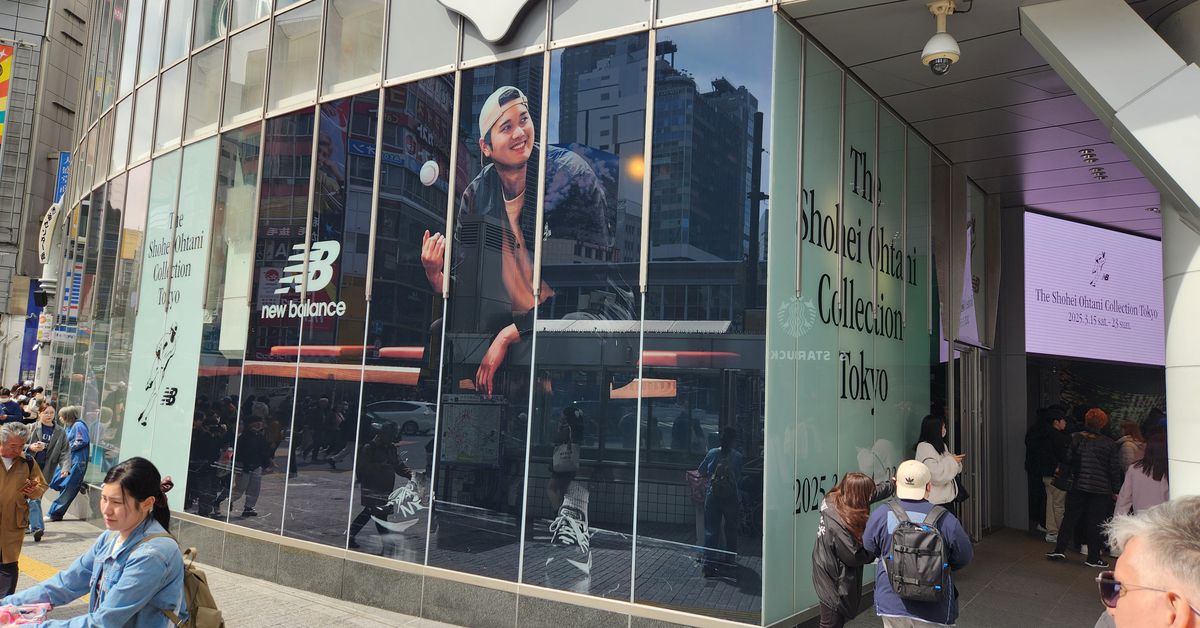
TOKYO — The window display you see above is in a random store in the Shibuya District in Tokyo. The Shibuya Crossing is one of the most famous spots in Tokyo; I wrote a bit about it the other day.
But it’s not just in random stores in Shibuya where you see images of Shohei Ohtani. It’s literally everywhere in Tokyo. Ohtani is more than just a great baseball player in Japan; he’s a national hero. The applause for him at the two games at the Tokyo Dome wasn’t just for his baseball prowess, it was for how he has become a worldwide icon. The only comparable person I can think of in American sports in recent vintage is Michael Jordan, or going back a bit farther, Babe Ruth — and in fact, that completes a circle, because Ruth’s trips to Japan were instrumental in promoting baseball here and starting what is now Nippon Professional Baseball (NPB).
You don’t just see Ohtani everywhere. You hear him, too. Remember this Ohtani commercial:
Walking throughout the Shibuya District on Sunday looking for (and eventually finding) the Topps pop-up exhibit, I kept hearing Ohtani’s “We got now” blaring from speakers all over the place.
And it’s not just the connection between Ohtani, the Japanese people and MLB that’s creating this sort of buzz. It’s the Dodgers.
I am not exaggerating when I tell you that Dodgers caps and other garb are everywhere in Tokyo, and not just at the ballgames I attended, I saw them at places not anywhere near the Tokyo Dome, and worn by people you wouldn’t expect to be baseball fans (teenage girls, in particular).
The Dodgers have carefully crafted this over a period of time, with not just Ohtani but other players, beginning with the signing of Hideo Nomo in 1995. Nomo, the second native Japanese player to appear in MLB, had rock-star quality when he came to North America, though nowhere near the level you now see from Ohtani.
That’s the sort of thing the Dodgers have created here in Japan — a worldwide brand. Years ago, it was said that Yankees caps were everywhere in the world, worn as a fashion statement. Now that’s true of Dodgers caps, though I also saw quite a few Yankees caps around town here in Tokyo.
Now, what does this have to do with the Cubs? My attention was called to this Wall Street Journal article on more or less the same topic I’m writing about here. In the article there is this note:
The Cubs’ revenue from Japan has grown 10-fold in the past two years.
“You don’t have that growth elsewhere in our business,” said Crane Kenney, the team’s president of business operations.
And that’s great for the Cubs, no doubt fueled by the presence of Shōta Imanaga and Seiya Suzuki in Cubs blue pinstripes. Both those players also got warm welcomes at the Tokyo Dome, though neither to the level of Ohtani.
But here’s the thing, and now, here’s my point. I have no trouble believing that the Cubs’ Japanese revenue has had a 10-fold increase over the last two years. Granted and stipulated. But what was the starting point for that increase? The Cubs had dabbled in the Japanese market, beginning with Kosuke Fukudome, who started out brilliantly but fizzled.
Incidentally, Fukudome threw out a ceremonial pitch before Tuesday’s game [VIDEO].
Other forays into NPB by the Cubs haven’t produced even that sort of result: Kyuji Fujikawa, So Taguchi and Koji Uehara are footnotes in Cubs history. Yu Darvish was courted by the Cubs when he first signed in MLB with the Rangers and eventually did sign with the Cubs, but… well, you know that story, no sense belaboring it.
Or maybe there is, because the Cubs dumped Darvish for salary relief after the 2020 pandemic season. You wouldn’t see the Dodgers do something like that. One of the reasons the Dodgers have reached the level of popularity they have in Japan is that they have not hesitated to spend money there, even if millions upon millions of dollars have been deferred. They’ve spent money in other ways, too. How big is the Dodgers brand in Japan? I went to several different stores that stocked MLB Tokyo Series merchandise. The overwhelming majority of it was Dodgers and/or Ohtani stuff. The Cubs appeared to be an afterthought, as some of you noted in the recap comments, and there were plenty of Cubs fans in Tokyo, myself included, who were disappointed in the available Cubs-branded merchandise for sale.
The conclusion seems clear. If the Cubs want to have that sort of brand outside Chicago in general and in Japan in particular, they’re going to have to spend. Not necessarily like the Dodgers, but more than just (for example) getting lucky with the Imanaga signing, a fantastic under-the-radar and under-market deal.
When Ohtani was a free agent, and last winter when Roki Sasaki had his little dance with MLB teams, it seemed as if both were pre-destined to become Dodgers. Whether that’s true or not is something we’ll likely never know.
But the Cubs are going to have to step up with money if they want to be that sort of brand. It’s just that simple.