
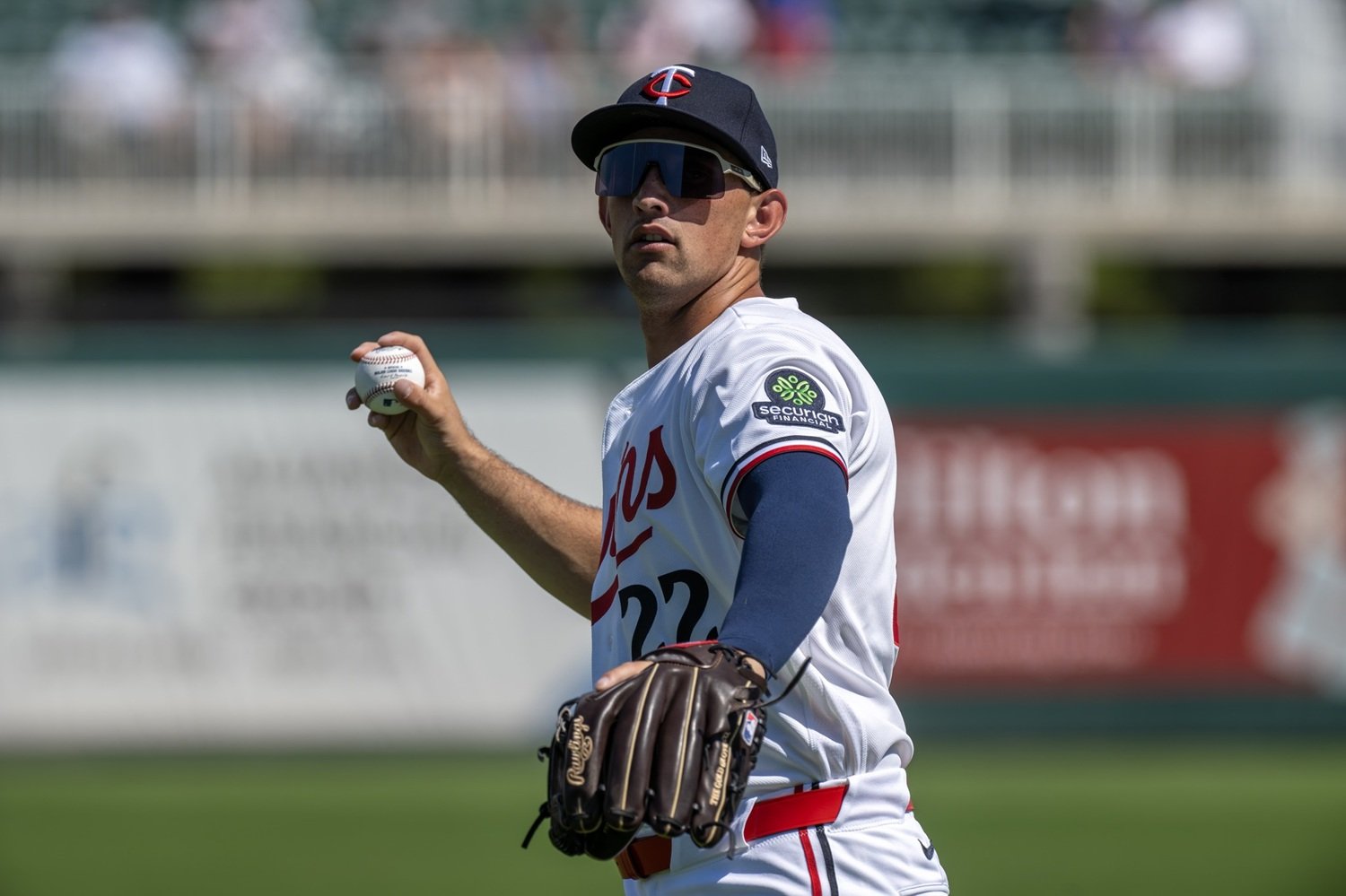
Spring training is a time when players across the league talk about adjustments. Some work on mechanical changes at the plate; others add strength or refine defensive skills. For young players trying to establish themselves at the major-league level, the offseason becomes a prime opportunity to evaluate everything.
For Minnesota, 2026 marks another important step for shortstop Brooks Lee. The former first-round pick has already shown flashes of the hitter he can become and demonstrated the steady hands and instincts that cemented him as one of the organization’s top prospects.
Despite his promise, Lee entered the winter aware that there were areas for improvement. Rather than reinventing himself, he concentrated on refining key aspects of his game to make a difference over a full season at the highest level of competition the game offers.
“Just same thing, hitting, getting better left-handed, staying the same right-handed. And then just lateral movement, get quicker, a lot of running,” Lee said about his offseason work. “And then just, yeah, trying new stuff in the weight room to help with that.”
That offseason focus led Lee to prioritize mobility. Last season, he posted -1 OAA at shortstop. Known for reliable hands and a strong arm, he felt he was missing out on balls he should be reaching.
“It’s kind of like an obvious thing,” Lee said. “You know, balls hit to me, I’ll make the play, but it’s the ones I don’t get to. So, just try to get to more balls. And that’s kind of the focus. And I think the straight-ahead speed got a lot better, and so the lateral speed will also get better.”
That work started in the weight room and extended onto the field, with sprint training and technique work designed to help him move more efficiently.
“Like the weight room stuff, just changing the new things and trying to focus on, you know, being as strong as I can be, and just creating the most force,” Lee said. “And then, yeah, definitely a lot of technique and sprint work that went into it, and it seemed like it paid off.”
Lee believes the difference is noticeable even during routine defensive drills.
“It’s just obvious,” he said. “When you take ground balls in the offseason, even just getting to certain balls off the bat you don’t think you’re going to get to. I’m not a numbers guy. If I feel like it got better, then it did.”
That defensive work ties into how Lee views his role at shortstop. At 6-foot-2 and 215 pounds, he understands he is built differently than some of the smaller, quick-twitch players who have historically played the position. Because of that, he knows maximizing his mobility is critical.
“I’m not a small shortstop. I’m a bigger one, so I’ve got to be able to use what I can to get certain balls,” Lee said. “Because I make the play usually when it’s in my glove, because I’m pretty accurate and I have good hands, but it’s just those ones that I’m not getting to, and I feel like I should, and the numbers say I should.
“Better first step,” he added. “You know, I always anticipate, but I think just getting better with changing direction really quickly is a really big focus.”
While defense was a clear offseason emphasis, Lee also worked on simplifying his approach at the plate. As a switch-hitter, much of that attention was placed on his left-handed swing. Last season, he had a .676 OPS as a right-handed hitter, and his OPS was 33 points lower from the left side.
“Just trying to find one swing that I could stick with left-handed, not make so many adjustments,” Lee said. “I felt like this offseason, I made the least amount of adjustments. Didn’t look at video that much. I felt good.”
Part of that adjustment involves using the entire field more consistently.
“Just try to hit the ball the other way more,” Lee said. “I didn’t really do that last year, left-handed. I feel like right-handed, I did. I got a lot more hits. So yeah, that was kind of a big focus. See the ball deeper so I could hit it that way. And I think that’ll help with chasing.”
Numbers confirm Lee’s self-diagnosis, albeit imperfectly. He used the opposite field about equally often from each side, but (according to FanGraphs) he did hit the ball more to center field (39.8% of his batted balls) and less to the pull field from the right side than from the left (32.6% of batted balls going to center). Interestingly, however, that distribution came despite a deeper contact point from the left side, and a greater pull orientation (as measured by attack direction at intercept) from the right side. He also chased pitches outside the zone at a higher rate (34.5%) from the right side than from the left (30.5%).
The adjusted approach could still better balance Lee’s offensive profile. While he has shown the ability to drive the ball with power, he knows maintaining his discipline will ultimately lead to more consistent results.
“I think the hits will come,” Lee said. “I have to stick to my approach and be OK with taking walks and maybe not try to force hits when I’m not doing well.”
For a player whose instinct is to put the ball in play, that can be easier said than done.
“It’s just kind of my nature, is to try and get hits,” Lee said. “But you’ve got to swing at the right pitches, and if you don’t, you’re probably out. Maybe I’ll get more lucky than others because of the bat to ball, but it could hurt me, too.”
Despite making several adjustments, Lee’s mindset entering the season remains simple: focus on his routine and allow everything else to fall into place.
“Yeah, it is what it is,” Lee said about playing shortstop. “Whatever happens, happens. I just keep doing my thing every day, letting everything play out. It’ll all work out in the end.”
For Lee, that consistency has become part of the job. The opportunity to play shortstop for Minnesota is something he has already grown comfortable with.
“Yeah, it’s great,” Lee said. “I’ve had that chance my rookie year, I’ve had it last year, I have it this year. I’m used to it by now. It’s a good feeling, but it’s just baseball.”
As 2026 approaches, Lee isn’t overhauling his game. He’s making targeted improvements that could pay dividends throughout the long season. If these adjustments carry over to the field, the Twins could see a more complete young shortstop take another step forward—via quicker steps left and right—this year.
What stands out about Lee’s offseason changes? Can he be the team’s long-term shortstop? Leave a comment and start the discussion.