
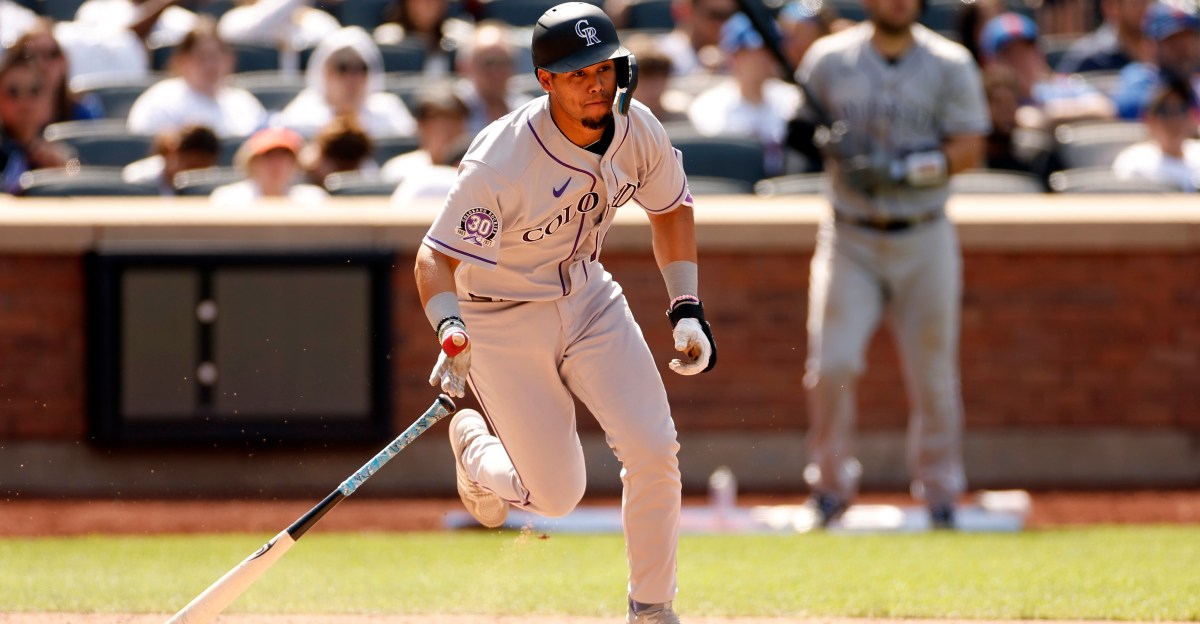
Playing shortstop is a point of pride.
Even now, years later, it still visits me in dreams — the slow chopper that turns into a barehand play; the diving backhand deep in the hole; the thrill of a perfectly timed double play. Shortstop lives at the heart of the diamond. Every ground ball feels like it might find you. Every pop fly is yours to claim. You call teammates off, direct the rhythm of the infield, and for a moment, you feel like the quiet general of the defense.
When I had to move to second base in college, it was devastating. Shortstop wasn’t just a position I played — it was the one I loved.
Because I played shortstop, those were always the players I watched the closest. Luckily for Rockies fans, there have been some excellent ones to watch over the years — from Troy Tulowitzki’s all-around brilliance to Trevor Story’s power and athleticism.
Today, the position now belongs to Ezequiel Tovar.
This is a snapshot of where the Rockies’ shortstop position stands entering 2026 — anchored by Tovar’s elite defense and shaped largely by what happens if he isn’t on the field.
The Rockies’ outlook at shortstop rests on two pillars:
Elite defense. Tovar is already one of the best defensive shortstops in baseball. Volatile offense. His aggressive swing decisions create both upside and inconsistency.
Tovar enters the 2026 season at 24 years old (turning 25 on Aug. 1) and looks to be the long-term answer at shortstop in Colorado.
His breakout season came in 2024, when he led the National League with 45 doubles, hit 26 home runs, and won a Gold Glove. That performance cemented his reputation as a cornerstone defender and one of the most dynamic young players on the roster.
Defense remains the foundation of Tovar’s value. According to Statcast, he recorded 15 Outs Above Average at shortstop in both 2023 and 2024, placing him among the elite defenders at the position. Even in a shortened 2025 season, he still produced 3 OAA, continuing to provide positive defensive value.
That 2025 campaign was limited to 95 games due to a hip injury in April and an oblique strain in June, which helps explain the offensive regression. But even in that abbreviated season, the underlying plate-discipline metrics moved slightly in the right direction.
Tovar’s offensive profile is defined by aggression. In 2025 he posted a 41.1% chase rate and a 60.7% swing rate, both dramatically higher than MLB averages (28.4% and 47.3%). That approach limits walks and can create streakiness at the plate.
However, there were encouraging signs beneath the surface. His walk rate improved from 3.3% in 2024 to 5.4% in 2025, while his strikeout rate dropped from 28.8% to 25.1%. They are small steps, but meaningful ones for a hitter whose biggest developmental hurdle is swing decisions.
The raw power is also real. Statcast measured Tovar’s average exit velocity at 88.8 mph in 2024 and 89.4 mph in 2025, with a maximum exit velocity of 112.5 mph. Those numbers support the “sneaky pop” profile Rockies fans have already seen when he’s locked in.
Another encouraging indicator is Tovar’s contact quality. Statcast’s Launch Angle Sweet-Spot percentage (LA Sweet-Spot %) tracks how often a hitter produces launch angles between 8° and 32°, the range most associated with productive contact. Tovar ranked in the 90th percentile in this metric, suggesting that when he squares the ball up, the underlying contact profile supports his potential for continued power production.
The Rockies clearly believe in him. Tovar is signed through 2030 with a club option for 2031, a deal that could look increasingly team-friendly if his offensive game continues to evolve.
FanGraphs’ Depth Charts projection system forecasts roughly 21 home runs and about 3 fWAR for Tovar in 2026.
Across projection systems, the expected range generally falls between about 2.1 and 3.1 WAR, reflecting both the stability of his defensive value and the uncertainty surrounding his offensive approach.
That defensive floor is important. Statcast’s Fielding Run Value credits Tovar with 13 defensive runs in 2023, 16 in 2024, and 3 in 2025, reinforcing the idea that even during a down year he remains a positive contributor in the field.
But if the approach at the plate continues trending in the right direction — fewer chase swings, a few more walks, and continued gap power — the upside grows considerably. That’s where the All-Star conversation begins to enter the picture.
Shortstop depth in the Rockies organization largely revolves around Tovar staying healthy.
Behind him, the options are mostly contingency plans rather than clear everyday alternatives.
Ryan Ritter – Ritter has the athleticism and defensive ability to play shortstop, though questions about his offensive consistency remain. He has already filled in during past Tovar absences but currently profiles best as depth or a utility option. Ritter’s defensive ability is far ahead of his offense at this point, but Ritter is absolutely destroying the ball this spring.
Willi Castro – Signed to a two-year deal before the 2026 season, Castro provides versatility across the diamond and could handle shortstop in short stretches if needed. Castro has tallied over 1,200 innings at short in his big league career to mixed results.
Nicky Lopez (NRI) – A glove-first veteran invited to spring training as a non-roster player. If he makes the club, it would likely be as a defensive specialist capable of covering shortstop late in games.
Cole Carrigg (No. 4 PuRP) – Carrigg is currently playing shortstop for Team Israel in the World Baseball Classic, a valuable opportunity to continue developing the position. Within the Rockies system, however, he is viewed more as a multi-position athlete than a long-term major league shortstop.
The broader point is simple: If Tovar misses significant time, the Rockies’ defensive stability up the middle takes a noticeable hit.
At the top of the Rockies’ shortstop prospect ladder sits Ethan Holliday (No. 2 PuRP), one of the organization’s most exciting prospects and the fourth-overall pick in the 2025 MLB Draft. The son of former Rockies star Matt Holliday, he enters the system with enormous offensive upside. The main question is whether he remains at shortstop long term or eventually shifts to third base.
Beyond Holliday, the shortstop pipeline is still developing rather than overflowing with top-tier talent. Ashly Andujar (No. 20 PuRP), a young switch-hitting infielder signed out of the Dominican Republic, has shown strong bat-to-ball skills and defensive instincts in the lower minors but still needs to add strength as he climbs the ladder.
Other names deeper in the system include Andy Perez and Dyan Jorge. Each shows defensive potential at shortstop but remains far from the major leagues.
For the foreseeable future, the Rockies’ stability at shortstop depends on Tovar holding down the middle of the diamond.
There is a lot of weight on Tovar’s shoulders, but he doesn’t need to be a superstar.
His defense already provides a valuable foundation. If the plate discipline continues to inch forward and the power remains part of his profile, Tovar could develop into one of the better all-around shortstops in the National League.
But he doesn’t have to reach those heights to be integral to the Rockies.
If he simply continues progressing — staying healthy, refining the approach, and anchoring the defense — Ezequiel Tovar can be exactly what the Rockies need him to be: A steady force through the rebuild, and a core piece of the next winning team in Colorado.
Please keep in mind our Purple Row Community Guidelines when you’re commenting. Thanks!